
EU Parliamentary (EP) elections are coming up this week. All member countries elect their national members, according to the number of members each country is allotted. This is Treaty stuff, by agreement of all member countries. The number of national representatives for each country is roughly proportional to size of the population. Candidates are usually nominated by parties at the national, member state level. However, once elected and assembled, the politicians form new groupings across the national boundaries. Different liberal parties join together in a EP liberal group, social democratic members join into a social democratic formation, and so on.
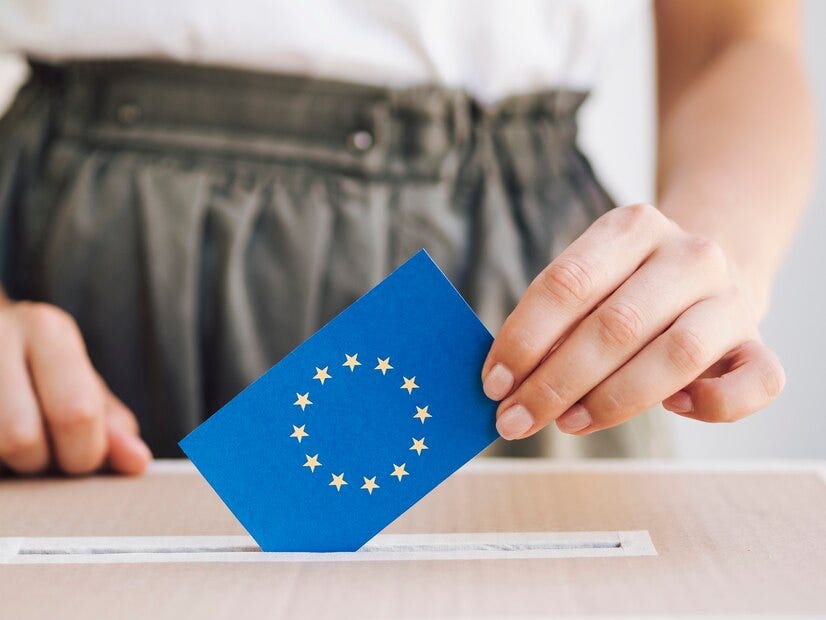
It seems the EP is the big equalizer that eliminates borders and joins politicians into super-national groupings, disregarding national differences. That is the whole idea. There are a few twists, though. Of course, because this is EU and the treaties are skilfully necogiated and written to take national special interest into consideration and yield to the major interests, whenever needed and possible.
So the elections are for one single parliament, unifying national groups into EU interest formations. And elections are all at the same time, nearly. But only nearly. It is within four days total, but with quirks.
One country votes on 6 June 2024, one country votes on 7, one country votes on both 7 and 8 June, 3 countries vote on 8 June, one country votes on both 8 and 9 June, and the remaining 20 countries all vote on Sunday 9 June 2024. That is in total 27 countries, all with different electoral systems. (If you think the total should be 28, it’s because you forgot that Britain has left the EU. The British seats in the EP have been re-distributed among the remaining members).
Despite numerous attempts of standardizing the EP election system, there are still major differences. Election in 2024 is thus to be conducted under the 1976 electoral act as amended in 2002.
Not only the date(s) of actual voting but also a number of other election rules are widely different between the member countries. Voting age starts at 16, 17, or 18 years, according to country. Most countries have voluntary voting, but some have compulsory voting which can be enforced or unenforced under the circumstances. Many countries do not allow absentee voting, others allow voting by mail or by proxy, or both, some allow online voting. Minimum age for candidacy varies from 18 to 25, even in countries that allow voting for younger persons. Most countries vote for the same candidates nation-wide but others are subdivided into constituencies with a subset of candidates. Countries have different thresholds for percentages of votes needed for getting elected.
As a reader of this, if you are perplexed about all these differences in the rules on how to get elected to one single parliament, join the club. It is incomprehensible, how this could be expected to work in the first place. Many critics also see this as clear sign that EU still has a long way to go before it can act as one union.
No posts
Comments
Nothing yet. Say the first thing.
Sign in to join the conversation.