
The incubation loop applies rotating analytical moves (Bayesian updates, steelmanning, ACH, cross-domain bridging) to your open questions on a schedule - the architectural equivalent of what the brain does during hypnagogic sleep
The domain watch scans your knowledge base for new notes that match declared intellectual interests, probes external signals, and auto-activates high-resonance findings into the thinking queue
The insight interview searches your existing notes before asking a single question - it grounds Socratic dialogue in what you already think, not in what sounds generically useful
All three require persistent autonomous operation, which is why Trinity is now the recommended deployment model for Cornelius
YouTube transcript extraction closes the last obvious gap in the capture layer
Most knowledge management systems are reactive. You query them. They respond. The insights you stored six months ago sit dormant until you remember to look. The connections between your notes on distributed systems and your notes on organizational behavior exist only as potential - unrealized until someone thinks to ask.
This is the correct design for a retrieval engine. It is the wrong design for a thinking partner.
The distinction matters because the most valuable cognitive work - the kind that produces genuine insight rather than retrieved information - happens at the edges. At the edges of sleep. At the edges of disciplines. At the edges of certainty, where a question has been sitting long enough that it has started to generate its own gravitational pull.
Cornelius v05.26 is an attempt to build those edges into the architecture.
Before describing the new capabilities, it is worth understanding the neuroscience that motivated the design.
A 2024 study published in Science Advances quantified something practitioners have suspected for centuries: the hypnagogic state - the liminal zone between wakefulness and sleep onset - produces an *83% insight solution rate* on creative problem-solving tasks. Full wakefulness produces 30%. Deep sleep produces only 14%.
This is counterintuitive. Deep sleep, the state most associated with rest and recovery, is the worst state for generating novel connections. The sweet spot is not rest or alertness - it is the threshold between them.
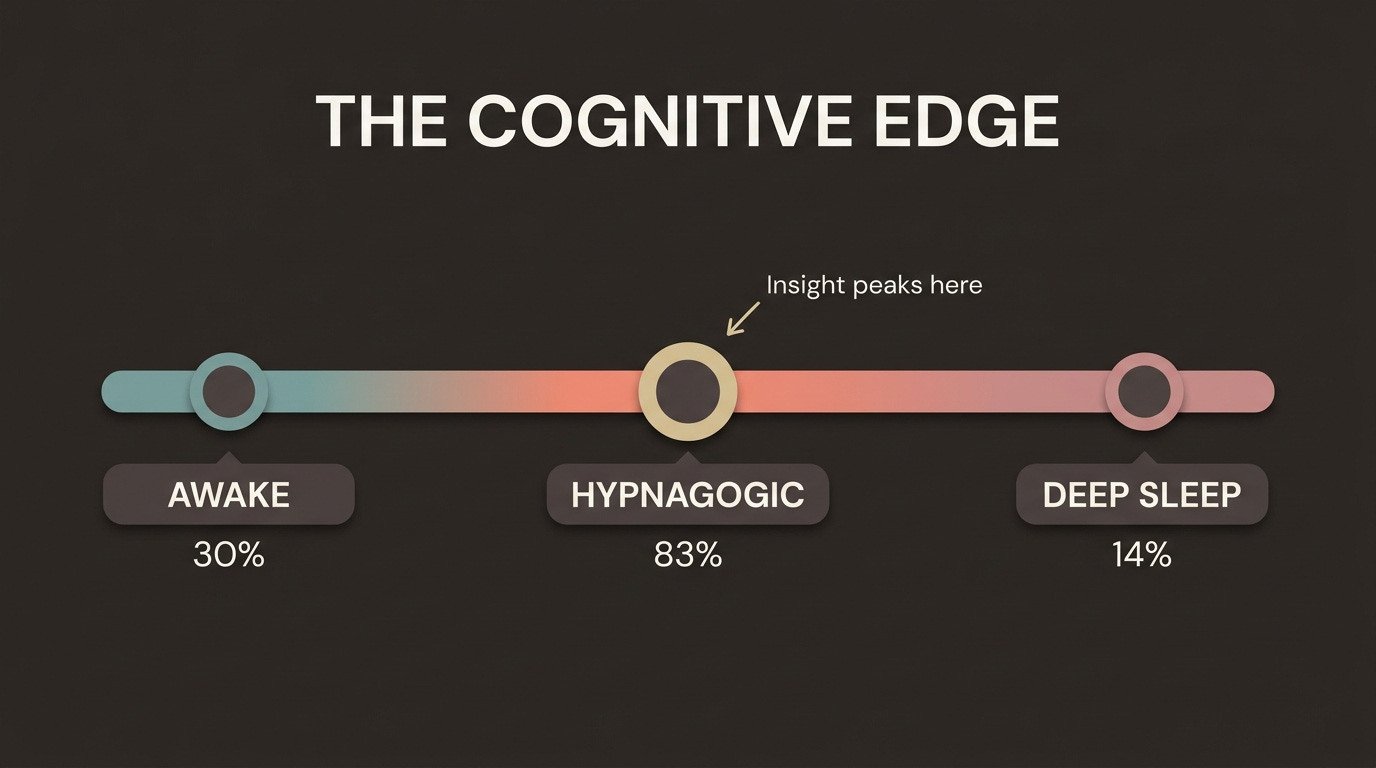
The mechanism is specific: during hypnagogic onset, logical monitoring from waking consciousness is still partially active, while associative loosening from early sleep onset enables distant semantic connections that executive control would normally filter out. Edison and Dali both independently discovered this and built nap techniques around it. The neuroscience now explains why their techniques worked.
There is a direct architectural parallel here. The hypnagogic state maps cleanly onto the problem with always-on reactive knowledge systems: they operate at full executive control. Every query is deliberate. Every response is filtered by what you consciously thought to ask. The hypnagogic insight rate of 83% - versus 30% for wakefulness - suggests there is significant cognitive value left on the table when you only query your knowledge at full attention.
A second research thread from a 2026 Physiological Reviews synthesis reinforces this point: Sleep as Biological Zettelkasten. The hippocampal-neocortical dialogue during sleep is structurally isomorphic with how a Zettelkasten builds knowledge. The hippocampus acts as an inbox (fast, episodic, temporary). The neocortex acts as permanent notes (slow-learning, abstract, long-term). Sleep replay (sharp-wave ripples) acts as the linking process - pushing episodic content toward neocortical integration. The implication: a knowledge system that only operates when queried is missing the offline consolidation pass that the brain runs automatically every night.
Cornelius v05.26 is the attempt to implement that offline pass.
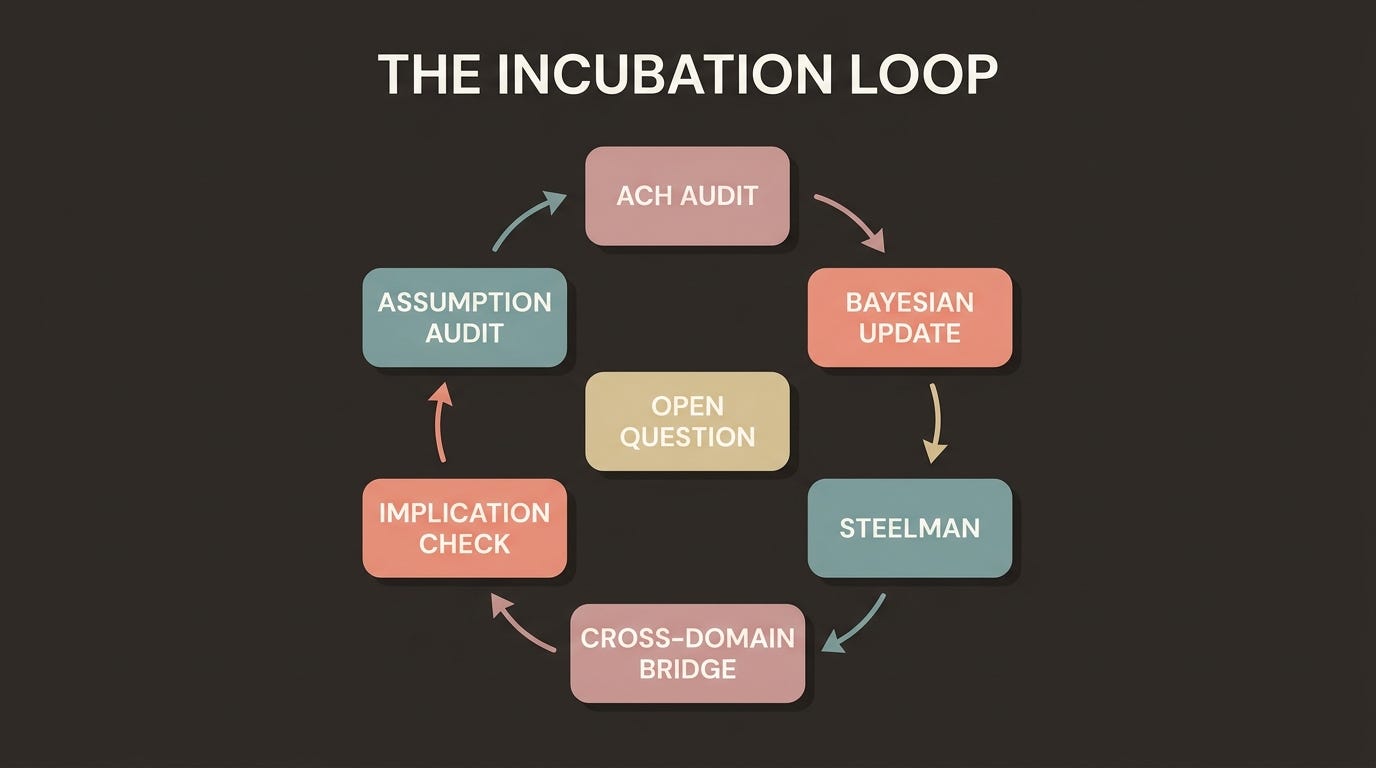
The incubation loop is the centerpiece of this release. It is an autonomous iterative thinking engine that processes your active open questions using a rotating set of analytical moves.
Each scheduled run applies one move from this set:
ACH audit - Analysis of Competing Hypotheses. Forces explicit enumeration of alternative explanations and maps which evidence supports or undermines each.
Bayesian update - Integrates new information into probability estimates. Does confidence shift with the latest available signal?
Steelman opposition - Builds the strongest possible case for the position you are leaning away from.
Cross-domain bridge - Searches for structural analogies in adjacent domains. What does the military say about this? What does evolutionary biology say?
Implication check - If the current leading hypothesis is correct, what follows? Are those implications consistent with other things you believe?
Assumption audit - What is the reasoning taking for granted? Which assumptions are load-bearing?
The rotation matters. Applying only Bayesian updates produces overconfident position drift. Applying only steelmanning produces paralysis. The rotation forces the question through multiple cognitive lenses without any single lens dominating.
Topics are managed in a registry at Brain/05-Meta/Thinking/THINKING-REGISTRY.md. Each topic gets its own reasoning file where the loop persists state across runs. Convergence is auto-detected: when the same hypothesis leads three or more consecutive runs with less than 5% confidence delta, the topic is flagged for manual crystallization via /synthesize-insights.
The crucial design principle: the loop runs on a schedule regardless of whether you are present. It is not waiting for your query. It is doing the work between your sessions, the way sleep does consolidation between learning sessions.
The incubation loop processes questions you have already framed. Domain watch handles something earlier in the pipeline: noticing when new signal has arrived that is worth framing into a question.
Here is the problem it solves. Every week, new notes arrive in your knowledge base - document insights, captured thoughts, extracted research. Some of those notes will resonate with questions you are actively thinking about. Most will sit in the graph, linked by semantic similarity, never surfaced as relevant to your current intellectual agenda.
Domain watch is a configured surveillance layer. You declare the domains you are watching (geopolitical stability indicators, agent memory architectures, attention economy mechanisms, whatever your actual intellectual priorities are). You specify what counts as a signal worth escalating. Domain watch then:
Scans new notes in the KB for pattern matches against your declared domains
Checks gap resonance - does this new note address something the incubation loop has been circling without enough evidence?
Probes external signals via web search for the domain
Auto-activates HIGH and MEDIUM resonance findings into the Thinking Registry
The result is a system that brings relevant information to your active questions, rather than requiring you to remember to search for it.
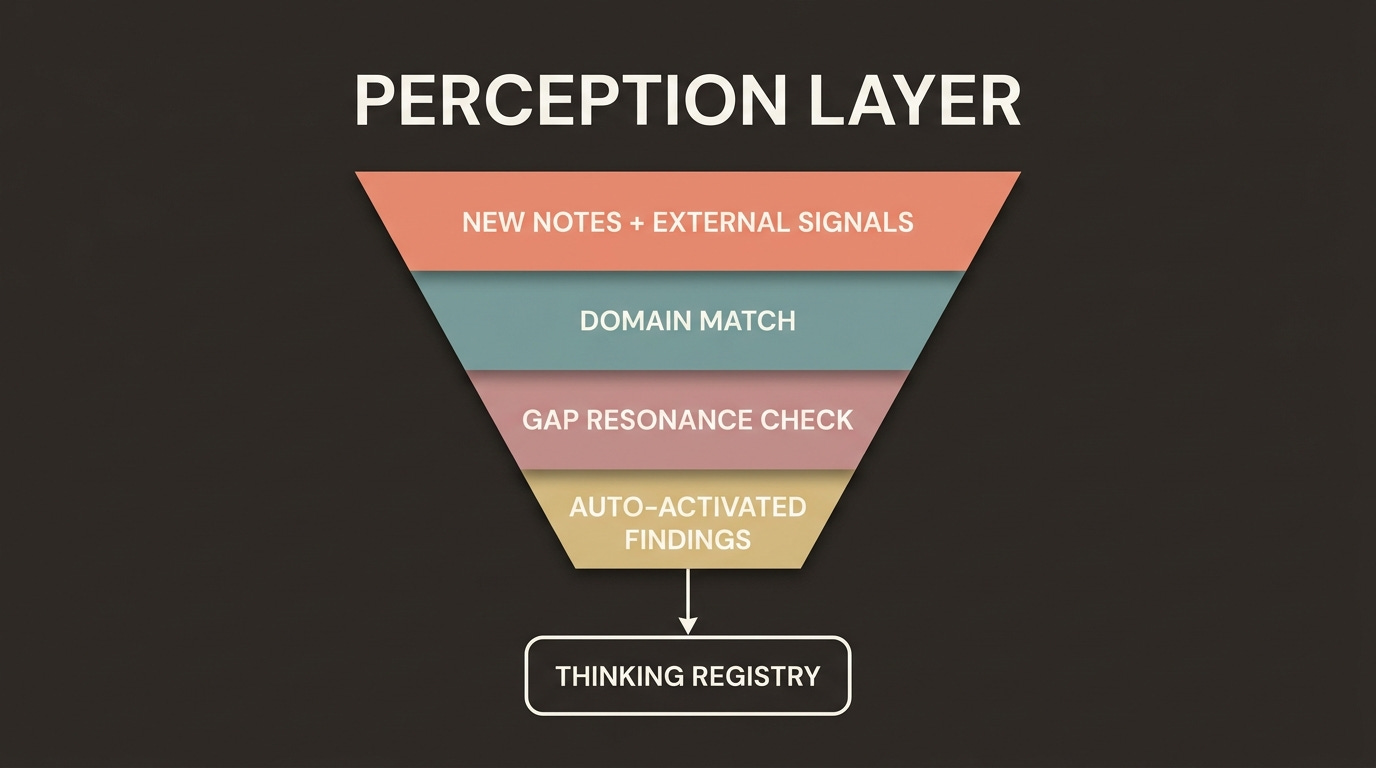
This is the difference between a retrieval engine and a perception layer. A retrieval engine answers queries. A perception layer monitors the environment and surfaces what matters. Cornelius previously had only the former. v05.26 adds the latter.
The insight interview addresses a subtler problem: how do you extract your own thinking from your knowledge base, rather than information?
Generic Socratic dialogue is easy to generate. Ask broad questions about a topic, get broad answers, surface nothing that was not already obvious. The reason standard brainstorming sessions often produce mediocre results is that the questions are not grounded in the specific state of the thinker’s existing beliefs.
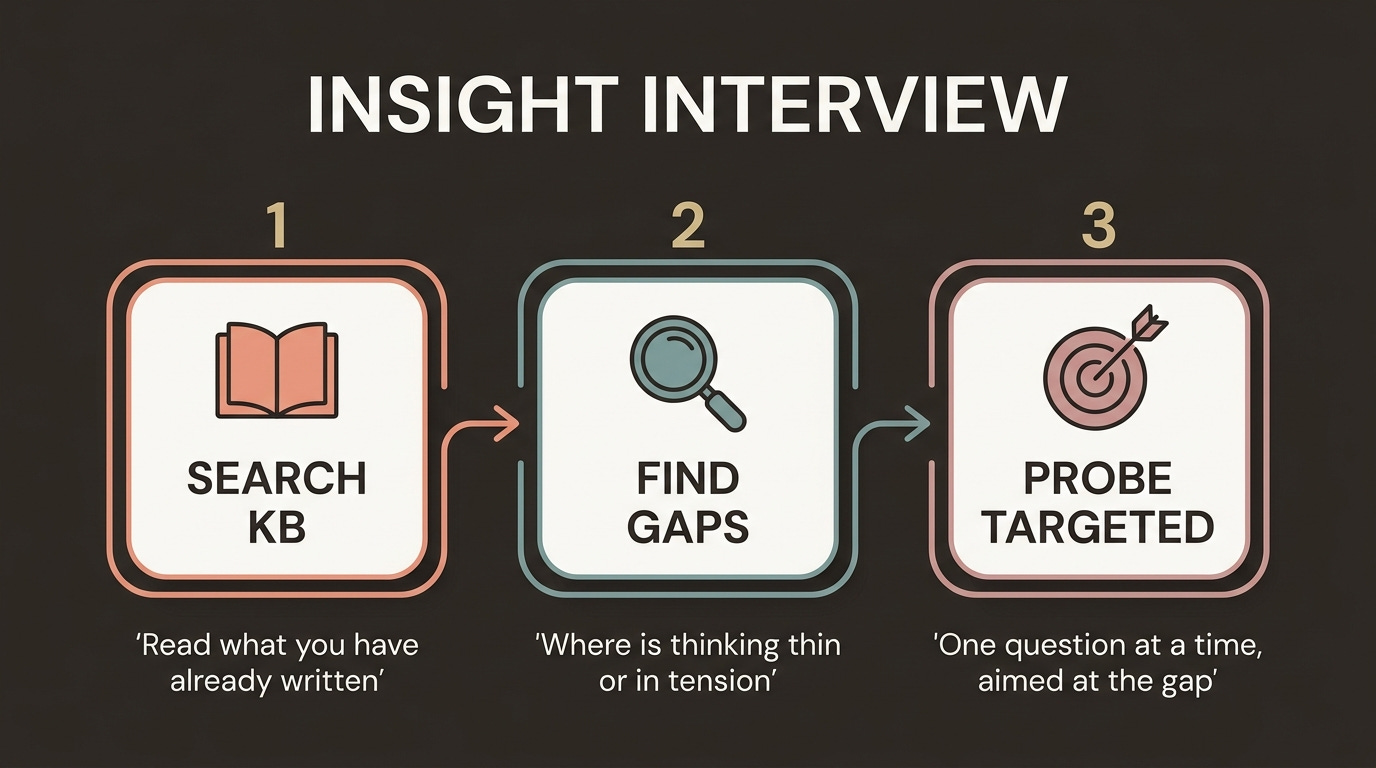
The insight interview starts differently. Before asking a single question, it:
Searches the KB for what you have already written about the topic
Reads the relevant permanent notes, extracted insights, and document insights
Identifies where your existing thinking is strong, where it is thin, and where it contains productive tensions
Only then does it begin the dialogue - one question at a time, each question targeted at the specific gap or tension in your existing notes. The conversation transcript is saved at the end, and the best extractions are run through the insight extractor to create new permanent notes.
The underlying logic is from research on expertise elicitation: the most effective questions are not generic prompts but targeted probes that surface tacit knowledge the expert holds but has not articulated. The KB search step is what makes this possible. Without knowing what you have already thought, any question is a shot in the dark.
These three capabilities share a common dependency: they require the agent to run when you are not there.
Running Cornelius locally - starting Claude Code when you want to work, closing it when you are done - is fine for interactive knowledge work. It is structurally incompatible with an agent that is supposed to process your thinking overnight, scan for signals while you are in meetings, and surface convergence findings the next morning.
This is why Trinity is now the recommended deployment model for Cornelius.
Trinity is an open-source platform for self-hosting autonomous agent fleets. Each agent runs in an isolated Docker container with cron scheduling, real-time monitoring, and agent-to-agent communication. The scheduled runs that power the incubation loop and domain watch are managed by Trinity’s distributed scheduler with lock guarantees - they run exactly once per schedule window, even in multi-instance deployments.
The default schedule is:
5am UTC daily - Rebuild FAISS index and bootstrap the Brain Dependency Graph
7am UTC daily - Run the incubation loop on all active topics
Monday 6am UTC - Run the coherence sweep (structural health, staleness, lifecycle briefing)
What this produces in practice: you wake up to a knowledge base that has already done a pass of analytical work on your active questions. The incubation loop ran at 7am. Domain watch flagged two new notes as HIGH resonance with your geopolitics questions. The coherence sweep identified that three of your crystallizing notes are ready for synthesis into a framework.
The agent thought while you slept. The 83% hypnagogic insight rate is not achievable through deliberate querying. It requires letting go of executive control and trusting the offline process.
The remaining new capability is simpler in design but significant in practice: /get-youtube-transcript extracts the full text transcript from any YouTube video by URL or video ID.
This closes the last obvious gap in the Cornelius capture layer. Text (PDFs, web articles, books via the epub extractor) was already handled. Audio from voice conversations was already handled. Video has been a manual transcription problem until now.
The workflow is: watch a lecture, podcast, or interview, then run /get-youtube-transcript on the URL, then pipe the result into /extract-insights for processing into the KB. The full insight pipeline from video content now runs without manual intervention.
Looking at the Cornelius changelog across versions, there is a consistent trajectory:
v01.25: Retrieval. Ask questions, get answers from stored notes.
v02.25 - v03.26: Memory architecture. SYNAPSE-inspired spreading activation, intent classification, Q-value learning. The system gets better at retrieval based on how you use it.
v04.26: Dependency tracking. The Brain Dependency Graph adds direction, lifecycle, and staleness. The system understands which notes are authoritative and which are stale.
v05.26: Autonomous reasoning. The system applies analytical moves to your questions, monitors for incoming signal, and surfaces gaps in your thinking - without being asked.
Each phase adds a layer that the previous phase made possible. You cannot do autonomous reasoning without a well-structured knowledge graph. You cannot have a well-structured graph without good retrieval. The architecture compounds.
The question this raises is: what does the next layer look like? A persistent institutional intelligence that does not merely store and surface knowledge but represents it, speaks from it, and builds on it across years of continuous operation. That requires the autonomous layer being added now.
*For existing Cornelius users:*
The new skills are in the public repo at github.com/Abilityai/cornelius. Pull the latest and the new skill files will be available immediately.
For autonomous operation, deploy to Trinity using the trinity plugin:
claude plugin add abilityai/abilities
# Then from inside Cornelius:
/trinity:connect
/trinity:onboard
Full plugin documentation at docs.ability.ai.
*For new users:*
Start with the QUICKSTART.md to get the local setup running, then use /trinity:onboard to enable the scheduled autonomous capabilities.
The incubation loop requires seeding topics in Brain/05-Meta/Thinking/THINKING-REGISTRY.md. Domain watch requires configuring your surveillance domains. Both are managed via the /manage-thinking-topics and /manage-watching-domains skills respectively.
The gap between a knowledge base and a thinking partner is not a retrieval problem. Better search does not close it. Semantic similarity scores do not close it. What closes it is offline processing - the kind of analytical work that happens between sessions, on a schedule, without requiring your presence.
The neuroscience is clear on this: the hypnagogic state, not alert wakefulness, produces the highest insight rate. The brain’s most productive reasoning happens at the edges of consciousness, not at the center of deliberate attention.
Cornelius v05.26 is built on this principle. The incubation loop runs at the edges - between your sessions, applying structured analytical moves to questions that have been sitting long enough to generate real friction. The domain watch monitors the periphery. The insight interview excavates what you already know but have not yet articulated.
The knowledge base is no longer waiting for your query. It is working while you are not there.
No posts
Comments
Nothing yet. Say the first thing.
Sign in to join the conversation.