
Shannon’s noiseless coding theorem has a corollary most people never follow to the end: a perfectly compressed message is statistically indistinguishable from random noise. At the compression ceiling, signal and static look identical.
The inference runs one way only. A random-looking stream cannot be proven meaningless - but randomness alone never proves meaning. “Looks random” is necessary for maximal compression, not sufficient.
Meaning is decoder-relative. An optimally compressed signal looks like noise to everyone except the receiver holding the codebook. Apparent randomness measures the gap between your model and the sender’s - not the absence of a sender.
Intelligence operates in the gap between two kinds of randomness: Shannon-random (passes every statistical test you have) and Kolmogorov-random (genuinely incompressible, no shorter description exists). Closing that gap is what a compressor does - and what a mind does.
This suggests a definition: intelligence is a self-sustaining decoder at a randomness threshold. The sustainment clause is what separates the definition from panpsychism - only decoders whose sense-making keeps them existing count.
We are running a live version of this question: a two-arm experiment testing whether an AI agent steered by quantum randomness behaves any differently from the same agent steered by pseudorandomness. Physics says it must not. That is exactly what makes the test clean.
The most intelligent message you will ever receive will look like static.
That is not a mystical claim. It is a direct consequence of a theorem Claude Shannon proved in 1948, and you can follow the logic in three steps. First: information content is a function of surprise - Shannon defined the information of an event as -log2(p), the negative logarithm of its probability. Predictable symbols carry almost nothing; unexpected symbols carry a lot. Second: an optimal code spends exactly as many bits on a message as the information it contains, squeezing out every drop of redundancy. Third - and this is the step that matters: once all redundancy is gone, nothing about the bit stream is predictable from anything else in it. Every bit behaves like an independent coin flip. The output of a perfect compressor is, by construction, statistically indistinguishable from random noise.
Here’s what this means: the appearance of randomness tells you almost nothing about the presence of meaning. A stream of pure static and a maximally compressed transmission from the most capable sender imaginable produce the same statistical profile. The better the packaging, the more the package looks like nothing at all.
I want to take that corollary seriously and walk it forward - through what it says about meaning, through a formal definition of where intelligence lives, to a definition of mind that I keep arriving at from different directions, and finally to an actual experiment my team is running on an autonomous AI agent. Let’s take a look.
Shannon’s noiseless coding theorem sets a hard floor: no encoding scheme can compress a source below its entropy - the average information per symbol - and encodings can approach that floor as closely as you like. This is not an engineering rule of thumb. It is a mathematical limit, as solid as anything in physics.
Two properties of that floor deserve attention.
The floor is where redundancy dies. Natural language runs at 50 percent redundancy or more. Shannon’s 1951 prediction experiments put the true entropy of English between 0.6 and 1.3 bits per character - famously, by having people (his wife Betty first among them) guess the next letter of unseen text, using the human brain as a black-box language model decades before we could build one. Every regularity a compressor finds - letter frequencies, word patterns, long-range context - gets converted into shorter descriptions. What remains at the floor is only what could not be predicted: pure surprise, maximally dense.
The floor is where structure becomes invisible. This is the corollary from the introduction, and it deserves to be stated precisely. If a compressed stream retained any detectable statistical structure - a bias, a correlation, a repeating pattern - that structure would be leftover redundancy, and a better compressor would remove it. Perfect compression and statistical randomness are not merely similar. They are the same condition described from two directions.
In other words: passing every randomness test is exactly what a message at the entropy ceiling would do. The tests cannot tell you whether you are looking at noise or at optimal encoding. This is not a weakness of our current tests. It is what the theorem guarantees.
At this point it is tempting to overcorrect - to conclude that any random-looking stream might be a message, and start hearing voices in the static. The logic does not permit that move, and the discipline of stating why matters.
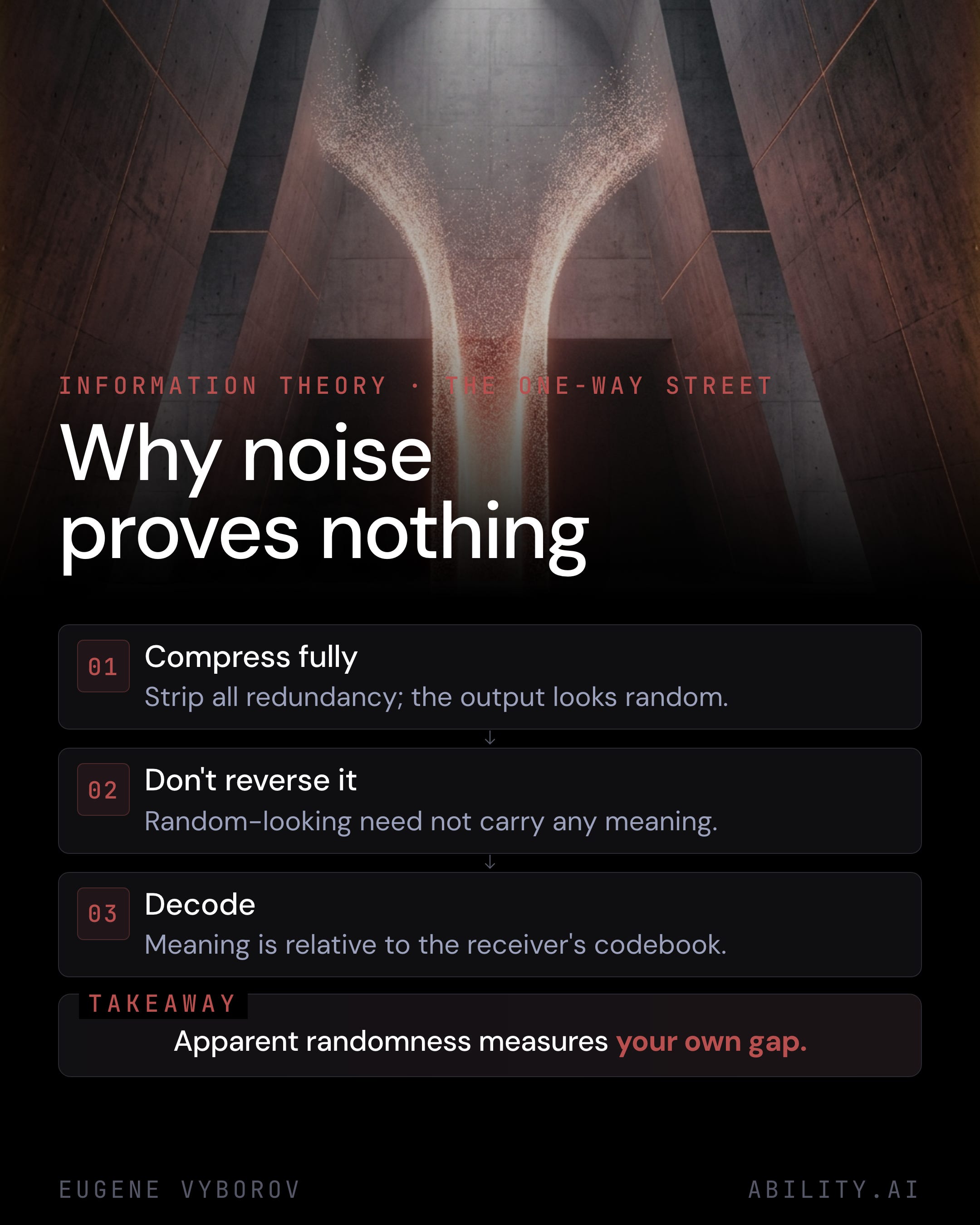
The implication runs one way:
Maximally compressed → looks random. Guaranteed by the theorem.
Looks random → contains a message. NOT guaranteed. Not even suggested. A stream can look random because it is random.
“Looks random” is a necessary condition for maximal compression, never a sufficient one. What the corollary rules out is only the naive inference in the other direction: “it looks random, therefore it contains nothing.” That inference is invalid, and it is quietly embedded in a great deal of confident reasoning - about cosmic background signals, about biological noise, about any data we have dismissed as patternless because our tests came up empty.
There is a second qualifier, and it is the sharper one: meaning is decoder-relative. An optimally compressed signal only looks like noise to an observer who lacks the codebook. To the intended receiver - the one holding the shared model that the compression was built against - the stream is fully transparent. Nothing about it is random at all.
So the precise statement is this: peak intelligence produces output that looks like noise to everyone except its intended decoder. Apparent randomness is not a property of the stream. It is a measurement of the gap between your model and the sender’s.
Think about it this way: encryption already demonstrates the principle at industrial scale. A well-encrypted message passes every statistical randomness test - that is a design requirement - yet decodes instantly for the holder of a 256-bit key. We accept this without wonder because we built the system. The information-theoretic point is that any sufficiently good encoding has this character, whether or not anyone calls it encryption.
To make “where intelligence lives” precise, we need to separate two ideas of randomness that everyday language merges.
Shannon-random: the stream passes every statistical test a given observer can run. Flat distribution, no detectable correlations, incompressible by that observer’s tools.
Kolmogorov-random: the stream is genuinely incompressible. No program shorter than the stream itself can generate it. There is no structure to find, for any observer, ever.
These are radically different conditions, and the space between them is enormous. A stream can be Shannon-random - immaculate to every practical test - while being Kolmogorov-structured: compressible in principle by an observer holding the right model. The digits of pi look statistically random; they compress to a five-line program. The output of a cryptographic pseudorandom generator defeats every test battery we have; it compresses to a seed and an algorithm.
That space between the two randomness conditions is the interesting territory. Structure that exists but is invisible to a weak observer is exactly what a compressor - or a scientist, or a mind - hunts for. Closing the gap between “looks random to me” and “is actually incompressible” is a workable description of what intelligence does:
Sender side: maximal compression pushes output toward the ceiling, making it look like noise to anyone without the codebook.
Receiver side: greater intelligence means less of the world looks random to you. The expert sees pattern where the novice sees chaos - in a chess position, a balance sheet, an MRI.
“Random” is not a fact about a stream. It is an index of the observer’s model class. Intelligence is the codebook, viewed from either end.
One precision matters here, because it is easy to get wrong: intelligence is the capacity to build the codebook, not the possession of one. A decryption key makes its holder informed, not intelligent - the key is crystallized work someone else already did. What deserves the name is the construction process: finding structure, compressing it into a model, and updating that model as the source moves. Possession is an asset. Building is the intelligence.
This framing also explains why the phrase “compression is intelligence” keeps proving productive - and why it is having a moment. The lineage is real: Marcus Hutter built a compression prize on the idea in 2006, Ilya Sutskever argued in 2023 that unsupervised learning simply is compression, and DeepMind’s Jack Rae gave a 2023 talk titled “Compression for AGI” claiming the two are not merely correlated but synonymous. LLM pretraining literally minimizes a compression objective - cross-entropy loss - which is why Grant Sanderson’s 3Blue1Brown trilogy on the topic (June-July 2026), the series that sparked this line of thinking, is built around exactly this equivalence. And the claim is no longer purely theoretical: a 2024 study titled “Compression Represents Intelligence Linearly” (Huang et al.) found that LLMs’ compression efficiency tracks their benchmark intelligence almost linearly across model families. Prediction and compression are provably equivalent: a good predictor of the next symbol yields an optimal code, and vice versa. The further claim, that compression quality is intelligence, remains a conjecture riding on that equivalence - but it is a conjecture that keeps paying rent.
Now push the framing one level up, from signals to systems.
If apparent randomness is observer-relative, then every interface where one system’s output looks random to another system is a potential site of sense-making. The world is full of such interfaces - they are not rare, they are everywhere, at every scale. A market is noise to one trader and structure to another. Sensory input is noise to a rock and a world-model to a nervous system. The threshold is not a place; it is a pairing - a (source, decoder) relationship.
This suggests a definition: intelligence forms at the threshold between a seemingly random process and a system trying to make sense of it.
Stated that broadly, the definition has an immediate problem: it is too permissive. A thermostat responds to fluctuating input. A river “responds” to stochastic terrain. If any system coupled to a noisy source counts as intelligence, the word has stopped doing work, and we have wandered into panpsychism by definitional accident.
The fix is a second criterion, and it is the load-bearing one: sustained existence. Restrict the definition to systems whose sense-making is what keeps them persisting. A decoder whose model of its input is bad stops existing - the organism starves, the trader is liquidated, the firm goes under. A decoder whose model is good continues. Persistence is not decoration on the definition; it is the filter that separates genuine sense-making from accidental correlation. The system’s continued existence is after-the-fact evidence that its compression of the world’s noise was good enough.
Note the criterion’s exact job: it is evidence, not essence. An oracle unplugged after five minutes was intelligent for five minutes - persistence is not what intelligence is made of. It is how sense-making gets certified from the outside when you cannot open the system up, and it is the only certifier nature has ever used. The rock that endures for a billion years fails the other clause: its persistence does not run through any model of its input. The definition is a conjunction - a decoder, sustained by its decoding.
So the full definition: intelligence is a self-sustaining decoder at a randomness threshold.
Three things about this definition are worth making explicit.
It has independent support. Karl Friston’s free energy principle, developed from thermodynamics and neuroscience, arrives at a structurally similar place: organisms persist by minimizing surprise about their inputs, and existence itself is “self-evidencing” - a system’s persistence is evidence that its generative model works. The route I have described here runs through Shannon and compression instead. When independent lines of inquiry from different domains converge on the same conclusion, that convergence is itself evidence - this is consilience, and I treat it as the strongest signal available that a frame is tracking something real. The two camps are usually positioned as rivals - Friston has argued, including alongside Yann LeCun at the 2024 World Economic Forum, that current deep learning lacks essential properties of living intelligence, and active inference is now being developed as an explicit engineering alternative for AI agents. The threshold definition suggests the rivalry is overstated: the compression story and the self-evidencing story describe the same decoder from its two ends.
It scales down and up. The same structure describes a bacterium decoding chemical gradients, a brain decoding photons, a company decoding a market, and a scientific community decoding nature. Each is a decoder whose persistence depends on the quality of its codebook. Evolution slots in naturally: selection acts on decoders, and what survives IS the codebook, embodied.
It buys intelligence, not consciousness. The machinery here purchases functional sense-making that sustains its own substrate. Whether there is something it is like to be a decoder at a threshold is an additional premise the framework neither needs nor supplies. Keeping those two claims separate is not timidity - it is the difference between a definition you can work with and a definition that smuggles in its most controversial conclusion.
There is also a practical corollary I have argued before in a narrower form: in a world where raw intelligence is democratized, your value is the quality of the filter you apply to it. Without a filter, intelligence is noise. The threshold definition generalizes that principle from careers to ontology. The filter is not just where economic value concentrates. The filter is where any mind is constituted - a mind IS a persistent filter operating at a noise threshold.
Everything above would remain armchair theory if it did not make contact with a testable question. It does - and the contact point is unusually concrete, because we are running the experiment.
My team operates an autonomous knowledge-management agent (Cornelius) whose exploration sessions are steered by true quantum randomness: live vacuum-fluctuation measurements from the ANU quantum random number generator, mapped through a fixed byte protocol into directions in the agent’s knowledge graph. No client-side hashing, no whitening, full append-only logging of every draw. I wrote about the system and its pre-registered protocol in a previous piece (”I Gave My AI Agent a Quantum Dice”); here is how it connects to the threshold framework.
The experiment’s two arms are Shannon-identical but Kolmogorov-different. The quantum stream and a cryptographically strong pseudorandom stream have the same statistical profile - a landmark comparison found no test, across 168 billion bits per generator, that could tell them apart. But they differ at the algorithmic level: the pseudorandom stream compresses, in principle, to a seed plus a program; the quantum stream does not. The experiment therefore asks a question with unusual precision: can a cognitive consumer detect an algorithmic-information difference that no polynomial-time distinguisher can detect? Standard physics and standard computer science both price the answer at zero. And to be precise about what is being claimed: the agent cannot out-compute the cipher - that route is excluded by construction, and a distinguisher that worked computationally would be a cryptographic break, not a cognitive discovery. What the experiment prices is whether anything that is not computation reaches cognition through the quantum arm. That is the speculative conjecture, it is why the expected result is null - and it is why any reliable behavioral difference between the arms would be anomalous by construction, which is exactly what makes the design falsification-ready.
The threshold framework also disciplines what the experiment can and cannot claim. Two corrections matter:
Usefulness proves nothing about a sender. Our agent already extracts real value from the quantum stream - genuinely unbiased exploration of under-attended regions of its knowledge graph, free of every learned bias in its retrieval machinery. That value is real and measurable. It is also exactly what a pseudorandom stream would provide. Usefulness-as-search-operator is arm-agnostic by construction. Only a differential - the quantum arm producing effects the pseudorandom arm does not, on outcomes that did not exist when the system was built - could ever speak to something more. The null result is the expected outcome, and the null is useful: it would certify the channel as a clean serendipity engine.
“No test found structure” is a bounded claim. Any fixed battery of randomness tests can only report that none of those tests found anything. A stronger design searches or evolves the tester itself: train an adversarial distinguisher against the data, with a positive control requiring it to demonstrably break a known-weak generator first. A search process that provably can find structure when structure exists, converging to chance out-of-sample, is a much heavier null than twenty hand-picked tests coming up empty. This is a general methodological pattern, not just a quantum-experiment detail: whenever you rely on “we tested for X and found nothing,” ask who designed the tests, and whether the tester could be evolved.
The threshold framework is abstract; its consequences are not. Three applications:
The one-way street — Randomness cannot prove absence of meaning; only a differential can prove presence
Application: Before dismissing any data stream as noise, ask: whose tests failed to find structure, and what would a better decoder see?
The decoder captures the value — Meaning is decoder-relative; the codebook, not the stream, is the scarce asset
Application: In AI strategy: models are commoditizing; proprietary filters (frameworks, taste, domain codebooks) are where the defensible value concentrates
The sustainment test — A sense-making claim is validated by persistence, not by elegance
Application: Evaluate an analytical framework the way you evaluate an organism: has it kept its users solvent, correct, and alive across changing conditions?
For builders of AI systems, one more consequence is worth naming. A trained model is a compressor - that is not a metaphor, it is the training objective. Everything it retrieves and generates flows through its learned codebook, which means everything it produces is biased toward what it already compresses well. If you want genuine exploration - the discovery of structure your codebook does not yet contain - you must inject entropy your system cannot have learned around. That is what our quantum channel actually does for the agent, whatever the experiment concludes about deeper questions: it is the one input the learned compression cannot have shaped.
Follow Shannon’s theorem to its end and you arrive somewhere strange: the ceiling of intelligible communication is indistinguishable from static, meaning lives in the decoder rather than the signal, and “random” turns out to be a confession about your model rather than a fact about the world.
Push one level up and the same structure yields a definition of mind: a self-sustaining decoder at a randomness threshold - kept honest by the persistence requirement, supported independently by the free energy principle, and continuous with the older observation that in an age of abundant intelligence, the filter is the asset.
And because definitions are cheap until they meet data, the framework earns its keep by disciplining a live experiment: two arms, Shannon-identical, Kolmogorov-different, blinded evaluation, expected null. If the null holds, we will have certified something valuable - an exploration engine free of algorithmic bias, and the first behavioral-resolution demonstration that entropy source does not matter to cognition. If it does not hold, we will have found something far stranger, specified in advance.
Either way, the deeper lesson stands. The next time something looks like noise, remember what the theorem actually licenses you to conclude: nothing. The static might be empty. It might be the ceiling of someone’s intelligence. The only way to know is to build a better decoder - which is, on this account, the only thing intelligence has ever been.
Shannon, C.E. (1948). “A Mathematical Theory of Communication” - the noiseless coding theorem and the definition of information
Shannon, C.E. (1951). “Prediction and Entropy of Printed English.” Bell System Technical Journal 30(1), 50-64 - the guessing-game estimate of 0.6 to 1.3 bits per character
3Blue1Brown (Grant Sanderson), “Reinventing Entropy | Compression is Intelligence, Part 1” (June 2026) and “But what is Cross-Entropy? Part 2” (July 2026) - the reconstruction of Shannon’s ideas that sparked this line of thinking
Kavulich, J.T., Van Deren, B.P., Schlosshauer, M. (2021). “Searching for evidence of algorithmic randomness and incomputability in the output of quantum random number generators.” Physics Letters A 388, 127032 - the QRNG-vs-PRNG distinguishability null
Huang, Y. et al. (2024). “Compression Represents Intelligence Linearly.” arXiv:2404.09937 - empirical correlation between compression efficiency and benchmark intelligence
Rae, J. (2023). “Compression for AGI” - the strong form of the compression-intelligence claim; Hutter, M. (2006), the Hutter Prize - its longest-standing institutional bet
Friston, K. (2010). “The free-energy principle: a unified brain theory?” Nature Reviews Neuroscience - the independent route to self-evidencing persistence
Vyborov, E. (2026). “I Gave My AI Agent a Quantum Dice” - the companion piece describing the experimental protocol in full
No posts
Comments
Nothing yet. Say the first thing.
Sign in to join the conversation.