
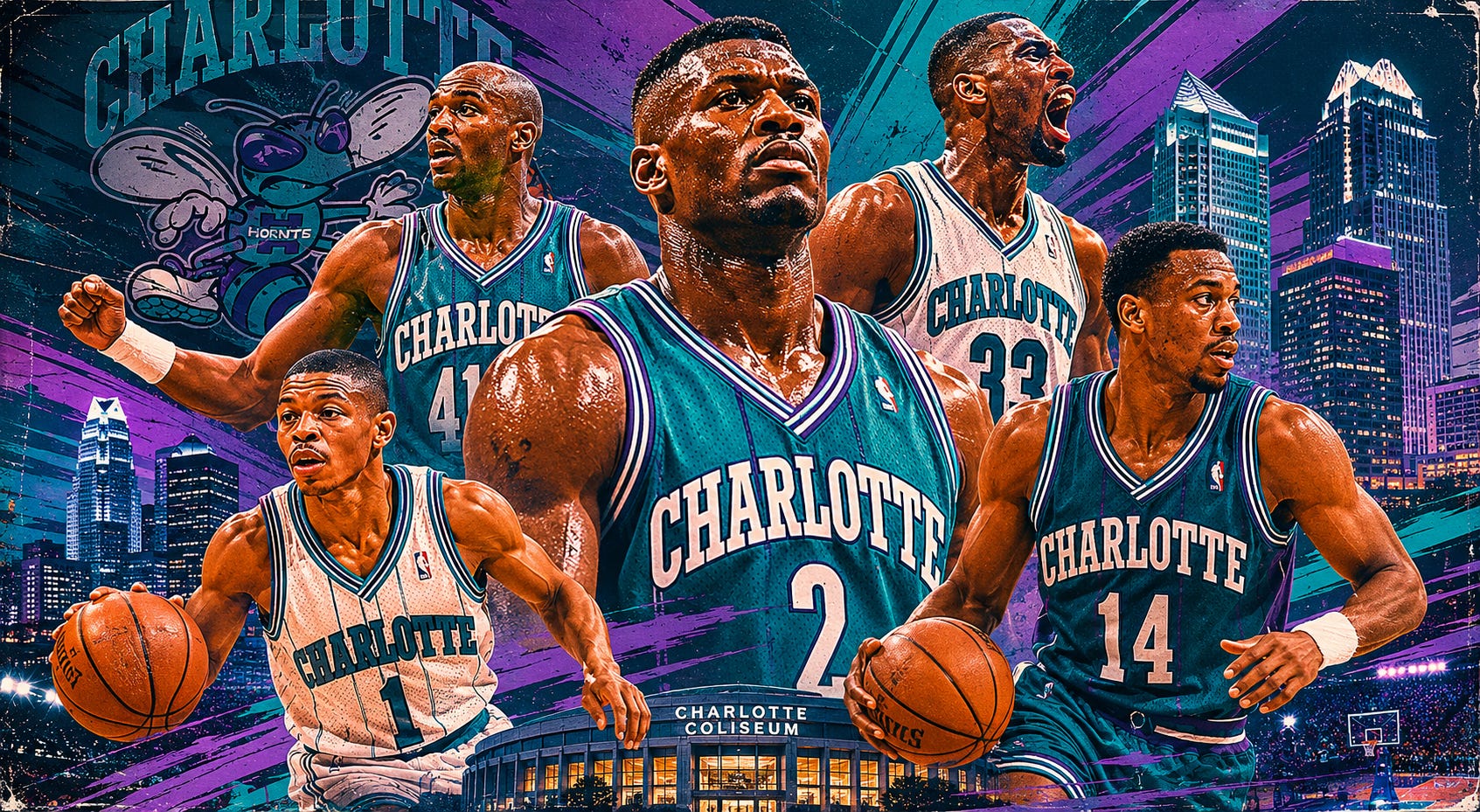
On April 5th, 1987, NBA Commissioner David Stern called George Shinn to tell him his group had been awarded the 24th NBA franchise. In that moment, without any crowd or ceremony, Charlotte became an NBA city.
When you attempt to understand what the Charlotte Hornets meant in the late 1980’s, you have to understand what came before them. Because the Carolinas were already basketball country in a way that went way beyond just fandom or habit. Duke vs. UNC wasn’t just a game, but mythology written in real-time every single year. College basketball had soaked into the DNA of just about every single person who grew up here.
College basketball fans could name obscure bench players from every team in the ACC. Mothers knew coaches’ families. Basketball was the language of the region, and everyone in the Carolinas had been speaking it their entire lives.
Professional basketball, though, was a little bit different. The NBA lived in Los Angeles, Boston, New York, Chicago; the big cities with their glamour and their history. The Carolinas had college basketball, and honestly didn’t think they were missing something. That is, until the NBA needed expansion and people realized Charlotte was a growing city, basketball-obsessed, wealthy enough, and hungry in a way that some established markets had forgotten how to be.
The expansion fee was $32.5 million — a fortune at the time — and Charlotte Business Journal tracked every penny raised, every corporate sponsor who stepped up, because this wasn’t a distant corporation dropping a franchise into a market. This was Charlotte building one organically.
George Shinn’s ownership group didn’t feel like outsiders in the way some expansion teams’ do. They felt more like neighbors, the kind who had been listening to what the city wanted and finally decided to provide it. And when they needed a slogan, it wrote itself: “Bringing the NBA to Basketball Country!” It was honest, direct, and it worked.
The 1988 expansion draft was a strange ritual, with other teams discarding players they didn’t want and Charlotte getting to pick from the leftovers — Jeff Hornacek, Dell Curry, Michael Brooks, Armon Gilliam — and nobody was expecting a championship roster, because this was a startup team in every sense of the word.
The first iteration of the Hornets was a collection of castoffs and role players trying to become something more than the sum of their parts. But what nobody anticipated was how badly Charlotte wanted to show up anyway.
The Charlotte Coliseum opened in 1988 and filled immediately, night after night, with people who had been waiting for this moment longer than they probably realized, and the first-year Hornets averaged 23,172 fans per game, leading the entire NBA in attendance as an expansion franchise.
A city with no NBA history and no generational stars on the roster showed up with more devotion than Los Angeles, New York, and every other established market in professional basketball. The team went 20-62 in 1988-89, and the Coliseum was full every night anyway.
Kids wore teal and purple jerseys to school. The Hornets Starter jacket became a cultural sensation overnight, and the franchise that had been promised to basketball country had arrived to find that the region had been waiting for it all along.
By 1991, the Hornets had their first real opportunity. A lottery pick and the first overall selection in the draft, and they took Larry Johnson out of UNLV — a power forward with charisma and a game that seemed perfectly built for the 1990s, physical, explosive and hungry in a way that matched the city around him.
LJ won Rookie of the Year and looked like the kind of player who could carry a franchise into genuine contention. Then in 1992 came Alonzo Mourning with the second overall pick, a 6’10” center with a defensive presence that made opponents uncomfortable from the moment he stepped on the floor. Kendall Gill was already there, a 6’5” guard with athletic ability and a competitive hunger that made teammates take him seriously even if stardom was never quite in the cards for him.
Here were two of the most promising young big men in the league, both in Charlotte, both entering their prime years together, and the results started to show. In the 1992-93 season the Hornets made the playoffs for the first time in franchise history, beating the Boston Celtics in the first round before falling to the Knicks in the second, and attendance stayed elite through all of it.
For a moment, it genuinely felt like this franchise had found the footing it had been searching for since that first improbable sellout in 1988.
By the late 1990s, the window had shifted in a way that often happens when franchises make decisions driven primarily by finances rather than overall vision. With Larry Johnson traded away in 1996 and Alonzo Mourning dealt not long after, the core that had built something real in Charlotte was dismantled and replaced with a rebuilt roster centered around Glen Rice and Anthony Mason.
The team kept showing up and finding themselves in the playoffs, and in 1997 they won a franchise record 54 games only to lose to the New York Knicks in the first round and watch their momentum take a hit.
They made the playoffs again in 2000 with 49 wins, consistent enough to maintain hope but never quite capable of doing anything with it. They were stuck in the purgatory that haunts so many franchises where the difference between the ceiling and the floor has shrunk.
George Shinn had owned the franchise since its founding in 1988, and by 2002, for reasons complicated and contested, he decided to move the team to New Orleans. Suddenly, after fourteen years of establishing a fanbase and proving that professional basketball could not only survive but thrive in basketball country, it was simply gone.
The move felt different than other relocations, because the Hornets hadn’t failed financially and they hadn’t collapsed on the court in any catastrophic way. Attendance had begun to dwindle a bit toward the end, but not in a way that made relocation feel inevitable.
For fourteen years, the city had proven that the fanbase was real and loyal, and would show up in a way that bigger, more celebrated markets sometimes couldn’t manage. And then, just like that, it was over.
The original Charlotte Hornets lasted from 1988 to 2002, fourteen years that in basketball terms amounted to nothing more than a blink. The Celtics had won 16 championships before the Hornets even existed, the Lakers had built dynasties spanning decades. Charlotte managed four playoff series wins, and a lot of regular season success that never found a way to translate into anything deeper or more lasting.
And yet, those fourteen years were still extremely significant because they proved something fundamental about what a city needs and what a region will support when given the chance. Give a basketball-obsessed area an NBA team and people will show up with devotion that has nothing to do with winning.
The Hornets represented something bigger than sports to Charlotte during the late 80’s, 90’s and early 2000’s. The city understood that even when the team was losing, even when the roster was being rebuilt, and even when the end turned out to be closer than anyone thought.
They never won a championship and never made it past the second round of the playoffs, and by any objective measure of basketball success that registers as failure. But by the measure of what they meant to a region that had clearly been waiting for this moment, they were proof that Charlotte belonged in the NBA.
The arrival of the Hornets was the moment when the Queen City finally got to claim a major league team as its own. The passion you see among the fan base in 2026 was born out of the years where Charlotte fell in love with a team before they gave it any real reason to. Purple and teal has been running through the city’s veins ever since.
No posts
Comments
Nothing yet. Say the first thing.
Sign in to join the conversation.