
Let’s build this week, SD!
1. Recap: Run A.I. with Run Tech Club [Techweek LA]
After a 2.5 mile jog along Santa Monica beach and the Venice boardwalk, ETH SD Founder gmchad sat down with Run Tech Club Founder Darius Fong and BoredNHungry Co-Founder Kevin Seo to chat about integrating AI into their day to day workflows.
Catch the recap clip in the below tweet:
Questions List:
WHY NOW? A.I. has been around and implemented in many facets of products and business for years. What contributed to the recent conversations and debates around AI (with ChatGPT/Dall-E), and how has it impacted your work?
What are the biggest value adds with recent advancements in A.I. via UI and computing power?
How should we view AI, as another tool, or as a replacement for humans and tasks?
How should we structure our team and org to best leverage A.I.?
What advice would you give yourself if you were growing up in this current technology age?
2. Recap: Base Meetup x Developer DAO [Techweek LA]
There were only a few crypto meetups during LA Tech Week but this one was definitely a highlight. The Base x Developer DAO meetup hosted panels and workshops from companies such as Polygon, Frax Finance, ThirdWeb, & Coinbase.
3. Call for Writers: Want to Contribute to the Weekly gm?
Do you love newsletters and are always up-to-date on crypto, SD, and all things tech?
We've always prided ourselves on the Weekly gm being a go-to resource for all things tech and crypto in San Diego. But now we're inviting you to make it even better. We're on the hunt for contributing writers from all corners of our tech community!
What's in it for you?
Connect with the local tech scene: Share your insights with our community.
Establish your voice: Gain visibility and become a thought leader.
Give back: Foster a culture of shared knowledge and learning.
We welcome a variety of topics: local tech developments, start-up profiles, event reviews, blockchain applications, crypto market updates, DeFi trends, and more.
Don't worry if you're new to writing - we're here to support you in sharing your insights. Let's make the Weekly gm even more of a community effort!
1. Apple’s Vision Pro
Last week's WWDC 2023 was chock-full of Apple reveals, including a new MacBook Air, iOS 17 features, and the M2 Ultra processor. But the head-turning 'One more thing' moment came with the announcement of the Apple Vision Pro - the tech giant's bold venture into virtual reality.
The Vision Pro VR headset, slated for release early next year, promises a blend of impressive specs and a user-friendly design. Priced starting at $3,499, the headset will be powered by two chipsets, the M2 and a new R1, each handling regular software and XR capabilities respectively.
Featuring dual 4K displays, the headset maintains a design similar to existing VR offerings with a front panel covering the eyes and an elastic strap. However, Apple adds a twist with an outer display showing the wearer's eyes. The headset can last up to two hours on a full charge using the official external battery pack.
In an intriguing departure from the norm, the Vision Pro doesn't include any controllers. Instead, users will utilize their eyes, hands, and voice to interact with its visionOS software.
While the anticipation builds, Apple has not yet provided specific launch details or mentioned plans for a release outside the US. So, stay tuned for further updates as we look forward to strapping into Apple's immersive vision for the future.
Dive into the Apple Vision Pro here: https://www.apple.com/apple-vision-pro/.
2. More AI Tools
The future is optimized. As the flooding of AI tools into the space continues, is there a particular tool, or set of tools, that you’re using daily?
If not, then check out the list above, and let us know which is your favorite!
1. SEC Sues Coinbase
The US Securities and Exchange Commission (SEC) is taking legal action against some of the biggest names in cryptocurrency, accusing them of violating US securities laws. On Tuesday, the SEC filed a lawsuit against Coinbase, America's largest crypto exchange, for allegedly operating as an unregistered broker. This action comes just a day after the SEC filed a similar suit against Binance, a major overseas competitor.
According to the SEC, Coinbase has made billions of dollars unlawfully since 2019, facilitating crypto asset securities transactions while not being registered with the Commission, as required by law. The SEC suggests this lack of registration deprives investors of significant protections.
Coinbase CEO Brian Armstrong responded on Twitter, stating the company is proud to represent the industry in court to seek clarity on crypto rules. Armstrong criticized the SEC for its lack of clear regulations and its "enforcement" approach. The company's chief legal officer, Paul Grewal, also asserted the need for transparent legislation, not litigation.
As a result of these allegations, Coinbase's shares fell more than 12%. Following the SEC's complaint against Binance, investors withdrew around $790 million from the platform and its US affiliate, according to data firm Nansen.
This regulatory crackdown comes as the digital asset industry is under heightened scrutiny, with investors still wary after the spectacular collapse of FTX late last year.
2. Binance Also Sued by the SEC
U.S. regulators have filed lawsuits against Binance, the world's largest crypto exchange, and Binance's billionaire CEO, Changpeng Zhao (CZ), for failing to register with the Securities and Exchange Commission (SEC), which claims to have regulatory oversight over most cryptocurrencies.
In the case of Binance, the SEC has accused Zhao and Binance of deceiving investors about their ability to detect market manipulation and of misappropriating customer funds, some of which were sent to a company controlled by CZ. The company is also charged with operating an unregistered trading platform in the U.S. and allowing U.S. customers to trade crypto on an exchange that should be restricted to U.S. investors.
SEC Chair Gary Gensler accused Binance of a range of deceptive practices, undisclosed conflicts of interest, and intentional evasion of U.S. securities laws. This legal action against Binance and Coinbase is the latest in a series of regulatory measures against crypto companies.
Binance has seen its market share grow substantially since FTX's collapse and has been under scrutiny by regulators and law enforcement agencies globally.
The SEC claims that Binance and Zhao circumvented their own controls to secretly allow high-value U.S. customers to trade on its international exchange, which should be restricted for U.S. users. Binance's U.S. operations are supposedly independently controlled by two subsidiaries, BAM Trading and BAM Management. However, the SEC alleges that Binance and Zhao secretly controlled the operations of Binance.US.
Despite the SEC's allegations, Binance.US has dismissed the lawsuit as "baseless" and pledged to "defend ourselves vigorously."
3. Vitalik Paints a Picture of What’s Needed for the Future of Ethereum
Ethereum co-founder Vitalik Buterin has outlined three major transitions that the Ethereum network must undergo to ensure its future: layer-2 (L2) scaling solutions, a shift towards smart contract wallets, and improved privacy for fund transfers. These transitions address the "blockchain trilemma," which posits that a blockchain can only achieve two out of three primary traits: decentralization, security, and scalability.
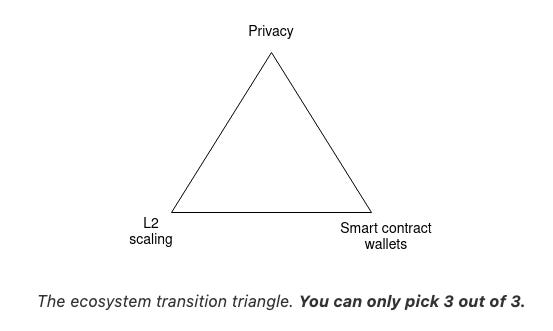
Buterin emphasizes the importance of expanding L2 solutions like "rollups," which bundle transactions and validate them as a smaller piece of data on mainnet, thereby reducing the cost of Ethereum transactions. Experts such as Karl Floersch, co-founder of Ethereum L2 Optimism, agree that L2s are crucial to Ethereum's scalability and its vision of becoming a global computational platform.
The second transition involves the move to smart contract wallets. These contracts execute their terms automatically when predefined conditions are met. While there are technical issues to overcome, Buterin views this shift as manageable and vital for making certain processes easier.
Lastly, Buterin identified the need for greater privacy measures, cautioning that without them, potential users concerned about privacy might avoid Ethereum. He suggests that "stealth addresses" could help protect user identities, though these methods are still in development due to cost and functionality issues. Read the full post here: https://www.vitalik.ca/general/2023/06/09/three_transitions.html
In essence, the future of Ethereum, according to Buterin, depends on overcoming these hurdles to ensure scalability, user privacy, and the broader application of smart contract functionality.
We’ll keep you posted every Monday on what’s happening in the space. Follow @ETHSanDiego on Twitter or visit ethsd.org for info on events, educational content, and more!
See you next week,
@ChaseOnChain.eth & @gmchad.eth
Disclaimer: None of this is financial advice and is for educational purposes. Always do your own research.
No posts
Comments
Nothing yet. Say the first thing.
Sign in to join the conversation.