
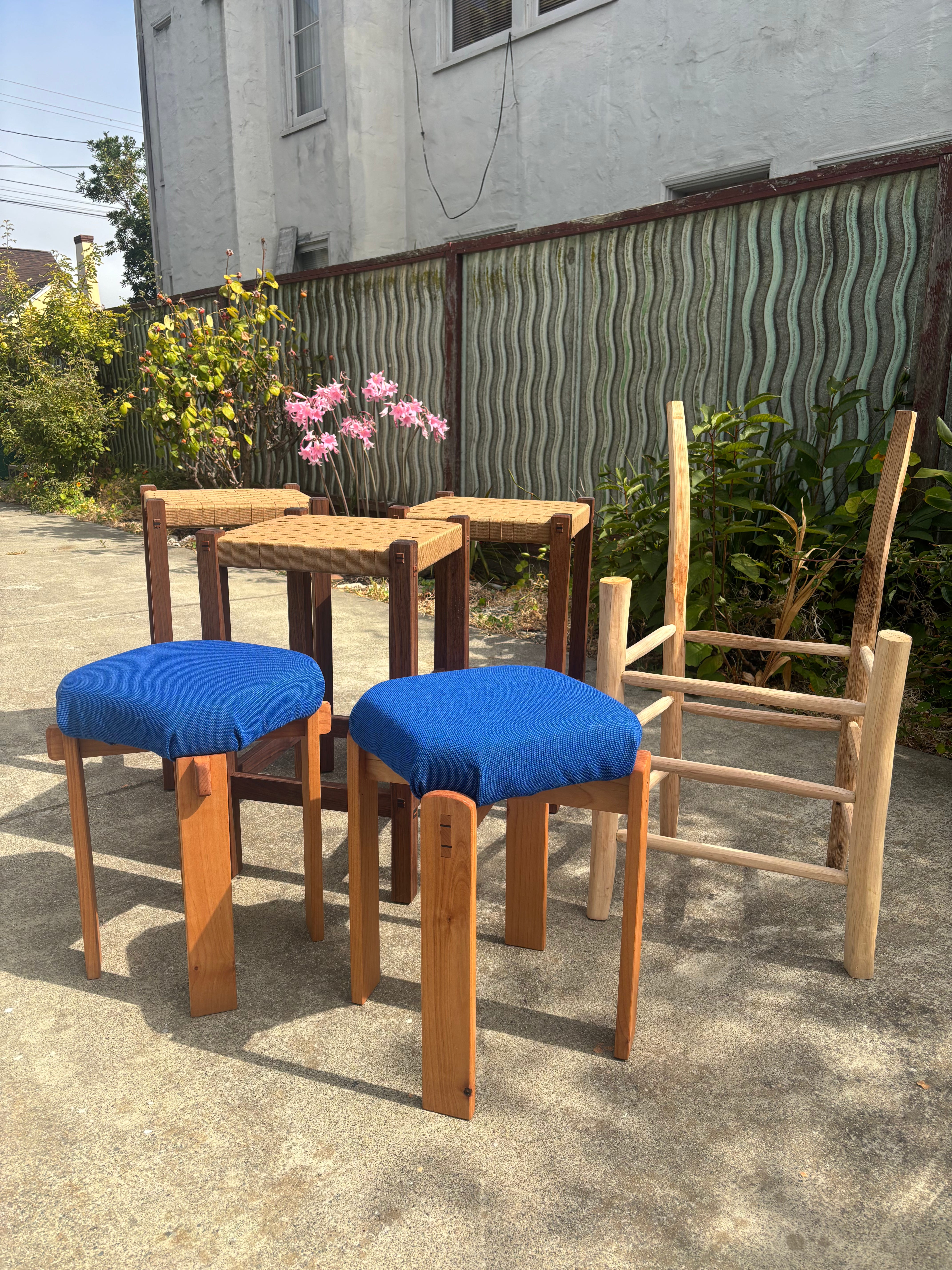
So many seats lately. Three counter-height stools, cherry and walnut. Two “normal height” (?) stools, alder and deadstock Kvadrat Steelcut Trio upholstered seats. And last but certainly not least, a WIP Jennie chair from a tanoak tree that grew in Willits, CA.
I wish I’d been posting more consistently because I have quite a lot to say about each of these and learned so much. I don’t think I’ll be able to do it all justice in the space of one post but something is better than nothing, so I will record a few notes on each. Let’s go!
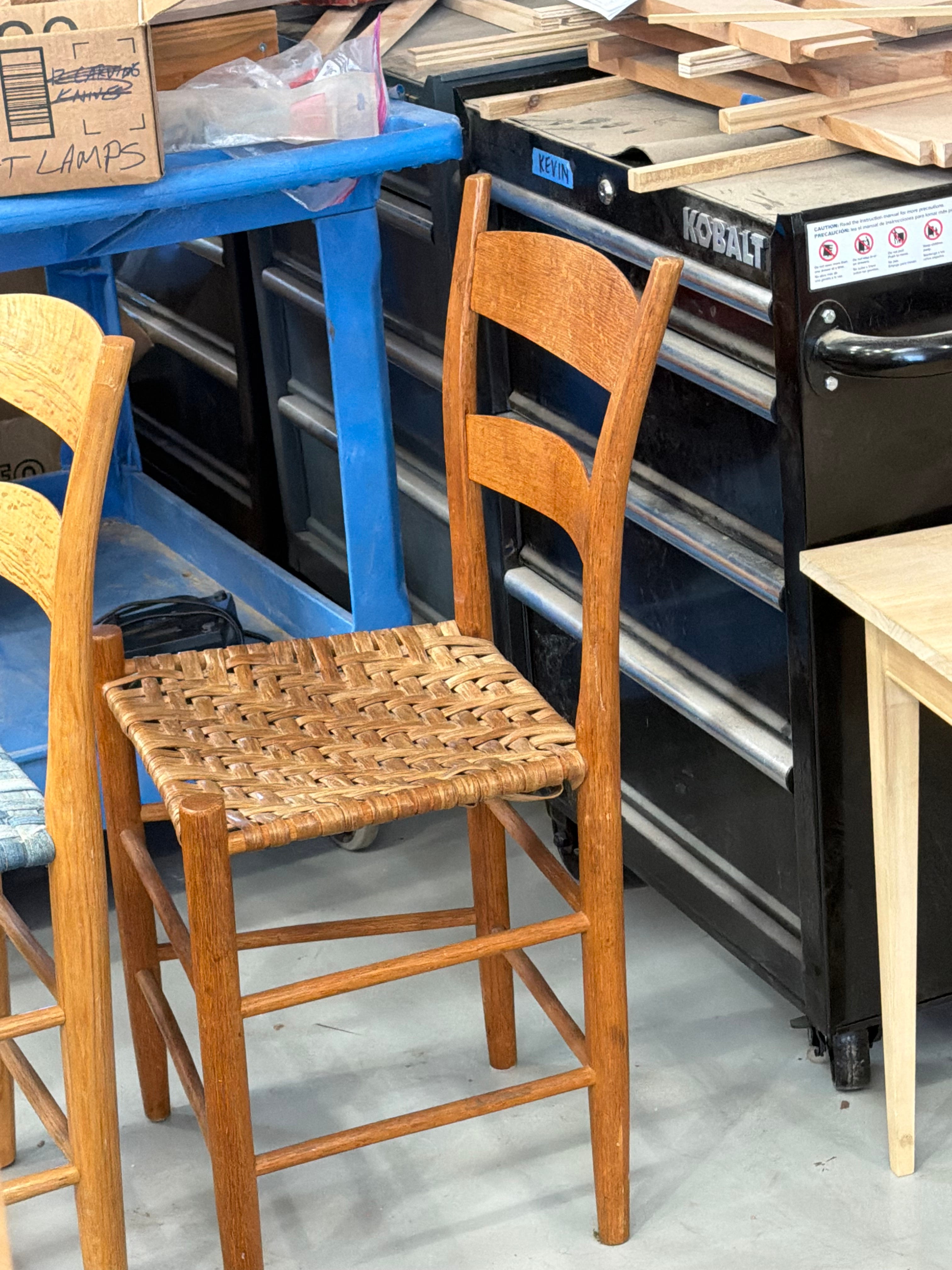
I took a six-day greenwood chairmaking class with Dan Stalzer at the (phenomenal) Mission Community Woodshop. I don’t feel that I can relay what I learned in specific terms. It somehow doesn’t feel like mine to share, at least not in this random a$$ Substack post. The info is very much out there for the taking, though.
I signed up for the class on the recommendation of a friend. I didn’t do much research or thinking, I was just like “I trust you and I’m free in July and I want to make a chair, let’s do this.”
So I was both surprised and delighted to hear on the first day of class that our instructor, Dan, learned from the queen of American greenwood chairmaking herself, Jennie Alexander. She wrote the wonderfully titled Make a Chair from a Tree. She has been on my radar for nearly as long as I’ve been interested in woodworking because she’s a legend and a trans woman. At the risk of being overly sentimental, I have not encountered many opportunities to feel connected to any kind of lineage of queer American woodworkers. What a gift to have learned from someone who learned from her!
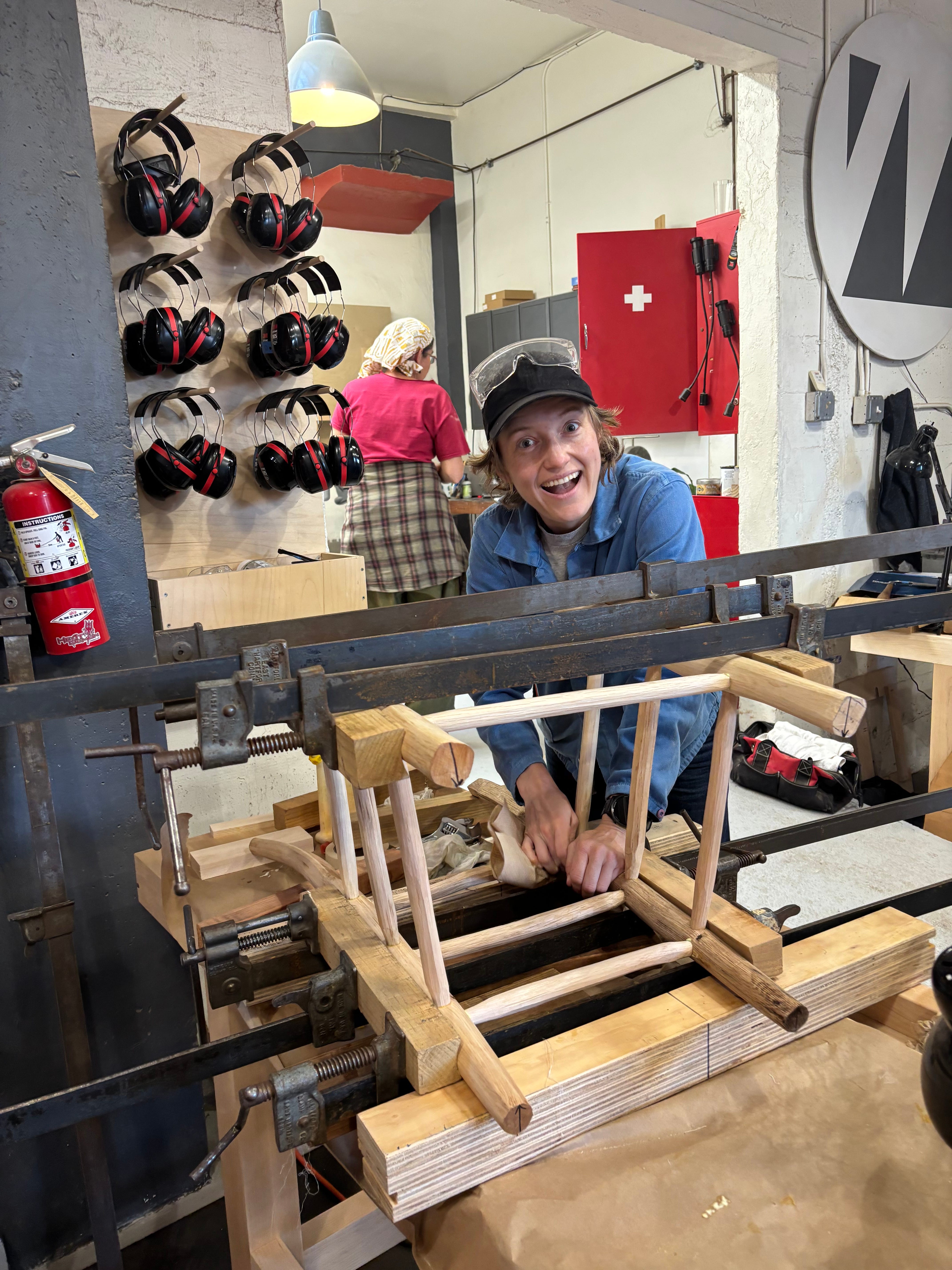
We didn’t have enough time to finish our chairs, but the bones are in place. We’ll be reconvening in September to add the steam bent back slats, level out the feet, trim the front legs, and other final details.
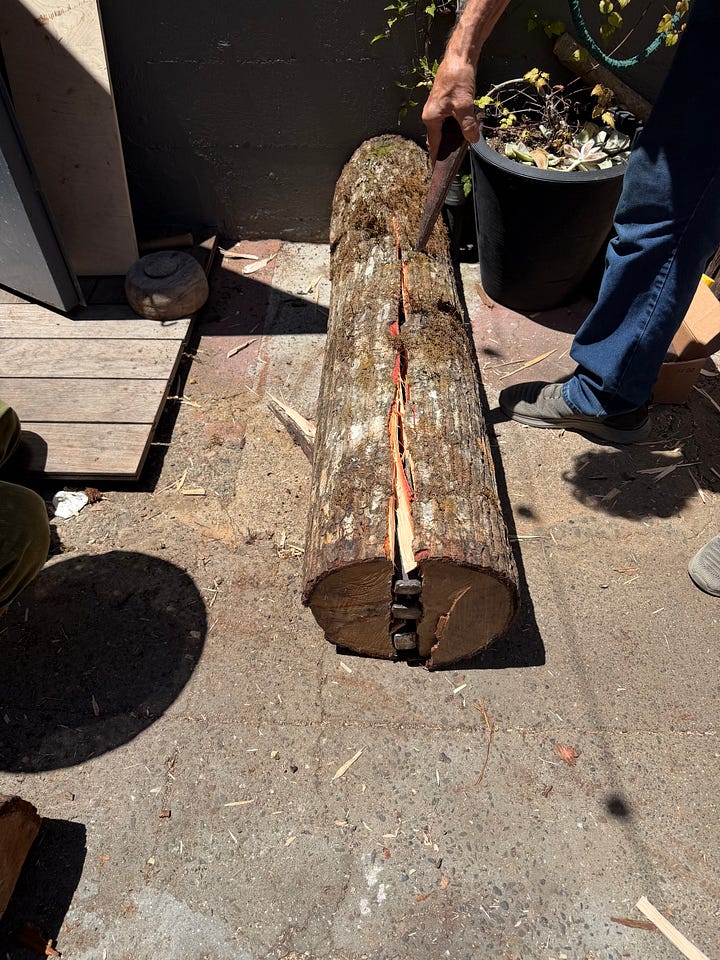
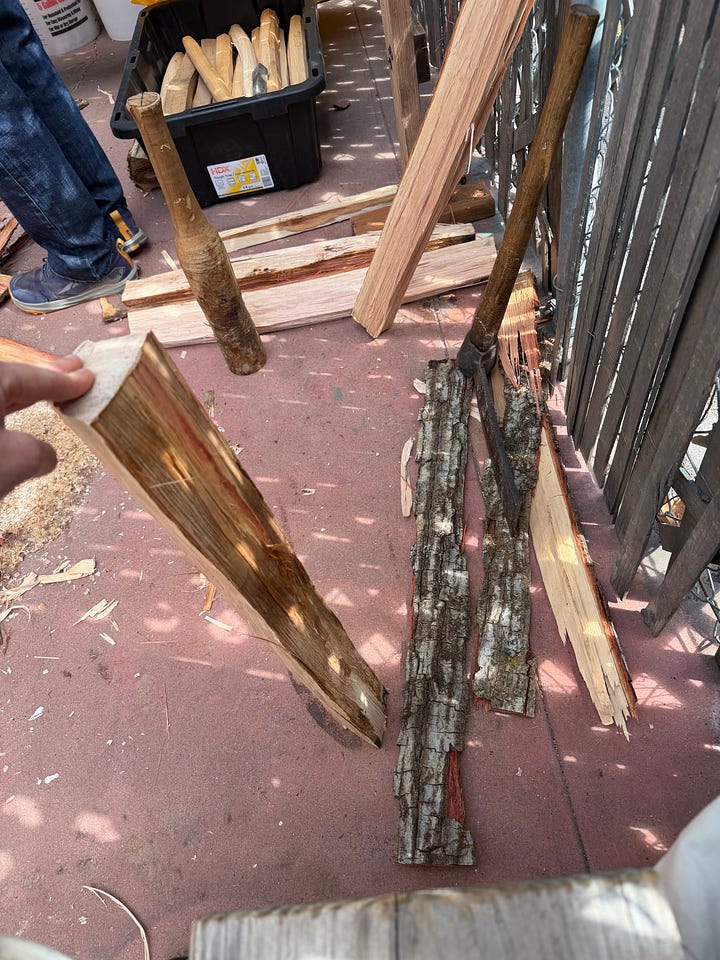
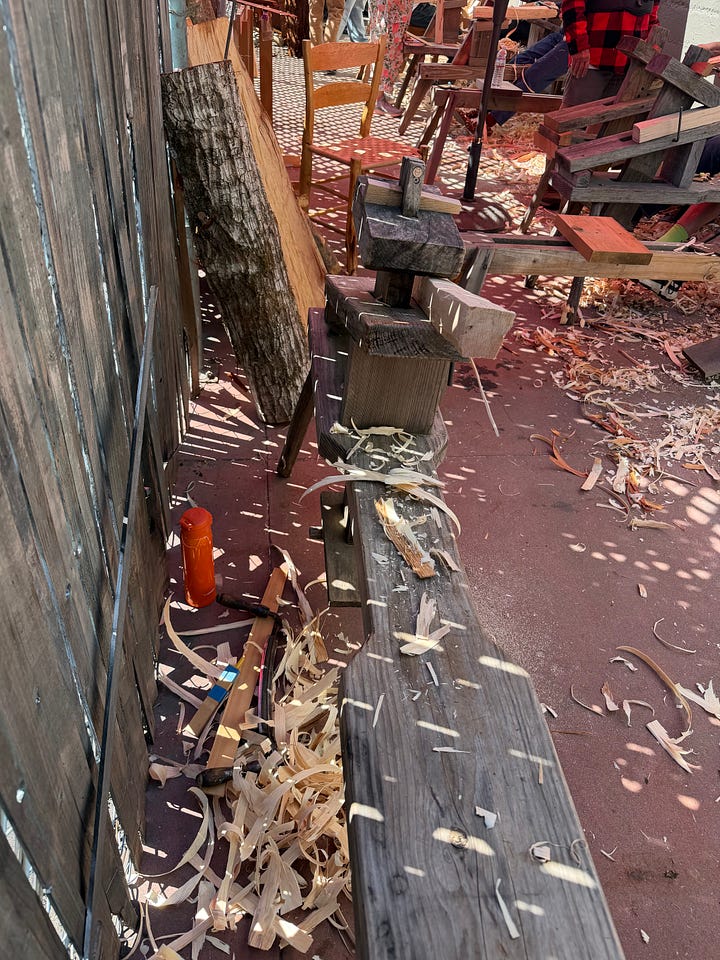
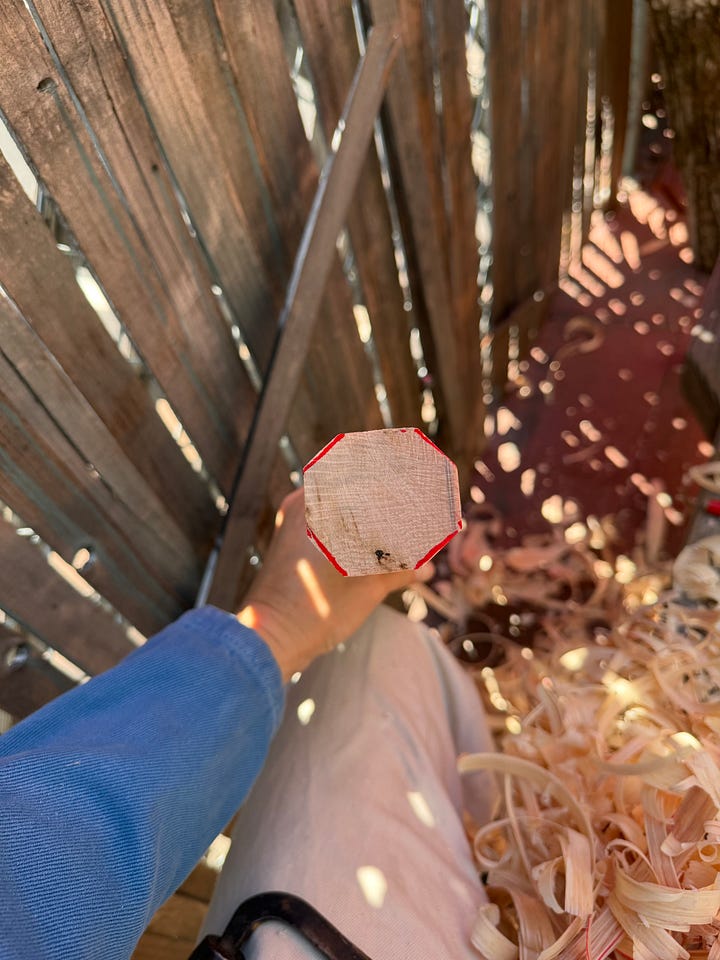
The coolest thing about this kind of chairmaking is the way the construction takes advantage of wood’s natural properties. In the simplest terms, wood expands when it’s wetter and shrinks when it’s drier. Accordingly, the legs of these chairs, which receive the mortises (holes), are made from wetter wood. The rungs, which are the tenons that go into the mortises, are made from drier wood. In class we dried them in a DIY kiln, basically just a plywood box insulated with foam and heated with a lamp for a reptile’s cage. This gets the tenons much drier than the environment. So when the tenons leave their dry kiln and enter the wetter mortise/environment, they expand and lock into place. Just brilliant!
Working in this way required an entirely different mindset than what I am used to. At first I thought the difference was that green woodworking requires turning off the perfection seeking part of one’s mind. You’re not precisely laying out every single cut, squaring with no gaps, splitting every line.
But then I realized that green woodworking is actually about trying to achieve perfection of a different quality. It is not about enacting control/domination over the material and more that you’re following what the wood wants, getting into the grain line and letting the shape emerge. One of the teaching assistants kept admonishing me to stop checking for square, “These are the chairs farmers made after work so they’d have somewhere to sit!” As ever, woodworking offers spiritual lessons…
A woodworking friend sent me a link to an episode of a podcast that featured an interview with Avram Dalton, a gardener working in the Japanese tradition. I’d recommend it to anyone interested in craftsmanship in any form.
The reason I raise it here is that Dalton’s description of the Japanese concepts of kiyō and bukiyō was a source of comfort and inspiration during my chairmaking class and in thinking about my craft pursuits more generally.
Here’s a lightly edited excerpt from the episode transcript:
[T]he way they look at things as the two categories are kiyō and bukiyō. And kiyō means somebody who’s very just naturally talented.
They can absorb things quickly and they just can feel it out. And they’re sort of quick on their feet and they’re skilled with their hands. And it doesn’t take them a lot to kind of pick up a technique or at least pick up the sort of proto version of a technique.
And bukiyō is the sort of exact opposite of that. It’s somebody that, you know, in order to mark out a straight line needs to get a string and line it up and make sure everything’s sighted perfectly and then mark it in very small increments and then they get a straight line.
Whereas a kiyō person can kind of look and maybe it takes them like one or two tries and they can mark out that straight line or draw that straight piece of chalk on a piece of wood or whatever it may be. And the kiyō, they will progress quickly. But a lot of times what they say is that you drown in being kiyō. Everything comes so easy for you.
It’s almost like you lose interest. And there’s obviously a deeper level of technique that you need to absorb and bring into muscle memory. And sometimes when stuff comes easy, you don’t put in that sort of extra practice going out every day and really like how does this really work? I just felt it out and got the right answer. But what are the steps? What are the details?
If I had to explain this to somebody, what are the intricacies of it? And that’s a place where somebody who’s a bukiyō will really shine because they have to learn every piece of a thing in order to get it. And they have to sort of struggle and really kind of go 1 through 10 and it may be that like where you’re sort of kiyō or bukiyō, there’s a little bit difference in the kind of work they do and how quickly they absorb stuff at the start.
When you draw that out over 10 years, somebody who’s bukiyō generally has a much more grounded understanding of things and can develop a consistent technique a lot better.
But that being said, somebody who’s kiyō, if they adopt a bukiyō mindset and not just get it, but really put in that extra struggle to understand it on a, on a detailed level. You know those, that’s your Michael Jordans […], your really high-level craftspeople.
I am a supremely slow learner in woodworking. I never understand anything the first time I encounter it. I’ve experienced this in negative to neutral terms. My self-concept is not one of being handy, so being “bad” at woodworking carries way less zingy ego charge for me than being “bad” at various intellectual/academic pursuits. My expectations for myself are so low in this arena that being able to do anything feels like a happy surprise. This has of course enabled me to actually improve at woodworking in a way I haven’t in other arenas where I am perhaps more naturally gifted but I digress.
The point is that this reframed my slow progress as a woodworker as a kind of strength. If nothing else, conceiving of myself as bukiyō allowed me to experience little to no stress or friction during the moments in the chairmaking class when my peers where nodding along with the instructor’s lesson and I was like “?????” Let’s hear it for being a little dumb but plodding along nonetheless!
One terrible part of living with a person who likes to make things is that you have to endure long gaps wherein you don’t have essential objects/furniture because aforementioned person wants to make them but hasn’t yet had time.
And that’s how it came to be that our little kitchen nook was basically unusable, our vintage Bruno Rey table (shoutout Enliven Mart in Emeryville) sitting there sans seating (or with a dining chair dragged in, SAD!).
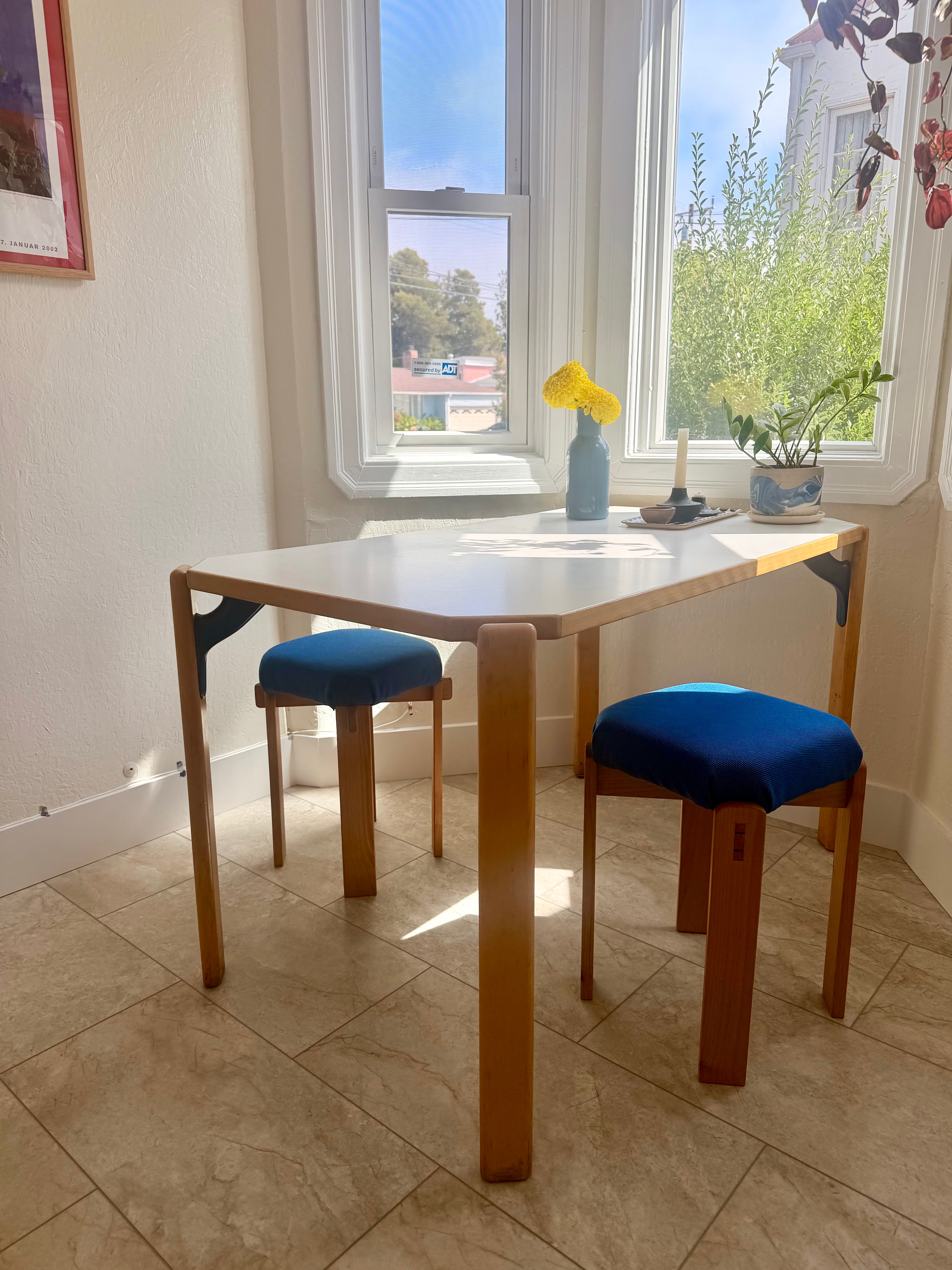
Anyway, I finally made us two stools for the nook. Thanks to Annie for your patience 🫡 And thanks to my sister Claire and her boyfriend Eric, who are the only true STEM people I know and helped me do math that actually proved unnecessary (ended up just referencing off existing parts to determine the seat dimensions) but helped me via text in my hour of need while designing these stools while on a flight to NYC earlier this summer.
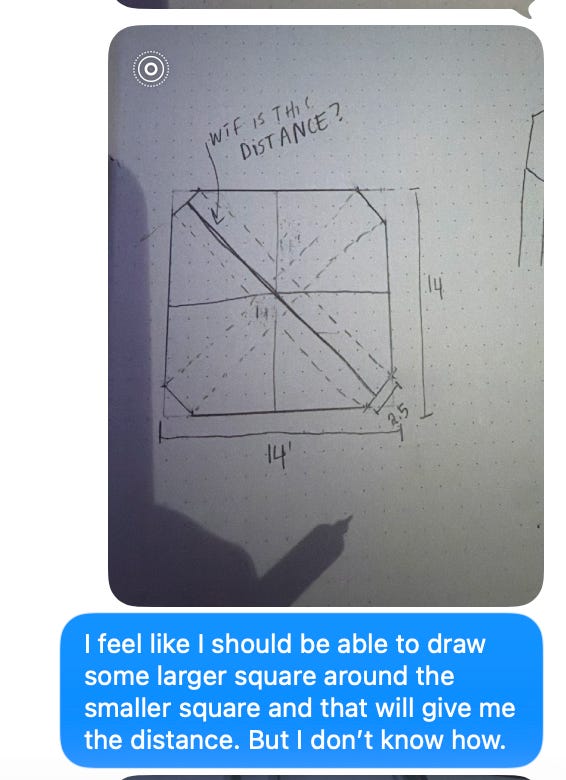

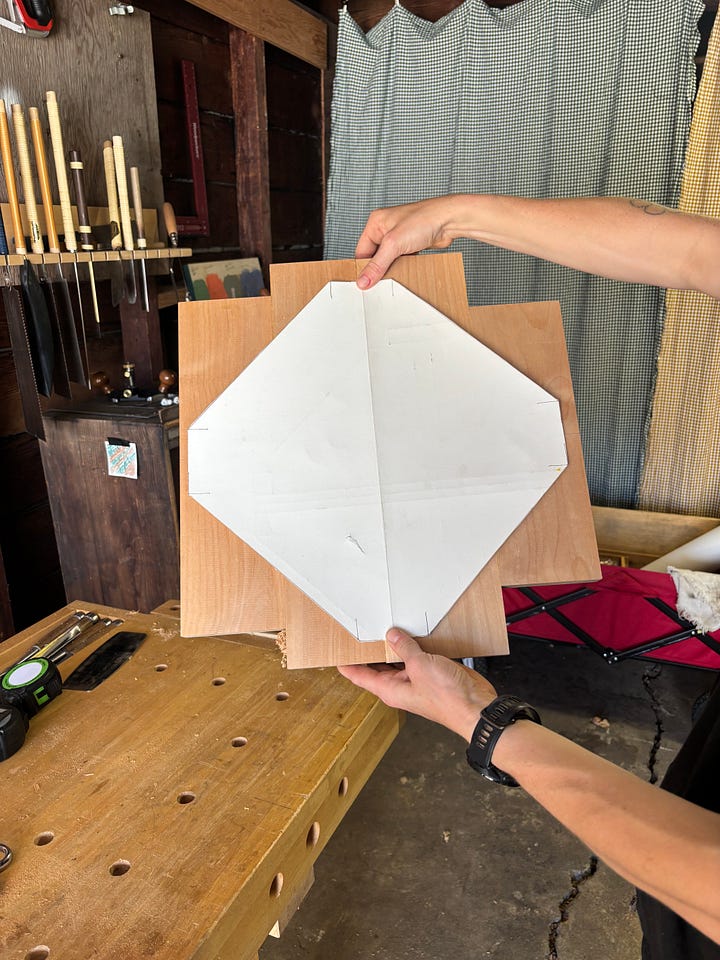
I thought it would be fun to make the seats squares with chopped off corners as an echo of the shape of the table. I don’t exactly know how much the visual motif lands since the octagonal corners get a little lost in the poofy upholstery foam but it was a fun detail to design — and a great way to put my track saw to work!
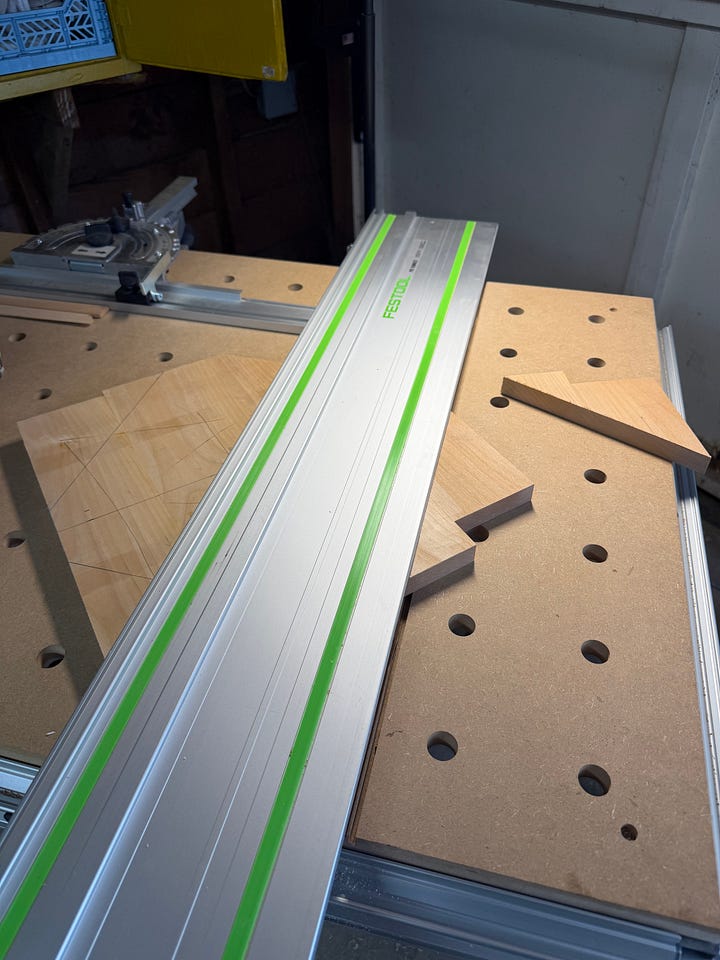
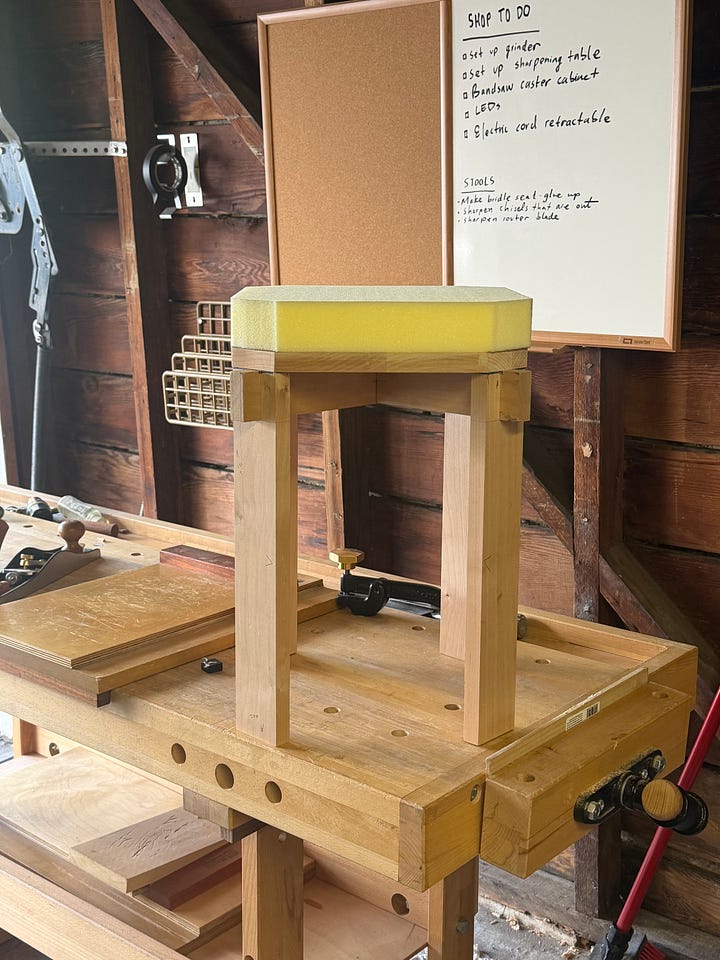
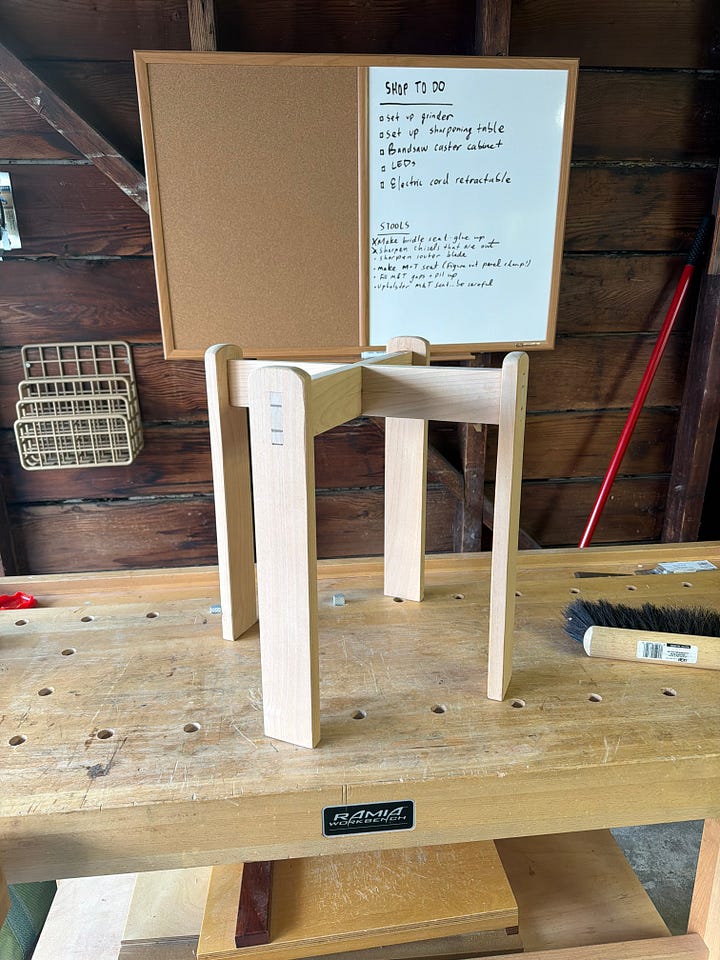
Both have half lap joints in the center and go into 2.5” wide legs. One has bridle joints and the other wedged mortise and tenons. They came together really quickly, about a day of work each. Let’s hear it for my track saw, bandsaw, and simple joinery.
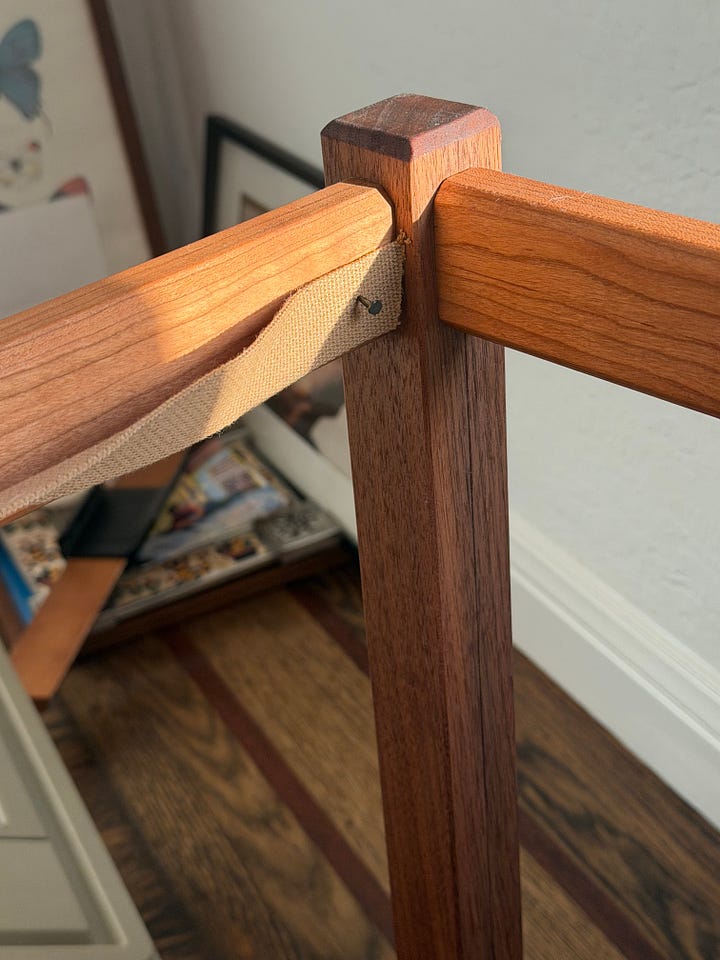
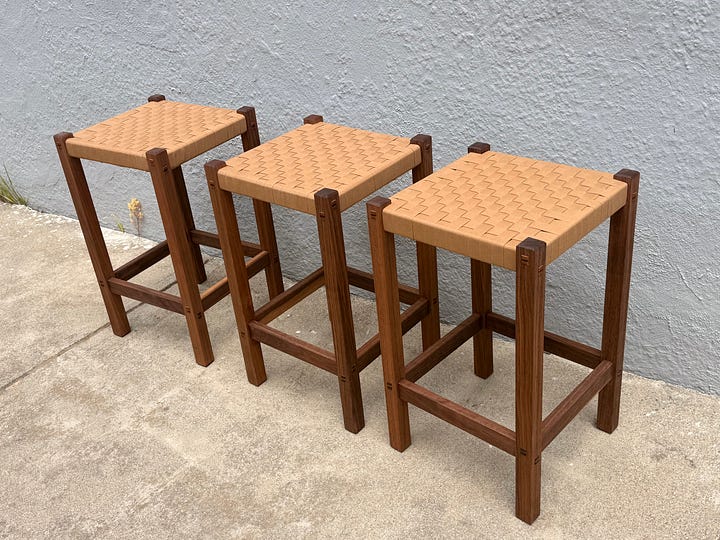
Finally done! I’ve already spilled plenty of digital ink on these in past posts so I will simply say that I am proud of how they turned out and can’t wait to get them to their future home at my friends’ kitchen counter in LA.
I hope to post more consistently so that there isn’t so much ground to cover and I can go into more detail on each project, so hopefully you will see me in your inbox again before too long. Thanks for reading, as always.
No posts
Comments
Nothing yet. Say the first thing.
Sign in to join the conversation.