

The Scottish National Party (SNP) has dominated Caledonian politics for decades. You may have heard the saying “Power tends to corrupt, and absolute power corrupts absolutely” (from a letter by Lord Acton in 1887). It is perhaps then not surprising that the self-styled “money man” of the SNP, Peter Murrell, and former husband of its long-time leader, Nicola Sturgeon, has been found guilty of embezzling ~£400,000.
Could we have seen this coming?
The Association of Certified Fraud Examiners’ most recent Report to the Nations once again highlights the most common behavioural indicators of fraud. First on the list, “living beyond means.” For years, I’ve struggled with this one, as it exposes an awful lot of our assumptions, presumptions, and biases (when are coworkers qualified to determine that someone is living beyond their means?).
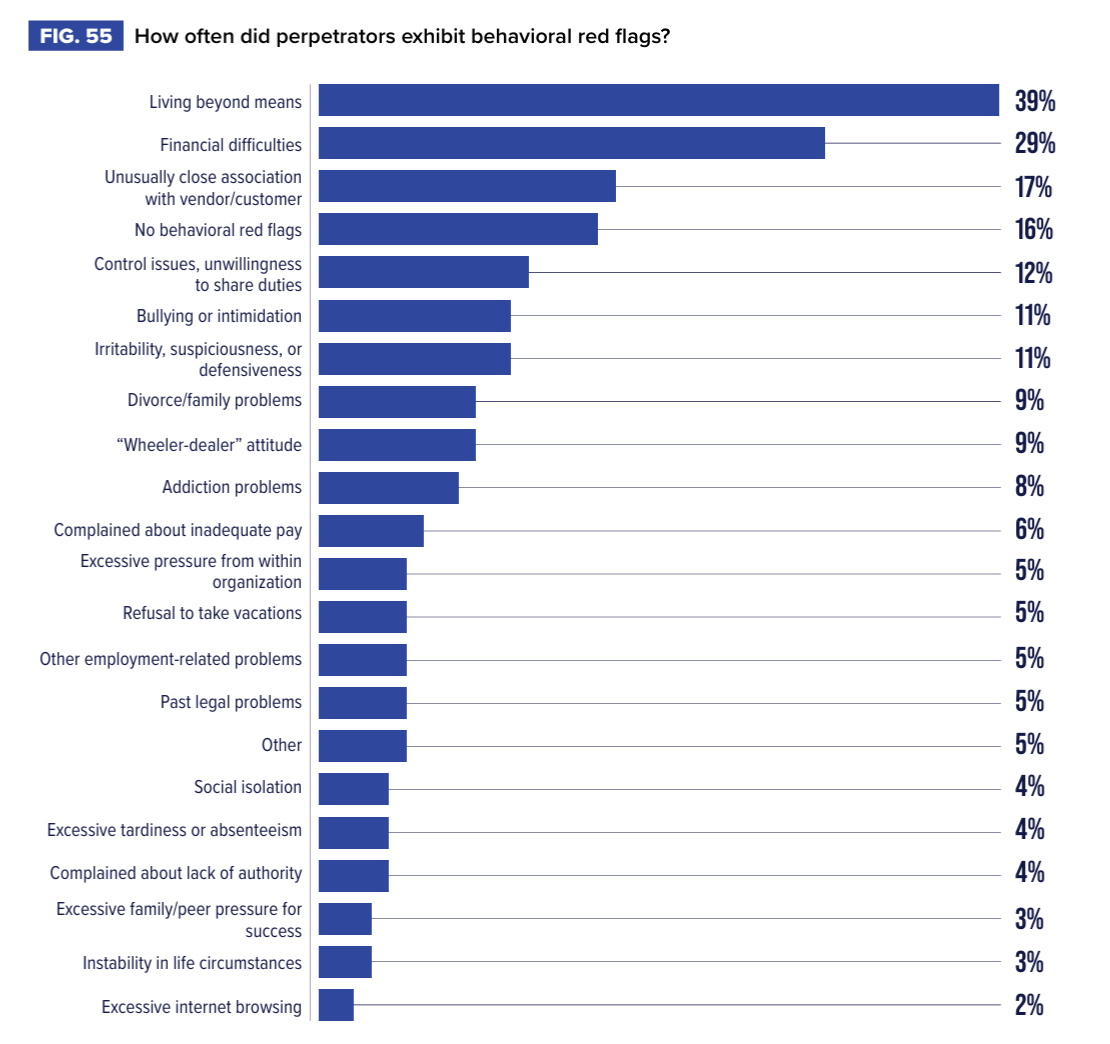
But let’s use the SNP case, as it’s a gloriously brazen one. First up, we need to summarise Murrell’s spending spree between 2010 and 2022 (most of which these purchases used SNP bank cards and were disguised, badly, with faked paperwork) :
A £124,550 motorhome (that only ever did 4 miles).
Luxury watches costing £9,350.25, reported as “event merchandise”.
A £3,070 robotic lawnmower, recorded as “legal fees”.
An egg poacher set worth £28.98 was described as “Ethernet cabling”.
A £57,500 on a Jaguar I-Pace.
£8,991.65 on four coffee machines.
£5,319.26 on Le Creuset cookware.
£2,618.16 on salt and pepper grinders.
£1,056 on Jo Malone reed diffusers and candles
An eclectic list, and you’d imagine the motorhome and Jag might raise some eyebrows. But, it’s the last four items I found curious. “Me theory” is generally a terrible idea in an investigative context. It goes something like, “I would never...[react that way, try to hide the crime that way, use that line of defence, etc.]” The suspect is not you or me. That said, I’m going to indulge in some me theory briefly...
...with context. Both my wife and I grew up in households where money was a constant source of stress, conflict, and anxiety. Unsurprisingly, we both, therefore, tend to notice purchases. If I had been splashing the cash on Le Creuset, amidst the delight, there would have been questions. So, when Nicola Sturgeon claims that she believed they could afford all of the above because she and Murrell were DINKs (double-income, no kids) with decent jobs, I’m not hugely inclined to buy that as a reason not to question further.
I am not alone here. A recent poll shows that only 20% of Scots believe her (60% do not). Her case is not strengthened by the assertion that she has “no memory of ever seeing the motorhome,” which was parked around the side of her mother-in-law’s house.
So, where does this leave us in determining if someone is “living beyond their means”?
Most (if not all) of my training and further studies in behavioural analysis and deception detection had a data-led obsession. For example, we now know that for a credible indicator of deception, we need a cluster of three or more emotionally contradictory indicators across two communication channels within seven seconds of the probe or question (3-2-7). That 3-2-7 science serves me well, but it takes a while to be able to a) learn what questions or probes elicit emotional reactions, and b) to spot them simultaneously across all six communication channels in real time.
Furthermore, and somewhat depressingly, science tells us that untrained people are no better than chance at detecting deception. But, fear not, even if we struggle to spot lies accurately, we do have an ancient in-built radar for a more general incongruence and danger: our intuition.
Intuition is wonderful when it works, but it can get us into trouble. Normally, this is because we’re trying to exercise that intuition in the wrong contexts. For example, the judgment requires too much complexity (data) for an instinctive read (e.g., relying on your gut to buy a house). Sometimes it’s because of bias (not just about other people, but we all have a truth or lie bias, pessimist, optimist, etc.). It can also be because we’re under stress, past traumas and triggers (here, we’ll hear the phrase, “clouding my judgment”).
So, we need to learn to track our instincts. Play games when you’re out and about - ‘cold reads’ of people we meet, followed by sensible questions, forecasting how a colleague might react in a meeting, observing those in your family as they go about their day-to-day (”I know who’s been pinching those biscuits…”). Note where you get it wrong (and right). Start to cluster the wrong judgments to understand if the cause was bias, trigger, trauma, or complexity (too many datapoints).
You need only do this for a few weeks to start to ‘trust your gut’ a bit more. When we start to dump and shed our preconceptions and baggage, our little limbic brain is actually very useful. It’s why we’re here (our ancestors’ fight, freeze, or fight response fired enough times correctly to allow them to survive long enough to perpetuate our lineage). Dr Tara Swart is a great place to start for more scientific analysis about the merits of listening to our intuition.
Instinct will always lead (it’s unbidden), but as we practice mindfulness around those responses, we can start to look for the gaps in our data. The very act of gathering data will further enhance our instincts, as it will teach us more about our triggers, biases, and the blanks we automatically fill in. For example, if your spidey-sense was triggered by a colleague who had started wearing clothing that didn’t match their paycheck, some data gaps might include:
Do they just have different spending priorities (e.g., maybe they live with parents and spend all their salary on luxuries)?
Did they buy the clothing (or was it gifted)?
Have they come into money legitimately (inheritance, investments, etc.)?
Is the clothing new (some smart shoppers find nuggets of gold in charity stores in upmarket neighbourhoods, or on FB marketplace, eBay, Vinted, etc.)?
Some data will be hard to gather, other factoids sit a few seconds away. For instance, a cursory Google of “Jaguar I-Pace price” would presumably have helped Nicola to spot incongruence and someone ‘living beyond means’, let alone questioning the value and validity of a barely used, and hefty, motorhome on her mother-in-law’s suburban driveway (see below).

No posts
Comments
Nothing yet. Say the first thing.
Sign in to join the conversation.