

Welcome to July’s long-form edition of The Integrity Gap. For new subscribers, the general format is:
What We’re Seeing - 3 trends or emerging risks
Intel - 1 case study
Tools & Resources - 1 practical framework or idea
What’s Next - forward-looking insight
I had a great personal tutor at university, who specialised in supply chain stress. He foresaw a bunch of issues we now live with (from agriculture and food prices, courtesy of supermarkets, to car parts). So, when The Economist recently reported on China’s solar industry’s “turmoil”, it was foreseeable. The domestic market (the biggest one) is falling because the grid can’t keep up, with installations expected to drop between 24% and 43% this year. And excess production has triggered price wars that have left most suppliers running at a loss since 2024. Whenever supply becomes constrained to a few suppliers, what happens? Crunch.
The FBI has reportedly built a 22,000 sq ft replica town to train its operatives for “real-world cyberattacks”. The “Kinetic Cyber Range” on the bureau’s Huntsville, Alabama, campus has buildings including residential homes, a supermarket, a courthouse and a hospital, all wired with functioning devices and systems so that real attacks can be simulated. How long until we get the equivalent to practice fighting off rogue AI, and has Hollywood kept the set of the Terminator movies...? 😬
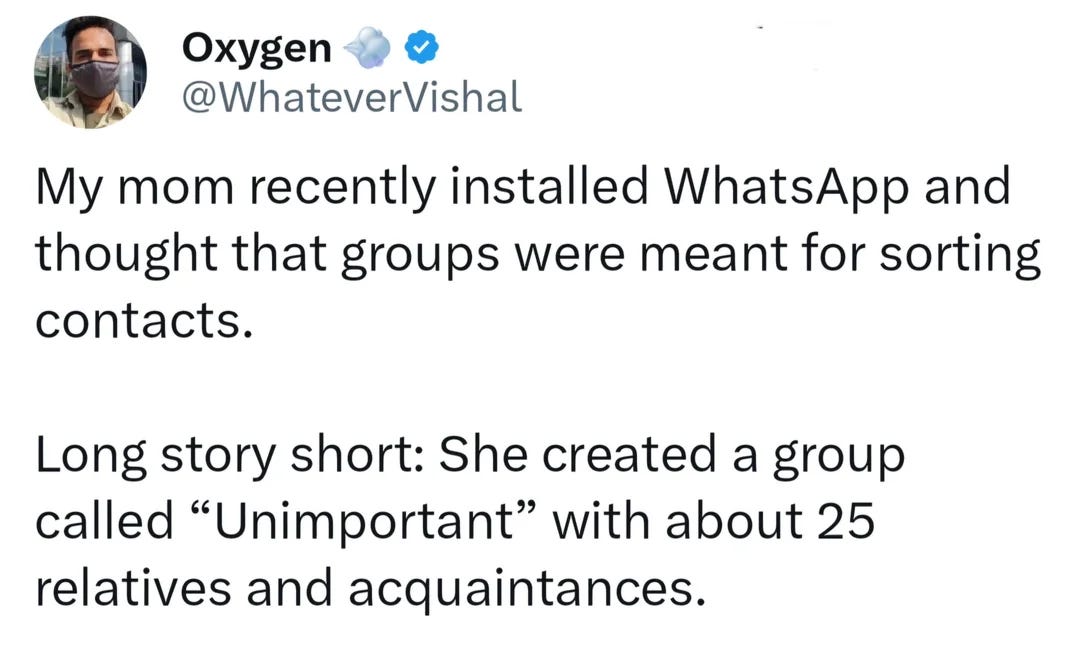
Can we call people again? All the data indicates we can’t. And when I suggested my daughter call a friend who was late for the bus taking them to the airport (recent school trip), I was met with a face of abject horror: how could you suggest something so cruel? The argument is that calling is interruptive and demanding. Instead, it appears preferable to send the unedited stream of consciousness that comes in WhatsApp (and don’t get me started on voice notes). What’s crueller, 74 notifications or one call? Still, could be worse…could be this person’s mum:
While I’m on a rant, let’s get to the commenting class. Have you recently worked on a project where no one is (really) in charge? Here are the indications:
The projects are invariably MASSIVELY delayed as everyone chips in with comments, in between their time off and hectic schedules of commenting on other commented-on documents.
There is no consolidation or comparison. This ensures that the comments are often contradictory, confusing, or conflated.
The output is a hideous chimaera of confusion festooned in meaningless jargon that (best case) withers away in a folder, praying for archiving rules or GDPR to end its misery. Or (worst case) becomes policy (like the EU’s recent sustainability directives).
Comments help when surfacing confusion in the writing or generally trying to bring out something lacking. They can also be a shield for people who don’t want to do the work. A comment saying, “Let’s circle back to this section and discuss rewording,” is about as useful as a submarine sunroof. Rewording the section requires you to demonstrate knowledge, expertise, and critical thinking. If you lack any or all of these, then why the fcuk are you commenting?
Here’s what now comes at the top of documents shared with headless chicken teams (no leader):
“Please ensure all comments specify the error/inaccurary, or include the exact replacement text or specific solution you are recommending. Feedback without proposed copy or a solution will be marked as resolved so we can meet our deadline.”
If you’re in-house, maybe add these:
Great point, [name]. Since you have a clear vision for how to align this with X, I’ve assigned Section 3 to you. Please drop your revised draft in by Thursday so we stay on track.
Thanks for the feedback. I’m going to proceed with [Option A] unless you can provide alternative wording by tomorrow at 2 PM
The New Zealand All Blacks (rugby team) apparently had (have!? 🤨) a “no d!ckheads” policy. No matter how talented you are, if you’re awful to be around, you don’t stay around. (This is in stark contrast to the Argentinian football team, which appears to have flipped that policy entirely.)
Last week, my daughter was on a school trip to NASA. Yes, lucky her. She described how one of the NASA team overseeing various tests and exercises would bark at them, “Y’all need to speak the heck up, and speak ‘murican [US English] as I can’t understand what none of y’all are saying.” Ignoring the confusing grammar (”so you can understand what some are saying!?”), that set an awkward tone for a school of English school kids, now freeballing their best Texan accents.
One of Aly’s schoolmates later asked another NASA chaperone a technical question around one of the challenges. Special K (a not very clever pseudonym), on seeing her authority usurped, lost it. She grabbed the kid by the collar and dragged them out of the lab, yelling “I’m the only one who gives orders here!” The outburst and Argentine football collar grab technique prompted a complaint from Aly’s teachers, and Special K was not present on the final day.
Maybe Special K was going through some stuff. Maybe the kid was annoying. Neither really excuses her. My point: even in the vaulted and esteemed walls of NASA (a pinnacle on any CV/resume), we find d!ckheads. I don’t know if this was Special K’s first offence, or if anything became of it.
But it got me thinking about that enforcement and who decides question. Misused, it could become a witch hunt, where employees could gang up on those they don’t like, proclaiming them a d!ckhead.
So, outside of the (relatively) small and rarified All Blacks squad and coaches, how do we judge someone a d!ckhead?
Here’s my first stab at the corporate d!ckhead test:
Downwards deviance: Over a six-month period, have there been two or more independently reported incidents where the person raised their voice, humiliated, threatened or physically intimidated someone with less authority?
Team test: During the past 12 months, has the person’s team experienced materially higher departures, sickness absence, transfer requests or formal grievances than comparable teams, with exit or employee feedback repeatedly identifying their behaviour?
I can immediately see challenges around defining ‘harm’, especially in an era where asking someone to turn on a camera can be considered violence. I can also see attribution issues with the team test (other potential d!ckheads, economic conditions, poor performance, unrealistic targets, etc.).
So, how do we get rid of the d!ckheads...?
In a slightly uncomfortable segue, after some really fantastic projects with niche teams, where there was greater accountability, we’re looking at how to replicate that model.
In that context, we’re starting to work more with family offices. If you want to know how (or better still, if you have any introductions), here’s a backgrounder on how we do that.
While I’m at it, another shameless plug: we’re researching podcasts, events (conferences to small get-togethers), and publications. If you have suggestions (ones you think I’d be a good fit for), drop me a note. If you need more of a steer around topics and content (bio, prior articles, podcasts, etc.), you’ll find that all on this mediakit site.
“As I hurtled through space, one thought kept crossing my mind: every part of this rocket was supplied by the lowest bidder.”
American astronaut John Glenn
If any of this lands, let’s talk.
No posts
Comments
Nothing yet. Say the first thing.
Sign in to join the conversation.