
There’s a line buried in the coverage of New Jersey’s new lawsuit against Amazon that I keep coming back to. New Jersey describes the complaint as the first state enforcement action alleging that a company unlawfully maintained monopsony power — not the more familiar monopoly theory we’ve all built our antitrust mental model around.
That distinction is small in wording and enormous in consequence. Let me explain why.
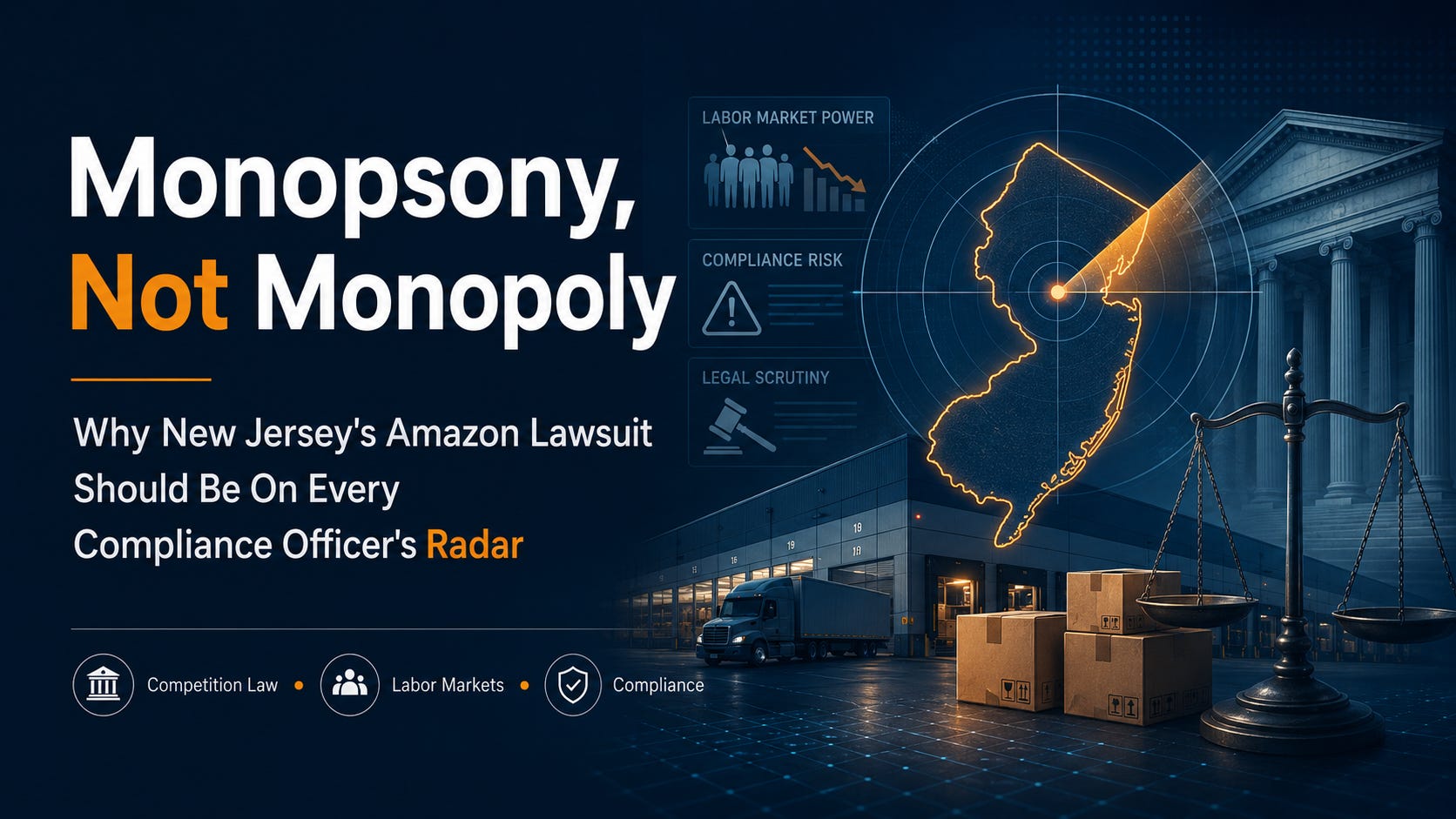
We all learned about monopolies at some point in our education — one seller, too much power, prices go up, consumers get squeezed. It’s intuitive. It’s the antitrust story we’ve heard a hundred times, from Standard Oil to Big Tech breakup headlines.
Monopsony flips the direction of the analysis. Instead of examining seller-side power over customers, it examines buyer-side power over workers, suppliers, or service providers. In a labor market, employers are the buyers and workers are the sellers. The concern is not necessarily that only one buyer exists, but that a buyer has enough market power to suppress compensation, mobility, or working conditions below competitive levels.
It’s a less familiar theory, but not a new one in economics. What’s new is a state attorney general building an entire enforcement action around it. New Jersey filed the complaint on August 4, 2026, and the Attorney General’s office and current reporting describe it as the first state case of this kind.
Attorney General Jennifer Davenport’s complaint, filed today in U.S. District Court, centers on Amazon’s Delivery Service Partner (DSP) program — the network of small, nominally independent companies that hire drivers to handle last-mile deliveries. The state alleges that while Amazon calls these companies independent businesses, it actually controls the substance of how they operate: routes, driver performance standards, hiring practices, uniforms, software, and delivery vehicles, with AI and in-vehicle cameras layered on top for monitoring.
The complaint’s monopsony theory goes beyond a single restriction. New Jersey alleges that Amazon used its position as the dominant purchaser of DSP delivery services to dictate rates and operating conditions, while also restricting competition among DSPs for drivers. Together, the state argues, those practices suppressed competition at both levels of the delivery network; Amazon’s power over the DSP businesses themselves, and the DSPs’ resulting lack of power over their own drivers.
Specifically, New Jersey alleges that Amazon restricted DSPs from recruiting or soliciting one another’s drivers, limiting competition for their labor and making it harder for drivers to use competing offers to improve their pay or working conditions. That’s a meaningfully different claim than saying drivers were legally barred from applying elsewhere, but as DOJ and FTC guidance has noted, an agreement not to recruit or solicit another company’s workers can still raise antitrust concerns even when those workers remain technically free to apply on their own.
The complaint further alleges that Amazon responded to suspected union organizing with intimidation and retaliatory route reallocation including, in one cited incident, deploying drones around a facility where drivers were organizing and that in another instance Amazon ended a DSP’s operation at a facility following organizing activity, causing that operation to close and a number of drivers to lose their jobs. Amazon denies the allegations and says DSP employees are free to choose their employer and associate with whom they want.
The complaint also alleges a human cost to the pay and control structure it describes including drivers reporting they’ve resorted to urinating in bottles inside their vehicles to keep pace with delivery metrics, alongside higher rates of lost-time injuries. That detail is worth investigating regardless of how the legal claims resolve: it’s a reminder that performance-metric design isn’t just an operations question, it’s a working-conditions question, and eventually a legal-exposure question.
Legally, the complaint alleges violations of both Section 1 and Section 2 of the federal Sherman Antitrust Act, as well as the New Jersey Antitrust Act — meaning the state is pursuing both an unlawful-restraint theory (the no-poach/no-solicit restrictions) and a monopolization theory (the alleged maintenance of monopsony power itself) in the same case. New Jersey is seeking treble damages for the wages drivers would have earned absent the alleged conduct, plus permanent injunctive relief.
Worth noting: this isn’t the AG’s office’s first case against Amazon. It’s the fourth active matter alongside a multistate FTC-joined case over pricing and marketplace competition, a Division on Civil Rights case alleging discriminatory treatment of pregnant workers and workers with disabilities, and a separate misclassification case over the Flex driver program brought with the state Department of Labor. That’s a useful data point on its own: this AG’s office is treating Amazon’s labor and market practices as a sustained, multi-front compliance failure rather than an isolated incident.
Nothing has been proven, and Amazon is contesting both the facts and the legal theory. But regardless of how the case is resolved, the complaint signals a broader enforcement question regulators are increasingly willing to ask: not only “what does the contract call this relationship?” but also “does the structure leave participants with meaningful competitive alternatives?”
Contractor and franchise relationships have traditionally been reviewed primarily through questions of classification, control, and joint-employer responsibility. This case adds another lens: whether the structure of the network also suppresses competition among the businesses and workers operating within it. It’s a distinct legal action from New Jersey’s separate misclassification case over the Flex driver program; different program, different theory, different statute. The DSP case is principally an antitrust matter, not a classification case, even though the underlying facts (who controls what, who bears the economic risk) will look familiar to anyone who’s worked a misclassification analysis.
That structural question is a harder one for compliance and legal teams to answer, because it’s not about your contract language. It’s about your market position. A company doesn’t need to be Amazon-sized to have outsized buyer power over a local or specialized labor pool a single large employer in a small town, a dominant platform in a niche gig category, a hospital system that’s the only major employer for a certain type of clinician within driving distance. Monopsony power scales down more than people assume.
Having significant purchasing power is not, by itself, an antitrust violation. The legal risk arises when an organization allegedly acquires or maintains that power through exclusionary restraints, coordination, retaliation, or other conduct that harms the competitive process. Limited alternatives are a risk indicator — not automatic proof of unlawful monopsony.
If your organization sits at the center of a network of contractors, franchisees, or vendor-employers — even loosely — this is a good moment to ask a few uncomfortable questions:
Do our contracts, operating rules, software, or informal practices restrict recruitment, solicitation, transfers, or movement among participating employers?
Do we centrally influence compensation, staffing, routes, workloads, performance scores, or termination decisions — even when another business is technically the employer?
Are algorithms or shared platforms being used in ways that standardize compensation or employment conditions across businesses that should be competing for workers?
Could a complaint, organizing effort, or request for improved conditions result — intentionally or unintentionally — in reduced work, adverse scoring, contract termination, or some other negative consequence?
None of these questions have a compliance checkbox answer. That’s exactly why they’re worth asking now, before a regulator asks them for you.
The larger compliance lesson is that contractual independence does not necessarily equal competitive independence.
I’ll be watching how this case develops — not just for what it means for Amazon, but for what it signals about where labor-market antitrust enforcement is headed next.
#ComplianceMatters #Antitrust #Monopsony #LaborLaw #EthicalLeadership #AmazonLawsuit #NJAmazon #MonopsonyPower #DeliveryDrivers #StateAntitrust
Thanks for reading Ethical Edge by Evie’s Substack! This post is public so feel free to share it.
No posts
Comments
Nothing yet. Say the first thing.
Sign in to join the conversation.