
I keep coming back to one question every time a company gets caught doing the opposite of what it claims to stand for: if they’ll cut corners here, where else are they cutting them?
Not “are they cutting corners everywhere.” Just — is it reasonable to wonder?
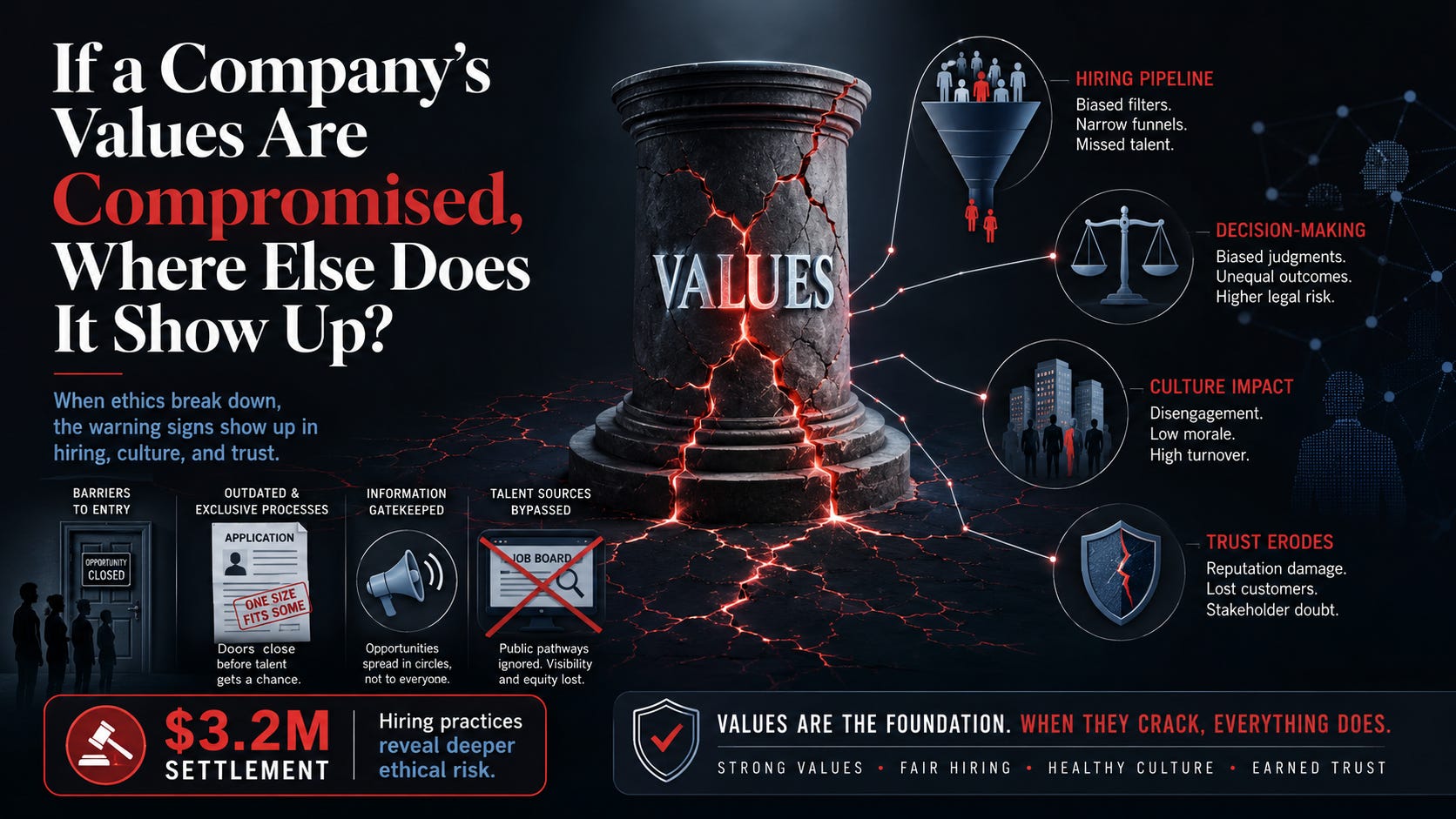
That question got sharper for me last week. OpenAI and its subsidiary Statsig agreed to pay $3.2 million to settle federal claims that they discriminated against U.S. job applicants, allegedly favoring workers on temporary visas and making it genuinely difficult for domestic candidates to even get in the door. The Justice Department’s list of tactics reads almost like satire: requiring paper applications in 2026, running job ads on the radio at odd hours, quietly skipping the external job boards where most people actually look for work. Fewer than ten positions were involved. The settlement was still $3.2 million, because, as the DOJ put it, the number needed to reflect the harm, not just the headcount.
My first reaction: wait, is this the same company whose product half of us use every day? My next reaction: I remembered learning about company values and how they show up in a product they create, in this case AI.
Let me get the caveat out of the way, because I think it matters more than the provocative part.
I have no evidence that OpenAI’s models are built with any kind of parallel bias. I don’t know who’s in the room when training data gets curated, or how alignment decisions actually get made, and neither does pretty much anyone outside that building. So I’m not going to write the version of this piece that says “their hiring practices prove something about their product,” because it doesn’t. That’s a leap dressed up as a finding, and I don’t think that kind of leap holds up, or deserves to.
What I am comfortable doing is asking the question honestly, out loud, and being upfront about where the evidence stops and the speculation starts.
Here’s the thing about organizational culture and I’ve spent close to twenty years inside it, in compliance roles where you learn pretty fast that a mission statement and a company’s actual behavior can be two very different documents.
Culture isn’t really what’s printed on the careers page. It’s the sum of a thousand small decisions made when nobody outside is watching. Whether a manager reports a near-miss or buries it. Whether a recruiter posts a job where people will actually see it, or where they won’t. Whether “we value transparency” survives contact with a deadline.
Those instincts don’t usually stay quarantined in one department. A company that treats fair process as optional in hiring isn’t obviously the same company that treats it as sacred in engineering. I’m not saying it’s impossible, organizations are messy, and plenty of them really do have pockets of integrity next to pockets of rot. But the version where the rot is neatly contained to HR and nowhere else? That’s the harder story to tell, not the easier one.
So no, the settlement doesn’t prove anything about how OpenAI builds its models. But the instinct to wonder isn’t paranoia. It’s pattern recognition, and pattern recognition is most of what compliance work actually is.
I think pieces like this owe readers some honesty about what it would actually take to move this from a hunch to a fact, otherwise it’s not analysis, it’s just innuendo with better vocabulary.
We’d need real visibility into who shapes training data and alignment decisions, and whether that process shows the same disregard for fairness the hiring settlement describes. We’d need reproducible bias in actual outputs, something you could point to, not just a feeling. We’d need more than one incident, frankly, because right now this is a single settlement involving a handful of jobs, not a pattern. And ideally, we’d hear from people who’ve actually been inside the building.
None of that exists publicly right now. What exists is one enforcement action, in one function, about ten positions. That’s real and worth taking seriously on its own terms, it just isn’t evidence about the product, and I’m not going to pretend otherwise to make the article land harder.
Here’s where I land, and where this actually connects to the work I do every day.
You don’t need proof of technical bias to justify a closer look at a vendor. You need evidence that an organization is willing to say one thing and do another and OpenAI just handed regulators exactly that, in writing. That’s not a smoking gun for the product. It’s a risk signal, and risk signals are how due diligence is supposed to work. You don’t wait for the worst-case scenario to be confirmed before you start asking questions. You ask because the confirmation, if it ever comes, tends to come too late to matter.
In the AI governance work I do with clients, vendor due diligence was never just “does the tool work.” It’s “does this company’s conduct match what it tells the world about itself, and if not, where else might that gap be hiding?” A hiring discrimination settlement doesn’t answer that question about a company’s product but it absolutely belongs in the file. It’s exactly the kind of thing that should move a vendor from “trusted by default” to “worth a second conversation.” Not because we’ve proven the worst. Because we haven’t ruled it out, and I’d rather my clients ask the uncomfortable question early than find out later they should have.
If you use OpenAI’s tools, or anyone’s, and you’ve never actually asked what the company behind them means when it says it’s aligned with its values, this is as good a nudge as you’ll get. I can’t tell you what you’d find if you looked. Honestly, neither can anyone outside that building. And that gap, the fact that we’re all relying on tools built by organizations we can’t fully see inside of is the real story here. Not a hidden bias I’ve uncovered. A question we don’t currently have the means to answer, about technology most of us use without a second thought.
That should probably bother us just as much as a confirmed answer would.
Evie Wentink is the Founder and Principal Consultant of Ethical Edge Experts LLC, where she helps organizations build integrity into how they hire, lead, and deploy technology — not just how they talk about it.
No posts
Comments
Nothing yet. Say the first thing.
Sign in to join the conversation.