
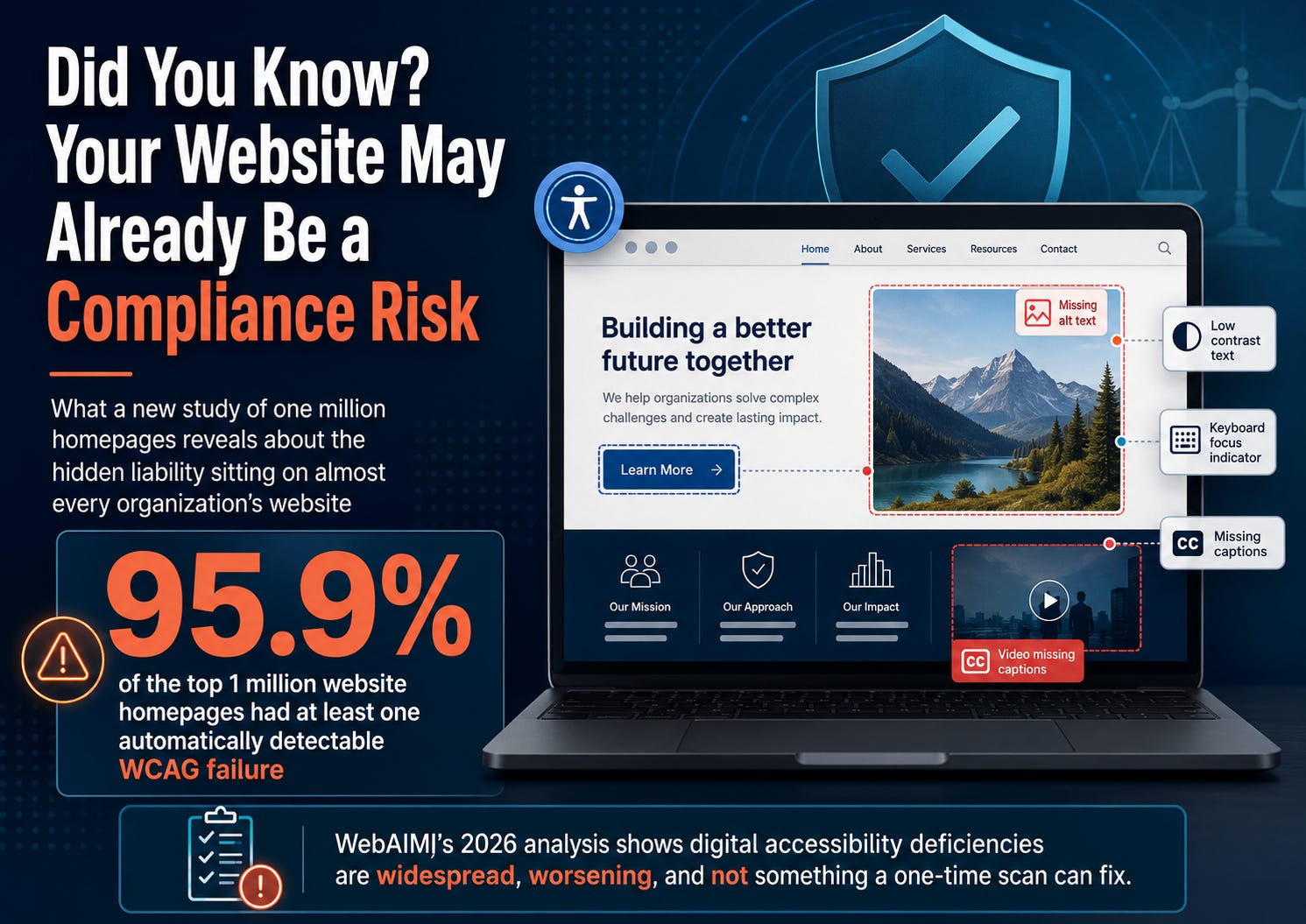
There’s a number floating around accessibility circles right now that’s worth sitting with: 95.9%.
That’s the share of homepages — out of one million tested — that had at least one automatically detectable accessibility failure under WCAG (the Web Content Accessibility Guidelines), according to WebAIM’s 2026 Million study. Not 95.9% of “bad” websites. Not 95.9% of small businesses that never thought about accessibility. Ninety-five point nine percent of the biggest, most visited sites on the internet.
And it’s getting worse, not better. In 2025, the figure was 94.8%. For years, WebAIM had recorded small, steady improvements. This year reversed that trend.
If you run a website — a business, a nonprofit, a municipality, a school district — this number probably applies to you too. The question isn’t really “does my site have accessibility problems?” Statistically, it almost certainly does. The real questions are: how serious are they, who’s responsible for fixing them, and what happens if nobody is?
Big statistics like this one get misused constantly, usually in one of two directions. Either they get inflated (”95.9% of businesses are breaking the law!”) or dismissed (”it’s just an automated scan, it doesn’t really count”). Neither is accurate, and the truth is more useful than either extreme.
Here’s what WebAIM actually did: they ran automated testing (their WAVE tool) across the homepages — just the homepage, not the whole site — of the top one million websites. That’s it. One page per site, checked for the kinds of errors software can reliably detect.
That means the study:
Did not test every page, PDF, video, or form on a site — just the front door
Did not catch everything a human tester would catch (keyboard navigation, screen-reader usability, caption accuracy — these need people, not just software)
Did not distinguish between a site with one minor contrast issue and a site with hundreds of serious barriers
So the honest reading isn’t “95.9% of organizations are legally noncompliant.” It’s something more like: automated tools alone are turning up detectable problems on almost every major website, and the actual scope of inaccessibility is likely larger, since automated tools can’t see everything.
That’s not a smaller problem. It’s a differently-shaped one.
Here’s the finding I think matters most, and it rarely makes the headline. The average homepage in 2026 contained 1,437 individual page elements — a 22.5% jump in just one year. WebAIM’s data links that growing complexity, along with the spread of third-party scripts, frameworks, and ARIA code, to more accessibility errors, not fewer.
In other words: accessibility failures usually aren’t the result of anyone deciding to exclude people. They’re the result of ordinary organizational entropy — a new vendor widget here, a marketing team upload there, a redesign that nobody accessibility-checked, a plugin nobody remembers installing. Nobody “did” this. It just accumulated, the way clutter accumulates in a house where everyone assumes someone else is tidying up.
Which means the fix isn’t a one-time scan. It’s governance — an actual owner, a process, a standard that survives staff turnover and vendor changes.
Comments
Nothing yet. Say the first thing.
Sign in to join the conversation.