
One thing that’s hard about my academic life is that my closest peers, colleagues and friends are not the people I see on a regular basis. I consider Emily Langerholc to be a great friend and progressive music ed comrade in arms, and I think I’ve been in a room with her, what, five times total?
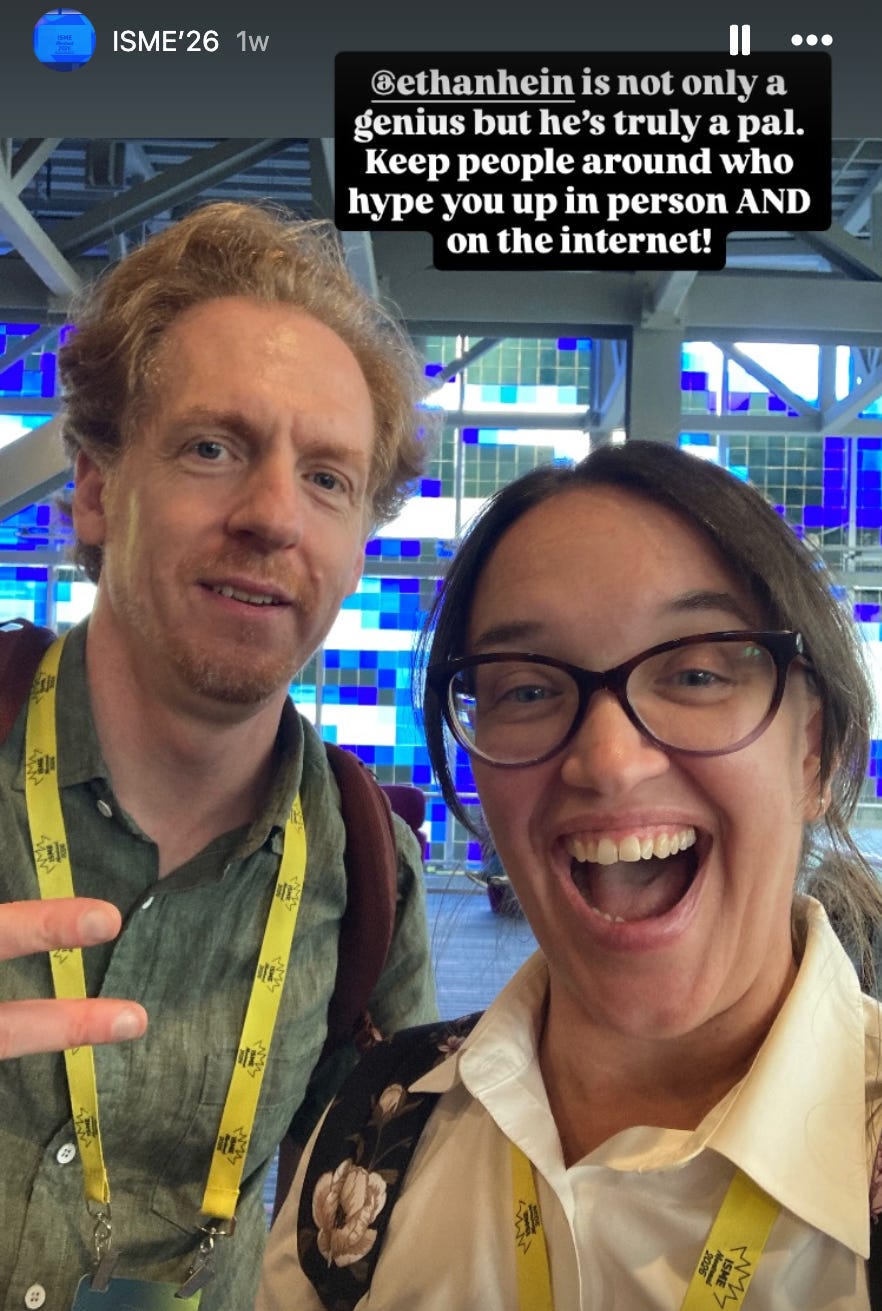
There were people at the ISME conference who I have been quoting and citing for ten years who I had never met face to face. It’s strange to have so much intense intellectual engagement with people who you never see in person. Sometimes I have social media relationships, or emails, or Zoom calls, but other times it’s really just in formal writing. And then getting to be in a room with them is such a rush, all the latent friendship just comes welling up and rushing out.
Anyway: I went to a session with Clint Randles where he described music teachers (especially songwriting teachers) as spiritual leaders. People might push back on the word “spiritual”, but Clint doesn’t mean anything supernatural. When he says spiritual, he means the social and emotional experience of flow, ego dissolution, transcendence etc. I’m sure plenty of people would describe these kinds of musical experiences in supernatural terms and more power to them, but the same practical approaches apply if, like me, you prefer to keep things secular.
I went to a panel on pop music pedagogy in elementary general music, featuring Martina Vasil, Brent Gault, Bryan Powell, Emily Langerholc, Tiger Robison, Sandy Adorno, Tiger Robison and Lauren Richerme. This was very much preaching to the choir for me, but it’s nice to be validated. I need another lifetime to learn to study early childhood music learning beside whatever I figured out through trial and error with my own kids.
The big motivator for pop music pedagogy is the fact that in the US, among high school kids who have elective access to school music, 80% of them do not elect to do it. That 80% includes me. Bryan Powell’s hypothesis is that kids get turned off from school music long before high school. My experience supports this hypothesis. I felt pretty positively about elementary general music, but middle school is where they lost me. I thought the showtunes we were doing in choir were cringe-y, and the classical rep we were doing in orchestra was boring. So the common sense solution might be, how about cooler repertoire that the kids relate to more? This is not easily implemented though! You have to deal with copyright, inappropriate lyrics, and teachers’ own preferences and cultural competencies. Sandy Adorno tells the story of walking into a Florida classroom prepared with recorders and “Hot Cross Buns” and the kids are all about reggaeton, so... then what.
The Kodályi method is a wonderful pedagogical approach, but it mostly uses European-descended folk songs that are hard to connect to. Kodályi himself used folk songs that were familiar to the Hungarian kids he was working with as a way to resist Austrian cultural hegemony. In the present-day US, however, folk songs don’t serve the same cultural role, because they aren’t necessarily familiar. Kodályi would presumably suggest that we pivot to meet the American kids closer to where they live. Pop music suits the Kodályi method perfectly, because it has repetitive ostinatos, approachable harmony, and nice clear formal sections. I bet you could do an amazing elementary music curriculum just using Talking Heads, Tom Tom Club and David Byrne songs. Lots of groovy ostinatos and cheerfully nonsensical lyrics.
Right now the approach in elementary music ed tends to be, “I need to teach sol-mi, let’s find a song to teach that”. Martina Vasil wants us to think, “Here’s a song that means something to the kids, what musical concepts can I use it to teach?” The point is not to just do music that the kids know already; the point is to build bridges to unfamiliar music. But the bridge has to start with the familiar.
Samples are such an excellent bridge from the familiar to the unfamiliar/historical. Emily suggests “Someone to Call My Love” by Janet Jackson, which had a moment on Tiktok recently and which quotes Erik Satie. “Everybody Wants to Rule the World” by Tears for Fears is a great song for teaching cross-rhythm, and Gen Alpha knows it well from a deeply accursed YouTube video whose name I will not utter here.
With pop from the past couple of decades, even when you get clean versions of songs, there can still be a a lot of innuendo. To me, there’s a simple solution: get instrumentals and write new lyrics, or better, yet have the kids do it. Gen Alpha loves Weird Al.
Emily Langerholc advocates Universal Design for Learning, which is always a good idea, because when you make something accessible for one student population you end up making it better for everyone. The classic example being widespread closed captioning, which were meant for deaf people but ended up benefiting everyone because now you can easily watch video with the sound off. So yeah, you want multiple means of engagement with students and multiple means of support. Again this does not just benefit the neurodivergent kids or whatever, it ends up improving the experience for all of them.
Emily likes to provide context for songs, but she observes sadly that she teaches in Florida, where context is illegal. I wish that was a joke.
Comments
Nothing yet. Say the first thing.
Sign in to join the conversation.