
Hi Everyone!
It’s Conor here from Outer Beach Conor and I’m back with a February 2026 launch update.
We’re looking at all of the ETF launches in the US during the month.
I’ll be putting my opinion on each launch while also singling a few funds out to take a deeper dive on and explain my reasoning.
The goal is to segment them by what version of helpful to the market I think they are.
But first, here’s a new fact.
As of March 5, 2026, ETF flows in Q1 have reached $351B, already making it the best first quarter on record and the fourth-largest quarter ever, with 18 trading days still to go. The all-time record remains Q4, when flows hit $565B.
Here are my metrics:
👍Good: Anything that may already exist in another form but is an honest attempt at reskinning the cat. Largely investor-positive.
🤔We’ll See?: May not exist yet, either as an asset type, strategy, or anything else in ETF format. Can be quite investor-positive. Requires analysis.
👎Bad: A fund that plays on an existing asset or strategy but without a value-add, sometimes with a value loss. Leveraged products, income products, high expense versions of existing product types with no discernible add-on. Almost always benefits the issuer instead of the investor.
Keep in mind that everything in here is just my opinion.
I’m happy to hear all challenges to my assigned ratings in the comments or via DM.

Breakdown:
For February, I ended up with the following results:
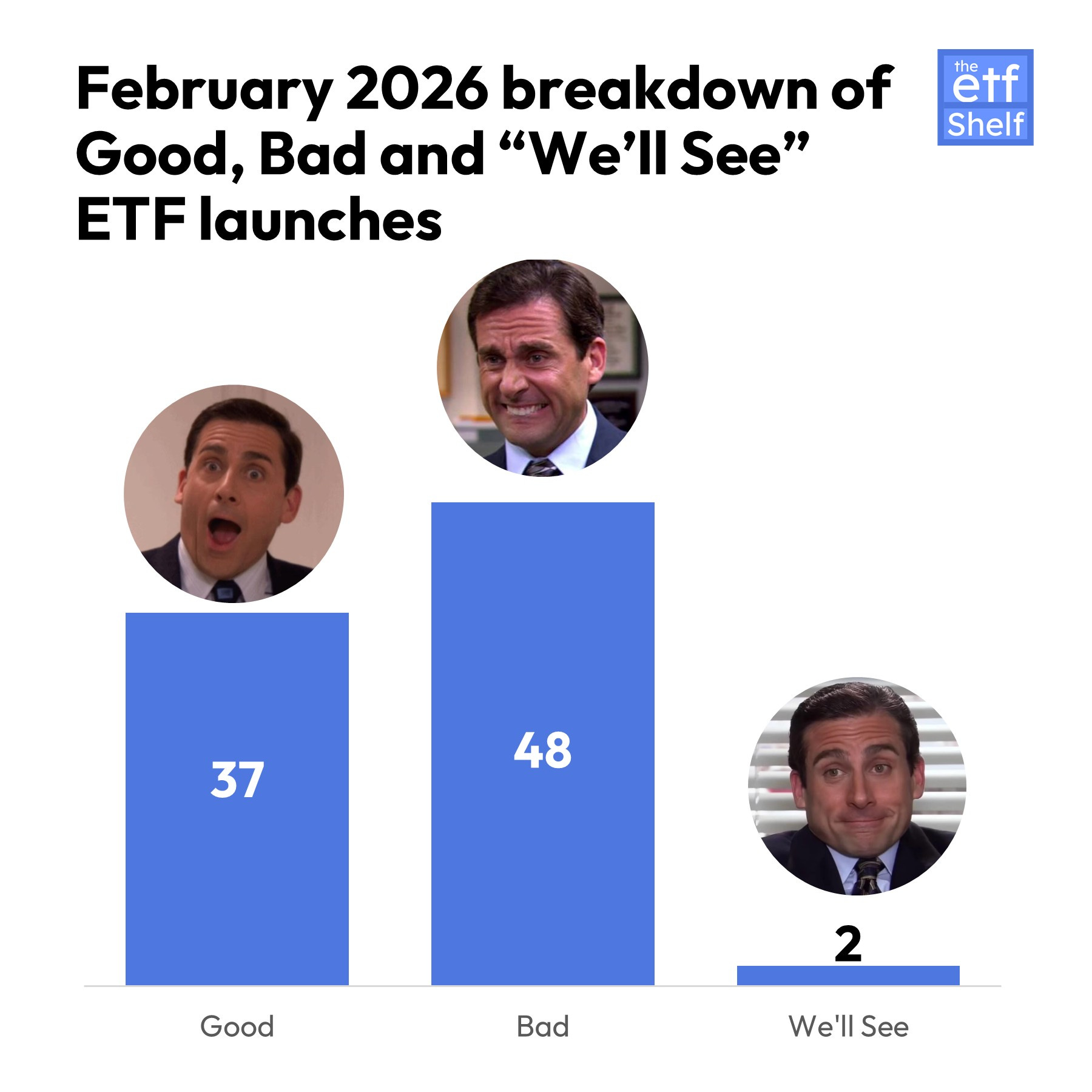
February had 87 launches, another healthy month but still down from the staggering levels of launches we saw in late 2025.
That said, there have been immense amounts of filings for new leveraged strategies utilizing 3x to 5x exposures to everything from single stocks to baskets. If those pass muster with the SEC, we’ll be looking at 400+ new funds just from those.
We also have a glut of filings from some new issuers set to go effect in March/April/May so stay tuned!
Note: the table that labels all the launches as Good, Bad or “We’ll see” will be added here soon.

We have a solid roster of Good products this month.
A lot of dual directional buffer products from FT and Innovator which, while expensive, are a good style for folks wanting downside protection from trusted brands.
A whole slew of fixed income products including a suite of high yield target maturity ETFs from State Street.
I’m a fan of these products, like the State Street My2027 High Yield Corporate Bond ETF (MYHA) as they allow investors and advisors to build their own bespoke maturity ladders and structures.
For 39 bps apiece, you can build it how you want it!
Another hat tip to the CLO products launching, particularly the Reckoner lineup additions. Reckoner Yield Enhanced AAA CLO Annual ETF (RAAY) is a 50% leveraged CLO product but this is NOT like equity leveraged products.
This leveraged is built via reverse repurchase agreements and is a constant leverage not a daily or weekly reset.
There is no volatility drag and these can be held long-term much more consistently than equity leverage products. Not a recommendation but these are worth researching!
More building blocks launched as well, Invesco launched Invesco Agency MBS ETF (IMTG). There were some sector-based launch and a bunch of dividend products from stalwart issuers like Virtus and First Trust.
I think it’s worth highlighting a few issuers pushing very reasonable income target funds.
As we’ve discussed I think funds offering unreasonable “income” returns up to 100% are scary and they don’t perform as advertised.
Global X launched Global X Nasdaq-100 Income Edge ETF (EDGQ) with a gross expense ratio of 53 basis points and a net expense ratio of 0% (*The fee waiver is contractual and in effect until at least March 1, 2027). The fund targets a 13% annual distribution rate on top of the equity returns generated by the remaining portion of the portfolio.
While Roundhill has a few products I don’t think are Good, they did launch the Roundhill S&P 500 Target 10 Managed Distribution ETF (TPAY) which targets a 10% annual return for 49 bps.
I’m hoping the “income” products skew further and further towards these much more reasonable and achievable distribution targets that can have real portfolio value for investors instead of some of the NAV eroding tax bombs that are in the market.
48 Bad funds launched this month, our lowest in quite awhile. That’s mostly due to a lower cadence of leveraged and inverse fund launches in the early part of the year.
18 of them launched this month, ranging from 75 bps to 149 bps(!).
These products have their place, but it isn’t for me to help promote them to your average newbie retail investor.
These require a lot more nuance and understanding to utilize in a safe and manageable way so they’ll always be in the Bad bucket in this monthly coverage.
That said… 149 bps is REALLY expensive, c’mon TRADR.

There are some other notable bones to pick in my list of Bad funds.
FINQ (no idea who they are) launched the FINQ DOLLAR NEUTRAL U.S. Large Cap AI-Managed Equity ETF (AINT) with a 125bp ER.
That ticker is correct because I ain’t getting what they’re selling here.
There’s a “regular” version for 70bps too but both of these purport to “use a proprietary, fully autonomous artificial intelligence framework developed by FINQ AI LLC to generate daily, model-based relative rankings of all 500 Index constituents.” I… don’t really think this is worth the fee.
Maybe I’m wrong but trusting Claude to stock pick doesn’t seem like a great idea if it’s going to cost MORE than most any other large cap product. Isn’t the point of AI to drive costs down?!
GraniteShares launched some single stock autocallable products on NVDA and TSLA, GraniteShares Autocallable NVDA ETF (ANV) and GraniteShares Autocallable TSLA ETF (TLA) respectively.
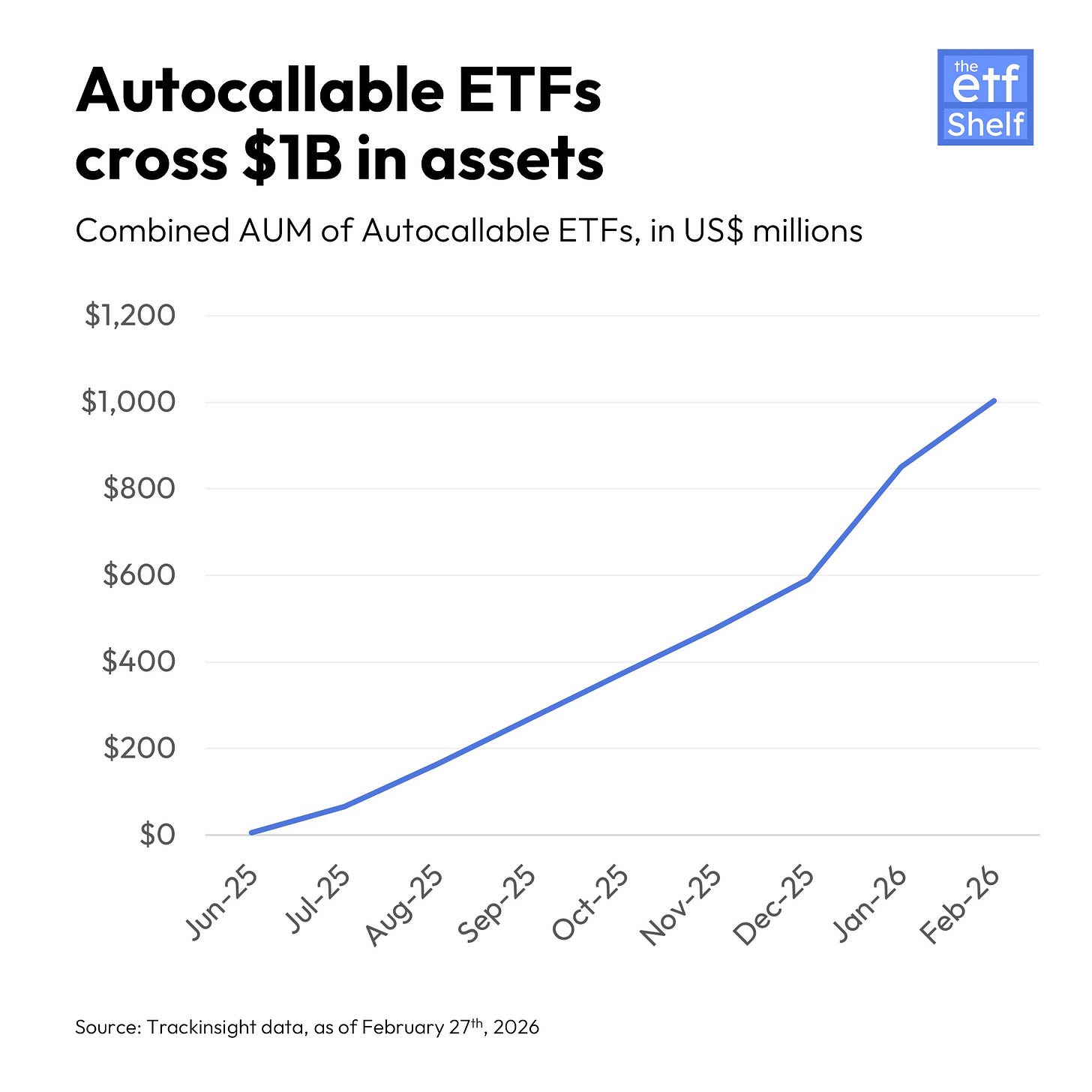
I’m not sure I can get on board with these versions yet. They’re also expensive at 107bps for products that are meant to be held long-term.
They’re also significantly more risky than the basket versions, even on something like QQQ. Gonna be a Bad tag from me until we see how they perform over time.
My last specific call out will be aimed at Tuttle Capital.
They launched Tuttle Capital UFO Disclosure ETF (UFOD) which is one of my favorite thematic topics I’ve seen put into ETF format.
The problem? They’re charging 99 bps for it.
That’s probably more than double what it should be and will hamper uptake. I wish it had been priced appropriately because it’s a really fun thesis. Swing and a miss!
My last general Bad commentary is that there are a LOT of active equity products launching with almost a copy-paste investment thesis that they do top-down and bottom-up analysis and build a basket, etc.
There is a such a high likelihood that they will underperform their benchmarks that I can’t jibe with any of them.
If the cost is low enough they may be worth a look but for 50+bps for a US equity product I just don’t see the value.
Two entries I’m excited to talk about this month.
First is the Pictet AI Enhanced US Equity ETF (PQUS).
I complained above about a somewhat similar product from another charging 70 bps! This ETF from Pictet offers what amounts to the same thing for 22bps.
At that price point I think it’s worth a deeper look. I’ll quote directly from their prospectus:
“Artificial intelligence refers, in this case, to the application of computer systems or models to perform tasks that typically require human intelligence. The artificial intelligence model uses 250+ features engineered from a broad range of data such as fundamentals, analyst sentiment, prices and market activity, short interest and calendar effects to make relative forecasts of the stocks of the Index. These are regularly updated and combined in a proprietary optimizer with risk and control estimates and constraints on position sizing. The Adviser reviews the output of the optimizer, which drives both buy/sell recommendations during implementation of the desired portfolio. These buy/sell recommendations are then reviewed and approved by the portfolio managers before purchases and sales are executed. “
This is pretty cool.
The prospectus also calls out and specifies that the fund uses ESG data in their analytics.
They exclude issuers that invest in and practice thermal coal extraction and nuclear weapon development.
I’d say that’s a pretty solid factor but no judgement.
I think we’re at the precipice of these funds becoming increasingly common and hopefully the price starting to match and undercut their analog brethren.
The next fund I want to zoom in on is the ProShares GENIUS Money Market ETF (IQMM).
This is a GENIUS act compliant Money Market fund that conforms to the standards being set out to back stablecoin reserves.
I’m not the biggest crypto wonk but I know that the crypto to traditional finance rails getting built are going to be heavily utilized.
By positioning themselves ahead of time to suit investor needs I think they’ve done themselves a pretty good turn.
The holdings are boring, just short term US Treasuries but being first out of the gate with a fully compliant product tends to benefit the issuer (Just ask IBIT).
So we’ll see how they fare as this legislation moves through and builds regulatory certainty around new asset classes.
Hat tip to ProShares!
I’ll try to keep a cadence of these going every month.
If you’d like to see me take a look at anything in particular, please comment.
I’m happy to dive into any ETF product that you’d like to see.
This newsletter is for informational purposes only and is not financial advice. The opinions expressed by any author or co-author are strictly their own and do not necessarily reflect the views of the publisher. We do not guarantee the accuracy of the information or calculations provided. It is essential to consult a qualified financial advisor before making any investment decisions. We are not responsible for any errors or omissions in the data. Investing in ETFs or any financial instrument involves risk, and you should conduct your own research. Past performance does not guarantee future results. By subscribing to this newsletter, you agree to these terms and conditions.
Comments
Nothing yet. Say the first thing.
Sign in to join the conversation.