
Combined monthly trading volume on Kalshi and Polymarket climbed from under $5 billion in September 2025 to about $24 billion by April 2026. Americans wagered roughly $14 billion per month through legal sportsbooks on average in 2025.
Prediction markets now move more money than the entire legal sports betting industry.
Retail investors can trade on these platforms easily enough. The companies operating them are private, which has kept ownership out of reach.
That changed in July. The ERShares Private-Public Crossover ETF XOVR 0.00%↑ committed $30 million to Kalshi, the largest US prediction market exchange, as part of its latest rebalance.

See the XOVR fund page HERE
Kalshi operates a CFTC-regulated exchange for event contracts.
Users trade contracts tied to whether a specific outcome occurs. Election results, economic data releases, weather, sports, and cultural events all carry listed markets. Each contract settles between $0 and $1, so the price functions as a live, market-set probability.

Growth has been steep. Kalshi recorded more than $31 billion in notional volume during June, up over 70% from May, with the FIFA World Cup driving most of the surge. Through the tournament final, the exchange accounted for roughly 83% of notional volume across CFTC-approved venues. Sports contracts make up more than 80% of its activity.
Investors have priced that trajectory aggressively. Kalshi carried a $2 billion valuation in June 2025. By May 2026 the company had raised another $1 billion at a $22 billion valuation in a round led by Coatue Management, roughly an elevenfold increase in under a year. Reports since have pointed to talks near $40 billion.
One detail matters for anyone holding this through an ETF. CEO Tarek Mansour has said an IPO will not happen before 2027.
Kalshi also operates in a contested legal environment. Several states have moved to apply their gambling laws to sports event contracts, the CFTC has sued to block those efforts, and a federal appeals court recently sided with the federal preemption argument in a ruling that could eventually reach the Supreme Court. How that resolves affects the majority of Kalshi’s volume.
The Kalshi position gets the headline. Two public holdings put considerably more prediction market exposure in the fund.
As of July 17, 2026, XOVR holds Robinhood HOOD 0.00%↑at about 3.5% of the portfolio and DraftKings DKNG 0.00%↑ at about 1.2%. Added to Kalshi, prediction market exposure across the fund runs near 6%.
Robinhood has been Kalshi’s largest distribution channel, with analysts estimating its users drove a quarter to a third of exchange volume on a shared two-cent-per-contract fee. It has since bought a CFTC-licensed exchange and clearinghouse with Susquehanna.
DraftKings launched its own exchange, DKeX, on June 26, built on a license it obtained by buying Railbird Technologies in October 2025.
Mansour has publicly named CME Group, Robinhood, and DraftKings as Kalshi’s real competition.
So XOVR owns the leading exchange alongside two of the companies chasing it, with Robinhood playing both parts as Kalshi’s biggest customer and a future rival.
For a shareholder, that spreads the bet across three business models, and the competitive fight lands inside the portfolio either way.
XOVR reaches both private positions through special purpose vehicles, separate legal entities that hold the economic interest in the underlying company. Shareholders own a percentage of the SPV, which delivers exposure without direct share ownership.
The ownership differs between the two. SpaceX exposure comes through a third-party SPV that XOVR invests into. Kalshi shares sit inside Kalshi SPV LLC, a vehicle wholly owned by the fund itself.
As of July 17, 2026, the private sleeve runs near 16.4% of the fund. SpaceX accounts for about 14.7%, Kalshi about 1.6%, and Anduril about 0.2%.
The traditional limit on illiquid private exposure inside an ETF is 15%. XOVR participates in a liquidity arrangement that reclassified the SpaceX position away from illiquid status, which allows the fund to operate above that threshold while maintaining daily liquidity.
Private positions carry no quoted market price, so the fund marks them at fair value under board-approved procedures. The assigned value may differ materially from what a position eventually realizes.
ERShares has run this playbook once already.
XOVR returned about 27.5% in the second quarter of 2026 and about 5.3% during June, a month when the S&P 500, the Nasdaq-100, and the Russell 1000 Growth Index all declined by as much as about 2.7%.
The SpaceX SPCX 0.00%↑ position drove it. ERShares reports the holding contributed more than $135 million in unrealized appreciation across the quarter, with roughly $84 million arriving in June alone. The firm’s internal attribution analysis puts that at about 75% of the fund’s total monthly return.
Assets followed. XOVR grew from roughly $400 million at the end of March to approximately $2.2 billion by quarter end.
The fund also did something unusual in the week before the IPO. As investors piled in for SpaceX exposure, XOVR began rejecting new creation orders, turning away what management estimates was more than $1 billion in potential inflows along with the fee revenue attached.
The reason was dilution. New cash spreads a fixed private position across more shares, thinning what existing holders own. XOVR entered the IPO with roughly 14% SpaceX exposure as a result.
That history matters for Kalshi. If the position ever reaches its own liquidity event, shareholders already know how this manager handles the pressure.
XOVR operates as a growth allocation with a feature that broad index funds cannot replicate.
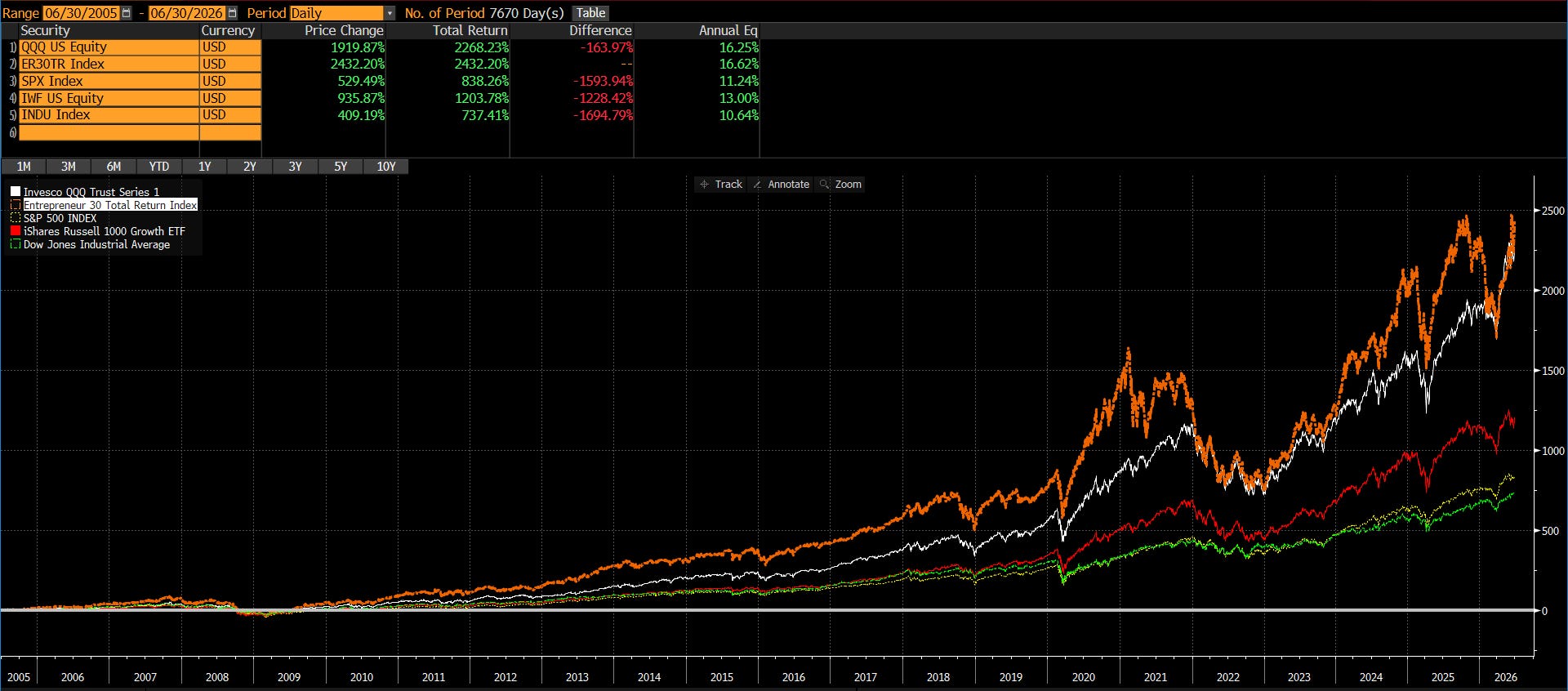
The public side is anchored by the Entrepreneur 30 Total Return Index, ER30TR, a proprietary framework with a 21-year track record independently calculated by LSEG.
From June 2005 through June 2026, ER30TR delivered a total return near 2,432%, or roughly 16.6% annualized. The Invesco QQQ Trust QQQ 0.00%↑ came closest over the same window at about 2,268%, or roughly 16.3% annualized.
Most large-cap growth funds concentrate heavily in the same handful of mega-cap names. An investor holding a total market fund alongside a dedicated growth fund frequently owns those companies twice.
XOVR screens for entrepreneur-led businesses and adds private-market exposure that a cap-weighted index cannot hold by design.
The SpaceX position ran the full course. It moved through fair-value marks, absorbed a period of extreme asset growth, and reached a public listing with shareholder exposure intact.
The next several years decide whether that path can be walked twice.
Kalshi has no listing date, no scheduled catalyst, and a legal picture still working through the courts. ERShares built XOVR around arriving early and waiting. This is where the waiting starts over.
Stay Connected
For more ETF breakdowns, market commentary, and educational content, follow along on X, Instagram, and YouTube, and subscribe to the Substack for full-length articles delivered straight to the inbox every week. LINK HERE 🔗
And if you are not already subscribed, I do stories like this every week for free. Hit subscribe and you will never miss another one. Thanks!

If you are interested in tracking my CURRENT ETF portfolio, download Blossom Social here, and follow my profile, etf.investments 🤓 (Available in US, Canada & 25+ Countries!)
Disclaimer:
Holdings and weights are as of July 17, 2026. Actual percentages may change and may be higher or lower at the publication date. Q2 2026 return of 27.45% and and June 2026 return of 5.30% are as reported by ERShares. Kalshi valuation figures reflect a $185 million round at a $2 billion valuation in June 2025 and a $1 billion round at a $22 billion valuation in May 2026. Index and fund comparison data covers June 30, 2005 through June 30, 2026, per Bloomberg: ER30TR Index 2,432.20% total return and 16.62% annualized; Invesco QQQ Trust 2,268.23% and 16.25%; iShares Russell 1000 Growth ETF 1,203.78% and 13.00%; S&P 500 838.26% and 11.24%; Dow Jones Industrial Average 737.41% and 10.64%. Index performance does not represent fund performance, and it is not possible to invest directly in an index.
Disclosure: This newsletter is for informational and educational purposes only and does not constitute financial, legal, or professional advice, a solicitation, or a recommendation to buy or sell securities. Content is not tailored to any individual’s financial circumstances, and the authors may hold positions in securities discussed at the time of publication.
Data points referenced are sourced from publicly available filings, the fund’s press releases dated July 6, 2026 and July 13, 2026, the issuer’s website, Bloomberg, and the XOVR holdings disclosure dated July 17, 2026. SpaceX contribution figures, estimated potential inflows, and performance attribution are based on ERShares internal analysis and fund records. All opinions reflect the judgment of the authors at the time of publication and are subject to change without notice. This article was produced in collaboration with ERShares as sponsored content, and any links to external sites are provided for convenience without endorsement. Investors should review the fund’s prospectus before investing, available at entrepreneurshares.com.
Investing involves risk, including potential loss of principal. ETFs carry market and underlying-investment risks, including concentration risk and private investment valuation risk relevant to this fund. Investments in private, non-traded securities involve illiquidity, limited transparency, valuation uncertainty, and the potential for substantial loss. Prediction markets and event contracts are subject to regulatory, legal, market, and adoption risks. Past performance is not indicative of future results, and diversification does not ensure gains or prevent losses. Conduct your own research and consult a licensed financial advisor regarding your situation, risk tolerance, and goals before investing. By engaging with this newsletter, you agree to hold the authors harmless from any outcomes resulting from its use.
Comments
Nothing yet. Say the first thing.
Sign in to join the conversation.