
Texas spent years telling the world it had electricity to spare. On August 3, 2026, the state stopped letting new data centers connect to its grid.
Governor Greg Abbott ordered ERCOT and state regulators to audit every data center waiting in line before any new connection gets approved.
ERCOT had 233 GW of projects sitting in its interconnection queue in January. By early August the governor’s office put that figure at 474 GW, roughly 90% of it tied to data centers.
Those requests add up to roughly five times the electricity Texas uses on its highest demand day on record.
The EIA responded within days, cutting its Texas load growth estimate for 2027 to 6% from 14%. The agency still expects national power demand to rise four years running, a streak the country has not seen since 2007.
PJM, the grid operator covering 13 states and Washington DC, runs capacity auctions that pay generators to guarantee power will be available on the hottest day of the year.
The auction for the 2024/2025 delivery year cleared at $28.92 per megawatt-day. Three cycles later, the 2027/2028 auction cleared at $333.44, an increase of more than 1,000%.
PJM’s independent market monitor tied $6.3 billion of the $16.4 billion in total charges to data centers. That record price still left the grid 6,625 MW short of its own reliability target, the first miss in the capacity market’s 18-year history.
Developers can raise the money for new power projects. Sourcing the hardware has become the harder problem.
Power transformers now average 128 weeks of lead time, close to 2.5 years, and roughly 80% of them arrive from overseas manufacturers. American grid expansion is standing at the back of a global queue.
One caveat belongs here before anyone buys the story whole. PJM’s market monitor traced about $6.2 billion of those capacity costs to data centers that have not been built and may never be, which is why Texas ordered its audit. Joining a queue costs a developer almost nothing.
Somebody has to manufacture the equipment, somebody has to install it, and somebody has to sell the electricity once it flows. Three ETFs carry the same theme across those roles and hand you three very different portfolios.
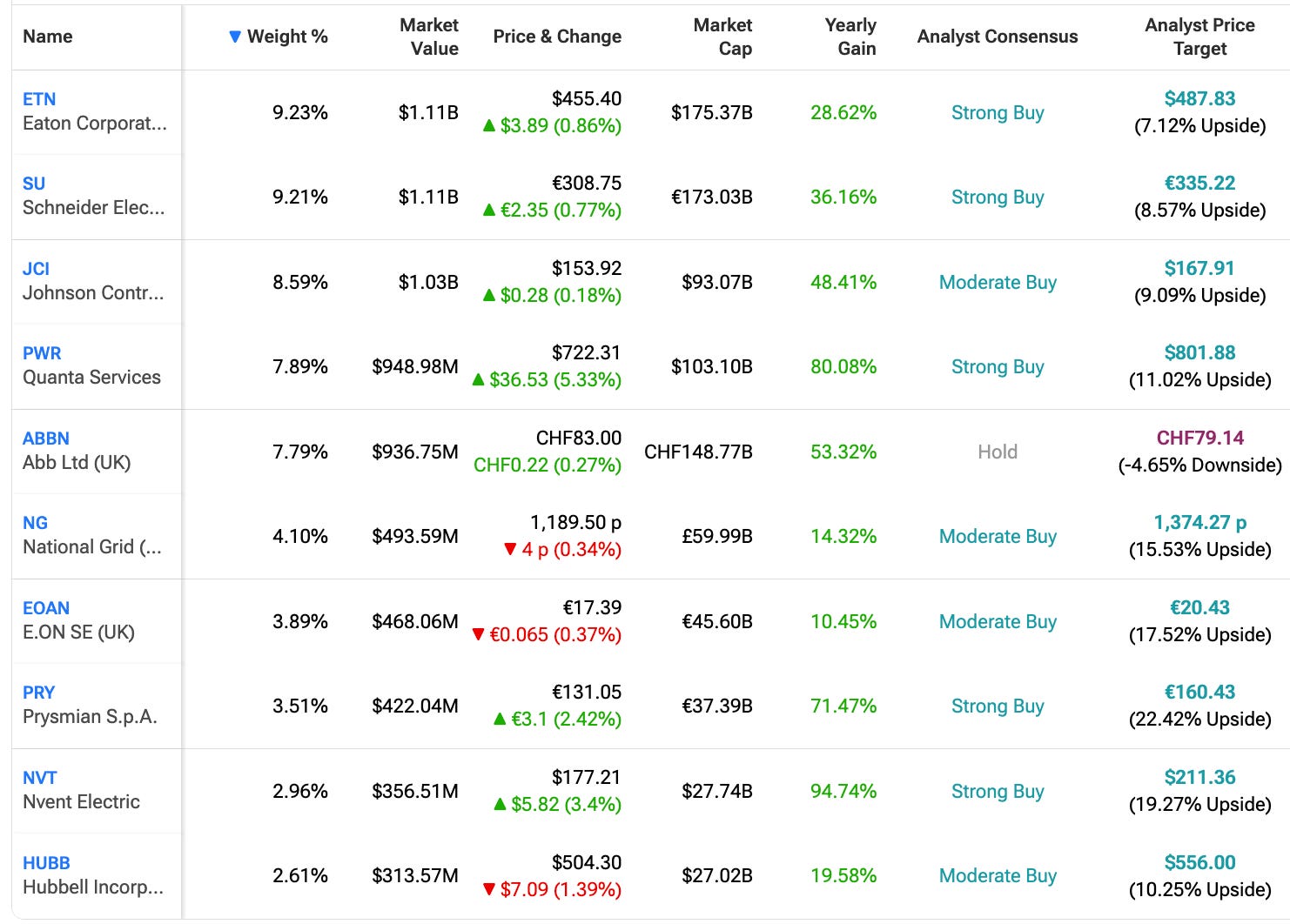
Every one of those 128-week backlogs sits on somebody’s order book. The First Trust Nasdaq Clean Edge Smart Grid Infrastructure ETF, GRID 0.00%↑, owns the companies filling them.
Eaton and Schneider Electric each take up 9.2% of the portfolio, followed by Johnson Controls, ABB and Quanta Services. The fund holds 119 positions and charges 56 basis points.
GRID follows a Nasdaq index that sorts every eligible company into two buckets. Pure play businesses built around grid and electrical infrastructure collectively receive 80% of the weight, while diversified companies carrying grid exposure inside a larger operation split the remaining 20%.
That 80/20 rule is why a fund labeled smart grid still carries 8.4% in multi-utilities and 8.3% in conventional electricity.
Half of the top 10 trades outside the US, including Schneider, ABB, National Grid, E.ON and Prysmian. Those foreign listings bring currency movement into your return.
A transformer does nothing sitting on a loading dock. Installing it pulls in contractors, steel and freight, which is the wider territory the Global X U.S. Infrastructure Development ETF, PAVE 0.00%↑, covers.
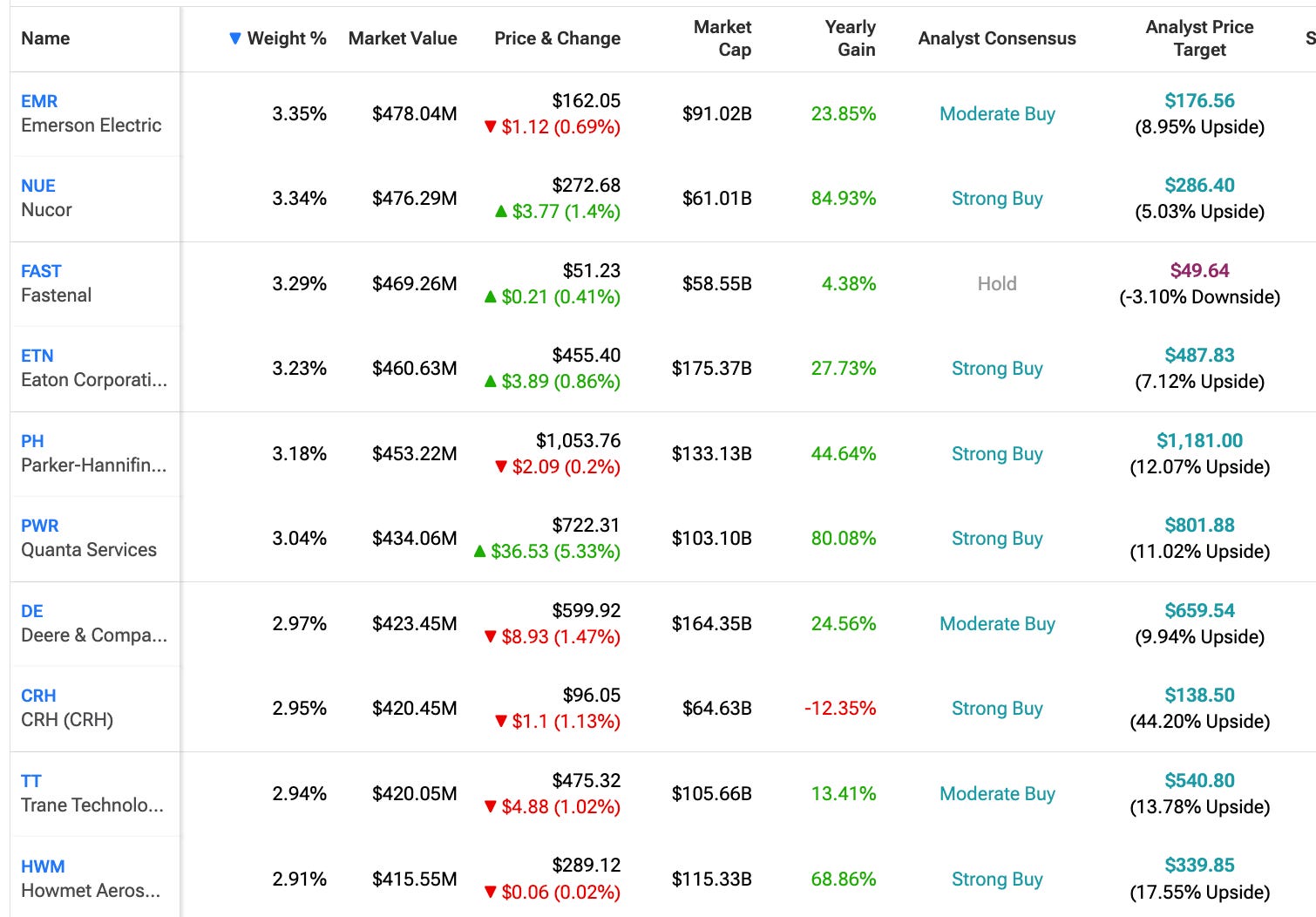
Emerson Electric, Nucor and Fastenal lead the holdings. Industrials make up 71.8% of the fund and materials another 23.4%, leaving utilities at just 3.5%. The fund charges 0.47%.
PAVE tracks the Indxx U.S. Infrastructure Development Index, which selects roughly 100 companies positioned to benefit from rising US infrastructure activity across raw materials, heavy equipment, engineering and construction. No sector cap forces the fund toward balance, so the portfolio drifts toward whichever industries dominate the theme.
Grid exposure arrives through Eaton at 3.23% and Quanta Services at 3.04%. Weights stay clustered near the top, with no position above 3.4%, so no single company drives the fund.
Owning PAVE for the power story means owning steel mills, railroads and fastener distributors in the same position.
On the other side of every capacity auction sits a utility company collecting the check. The Utilities Select Sector SPDR Fund, XLU 0.00%↑ owns the biggest ones.
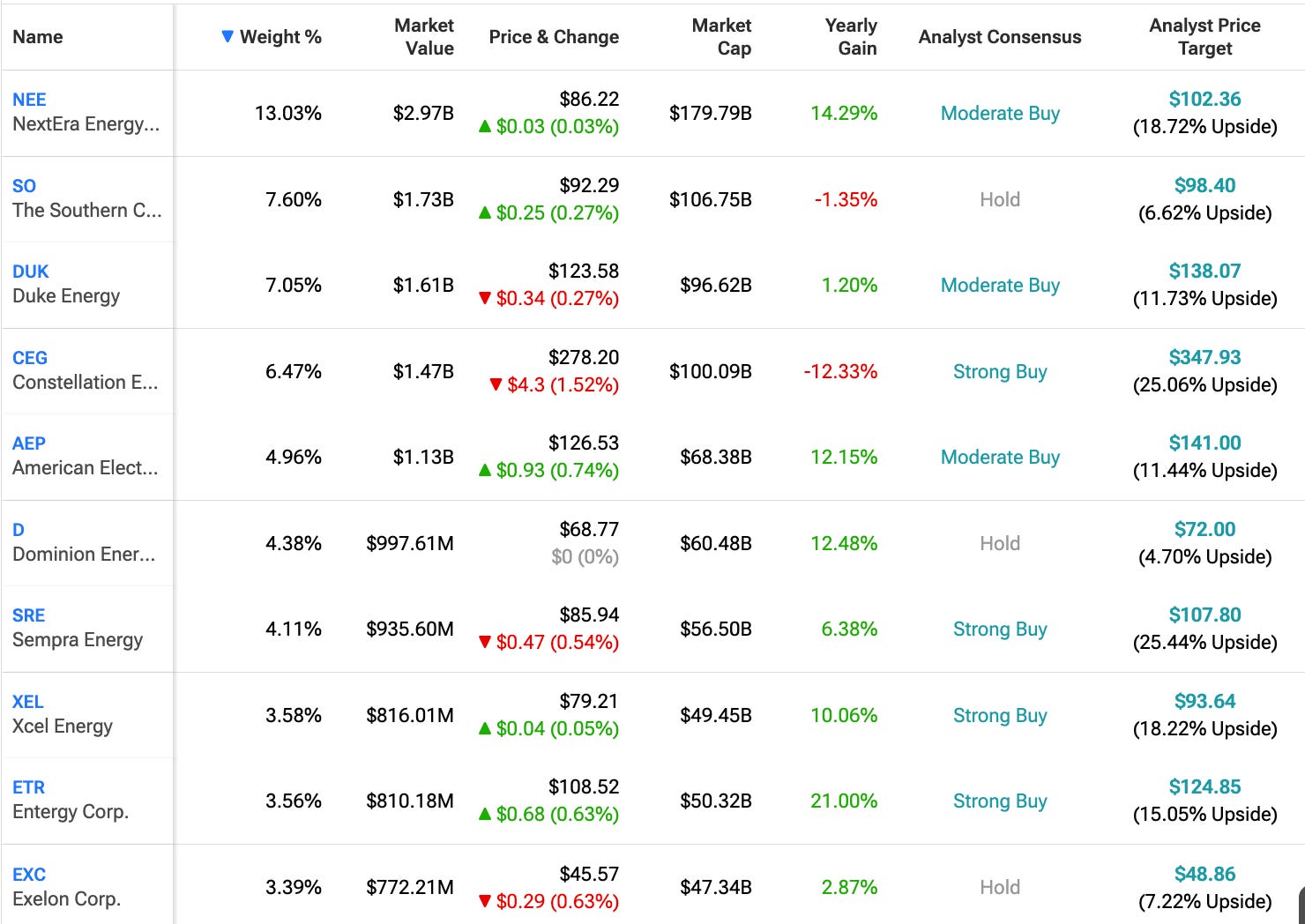
NextEra Energy alone accounts for 13% of the fund, with Southern Company and Duke Energy behind it. XLU charges 0.08% and carries a 2.76% 30-day SEC yield.
The concentration comes straight from the index rules. The Utilities Select Sector Index takes the utility companies already inside the S&P 500 and weights them by market cap. That membership requirement caps the fund at 31 holdings and excludes every smaller utility in the country.
Electric utilities represent 65.7% of the portfolio and multi-utilities another 26.1%, with independent power producers at 4.15%. Constellation Energy sits at 6.47% and has become the name investors watch for direct data center supply agreements.
Those dividends also make XLU sensitive to interest rate moves.
Every piece of this bottleneck gets solved by a different set of companies. Manufacturers clear the backlogs, contractors energize the substations, and utilities collect once the meter spins.
One chokepoint runs through three addresses. Knowing which one you bought matters more than agreeing the shortage is real.
Stay Connected
For more ETF breakdowns, market commentary, and educational content, follow along on X, Instagram, and YouTube, and subscribe to the Substack for full-length articles delivered straight to the inbox every week. LINK HERE 🔗
And if you are not already subscribed, I do stories like this every week for free. Hit subscribe and you will never miss another one. Thanks!

If you are interested in tracking my CURRENT ETF portfolio, download Blossom Social here, and follow my profile, etf.investments 🤓 (Available in US, Canada & 25+ Countries!)

Disclaimer:
This newsletter is for informational and educational purposes only. It is not investment, financial, legal, or tax advice, and nothing in it is a recommendation, offer, or solicitation to buy or sell any security. Nothing here is tailored to your personal financial situation.
The authors may hold positions in the securities discussed at the time of publication.
Every effort is made to ensure accuracy, but no guarantee is given as to completeness, reliability, or timeliness. All opinions reflect the authors’ judgment at the time of writing and are subject to change without notice. Links to external sites are provided for convenience, and we are not responsible for third-party content.
All market discussion is historical in nature and does not guarantee future results. Investing involves risk, including possible loss of principal. Diversification and asset allocation do not ensure gains or prevent losses.
Conduct your own research and consult a licensed financial advisor about your individual situation before making any investment decisions. By engaging with this newsletter, you agree to hold the authors harmless from any outcomes resulting from use of the information provided.
Comments
Nothing yet. Say the first thing.
Sign in to join the conversation.