
There is a detail in Michelangelo’s Creation of Adam that most people miss. God is straining forward. His whole body leans across the heavens, arm fully extended, finger outstretched. Adam, by contrast, is barely trying. His arm is limp, his finger drooping, as though the effort of reaching might not be worth it.
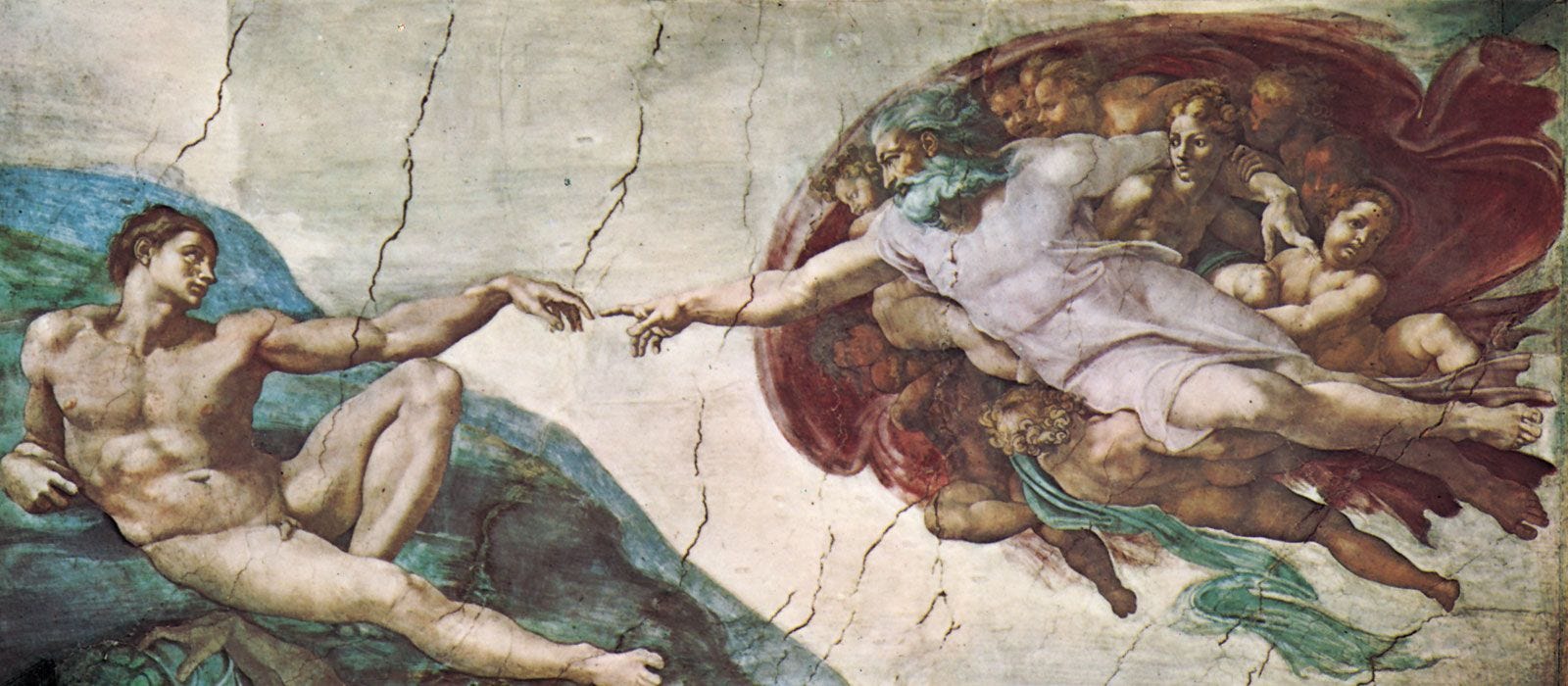
The gap between their fingertips, that electrifying sliver of space, is not the failure. It is the entire point. Michelangelo understood something that theologians have circled for centuries: connection is not a given. It must be chosen, initiated, completed. The threshold between two hands is where the sacred lives.
But what happens when we stop reaching toward each other… and start reaching for something else?
The image of hands reaching toward one another appears in ancient Egyptian reliefs, in Byzantine mosaics, in Hindu iconography, in the illuminated manuscripts of medieval Europe. Across every tradition, the meaning holds: transcendence requires extension. It requires relationship. Nothing exists without it. You must leave the comfort of your own gravity and lean toward something beyond yourself.
What the image captures is not touch.
It captures almost.

The moment before contact, when the reaching is still pure. Still about the longing itself rather than its satisfaction. Every major spiritual tradition has a word for this space. Some call it surrender. Some call it prayer. Some simply call it God.
The gap between the fingers is where the sacred lives, not in the touch, but in the almost.
What none of them anticipated was a civilization that would learn to fill that gap with substitutes. With things that quiet the ache without resolving it. With connections that feel, for a moment, like transcendence, but cannot reach back.
This is not a modern failure. It is the oldest one. The apple. The golden calf. Scripture even notes that man fell into a deep sleep, and never records him waking. We have always reached for the thing within arm’s length rather than the thing that requires us to stretch.
You do not have to be addicted, estranged, or divorcing to belong inside this. You only have to be human, and occasionally hollow, and reaching for something that has not yet satisfied you. Which is, if we are honest, most of us, most of the time.
The United States Surgeon General declared loneliness a public health epidemic in 2023. Not metaphorically, but clinically. The research compared the mortality risk of chronic loneliness to smoking fifteen cigarettes a day. Meanwhile, rates of family estrangement have risen quietly for decades; some studies suggest roughly one in four Americans is estranged from a family member. Gray divorce, couples separating after fifty years of marriage, has doubled since 1990, even as overall divorce rates fell. The opioid crisis has claimed hundreds of thousands of lives, each one a person who found in a substance what they could no longer find in a person.
These are not separate crises. They are the same crisis wearing different faces.
Look at the shape of each one. The addict reaches for the pill, the drink, the needle, a chemical that briefly dissolves the self into something quieter and larger, the way real intimacy does. The estranged child reaches for the phone, hovers, puts it down. The divorcing couple, after decades together, reach toward who they thought the other person was, and find only who they became. The person alone at midnight reaches toward a screen, scrolling for proof that someone out there is awake, alive, present.
The gesture is never lost. Only the direction changes.
Everyone is still reaching. We’ve just forgotten what we’re reaching for.
The tragedy of every substitute is not that it fails to satisfy. It’s that it partially succeeds. Enough to quiet the hunger. Not enough to end it. And so the reaching continues… more desperate, more frequent, more disconnected from its original object. Until the motion itself becomes the habit, and the person has forgotten what they were ever reaching for.
A screen cannot strain forward. A substance cannot close the gap. Silence between family members is not the same as peace… it is the absence of the courage to reach. The gray divorce is not the end of love, in most cases, but the exhaustion of two people who stopped extending toward each other so gradually that neither noticed the hands fall.
Michelangelo painted God leaning harder than Adam. This is not incidental. The divine, in that image, is the one who wants the connection more, who extends further, who risks more in the reaching. The human barely tries. And yet the current passes anyway, or almost does, across that impossible sliver of space.
What the painting asks is whether we will lift the hand. Whether we will extend it. Whether we will bear the vulnerability of reaching toward something, someone, who might not reach back.
Every epidemic of disconnection is a misdirected reach. The loneliness, the estrangement, the addiction, the quiet dissolution of long marriages. None of these are evidence that people stopped wanting connection. They are evidence that the reaching continued, desperately, toward things that cannot complete the circuit.
The gap between the fingers is not a wound.
It is an invitation.

It has always been an invitation… to extend yourself past the edge of comfort, past the risk of rejection, toward another person who is also, desperately, reaching.
Reaching out,


"Self-rejection is the greatest enemy of the spiritual life because it contradicts the sacred voice that calls us the Beloved."
~ Henri Nouwen
I created a free six-week recalibration series that meets you where you are and walks with you softly, one step at a time through what you may be experiencing.
Not ready yet? Keep reaching. I'll be here.
Comments
Nothing yet. Say the first thing.
Sign in to join the conversation.