
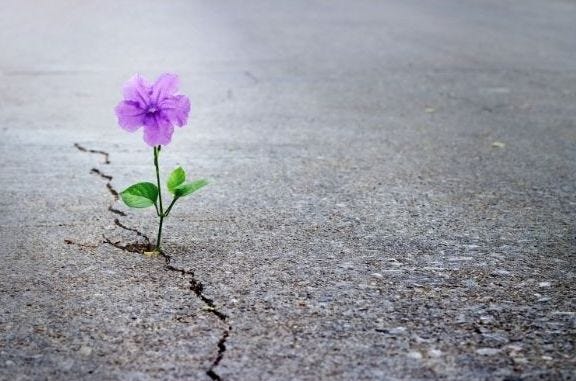
We hear a lot about building resilience in children and, to be honest, I’ve come to really dislike the word. So often, it sounds like an easy way to justify thoughtless adult behaviour and to dismiss children’s feelings. As though going through a hard time is enough to create resilience—the famous “school of hard knocks” advocated by many an unhappy adult.
I looked up the word “resilience” and the most common definition is something along the lines of, “to adapt well in the face of adversity”. Look anywhere into what goes into a child being able to “adapt well”, and you’ll find that yes, they do need some exposure to life’s challenges, but that there is plenty more to acquiring this learned skill. When challenges take place within a safe environment and responsive relationships, children can learn what they need to adapt to the ups and downs of life, such as regulating emotions, solving problems under stress, forming secure attachments, sustaining friendships, and having a positive sense of their own agency.
And, although there are remarkable people in the world who have been through incredibly difficult childhoods and have come out resilient, research shows that living through stress without support can lead to an exaggerated nervous system response, a lack of trust in others, inability to solve problems under duress, and a sense of powerlessness and lack of agency. In short, the very opposite of the skills needed for resilience.
I’ve been learning a lot about resilience this week. Two of my children have had disappointing situations to figure out this past year. They each had a plan, based on what they love, aligned with their dreams and values, and seemingly perfect! They had imagined how life would look, the things they would do, and all the possibilities these particular choices would then lead to. I had been equally enamoured by their plans, and happy to see them choose things that felt so “right”, so I joined in with their daydreams and together we made possibilities feel definite.
And then, for different reasons, reality dealt different cards, and we were left, slightly shocked and sitting in that uncomfortable gap between expectation and reality.
On both occasions, I have been surprised by the grief I’ve felt at their derailed plans. It has seemed unfair and incomprehensible to me that something so well thought-out and logical wouldn’t happen. And, if there were someone clearly in charge of all this, I would have lodged a complaint immediately and explained that this is absolutely not acceptable, and that there is really no way that we can accommodate this change in plans. Alas, I haven’t yet figured out where to send that email.
My grief seems odd when I reflect on it. I have long since made peace with not imposing my expectations onto my children. I love seeing them grow into themselves, and watching their paths unfold in all sorts of surprising ways, and I think I am as unattached to outcomes as I can hope to be, without spending some years in deep contemplation on a mountaintop. This is in part due to a lot of reflection and observation of myself, but mostly because they always show me that the paths they create are way more interesting and satisfying than anything I could have ever dreamt up myself. Whatever I have ever expected, they have unfailingly come up with something far better.
But, if I want to be a helpful ally in navigating uncertainty, then I really do need to figure out why I feel their disappointment so intensely. Because although my role is to meet that disappointment with compassion, it is also to hold steady and believe in their resilience—to model all those skills with them, such as problem solving, emotional regulation and figuring out what agency looks like when life throws you a curveball.
So I guess I feel the grief because, like most parents, as my children grow older and things move further out of my realm of influence, I am learning to let go. And, there is a part of me that would willingly form a secret pact with the universe to spare these particular three people all heartache and disappointment. Here, the world would bend and shapeshift around their plans, ensuring a smooth, joyful and bump-free journey through life. Again, who to send that email to…
And perhaps my grief comes from some deeper fear that difficult things will knock them over. I’ve no doubt that at their ages I looked more resilient on the outside than I felt on the inside, so perhaps I am also living into how I myself might have felt back in the day.
I was in the car with one of them this week, and they told me that they haven’t given up on Plan A, and have figured out some things that could still make it work. They also shared how they had played that plan over in their head so many times and in such fine detail that it was taking quite an effort to make the mental shift to the idea that it may not happen. However, they mused, Plan B was actually pretty good too, and they listed some of the many obvious positives of that plan. They were not knocked out by it all at all—within their obvious grief of letting go of the definite, not only were they aware of the games their mind was playing, but they also had the capacity to be open to other possibilities.
Earlier in the year, my other child had done something similar. After some deeply felt disappointment and tears, they had moved quickly into opening up to new possibilities. And in fact, that led us to a wonderful new idea which is now feeling more exciting and aligned than the original one (though, of course, it too may not work out!).
As my child got out of the car and headed off to join their friends, I felt my own grief around their disappointment entirely dissipate, and I felt instead so much admiration for this young person and deep joy at what they were showing me—that there is really nothing more important in life than our capacity to navigate the hard times. Whether they achieve what they set out to achieve and whether things go to plan or not is entirely secondary to this.
And life, of course, will not be without heartache and disappointment. So much is beyond our control, and we do our children a disservice to make them think that it can possibly be a straight line through, or that there ever is any failure when the inevitable curveballs come.
Rather than hoping in vain that our children have lives in which everything goes to plan, we can help them come to know themselves as people who know what to do when the plan falls through. That they can feel grief and disappointment without being overwhelmed. That they can ask for help, recognise where they have agency, and have the capacity to remain open to possibilities they hadn’t previously imagined.
And maybe, in order to nurture our children’s resilience, we need to ask ourselves: how resilient are we? Can we sit with our own discomfort when their plans don’t work out? Can we trust that they will find their way? How easily can we loosen our own grip on Plan A and turn to the yet unexplored possibilities of Plan B?
I notice that my children’s resilience is making me more resilient, and I think I am edging closer to letting go of the fantasy of that secret pact with the universe, and surrendering fully to what I actually believe, which is that real resilience comes from living through the ups and downs in loving and trusting company. And I notice that, like everything I once thought I might impart to my children, this is a two-way street, and I am learning just as much as they are.
No posts
Comments
Nothing yet. Say the first thing.
Sign in to join the conversation.