

Last week I wrote about Europe’s economic stagnation and the foolish degrowth ideology. Degrowth thinkers such as the French economist Thomas Piketty argue that Western countries should grow less economically. Wealth, in their view, should mainly be redistributed globally. My main point was this: as Europeans, we should leave this degrowth dystopia behind and focus above all on creating wealth, not redistributing it.
After my previous post, I was glad to see several posts that cut through these delusions. Degrowth requires an unprecedented planned economy that is neither desirable nor realistic. It is a fundamentally paternalistic, undemocratic, and illiberal economic model. People are individuals who make their own economic choices. And where European left-wing parties once aimed for a better standard of living for workers, left-wing degrowthers now see it as a noble goal for people in the Western world to become collectively poorer in order to save the climate. Europeans would become “Europoors.”
In short: Europe should ignore this dystopian degrowth delusion and focus on economic growth, on the conditions needed for it, and on wanting to grow. But one point I did not address enough in my previous post about Europe’s economic stagnation is how quickly Europe has already fallen behind other countries, especially the United States and China.
In this post, I compare the European economy only with that of the United States. As Europeans, we already love talking about the U.S., because the average European despite his dislike of Trump, still sees himself as a citizen of a 51st state. As a result, Trump being unpopular gets more attention than the fact that almost every Western European head of government is more unpopular than at any point in history. There is, however, very little real discussion or serious comparison with the United States. Our media prefers writing day in day out about the Orange Man, Elon Musk, or about how Americans are idiots.
This economic comparison matters mainly because of two simple facts:
The United States and its people are significantly richer than the European Union;
The U.S. economy has grown much faster in recent years than the EU economy
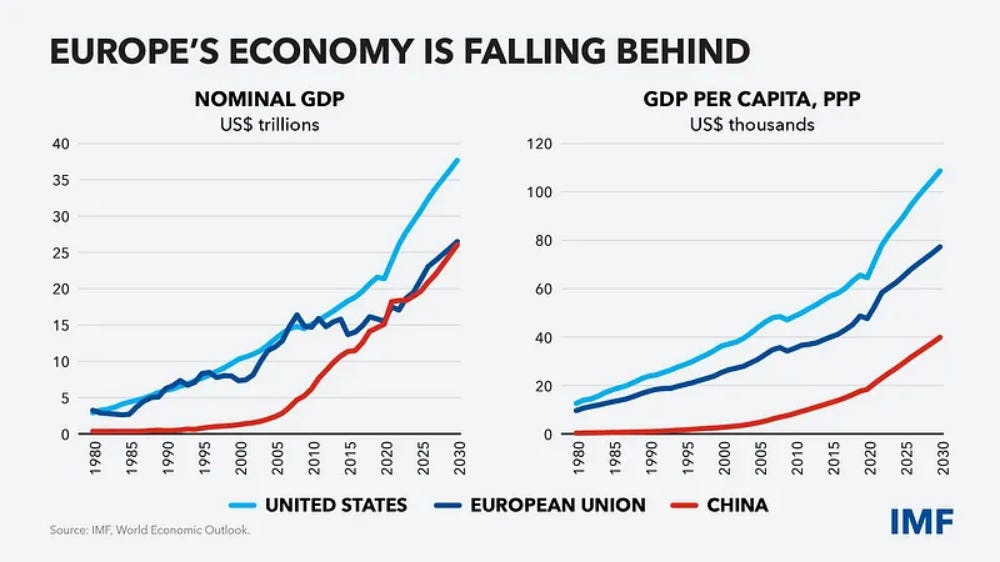
Europe has largely missed the economic boat over the past fifteen years. In 2010, the EU countries still had a combined gross domestic product (GDP) roughly the same size as that of the United States. Now it is much smaller, and China has overtaken us. Between 2008 and 2024, U.S. GDP grew by 94.7% (from $14.77 trillion to $28.75 trillion). EU GDP grew by only 19.1% (from $16.37 trillion to $19.5 trillion)
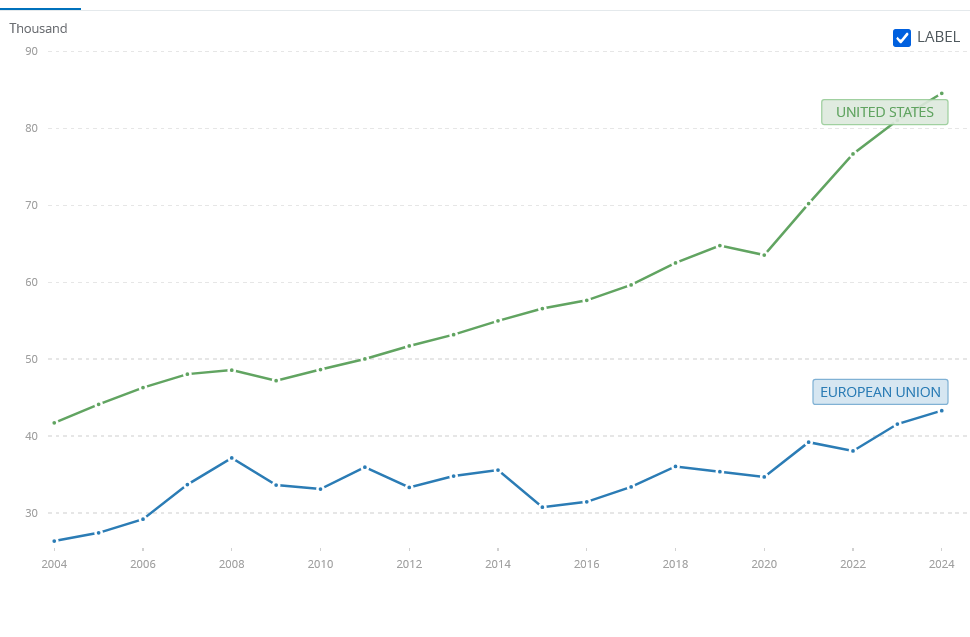
As a result, GDP per capita in the EU in 2024 was almost half that of the U.S. ($43,305 versus $84,534), whereas in 2008 it was still 76.5%. And the gap keeps growing every year. Measured in purchasing power terms, the average American in 2024 was also nearly 40% richer than the average EU-citizen. Keep these numbers in mind the next time some pedantic European journalist, or whatever passes for one, suggests that the U.S. is a country full of idiots and that we Europeans do everything better.
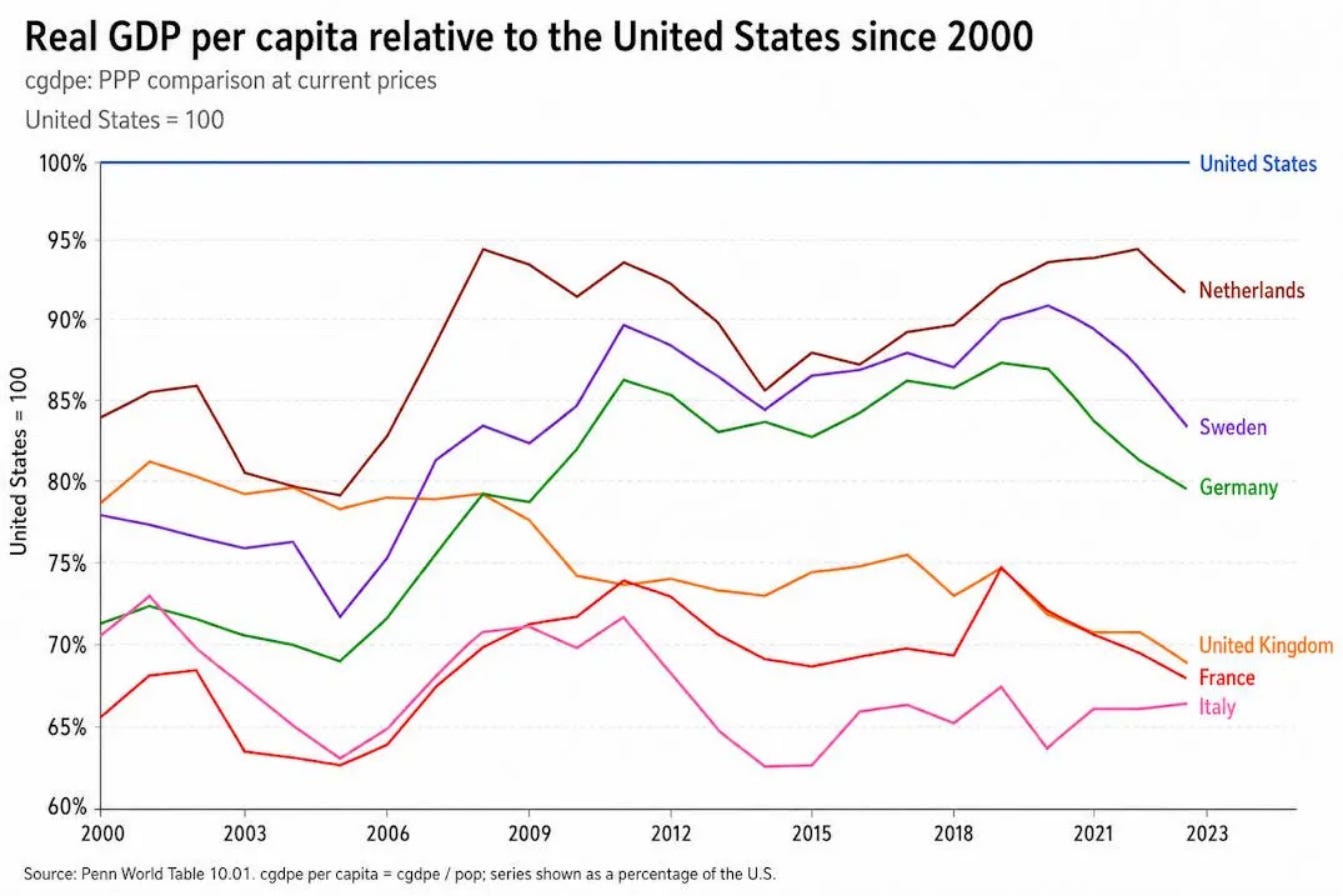
Western Europeans who do not want to face these inconvenient facts will no doubt say this comparison is unfair, because Western European countries are much richer than Eastern European ones. But even in Western European countries, especially Germany, France, and Italy, real GDP per capita is still far below that of the U.S. And it is precisely most West European countries that have seen barely any economic growth in recent years, especially compared with Central and Eastern European countries, as I also described in my previous post.
Why has the American economy grown so much faster than that of the European Union? First of all, Europe has come through various crises much weaker: the financial crisis and euro crisis (2008–2014), the COVID-pandemic, and the war in Ukraine, especially because of our dependence on Russian energy. Partly as a result, energy prices in Europe are almost three times as high as in the U.S.
But there are more important, structural reasons for American growth and West European stagnation. One of them is labour productivity. According to the European Central Bank, labour productivity in the U.S. rose by 6.7% from Q4 2019 to Q2 2024, compared with only +0.9% in the EU. In Italy, productivity is even below its 2010 level. Closely related to this is, of course, the American tech sector and digital services, which also invest heavily in research and innovation. That lead in tech also spills over into other sectors.
While AI is booming in the U.S. and China, the EU had already tied companies up in regulation before the AI race had properly begun. It is like a boxer stepping into the ring with one hand tied behind his back. Scientists and economists are now warning of economic damage. Many Europeans respond by saying that the American economy is only growing faster because of the tech sector, and that this therefore doesn’t say much. As if an athlete loses the decathlon and says the 1500 meter shouldn’t count.
Many Europeans also think these gains in the U.S. only end up with “the elite” or, worse, with Elon Musk. But according to OECD figures from 2021, the median income of Americans, adjusted for purchasing power, was 30% higher than the median income of Dutch people, 31% higher than that of Germans, and 52% higher than that of the median Frenchman. I will leave the technical economic analysis here to people with more expertise, such as economists Luis Garicano and Pieter Garicano. The main point is this: over the past 25 years, the wealth gap with the U.S. has grown sharply. America is doing something very right, and EU countries are doing something wrong.
What should Europe do? I will go into that in more detail in later posts. For now I will limit myself to what we should definitely NOT do. A dominant reaction to our relative European economic decline is Eurocope, a concept coined by writer Noahpinion. Eurocope is the systematic refusal to look at European problems directly, or the habit of brushing them off as a way of “coping.” Many Europeans do this by pointing to problems in other countries, even when those problems have no real relevance in the comparison. If someone says Europe’s economy is not doing well and the American economy is growing much faster, the Eurocoper says: “Yes, but the U.S. is worse at B.” I recently saw this again under a post about the beautiful football stadiums in the United States: “but at least we have healthcare.”
That B often consists of the following:
Americans do not have free healthcare
The U.S. is a very unequal country without a social safety net
Americans are uneducated idiots
America is full of gun violence
One point is that these problems are often exaggerated clichés. But more important is that such criticism of the U.S. is useless for Europe. Even if those points are true, they do nothing to solve our own European problems.

One of the most common forms of Eurocope is to point to the differences in our socio-economic model. Our European welfare states versus the cold capitalism of the U.S., where people live paycheck to paycheck. It is legitimate to point to things like greater income security, better access to healthcare, and less inequality in exchange for more American growth.
The problem is that this comparison is becoming less and less convincing, because our European welfare states are rapidly becoming unsustainable. In Germany, for example, ageing has led to sharply rising spending on pensions and healthcare, which is growing much faster than the economy. Total social security spending in Germany amounted to €1350 billion in 2024, more than 31% of German GDP. German government spending has risen by 63% since 1999, while the economy has grown by only 31%, and capital investment by just 16%. In 2025, 140,000 jobs disappeared in German industry, while more than 200,000 jobs were added in healthcare and government. Germany has changed from a manufacturing economy that creates wealth into a boomer economy that increasingly redistributes it.
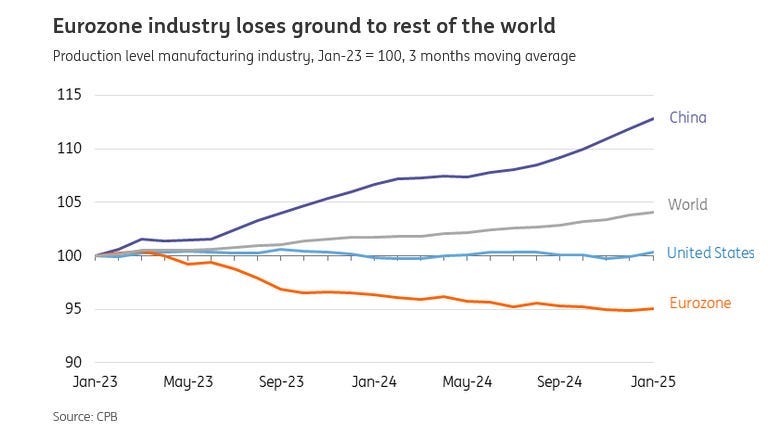
In short: a welfare state needs wealth, but Western European countries are creating less and less of it. In that respect, the U.S. is doing several things much better than we are. Let’s look at what Europe can learn from that, before we turn into an economic museum that produces less and less, into a public care institution in which we mass-produce care for a dying society, and into a continent that only manages its own decline. I will say it once again: economic growth is good, and wealth has to be created. And the next time a European dismisses our economic problems by pointing to the U.S., ask yourself: who are the idiots, really?
Thanks for reading Essential Europe! Feel free to share this post.
No posts
Comments
Nothing yet. Say the first thing.
Sign in to join the conversation.