
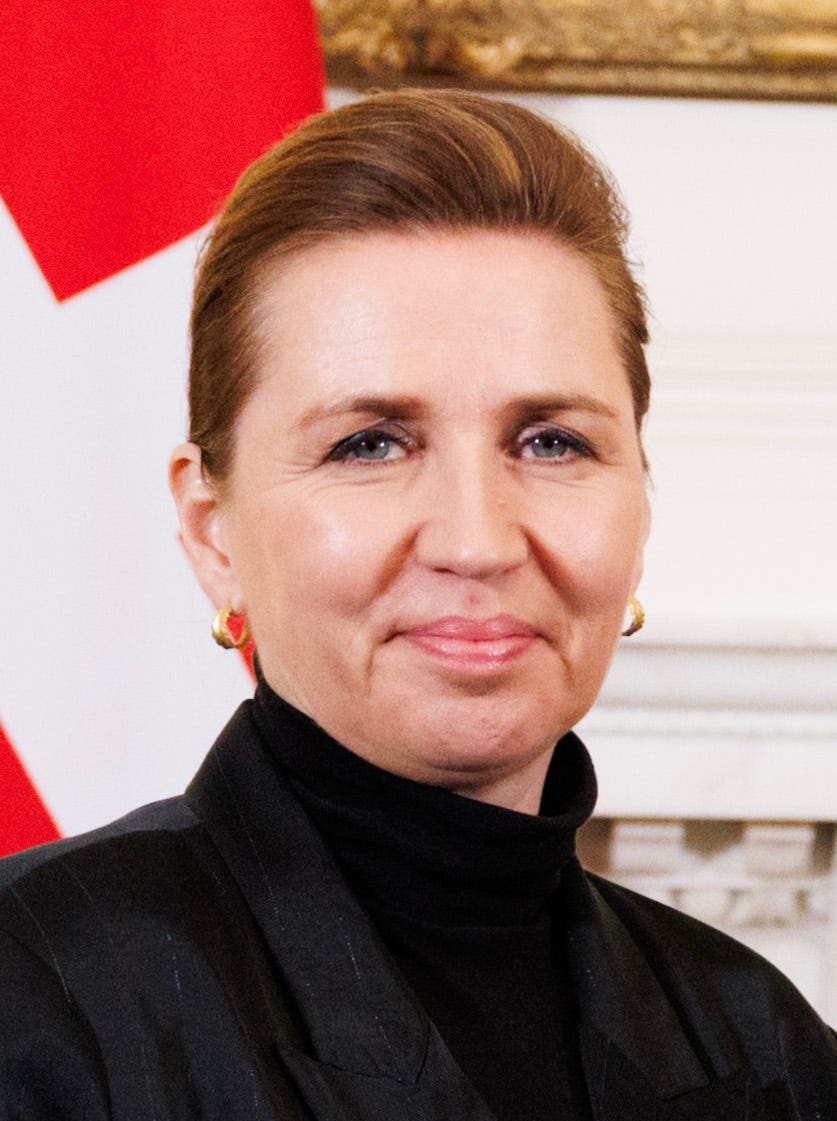
“The problem is that a great enemy has started to grow up from within, and it is foreigners who have come to Europe, it is Hamas supporters, it is people who commit terror against European societies, it is people who do not recognise our fundamental European values, it is people who sympathise with some of the darkest forces in this world. So Europe is under threat. The problem is that we are both threatened from the outside and now from the inside, but it is not because of a disagreement between the Danish and Spanish governments, but because of people with Islamic backgrounds who do not want the open, free European society, unfortunately.”
This quote from a speech by Denmark’s social democrat prime minister Mette Frederiksen in parliament struck me last week. First of all for its directness. I also reckon that in many European countries such a clear statement, especially about foreigners and the threat to Europe, would swiftly result in hollow, hysterical responses in politics and media about racism and xenophobia.
I will share more similar quotes in this post than I usually do. That’s because I think they show that Denmark’s Social Democrats and Frederiksen genuinely think strikingly differently about migration and integration than most other European left-wing parties and politicians. And this in my view largely explains why they have been going against the European political trend.
They are doing so in two ways. First of all, Denmark is one of the few EU countries where a social democrat is the head of government, together with Spain, Malta and Lithuania. Mette Frederiksen has led three successive governments since June 2019.
Across most of Western Europe, social democrats have performed historically poorly in recent years. In Germany, the SPD recorded its worst result ever in February 2025 federal elections with 16.4% of the vote, 9.3% less than in 2021. In France, the Parti Socialiste holds just 69 of 577 seats in the Assemblée nationale. In Dutch elections in October 2025, the PvdA won just 12.8% of the vote, even together with the Green party. Spain's social democrat prime minister Pedro Sánchez leads a minority coalition that is embroiled in multiple corruption scandals and weakens the EU in multiple ways, as I’ve written about previously.
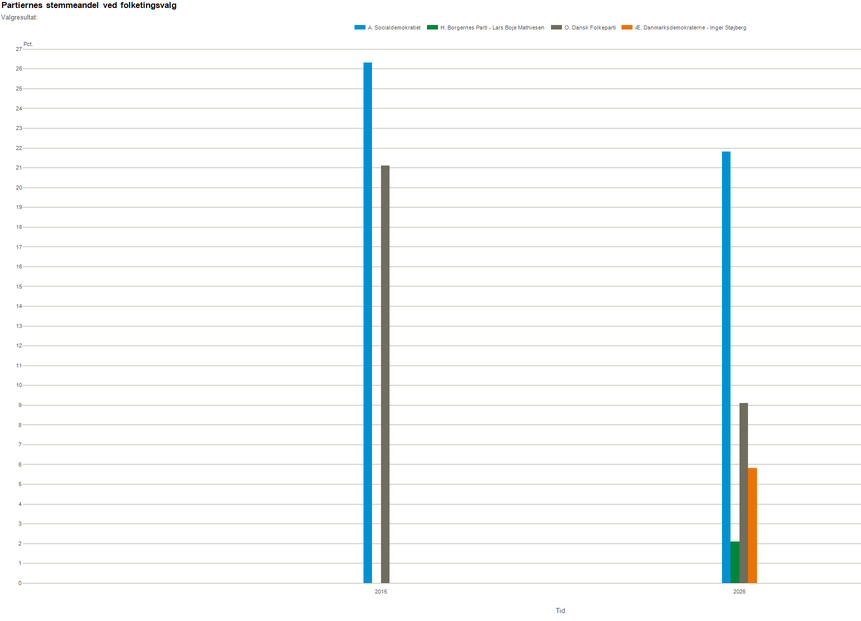
Yet in Denmark, the social democrats won well over 25% of the vote in elections in 2015, 2019 and 2022. Although the party suffered a substantial setback in the elections of March this year, winning 21.9% of the vote (-5.6% from 2022), it is still the biggest party in Danish parliament by far.
At the same time, the far-right hasn’t been so powerful in Danish politics over the last ten years as in other Western European countries where they are stronger than ever before. In Germany the AfD secured its best ever result in the 2025 federal elections, winning 20.8% of the votes, and is currently polling at 28%. Marine Le Pen’s Rassemblement National is leading in the polls for next year’s presidential elections. And in Austria the FPÖ won 29% of the vote in the 2024 parliamentary elections and has been polling at 39% recently.
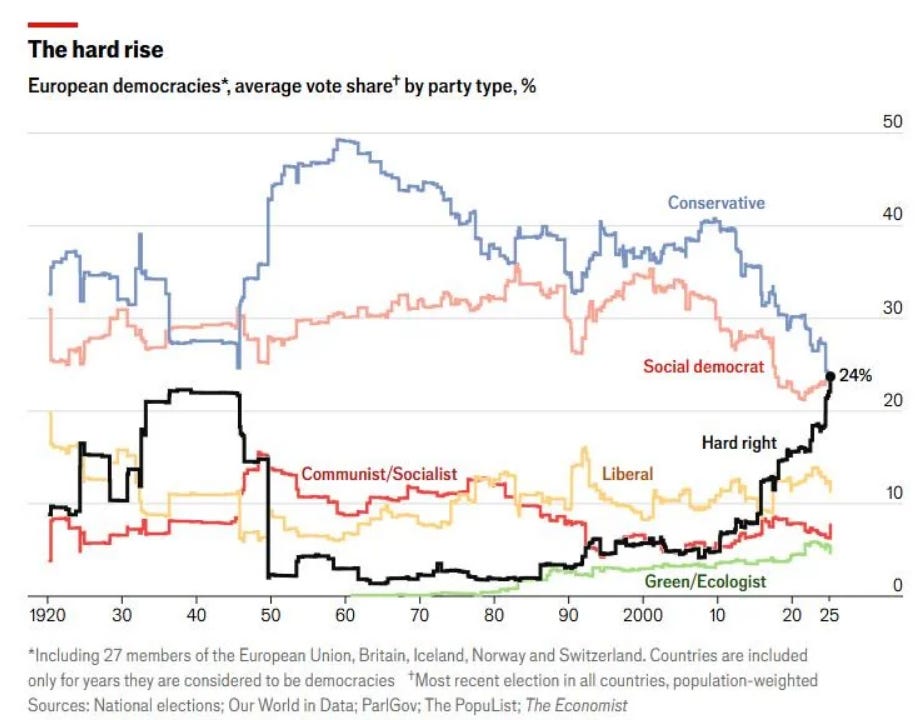
The far-right had been growing in Denmark too until 2015, the year of the European migration crisis furthered by its southern neighbour Germany and Chancellor Angela Merkel’s Wir schaffen das. It was also the year in which Denmark received a peak amount of 21.316 asylum applications. At the time, the Danish People's Party was the second biggest power in parliament with 21% of the vote. They increasingly drew disillusioned working class voters away from the social democrats.
Under its new leader Mette Frederiksen, the social democrats shifted course and openly broke with the party’s past reputation and policies of ‘openness’ to migration. In 2016, Frederiksen said that her party should have listened sooner to mayors in deprived parts of the country, who had warned about the negative impact of immigration.
From then on, the social democrats explicitly framed their migration policy in social democratic terms. They claimed that their migration policy would protect the welfare state, public services and social cohesion. At a party conference in 2016 Frederiksen even said that the Danish welfare society with free and equal access to health, education and social services is incompatible with an open immigration policy.
As she said in a 2016 interview: “Integration must work. But there must be a balance so that we don't take in more than we can integrate. Our social model is so unique that it rests on an economic stability and balance, as well as a social cohesion.” In this view, the poorest Danes feel the negative effects of immigration the most. As Frederiksen said in 2025: “High levels of immigration undermine cohesion while imposing burdens on the working class that affluent voters largely escape.”
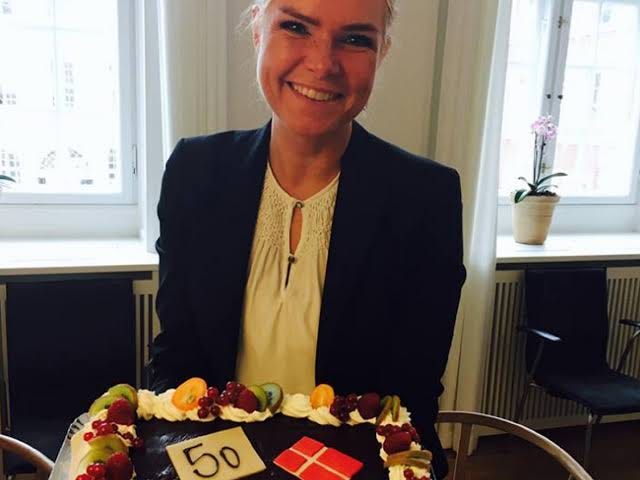
As their position on migration shifted, the social democrats then in the opposition supported many of the immigration and integration policies introduced by the right-wing liberal government between 2015 and 2019. The far-right Danish People’s Party also supported most of these. The then migration minister celebrated the adoption of her fiftieth immigration restriction with a cake and a picture on Facebook. Admittedly, Denmark’s opt-out from EU justice and home affairs rules - which means Denmark is not bound by EU laws concerning issues such border control, immigration policies - gave successive governments greater freedom to set their own policies. Still, political action is mostly the result of political will.
Among others, the social democrats voted in favour of a law allowing jewellery and other belongings valued over 1300 euros to be taken from asylum seekers in return for their reception, as well as a burqa and niqab ban. Frederiksen also backed the People’s Party ‘paradigm shift’ of making temporary protection and repatriation instead of integration the goal of asylum policy.
On integration policy, the social democrats also supported most of the ‘ghetto laws’ that were introduced in 2018 in an effort to dismantle what the government called “parallel societies” in housing areas. Among others, these laws compelled children living in the targeted areas to attend day care for 25 hours a week to ensure they learn the Danish language and values. Parents who take their kids back to their countries of origin for extended periods could face prison or deportation. And crimes committed in neighbourhoods deemed ghettos would carry heavier sentences.
The social democrat spokesman on migration and integration even called the laws too soft. “It should be a core issue for social democratic parties to break down these parallel societies and make sure we all belong to each other”, he said, adding “Why should the social democratic position be we should leave people alone, and leave the right with the argument that we have to have a common cultural background?”; “It’s a problem for a Social Democrat if we have areas in our country where the language is shifting to Arabic or Turkish, because it undermines the common ground [on which] the welfare state is based.”
Despite internal criticism over policies that some considered “too harsh”, the social democrats stayed the course and presented their own proposals in 2018, under the banner ‘Fair and Realistic - A migration policy that unites Denmark’. As they say on their website: “We were faced with a European asylum system which had de facto collapsed. And where no one knew who was actually among the many who came here.”
These proposals were divided into three pillars, which largely revolve around reducing the incentives for migrants to come and stay in Denmark:
Control the number of people coming to Denmark, arguing that Denmark should only accept as many migrants as it could realistically integrate. This included:
A cap on the number of new non-Western immigrants Denmark would accept each year;
Moving away from the existing system where people could arrive in Denmark and apply for asylum, toward a system where applications would primarily be processed at centres outside the EU;
Returning more asylum seekers whose claims are rejected to their countries of origin;
Strengthening border controls and stronger efforts against illegal immigration and human smuggling;
Stricter family reunification laws.
Help asylum seekers closer to their countries of origin
Rather than trying to accommodate large numbers of refugees in Denmark, the social democrats wanted more assistance in their neighbouring countries. They proposed increasing Danish aid to refugee-hosting regions and working through the EU to improve conditions in Africa and the Middle East. This would reduce the pressure for people to undertake dangerous journeys to Europe.The ‘new battle for freedom’. At the core is the idea that immigrants should have both rights and obligations. This means:
Greater emphasis on employment and self-sufficiency;
Stronger requirements for learning Danish and emphasis on getting children from immigrant families into Danish-language education and institutions;
More requirements for immigrants receiving welfare benefits to participate in work or other activities;
Tougher action against parallel societies in neighbourhoods where immigrants form the majority, similar to the ‘ghetto laws’;
Stronger expectations regarding Danish democratic and social norms.
With this platform, the social democrats won the 2019 elections with 25.9% of the vote. Although the social democrats did not deliver on all of their proposals, such as the cap on non-Western immigrants, governments led by Frederiksen have since translated many of them into law. This includes stricter asylum rules, the creation of a Return Agency, stricter integration requirements for those seeking citizenship, and stronger work obligations for receiving welfare, with some migrants required to work 37 hours a week in order to receive benefits. “For too many years we have done a disservice to a lot of people by not demanding anything of them,” Frederiksen said about the latter.
Additionally, Denmark has incentivised the return of those who had to leave the country. Applicants whose asylum claims are rejected no longer receive monetary benefits. Instead, people who have decided to return home are offered up to 5400 euros. As the migration minister said in 2020: "Whenever possible, it is only natural for refugees to travel back to their homeland."
In short, the goal of Denmark’s migration policy has been to reduce the incentives to come to and stay in Denmark. As then immigration minister Mattias Tesfaye said, the decline in arrivals was due to Denmark’s strict immigration policies that made it a less attractive destination. Frederiksen has even repeatedly said that her vision is for Denmark to have zero asylum applications.
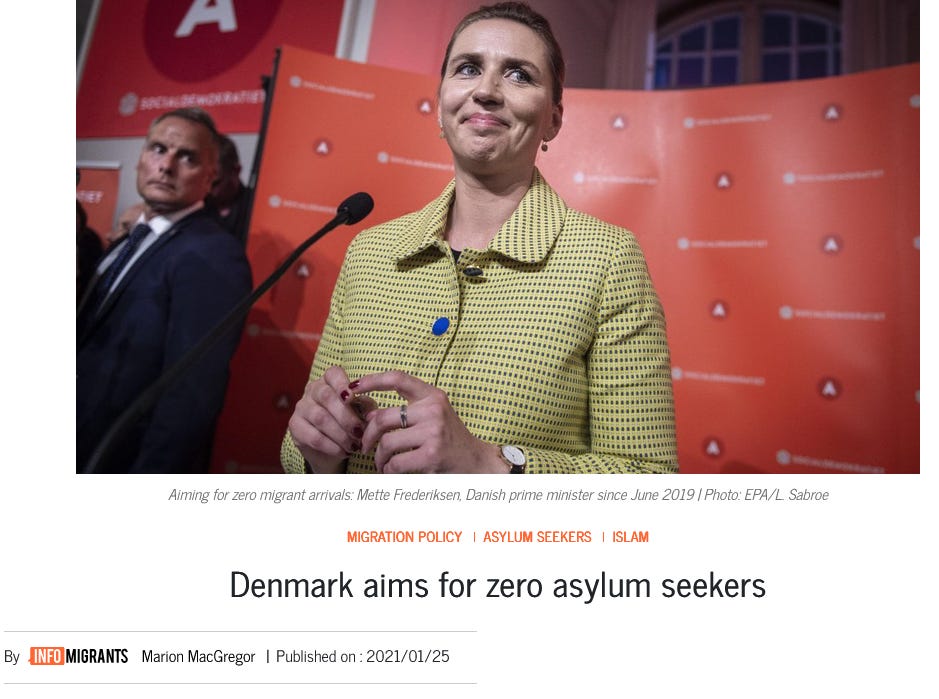
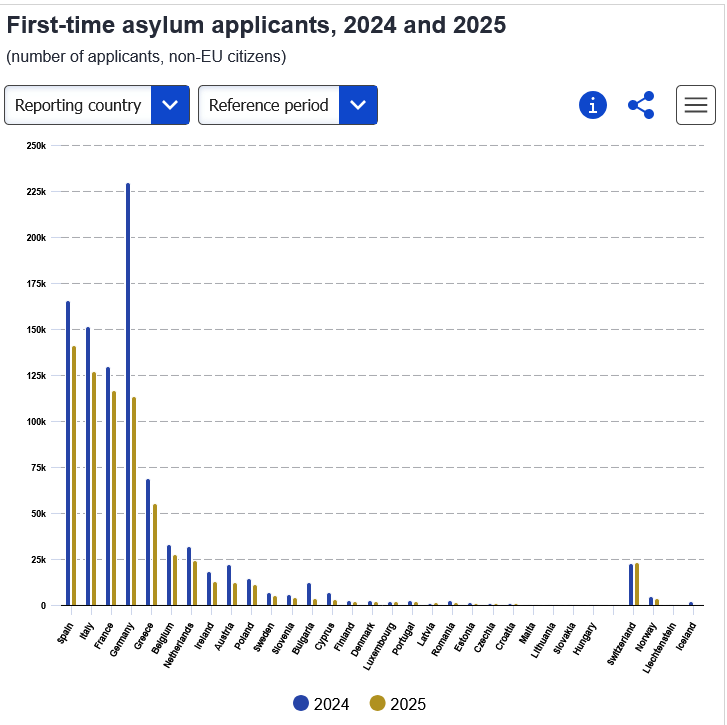
And taking the repeatedly stated goal of reducing the amount of foreigners coming to Denmark and obtaining asylum as a benchmark, changing the incentives has worked. Denmark has for years received substantially less asylum applications than other Western European countries. In 2025, Denmark registered 1961 applications out of which 1628 were new arrivals.
In comparison: Ireland, which has a smaller population, received 12.975 first-time applications in 2025. And Belgium received roughly 7 times as many asylum applications per capita as Denmark in 2025. The number of admissions was also historically low last year, with 839 granted permits at the end of November, after 864 people had been granted asylum in 2024.
Politically, these policies have been a success too. They have largely neutralised the issue of migration for the Danish far-right to capitalise on. Member of European Parliament for the Danish People’s Party, Anders Vistisen, (most famous for telling Trump to ‘fuck off’) admitted that the social democrats migration policies have hurt the far-right’s vote. “It has impacted our voting share that we have competition on migration. Of course we still want to go further, but in relative terms to other countries, especially western European countries, there is consensus in the Danish debate to have a strict line on migration and that is not really challenged.”
Similarly, political science professor Rune Stubager said that “immigration-sceptic” parties had not been able to grow beyond about 15% of the overall vote since 2015. He attributed this to the shift of mainstream parties: “Had the mainstream parties not moved, I would have expected the immigration-sceptic parties to grow like we’ve seen in other countries where mainstream parties have not tightened immigration regulation to the same extent.”
Combined with the tone deafness of the Danish People’s Party on topics like security policy and the European Union, this resulted in their share of votes reducing from 21% in 2015 to just 2.63% in the 2022 general elections, with ‘New Right’ gaining 3.66%. And in the 2024 European Parliament elections, the Danish People's Party just barely won one seat with 6.37% of the vote. In March this year, the Danish People's Party won 9.10% of the vote, and the Citizens' Party received 2.13% of the vote. The Denmark Democrats who are part of the European Conservative ECR group won 5.75% of the vote. This share is still far below that of far-right parties in other Western European countries.
Frederiksen has also tried to replicate her domestic success abroad in pushing the EU to take a stronger stance on migration. In particular, she has made increasing returns of those ordered to leave Europe a priority. As she told Members of European Parliament last year: “It is challenging Europe, affecting people’s lives, and the cohesion of our societies (...) We have to lower the influx of migrants to Europe. Our citizens expect us politicians to find new solutions with a good reason and European citizens have a right to feel safe in their own countries. That is why we need to strengthen our external borders.”
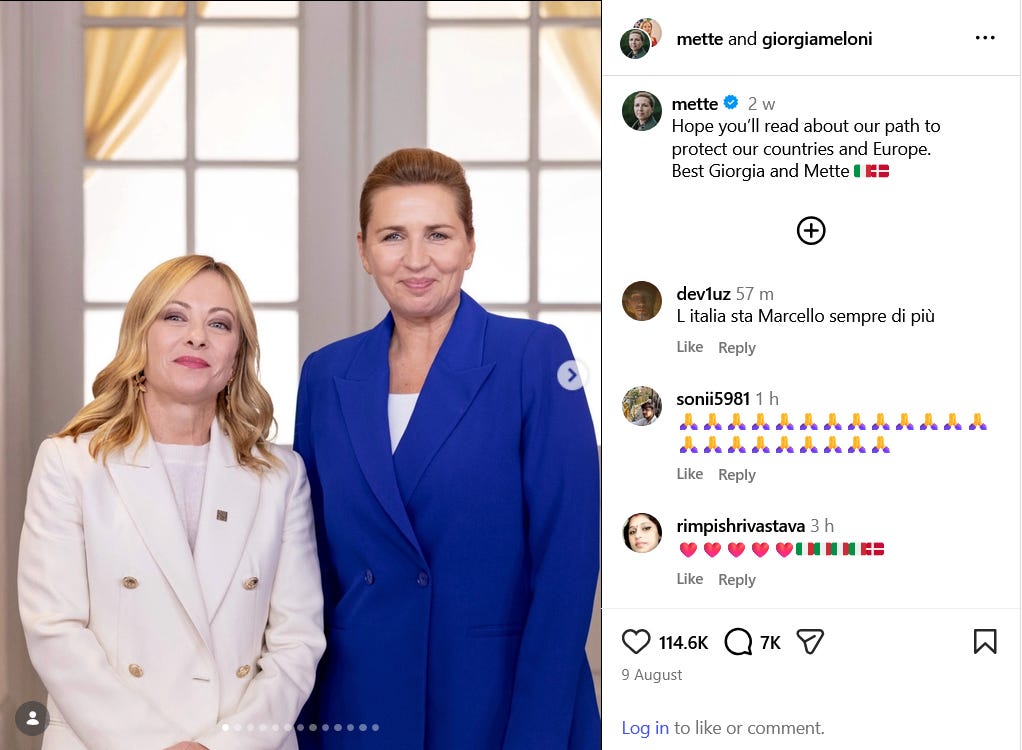
In doing so, she has formed an ideologically odd partnership with Italy’s conservative prime minister Giorgia Meloni and repeatedly joined forces on migration policy. “We know that many people are puzzled by our partnership”, the two said. In 2025, they initiated a letter calling on the EU to make it simpler for member states to deport criminal migrants and criticised rulings by the European Court of Human Rights, saying they’ve limited the ability to “make political decisions in our own democracies.” This ultimately led to the Chișinău Declaration that was endorsed by all 46 countries of the Council of Europe and called for a renewed interpretation of the European human rights system.
Denmark and Italy have also for years been at the forefront in calling for so-called return hubs: centres outside of the European Union where migrants who have been ordered to return can be detained and deported from. After the EU adopted the Return Regulation in June, 19 EU countries said they would take the lead in setting up these hubs. Frederiksen´s Spanish socialist colleague Pedro Sánchez called these hubs “absolutely inefficient” and “worthless.”
Frederiksen’s cooperation with Meloni and her migration stance have even caused a rift within the European socialist group. Days after the storming of Ceuta in July, Frederiksen and Meloni took the lead in a joint letter that was signed by 22 Member States, that criticised Spain’s regularisation programme that has received almost 1.2 million applicants as a ‘pull factor’ of migration to Europe: “We have a duty to effectively deter and relentlessly combat illegal migration, by coordinating our action, strengthening our external borders and addressing all policies that can serve as pull factors, such as the regularisation of [a] very large number of irregular migrants.”
Addressing the Danish Parliament, Frederiksen also refuted the hollow line that the rest of the EU had to show more ‘solidarity’ with Spain:
“One cannot draw the solidarity card quite like that when a government in Europe goes the opposite of almost all of us. In almost all European governments, we devote all our time and effort to ensure that people do not enter Europe and that, by the way, we can get rid of those who do not behave properly, and when there is a government, regardless of the specific situation that legalises illegal immigration and goes counter, then we will have to go up against it.”
But Frederiksen went further, signing a joint statement with Meloni two weeks ago, pledging to oppose ‘uncontrolled migration’ and speed up the creation of return hubs in non-EU countries. These quotes from the statement which they shared on Instagram again show that Denmark’s social democrats are distinct in their position on migration and integration:
“The European populations, understandably, expect action from their politicians. For far too long, especially ordinary people have paid a far too high price for uncontrolled immigration”.“We don't accept uncontrolled immigration to Europe, and we have spearheaded a strict immigration policy, both in our home countries and in Europe. None can deny that illegal immigration has a negative impact on our societies: growing crime rates, increasing pressure on public services and erosion of public trust” “It is particularly serious when illegal migrants - who have no right to remain in our countries - commit violent crimes, engage in drug trafficking or are responsible for sexual violence.”
“Respecting our laws must go hand in hand with respecting European values. This applies to illegal migrants, but also to the millions of foreign nationals living legally in our countries and throughout Europe.”
“We expect people who come to our countries and wish to make Europe their home to respect European values and not to impose on us a way of life that we do not want. We believe that this is the right way to protect Europe, our shared values and the European way of life.”
They are in essence calling for the nation state to perform its basic functions: defending its borders, deciding who gets to remain in its territory and ensuring that those who are in the country adhere to the law. As I’ve written in multiple previous posts, other Western European governments have utterly failed at these tasks. This state incompetence and lack of political will has driven support for the far-right across Europe.
Wanting a state to function as it should, seems like a normal position for social democrats to me. Yet there are those who fear that Denmark’s social democrats have ‘normalised’ the far-right and their ‘extreme’ policies, like professor of EU law Alberto Alemanno, who claims that the “far-right owns the topic of migration” in Denmark. Mister Alemanno did not substantiate this claim. As I’ve argued, the exact opposite is true. Denmark has for years barely had a strong far-right party, because the mainstream parties acted on migration and did not leave the topic to the far-right.
In fact, Frederiksen had warned her colleagues that leaving the topic of migration to the far-right would deepen the woes of social democratic parties across the world. As she said at a meeting of social democratic parties in 2017: “For years, we have underestimated the challenges of mass immigration, (...) We have failed when it comes to maintaining the social contract, which is the very foundation of the social-democratic social model.”
Thanks for reading! Feel free to share this post with people who might be interested.
Most of her fellow social democrats, such as Germany’s Bärbel Bas, have refused to listen. Instead, they have downplayed the concerns of citizens or even mocked them. They seem to be more content with ruling over them. That is why they will continue to pay the electoral price.
Others claim that Denmark’s social democrats have undertaken an ‘aggressive anti-immigrant policy, added to a ‘political culture of Islamophobia’, or even that Frederiksen is a ‘race-baiting fake’ and that the Danish social democrats are themselves ‘far-right’.
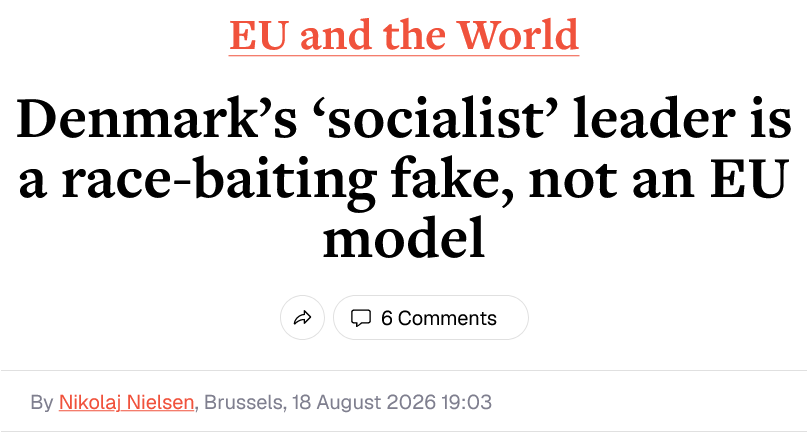
Although those who spit out these terms rarely substantiate them, I will give them a response. Is it really ‘far-right’ to believe that a nation has the right to decide who enters, who stays, and what is required to become part of the national community? To quote Ed West: “the Danes are happy because they are largely surrounded by other Danes, and they consider their future wellbeing dependent on that continuing.” How very radical and frighteningly far-right indeed.
My Europe is one in which sovereign nation states decide and control who stays in their country. Or as the social democrat party programme says: “We must distinguish between those who can and want to be part of Denmark, and those who cannot or will not.” I wish every European country had social democrats like Denmark’s.
No posts
Comments
Nothing yet. Say the first thing.
Sign in to join the conversation.