
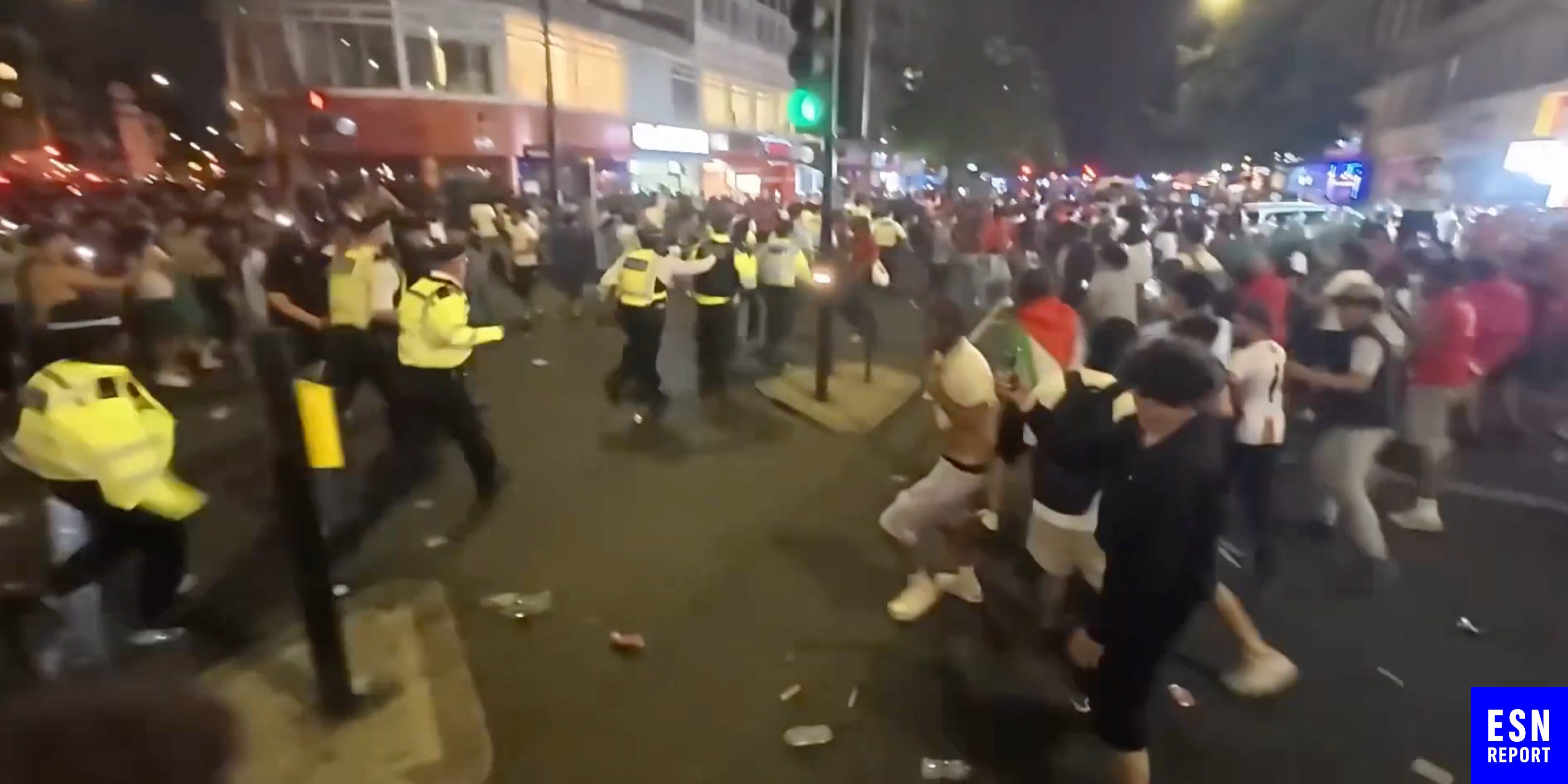
When you hear that a Metropolitan Police officer has been knocked unconscious on the streets of London following a World Cup match, your first instinct might be to assume England had just played.
You would be wrong.
Thursday evening, at approximately 11pm, France beat Morocco 2-0 in a quarter-final played thousands of miles away in Boston, United States. By the time the final whistle blew, a large crowd had already assembled on Edgware Road in central London. Within minutes, the street had become a scene of shocking violent disorder that left one officer in hospital but only four people under arrest.
Edgware Road is the traditional gathering point for London’s Moroccan and North African community. Officers had already been to the same street earlier in this World Cup tournament, when Morocco fans celebrated their team’s win over Australia. Those scenes had passed off without serious incident.
Thursday was different.
Police were called initially because a group had congregated in the road and blocked traffic. That, in itself, was manageable. Then the missiles started.
Glass bottles were hurled at officers. Fireworks were launched directly into police lines. Smoke bombs filled the road with thick, choking clouds. Flares were set off. The crowd surged forward. Officers fell back.
In footage circulating widely on social media, a police officer can be seen lying on the road. His brave colleagues did not retreat. They formed a human barricade around him, shielding him with their own bodies as a hostile crowd pressed in from every side. Two riot vans were quickly positioned to create a physical barrier, and brave LAS paramedics worked on the stricken officer in the middle of the street while his colleagues held the line around him.
He had been struck on the head by a glass bottle. He was knocked unconscious.
He was taken to hospital with head injuries.
Metropolitan Police Deputy Commissioner Matt Jukes spoke to LBC Radio in the hours that followed. He confirmed the officer had been knocked unconscious but had since been released from hospital.
“I am really pleased to know they are doing well. I will be catching up with them later.”
He did not mince his words about what had taken place on those streets.
“This was very serious rioting. We will be circulating footage as we go after those who haven’t yet been arrested and need to be.”
The Metropolitan Police confirmed four arrests for violent disorder. A spokesperson said: “We will not tolerate such disorder on our streets, or attacks on our officers. A police presence will remain in the area overnight and we will be reviewing CCTV and video footage circulating on social media to ensure all those responsible are brought to justice.”
The road was not cleared and reopened until around 1am.
In the chaos and noise of a street riot, with fireworks going off around them and bottles raining down, those officers who formed that barricade around their fallen colleague deserve to be recognised. They did not run. They stood over him and took whatever came next.
That is what the cowards throwing bottles do not understand, and perhaps do not care about. These are not symbols or uniforms. They are people. Somebody’s colleague. Somebody’s child. A person who left the house that evening to do a job and ended up on a London road, unconscious, with his colleagues standing guard around him while a crowd bayed at the lines of officers trying to protect him.
Westminster City Council leader Paul Swaddle issued a statement condemning the disorder.
“It is completely unacceptable that Metropolitan Police officers appear to have been turned on by some groups and one officer injured as they were reportedly pelted with bottles. I condemn this behaviour and appeal to all fans to be respectful throughout the tournament.”
This is not an isolated incident, and it is not a pattern that emerged from nowhere.
Earlier in this 2026 World Cup tournament, Morocco supporters in The Hague, Netherlands, clashed with Dutch police following Morocco’s elimination of the Netherlands. Riot police and water cannon were deployed. There were arrests.
At the 2022 World Cup, after Morocco beat Belgium in the group stage, riots broke out in Brussels. Cars were burned. Property was attacked. Police deployed tear gas and water cannon in multiple cities. When Morocco were eliminated by France in the semi-finals of that tournament, disorder erupted across several European cities simultaneously.
The pattern of violent disorder involving sections of the Moroccan diaspora community following high-stakes matches, particularly against France, is documented, repeated, and well known to law enforcement agencies across the continent.
Which raises a question that the Metropolitan Police will need to answer.
The article continues below for paid subscribers. Here is what is in the premium section:
Was this preventable? What the Met knew, what the pattern showed, and whether the public order response was adequate from the outset
A full timeline of disorder involving Moroccan football fans across Europe since 2022, and what it tells us about the intelligence picture going into last night
The impossible balance: how police plan for diaspora fan gatherings that are overwhelmingly peaceful but can turn violent in minutes
What happens next: the CCTV and social media review, likely further arrests, and what the Met has committed to
Why deploying riot police reactively rather than proactively costs more, puts officers in more danger, and produces worse outcomes
Everything below this point is exclusive to paid subscribers. Subscribe to ESN Report to read on.
Paid subscribers only
Comments
Nothing yet. Say the first thing.
Sign in to join the conversation.