
Hello from the midst of summer in Narni, Italy. Lovelier than ever.

Coming here feels like stepping into a totally different life, one layered with centuries of slower ways of being. I’m a different version of myself in Italy—less harried, more willing to let things take their time. Because there’s no other way you can be in Italy and keep your sanity.
I keep my sanity, but sometimes only just. Remember the swifts nesting in my chimney? So many of you said nice things to me about how graciously I accommodated them, I was starting to feel like the Mother Theresa of baby birds.
And then things took a turn.
I really shouldn’t have been surprised. Last summer, I spent hours cleaning what looked like decades—if not centuries—of pigeon poo and detritus from the deep stone windowsill of the tower. Someone before me had already put heavy chicken wire over the window to keep future pigeons out, so I knew (or thought I knew) that the piles of guano must be ancient. There was no way (I thought) that a pigeon could squeeze through the small bit of chicken wire that had come loose at the bottom of the window.
Reader, I erred. There was indeed a way. Shortly after sending out my missive about the swifts, I climbed up to the top of the tower for my favourite view over the rooftops of Narni and green hills beyond. When what should I discover but a second bird family living in my stone house in Italy!
Yes, there were two half-grown pigeons, tucked into the supposedly pigeon-proofed windowsill.
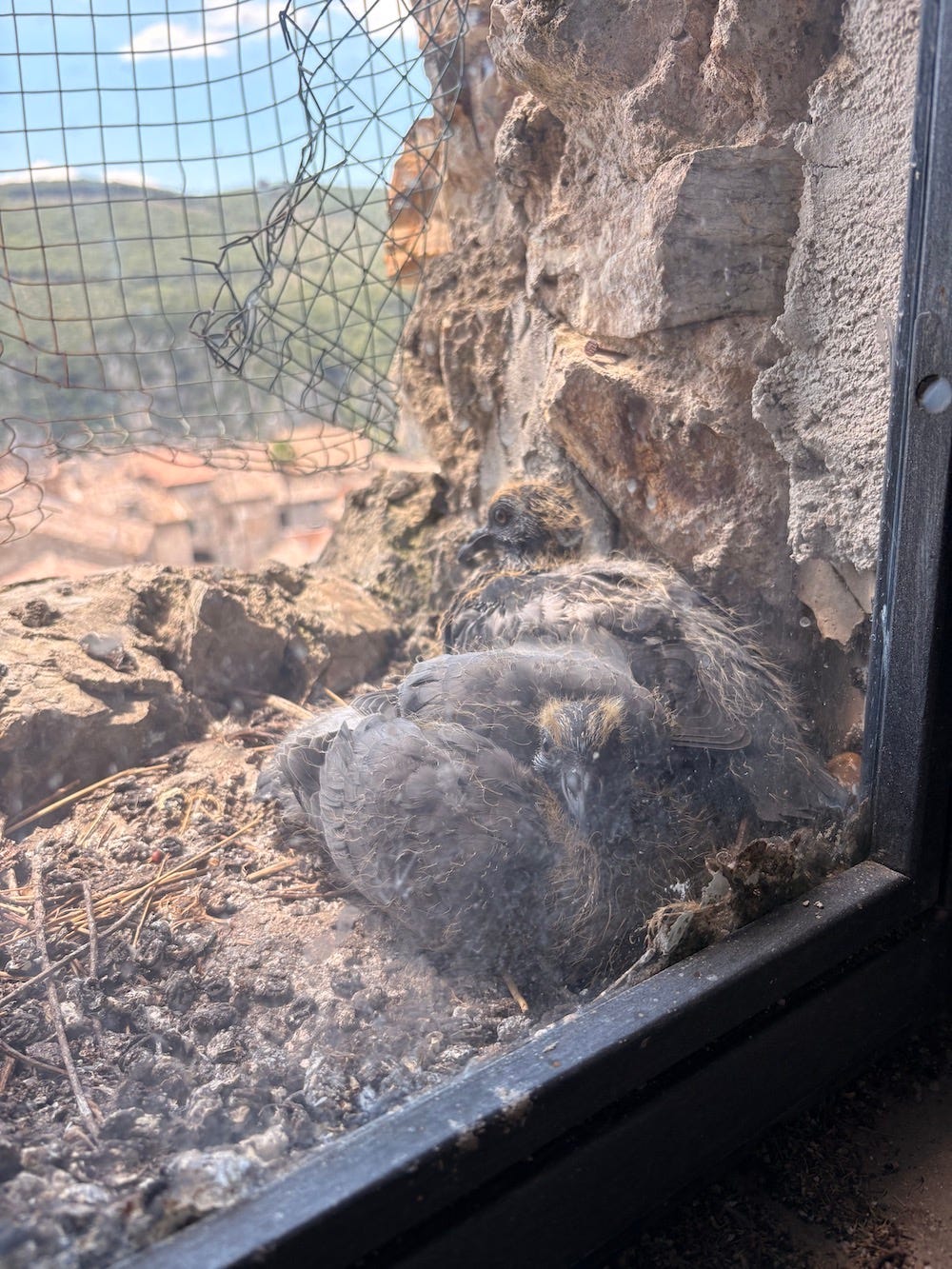
Is it wrong of me to be less excited about pigeons than swifts? Somehow, they just don’t feel quite as magical.
Did you know that baby pigeons go by the ungainly name of squabs? Among many other bits of esoteric knowledge, I happen to know this technical term for juvenile pigeons because as a homeschool kid, I lived for the used book sales my mom would take us to. That’s how she filled our whole house with books.
Sometimes these sales were held at the public library—a mix of donations and titles culled from the library collection. But the really interesting sales were run by the local school district, offloading books and supplies that were outdated or just no longer used. Once, we came home with a whole set of bright yellow raincoats. Another time, we outfitted our homeschool room with desks and chairs. And always, there were books. Whole rooms of books.
I was a nineties horse girl, and maintained a growing collection of horse books, so I always kept an eye out for those. My mom ran a homeschool choir, and early on, she scored a whole set of textbooks containing folk songs from an erstwhile California primary school music curriculum.
To be honest, a large proportion of the books at these sales consisted of outdated textbooks. That was O.K.; they still contained plenty of excellent information. I must have been eleven or twelve when I acquired the two foundational texts of my teenage years:
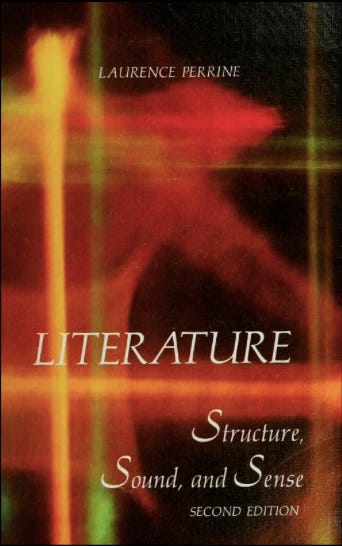
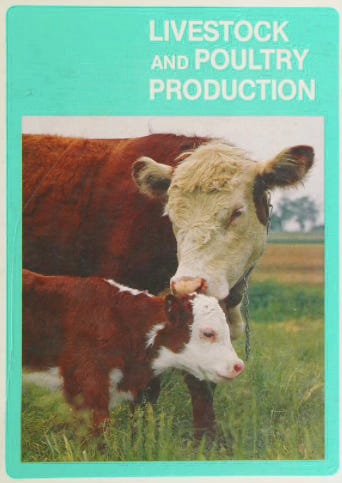
By the early nineteen-nineties when I acquired them, both textbooks had undoubtedly been replaced by more recent versions. Or maybe by then livestock and poultry production no longer featured as an essential high school subject. For whatever reason, these books had ended up in a Woodland Joint Unified School District used book sale.
I lived in those old textbooks. They nourished my twin fantasies: becoming a writer and owning a farm. Those books were the reason I knew the difference between iambs and dactyls. They were also the reason I could rattle off a whole list of “common unsoundnesses of a horse.” Even though I’d spent a combined total of maybe a few hours of my life in close proximity to livestock, I had a ridiculous store of theoretical knowledge on the relative merits of different breeds of sheep, or how to tell from a chicken’s comb and eyes whether she’s a good layer.
Livestock and Poultry Production did not include a section on raising pigeons. But since most of the animals covered in the book would self-evidently not fit in our suburban backyard, I started branching out to other, smaller possibilities. Sadly, I’m violently allergic to rabbits, so pretty much pigeons were what was left.
Also, while I collected horse books, my mom was collecting Newberry Medal winners, with the goal of having the whole set from 1922 to the present day. I feel like those older Newberry winners sometimes get lost in the sands of time. While admittedly The Story of Mankind is a little dry, some of those early winners are great. Check out Smoky the Cowhorse (1927), which fit both my mother’s list and mine. Other gems include Hitty, Her First Hundred Years (1930), and Mr. Popper’s Penguins (1939, though it was just a Newberry Honor book, and not the actual winner; the medal that year went to Thimble Summer, which includes, among other things, a scene where the protagonist gets accidentally locked in the local library overnight. Truly the stuff of dreams).
When I read the 1928 winner, Gay-Neck, the Story of a Pigeon by Dhan Gopal Mukerji, I became captivated by the idea of raising carrier pigeons. Sadly, like so many of my dreams, this one never came to fruition (or at least hasn’t yet). But sometimes I think the key to happiness is having so very many dreams that even a fraction of them coming true will make your life beautiful.
All that said, from my unrealised teenage dream of raising carrier pigeons, I learned that young pigeons were called squabs, vital knowledge that thirty years later I found myself recalling upon discovering two of them squatting in my medieval tower in Italy. And all that mess I’d cleaned up last summer—what I thought was the fossilised remnants of generations? Well, it turns out to be the exact amount of mess two squabs can make in the course of the scant four weeks they spend in the nest.
Which may partially account for how thrilled I was not when I discovered them. Nevertheless, I’m not a monster. I wasn’t about to turn two baby birds out in the cold. Even if they were squabs. So we waited a few weeks, until they looked like actual pigeons, and all the downy fluff had fallen off their necks. The male, who would puff himself up threateningly when I peered at them through the window, was a bolder sort. He soon began ducking under the ineffectual wire and going on little flying expeditions.
The female, though, was timider. She stayed home for days after her brother began exploring. And I confess I was getting a little impatient by this point. My own children were coming soon, and last time they visited our house in Narni, we squashed them both into the Bookish Husband’s office, which doubles as our guest bedroom. I wanted a room for each of them. Plus, if I were visiting myself in Narni, I would definitely want a night in the medieval tower, which up till now has stood empty, aside from—obviously—countless generations of pigeons.
The Bookish Husband and I had already found the perfect guest bed, which was perfect precisely because when disassembled it could fit up through the narrow trapdoor that leads to the tower. I wanted to set up the bed and make the place homey and at least somewhat liveable, even if it may always retain a slightly sinister Tower of London ambiance. But there was an unsightly pile of pigeon poo preventing me.
Which is when I resorted to desperate measures.
There’s a poem by Christopher Logue (perhaps a translated paraphrase of Guillaume Apollinaire; the sages of the internet aren’t in complete agreement). As poetry tends to do, it says exactly what was in my head, and better than I could:
Come to the edge.
We might fall.
Come to the edge.
It’s too high!
COME TO THE EDGE!
And they came,
And he pushed,
And they flew.
Am I a terrible person? Because that’s exactly what we did. After days of waiting for little miss shy pigeon to follow her brother out of the nest, we finally opened the window and shooed her to the edge. We didn’t go so far as to push her, but we shooed until she was perched precariously on an outcropping of rock.
And guess what?
She flew!
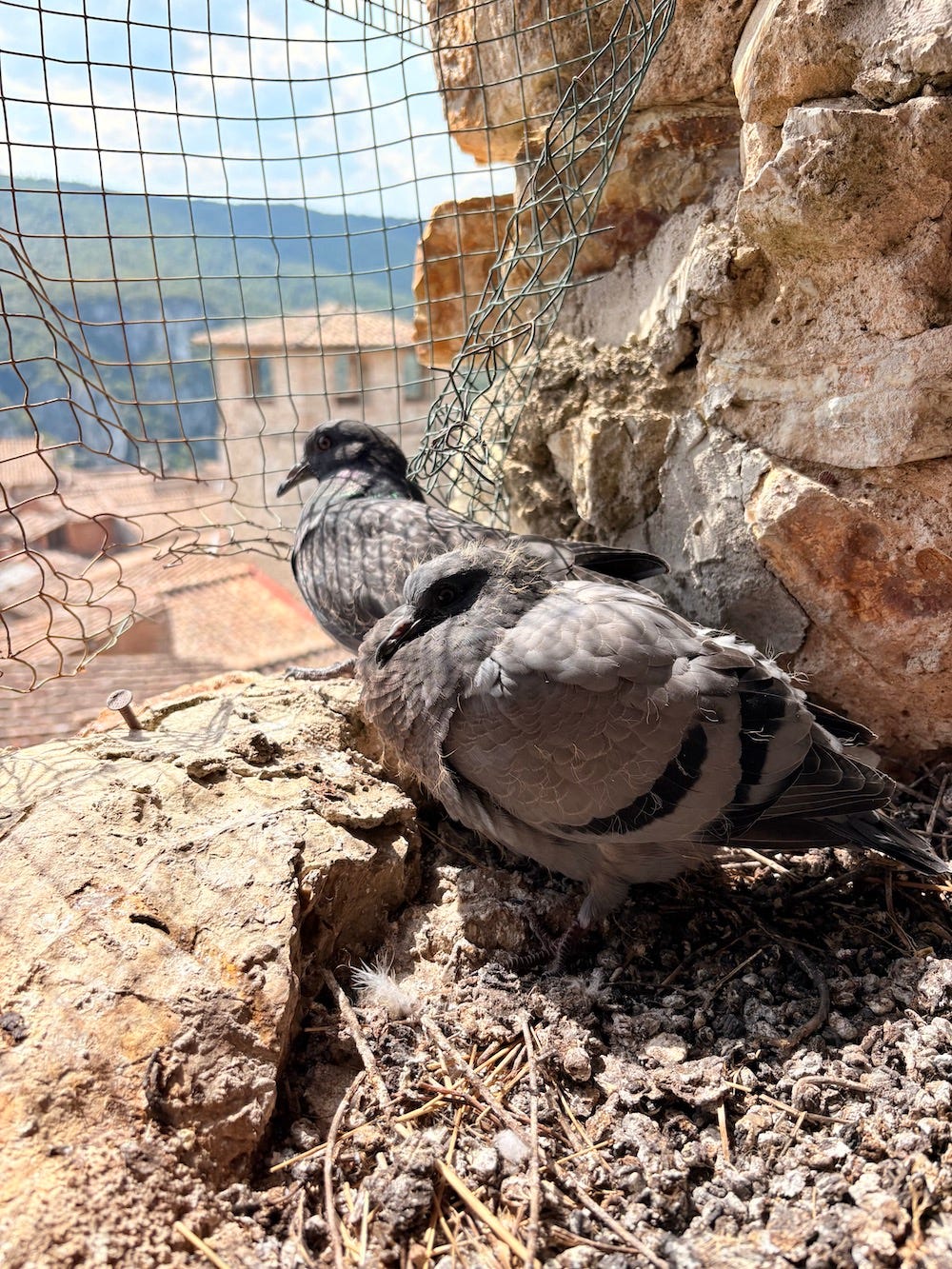
Post-haste, the Bookish Husband wired the chicken wire more tightly around the entrance. And then—bless him—he went the extra mile and cleaned up all the poo. And that was the end (I hope!) of a pigeon saga for the ages. Aside from the fact that as revenge, the entire family (and possibly several friends) have been pooping all over my front steps since then, in retribution.
And the swifts? It’s been at least a week since I heard peeping from the chimney, so I think they’ve grown up and headed for warmer climes, along with the rest of the swifts of Narni, who’ve left on their winter migration to Africa. They’re welcome to come back and nest in our chimney every year. But the pigeons, I fear, will have to find another home.
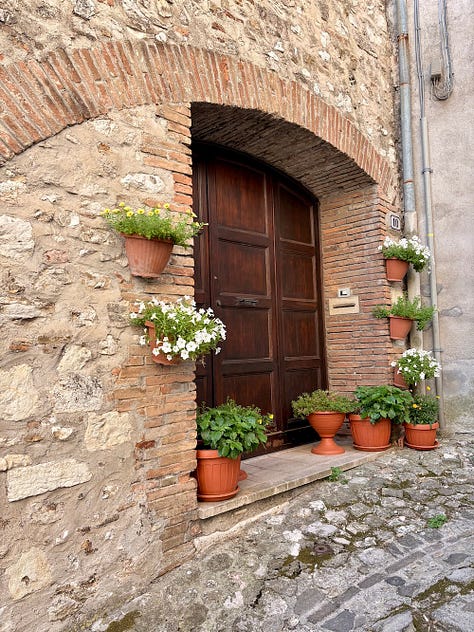
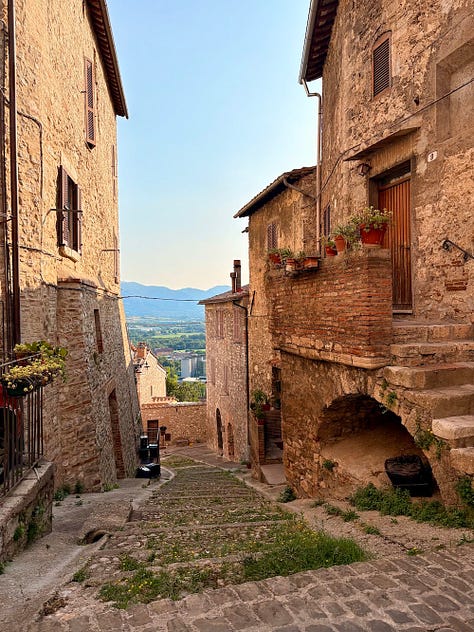
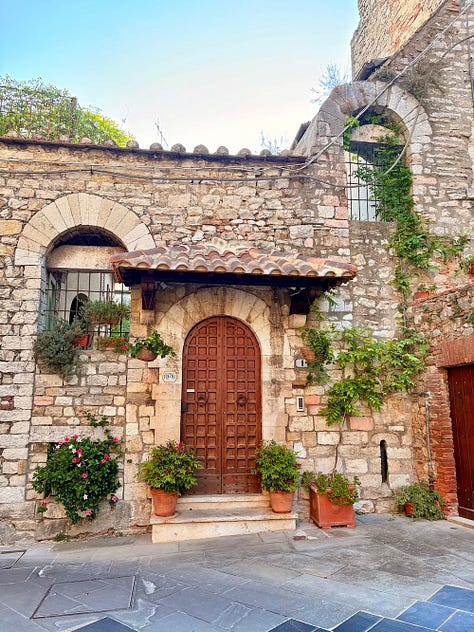
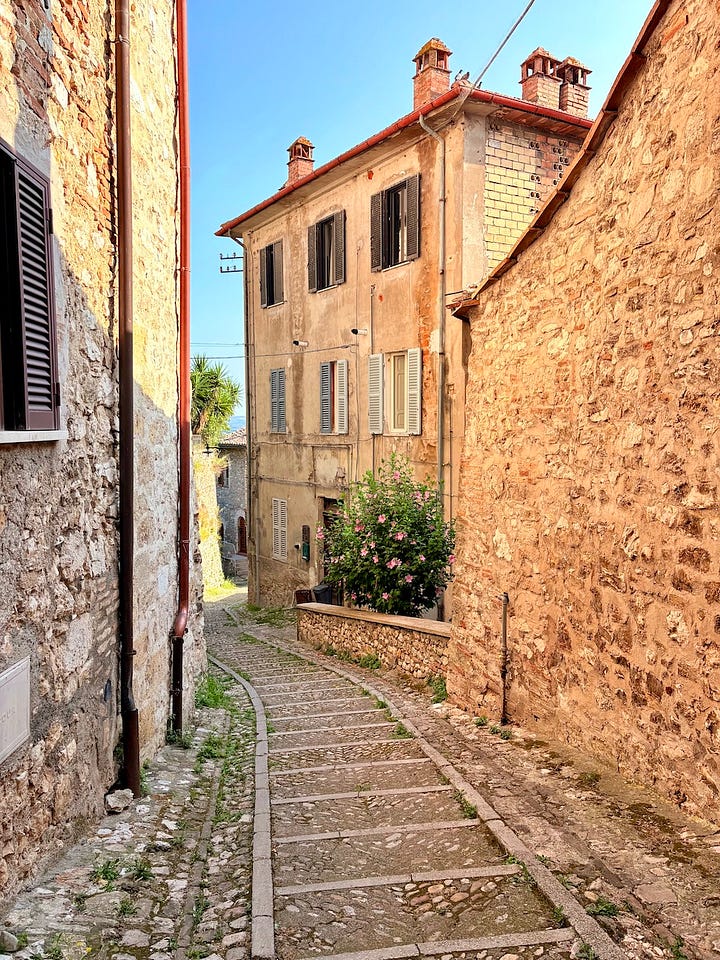
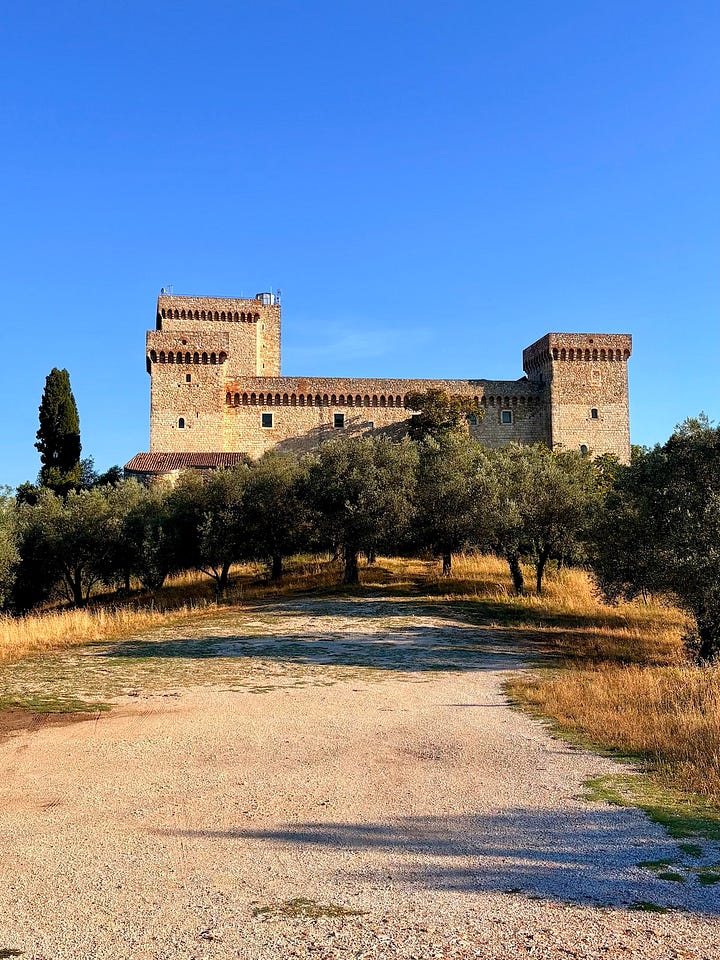
That’s pretty much all the news I have to share from Narni. Well, that and a little carousel from my daily walks at golden hour. Because isn’t this the kind of news we could all use a little more of? Slow news. No news. Just swifts in the chimney, pigeons in the medieval tower, and beautiful views that haven’t changed in centuries.
Comments
Nothing yet. Say the first thing.
Sign in to join the conversation.