

The Cure of Folly by Hieronymus Bosch
This is where I come out and admit something that is actually kind of taboo in science and in educated circles in the Northeast – I watch American football.
Obviously this is essentially expected for the average American male, but in scientific circles, it’s a signal that you’re Not Serious™. Your hobbies should include reading papers, writing papers, discussing papers, and maybe acceptable sports, like rock climbing. Even baseball is OK, I guess because of sabermetrics. But no, not football.
However, I no longer feel the need to impress people, so I feel fine talking about it these days.
As a proud fan of the NFL playoff’s current laughing-stock, the Green Bay Packers, I naturally was disappointed by the results of the Wildcard Round. The Packers defense, if you can even call it that, was ass, something I think is directly attributable to the loss of generationally talented defensive end Micah Parsons a few weeks prior to an ACL tear.
I remember when it happened, I thought “man, it’s crazy that elite athletes get the same treatments for these injuries that 17 year old weed addicted snowboarders do” (yeah this is a shot at snowboarding). Then I remembered reading that NFL receiver Tyreek Hill and previously GOAT QB Aaron Rodgers had gotten some non-standard therapies for their recovery from similarly devastating ligament and tendon injuries, in addition to surgery: stem cells.
Basically, high level athletes and health enthusiasts are going to specialty clinics where, after surgery (if indicated for their injury), they get injections of stem cells at the nidus of pain.
I figure, there has to be something here. So I looked into it, learning something about stem cells but the importance of randomized control trials more broadly.
To my surprise, they kind of seem to work, though not how you’d expect. What I learned in writing this has implications for Twitter’s new favorite thing, peptides.
Obligatory statement here that I’m not an orthopedic surgeon. I’ve observed a handful of spine surgeries, but I don’t care much at all about long bones, so I never sought out seeing one of these surgeries. However, you do learn at least something about them in medical school, so it’s worth visiting some basics.
Long bones articulate (interface) with each other at joints, and the stability of these joints depends on two key connective tissue structures: ligaments and tendons. Though often confused, they are actually different in a topically relevant way. Ligaments connect bone to bone, providing passive stability to a joint. For instance, the ACL (anterior cruciate ligament) holds your femur (the one above the knee) to your tibia (long bone below the knee), preventing your knee from buckling forward. Tendons, on the other hand, connect muscle to bone, transmitting the force of muscle contraction to produce movement, like the Achilles tendon pulling on your heel bone when your calf fires.
There’s a critical asymmetry here that exists, and is why you hear more about these devastating injuries in elite athletes and less so in the general population. While muscles respond robustly to training (and respond very robustly to anabolic-androgenic steroids which I am almost 100% positive is nearly ubiquitous in the NFL) tendons largely do not. Muscle is highly sensitive to both mechanical loading and metabolic stress, hypertrophying in response to a wide variety of stimuli, namely lifting heavy weights. Tendons, by contrast, require very specific loading conditions (high strain magnitude, sustained duration) to adapt at all, and even then their response appears far less sensitive than muscle.
This is a lot of words to say that when you have big muscles – especially from, uh, a chicken and broccoli diet – you are extremely liable to exceed the load your tendons are capable of withstanding. And as players get bigger, their muscles can exert forces in strange ways that result in soft tissue injuries to ligaments, too. Next thing you know, your team is bounced from the playoffs because their star DE is also eating a lot of chicken and broccoli.

Recovery from these injuries are further complicated by the fact that ligaments and tendons are not really that vascularized. They’re dense, fibrous structures composed mostly of collagen, with comparatively few cells and blood vessels woven through them, which makes biomechanical sense when you think about the purpose of these tissues being to be strong and stiff, not spongy with capillaries. When you tear your ACL, the body has limited natural capacity to deal with it, and as such, these injuries do not heal on their own. Surgery is required if you want to keep racking up 14.5 sack seasons like Micah Parsons.
I won’t talk much about the surgery itself, since I know basically nothing about it nor care to, but there are plenty of videos online. The gist is you basically surgically reattach the disconnected pieces together.
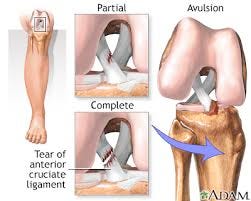
A visual for what the ACL actually looks like when it’s torn.
This vascular poverty is, in theory, exactly where stem cell therapies might offer something. The pitch is basically a way to deliver regenerative cells directly to a tissue that can’t recruit them on its own.
Let’s now talk about stem cells.
When people hear “stem cells,” they usually think of embryonic stem cells that can become literally any tissue in the body, that’s not what we’re talking about here. The stem cells used in orthopedic applications are almost exclusively mesenchymal stem cells (MSCs), which are more limited in what they can do.
MSCs are adult stem cells, meaning they exist in your body right now, but they can’t become just anything like an embryonic stem cell. They’re found in bone marrow, adipose (fat) tissue, umbilical cord blood, and various other connective tissues. Unlike embryonic stem cells, MSCs are multipotent rather than pluripotent, meaning they can differentiate into a related family of cell types (bone, cartilage, fat, and arguably tendon/ligament), but they’re not going to turn into neurons or heart muscle. Think of embryonic stem cells as a blank check and MSCs as a check that can only be cashed at certain stores.
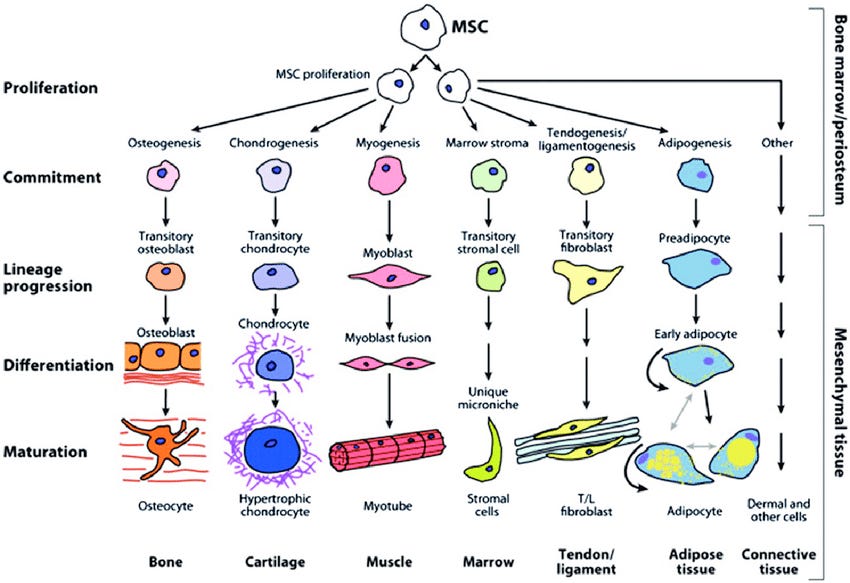
Possible fates of a MSC.
The theory goes something like if your ACL can’t heal because it lacks the cellular machinery to rebuild itself, why not just inject cells that can become ligament tissue directly into the injury site? MSCs can, at least in a petri dish, differentiate into tenocytes (tendon cells) and cells resembling those found in ligaments. They also secrete a cocktail of growth factors and anti-inflammatory cytokines that might create a more favorable healing environment even if the cells themselves don’t stick around and integrate into the tissue.
The standard procedure for obtaining MSCs is a bone marrow aspirate, typically drawn from your iliac crest (the top of your hip bone) with a big needle. This isn’t pleasant, but it’s a same-day outpatient procedure. The aspirate is then centrifuged to concentrate the mononuclear cell fraction and this “bone marrow aspirate concentrate” (BMAC) is injected into or around the injured tissue, sometimes during surgery and sometimes as a standalone treatment after surgery is done. You can also go the liposuction route, if you have the deposits for it, since adipose-derived MSCs are an alternative.
What happens from there is somewhat unknown, though. It turns out that stem cells need quite a bit of context to know what to become, which sometimes is not possible by simply introducing undifferentiated cells into a broken environment. Knowing what we currently do about stem cells, it follows that it’s unlikely that stem cells are really meaningfully becoming usable tissue, but again, no one really knows. This is part of the thing that Polyphron is trying to solve with their approach, something I wrote about last year.
Regardless of what actually is happening once the needle goes into the swollen joint, it does seem that this actually just works pretty well by one metric, pain alleviation.
I’ll start by saying that there actually have been human randomized control trials that have attempted to use MSCs in the treatment of all sorts of orthopedic injuries, namely in knees. The general breakdown of these studies is to divide patient groups into surgery only vs surgery and stem cell injections.
Data collection is where things get a little dicey. At some point down the line they assess how much function the patients have gained using patient reported outcome measures (PROMs), which just means we ask patients how they feel and report that data as objective.
Let’s examine this randomized control trial looking at augmentation of meniscus repair with MSCs. They start with nearly 100 patients, and divide them into each of the two groups that got surgery, with one group getting MSCs and the other going without. In addition to the patient-reported outcomes, the study includes radiographic outcomes using Kellgren-Lawrence (KL) grading at baseline and 1 year postoperatively, measured in both extension and flexion views and measured joint space height changes over time. These are objective, imaging-based measures of osteoarthritis progression.
At 1 year, which is plenty of time later for a meniscus repair, the MSC group had no difference in outcomes by imaging (MRI in this case), but they reported higher return to activities of daily living and sport, with less pain!
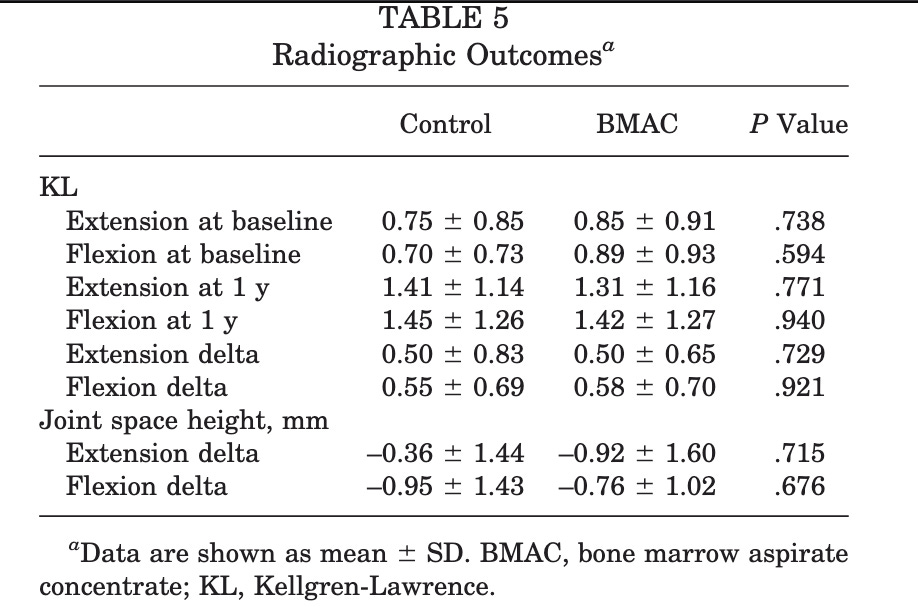
Results of the trial. BMAC is the bone marrow group, control is the surgery only group.
What? So the doctors couldn’t see any differences, but the patients felt better? That doesn’t make sense. This is double-blind! That may very well be true, but maybe you can explain to me how you blind a patient from knowing a hole was drilled in their hip to extract bone marrow aspirate.
There are other studies out there but ultimately this isn’t an academic review, so I’m not going to break them down, but I did want to talk about an important thing here, which is the pain-function axis. It is the backbone of many of the findings that support the use of MSCs in repair and recovery. The pain-function axis refers to the bidirectional relationship between how much pain someone perceives and how willing they are to use and rehabilitate an injured limb. Less pain means more movement, more movement means better functional outcomes, and better function often means less pain. This creates trouble when it comes to using these types of data in trials. Essentially, the thought here is that if patients believe they got a special treatment they will believe they are on their way to improving, and then will shift their behavior towards one that will aid in recovery.
This doesn’t need to be viewed as a “woo” thing. It’s really pretty simple. If you believe that your knee WILL get better with this special treatment, you are very likely to more meaningfully engage with recovery measures. You’ll trust that leg a little more the first time you try walking, or maybe you’ll push a little more in physical therapy.
Again it’s totally possible that there is something more physiologic occurring, but I don’t want to discount the power of psychology here in driving the kind of shift necessary to speed up recovery from physical injuries. It’s even something that’s been studied in orthopedic surgery itself, because it’s a fascinating idea.
A New England Journal of Medicine article from 2002 looked into this as part of a wider study on arthritis surgery. They broke their 180 enrolled patients into three groups: arthroscopic débridement, arthroscopic lavage, or placebo surgery. The placebo group here got a real incision under real anesthesia, but didn’t get anything else – they were closed back up without further intervention.
I’ll just quote the authors here on the outcome:
“At no point did either of the intervention groups report less pain or better function than the placebo group. For example, mean (±SD) scores on the Knee-Specific Pain Scale (range, 0 to 100, with higher scores indicating more severe pain) were similar in the placebo, lavage, and débridement groups”
There might be something to be said here about the merit of this specific surgery itself, but this actually extends beyond knees. In a different 2004 JAMA Psychiatry study, 30 patients with Parkinson Disease were blinded and divided into sham-surgery versus stem cell implant surgery. You might be able to tell where this one’s going at this point, but I’ll quote again from the study directly:
“In all cases, those who thought they received the transplant reported better scores. Blind ratings by medical staff showed similar results.”
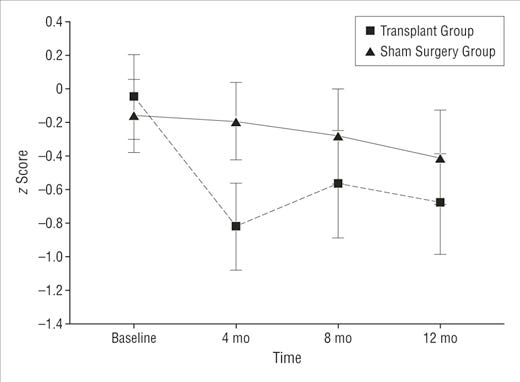
“Mean changes in Physical functioning quality of life from baseline to 12 months: actual surgery. Decreased scores indicate improvement. Error bars represent SEM”
The power of placebo in surgeries is extremely underrated by the general public. That’s not to say that nothing is happening, but I believe a lot of what is happening is in the mind of the person who receives the surgery. To be clear, some evidence exists to suggest more molecular things are happening when stem cells are put at a site of injury, I just don’t think it’s the predominant thing that is occurring.
It’s difficult for me to say that MSCs are actually doing much beyond changing enrolled patient psychology and behavior, but I would be comfortable saying that they clearly are providing something. I just don’t think these treatments are doing what many clinics are reporting they do.
So, let’s now talk about BPC-157.
There’s been considerable attention on peptides like cerebrolysin and BPC-157 online, but now also in mainstream outlets like the New York Times, with users reporting incredible claims of recovery from injuries, slashing their sleep, and even improving their social performance. To me, the hype around peptides should immediately trigger legitimacy alarm bells in your mind, the same way expensive surgeries that seemingly don’t outperform placebo do.
Let’s consider the example of BPC-157. Very briefly, BPC-157 is a peptide that some people are injecting for the purposes of recovery. “BPC” stands for “Body Protection Compound” (DING). It’s a synthetic 15-amino-acid fragment derived from a protein found in human gastric juice, first characterized by a Croatian research group in the early 1990s studying gastric ulcer healing. Since then, rodent studies (almost entirely from that same Croatian group – DING again) have claimed it accelerates healing of basically every tissue anyone has bothered to test, with proposed mechanisms ranging from growth hormone receptor upregulation to nitric oxide modulation to angiogenesis promotion (DING once more).
The reality is that there are zero controlled human trials, no independent replication of most findings, and no actual consensus on mechanism. Despite what people on Twitter will confidently tell you about the FAK-paxillin pathway or collagen synthesis, the honest answer is we simply don’t know if it works in humans or how.
But, to be fair to the defenders, there is a single CHART REVIEW analyzing efficacy in humans (DING DING DING). I want to make it clear in no uncertain terms that chart reviews are not the standard for analyzing the efficacy of treatment in humans by anyone’s definition. They basically involve a researcher looking at the medical chart of patients who got some treatment in the past. These are retrospective, uncontrolled, and rely entirely on whatever happened to be documented in medical records, without any particular attention to inclusion factors of patients beyond them getting the treatment in question. There’s no randomization, no blinding, no placebo group, and no way to distinguish actual drug effects from natural healing, placebo response, or the dozen other treatments patients were probably receiving simultaneously.
Unfortunately, this is all we have to go off of after 30 years of BPC-157.
People are using it though, and they are reporting improvement in knee pain, energy and other things. If we apply our critical lens established by everything above in this piece, we should consider that it’s possible these are the result of a placebo effect. And the same is likely to be said about other unstudied peptides.
There’s also a chance that BPC-157 injections into bum knees and hurt elbows is taking advantage of the same mechanism that makes platelet-rich plasma injections helpful for knee injury recovery. In that treatment, a patient’s own blood is taken and filtered down to just platelets, then injected at the injury site, with the belief that this provides some signaling necessary to speed up the healing process.
If after reading this you are starting to question BPC-157 and how it works, then I have made some progress towards accomplishing my real goal. The trouble with peptides and bold claims about their effectiveness is that N-of-1 trials for things as simple as lifestyle changes can be difficult to extrapolate to larger populations.
The use and excitement is not a reflection of the intelligence of anyone using the compound. Rather, I’m simply saying it’s a standard complication the medical research industry has dealt with for nearly a century. Standardization is needed in trialing these things if we are going to know what the deal is.
There are Telegram groups where people share things like liver function tests (LFTs) and their electrolyte panel or their blood cell counts, and that’s great that they’re collecting that safety data, but this is not the same thing as collecting efficacy data. Furthermore, it’s worth mentioning that BPC-157 is not safe just because it doesn’t cause your liver to explode (the approximate cause of elevated LFTs). It’s not safe because your blood cells don’t collapse to zero and give you anemia instantly. These are acute markers of issues – helpful to know if you should drive yourself to the hospital ASAP – but not indicators of whether future cancer risk is elevated from its use.
And that brings us to the conclusion here. Yes, I know that I’m a part of the medical establishment or whatever, but hopefully you can develop an appreciation for why PhD- and MD-researchers wax poetic about randomized control trials when they see fantastical claims of recovery from mystical internet substances. We’ve been burned before by much more innocuous things – things that worked in mice or rats, things that were so logical it seemed insane we didn’t try them before. But, the medical community has since come to realize that 95% of these rodent studies do not replicate in humans, and peptides are not a special case.
So, should you get MSC treatment or take peptides for your knee pain? Not medical advice, but sure, maybe after trying a blinded saline injection first.
Yes, even you Micah. And maybe try cutting down on the chicken and broccoli.
#GoPackGo
No posts
Comments
Nothing yet. Say the first thing.
Sign in to join the conversation.