
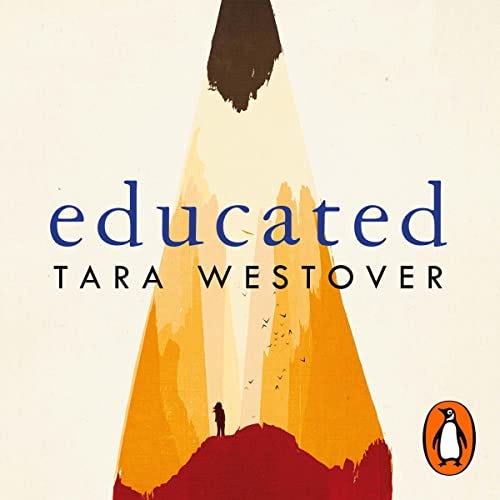
It’s like sitting with someone who has finally decided to tell the whole truth about their childhood. You then realize that “education” here isn’t a neat before-and-after, but a slow tearing apart of the only world she ever knew.
Westover grew up in a deeply conservative Mormon household in rural Idaho, where family loyalty and her father’s version of faith shaped every decision. She had no regular school days, no doctors, no safety nets. She only had her mother’s makeshift homeschooling, her father’s junkyard, and a constant undercurrent of fear about the government, the end times, and sin.
Young Tara learned to see the world entirely through her family’s eyes—through her father's paranoia, which becomes her reality.
Some of the hardest portions to read happened in the junkyard and inside the family home. She recounted how her father repeatedly puts her and her siblings in danger through reckless work and refusal to acknowledge risk.
Meanwhile, one brother, fueled by jealousy and rage, turned their home into a place of violence and humiliation, which Tara endured in silence. A silver lining: another brother became her lifeline, the one who believed she might be capable of something beyond their mountain and nudged her towards formal education.
This tension between cruelty and care, between the brother who destroys and the brother who believes, was part of what made this memoir (a) heavy (read).
What made Educated compelling is how sharply Tara remembers. Her memories felt cinematic: the texture of the junkyard, the way her father’s moods can shift an entire day, the physical details of accidents that became “God’s will” instead of preventable harm.
She also showed how memory itself cannot be contested, how her family’s version of events clashed with her own recollection. At one point, she even doubted her own memory, questioning moments in her life. That tug-of-war over “what really happened” was as central to the story as the actual events.
So when she finally steps into a real classroom (she was homeschooled), first at Brigham Young University, then at Cambridge and Harvard—education doesn’t magically fix her. It destabilizes her. The more she learned, the harder it became to keep her family’s worldview intact.
History, philosophy, and conversations with mentors also began to broaden her perspective, and that widening was both liberating and devastating. For her, the cost of seeing clearly is realizing how much harm has been normalized and made sacred by the people she loved most.
All in all, this is not a rags-to-riches narrative in which the heroine escapes, earns degrees, and everything is fine. It’s a story about what it means to lose your family because you chose truth and safety over loyalty and silence.
Tara’s education doesn’t just give her knowledge; it forces a reckoning. She had to decide whose voice to trust: her own, or the voice of a family that would rather call her possessed than admit to abuse.
So the book closes not with a triumphant reunion, but with a painful kind of distance: she is more “educated,” yes, but also more alone.
For me, Educated is worth reading, not because it’s inspiring in a motivational-poster way. Because it’s honest about the cost of changing your mind when your entire identity is built around one story of the world.
Educated is indeed a memoir about growing up, breaking away, and accepting that sometimes, the price of seeing more clearly is losing the people who taught you how to see in the first place.
Tara’s story reminds me that education can be like a solvent that dissolves old certainties rather than simply “elevating” her.
This was in contrast to how her family interpreted her education: rebellion and spiritual corruption, not growth. The more she learned, the more her family insisted that “she’s lost,” or “even under the influence of the devil.”
As her story ended, Tara didn’t get closure or a neatly healed family. Thus, this puts forward the question: what are you willing to lose to live in truth?
In the end, Westover calls this painful transformation, what her family might see as betrayal, her education. It’s not just the degrees or the prestige; it’s the decision to live in her own mind, trust her own memories, and accept that whoever she becomes was always inside her, even on that mountain.
That’s the kind of “educated” this book is really about.
No posts
Comments
Nothing yet. Say the first thing.
Sign in to join the conversation.