
To paraphrase Tolstoy: All unremarkable cities are alike; each remarkable city is remarkable in its own way.
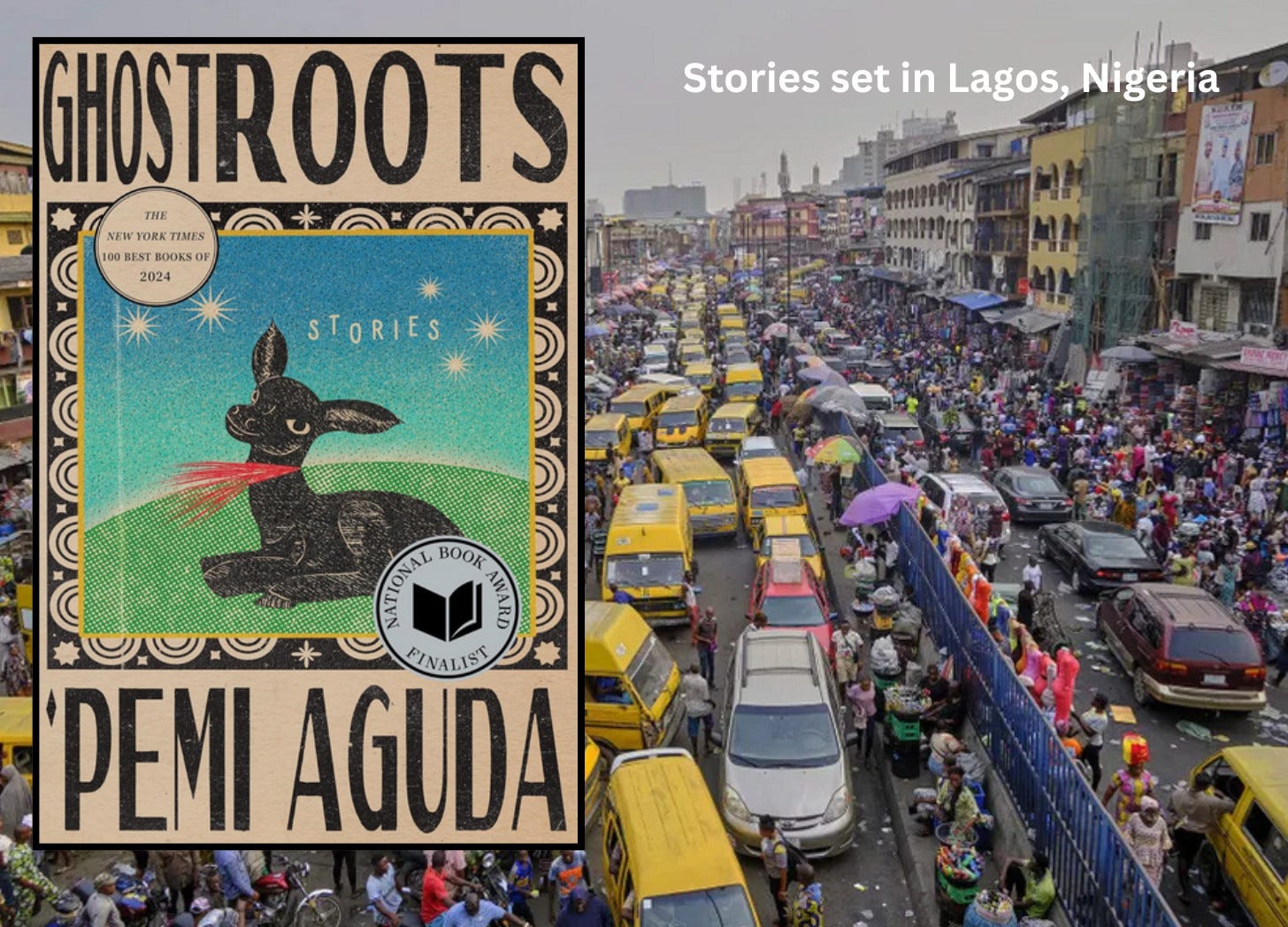
Consider the sprawling, chaotic, and cosmopolitan city of Lagos, Nigeria. Founded in the 15th century, built amid a network of lagoons, it is now Africa’s busiest seaport. The city’s film industry—Nollywood—is second in size only to India’s Bollywood. Lagosians are roughly split between Christians and Muslims, with many people practicing traditional African religions alongside those two more recent faiths.
I don’t know the city well, although I did live there as a child. In the 1960s, my father worked for the US National Health service as a doctor for Peace Corps volunteers in Nigeria. I still have sensory memories of the heat, the smells, and the crowds, and I’ve always wanted to go back to Lagos, despite the city’s reputation for crime and corruption. My younger brother was born there; his birth certificate, on pale blue onion-skin paper printed with a silhouette of Africa, has a line where you’re supposed to note the baby’s tribe. Our tribe is Van Rheenen. We are a small clan, but we too have our beliefs and superstitions.
Speaking of superstitions, there’s one in Nigeria that says if you pick up money on the road, you’ll turn into a yam. Yum! I heard another about a headless girl who braids her own hair. I guess she must hold her head in her lap? That would certainly make it easier to braid the back.
In Ghostroots, ’Pemi Aguda’s stories are right at home in this cauldron simmering with reality and unreality. In fact, she takes that strange brew and turns it on High.
In a recent interview in the New York Times Book Review, the author V. E Schwab said that some writers “take you out of your world in order to deposit you in a magical one. Others try to convince you that magic has been in your world all along.” Aguda’s approach is a mix of those two.
We are both grounded and upended in a world where street markets are strewn with “unlikely lottery tickets stained pink by the juice from baskets of tomatoes,” and where a woman flies away but is brought down by rocks hurled by those who think she’s a witch. We visit neighborhoods where mothers pre-mourn their imperiled sons and gossip about a woman who must be unhappy because she doesn’t have a man. “If man for day, shebi im go dey smile,” they whisper among themselves, and we get it without the author translating the dialect. Or we sort of get it, which leaves the (non-Nigerian) reader in a state of half-comprehension that is shared by many of Aguda’s characters.
Things are not as they seem in Aguda’s world. Or better put, they are as they seem, only more so. Real situations and recognizable emotions are twisted and pushed to extremes. In a woman’s collective that requires contributions from its members, a poor woman contributes parts of her body instead. Everyone thinks that’s a viable solution.
All these oddities would be just that—odd—if they weren’t grounded in realistic and surprisingly resilient characters who we care about, or at least want to follow along as they traipse through a world in which the surreal steadily drips through the cracks of the real.
Ghostroots: Stories by ‘Pemi Aguda
W. W. Norton & Company, May 2024
224 pages
No posts
Comments
Nothing yet. Say the first thing.
Sign in to join the conversation.