
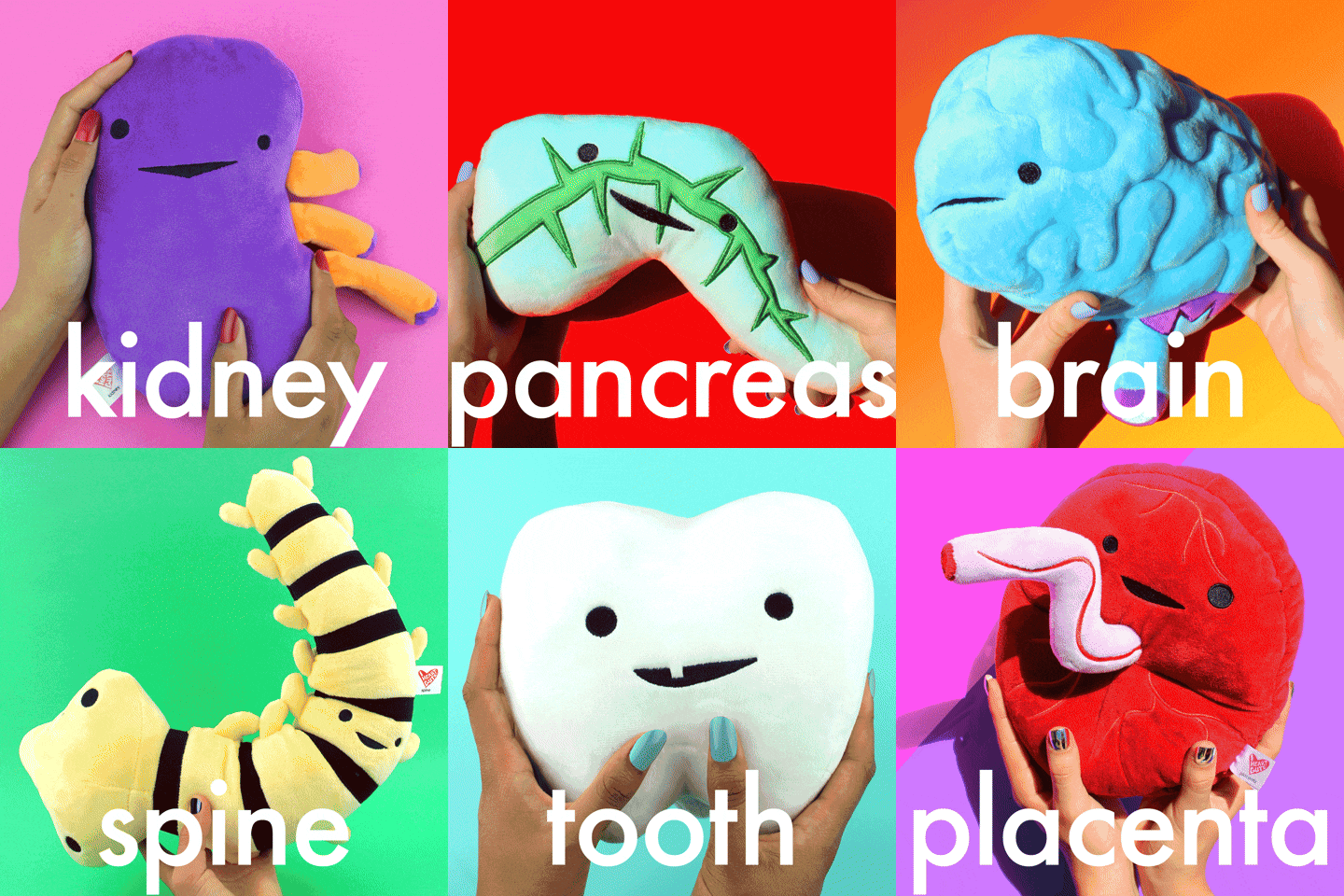
I’ve been dealing with kidney stones - and they can literally, figuratively and all the other ly’s suck ass.
In the last year I’ve had three. I’ve never in my life had them so this has been a health journey (I hate using the word journey to describe our experiences, but at this exact moment, words are failing me) that I never anticipated or appreciated because again, ouch.
So I passed a stone this past weekend, and at my follow-up x-ray the doctors saw cysts on my kidneys and scheduled me for an ultrasound of my kidney’s and bladder. I haven’t had an ultrasound since I was pregnant with my babes.
The ultrasound technician put the warm goo on the thing, started the ultrasound and my body had, I think for the first time ever, a really strong reaction to the experience. The last time I had an ultrasound was when my daughter was 31 weeks old, she came the following week when my water broke at 32 weeks. You can read more about her birthing story in The Myth of the Perfect Mom.
But damn, the feelings of being pregnant during the pandemic came rushing over me. The fear, the urgency, the unknown.
We finished up, I gathered my things, got in my car and immediately started crying. And yes, I’m well aware of the preemie trauma I likely haven’t processed. Also, having a preemie in May of 2020 was terrifying, for so many reasons.
Ok, so what’s the point? The point is this: I have recommended The Body Keeps the Score to SO many clients over the years, and I regret it. I don’t think it’s a book written for women, moms, birth, postpartum or motherhood. I just don’t. I think it needs to be rewritten for us.
Before diving in, I need to give credit where credit is due. The Body Keeps the Score has been a culture changer. It has brought really important mental health conversations to the forefront:
Trauma
How we hold trauma
PTSD as a body based experience
Somatic healing.
And also, I think it’s really important to ask whose bodies are we talk about? Whose bodies are we studies, and what are the circumstances around what we are seeing? Early PTSD studies revolved primarily around veterans, not specified to parenting. But the longer I’ve worked with women—especially mothers—the more I’ve wondered whether we’ve missed an important piece of the story.
Not because the book is wrong, but because it isn’t the whole story. Much of our foundational understanding of trauma came from studying soldiers, combat veterans, and other populations that were overwhelmingly male. Those studies changed medicine. They deserved to.
And still, women don’t always experience trauma the same way combat veterans do. And we often don’t carry it the same way either. Think birth trauma, infertility, perinatal mood disorders, what the stress of parenting does to our nervous systems and the whiplash we experience in our relationships after becoming moms.
In my experience as a therapist, most of the women I work with who have trauma don’t look traumatized, they look competent. We’ve learned to survive by adapting, requesting little of the environment around us. And because “being easy” is praised, we rarely get recognized for what we’ve been encouraged to embody: brilliant adaptations to environments where our needs didn’t feel seen, safe to express or acknowledged as real.
One of the things we rarely talk about is that the science of trauma and surviving traumatic experiences has never been as objective as we’d like to believe.
For decades, much of what we’ve understood about the human body has came from studying men. Not because researchers thought women’s bodies weren’t important (I think this is up for debate), but because they we’ve been considered too complicated. Hormonal fluctuations, menstrual cycles, pregnancy, and menopause introduced variables that made research more difficult. So women were often excluded altogether.
Trauma research has followed a similar path and I’ve often wondered what our understanding of trauma would look like if the foundational research had begun somewhere else. Somewhere like with women.
What if we’d started by studying women navigating years of coercive relationships? Mothers recovering from traumatic births. Women carrying childhood emotional neglect into adulthood. Caregivers whose nervous systems rarely have the luxury of returning to baseline because someone is always depending on them. Many women don’t present with the trauma symptoms we’ve been taught to look for.
We don’t necessarily relive the event in obvious ways. We don’t always appear angry, explosive, or visibly hypervigilant. Sometimes it’s crying after an ultrasound and being brought back to having a baby during Covid.
That’s the nuance I think we’re still learning to see. The goal isn’t to replace what we know about trauma. It’s to broaden the picture. Because when the research begins with one group, it’s easy to mistake one version of trauma for the universal experience of it.
Women’s bodies have always been telling us their stories. We’re just need to get better at asking the right questions.
The body absolutely keeps a score. For some it’s the whole thing, for others it’s just a part. But we need to make sure that it includes women, not just men. Every psychological theory on trauma can’t be applied to just one set of people.
Right? Like my kids both like noodles, but they don’t like them in the same and therefore we cook 800000 dinners because the same carb can’t be applied to the same tastes of 2 different people. Yes, I recognize this as a very very simplified comparison, but one just the same.
As a clinician, I don’t think the takeaway is that women need an entirely different model of trauma. The nervous system is still the nervous system. Trauma is still trauma. But I do think we need a more expansive lens.
One that recognizes that survival doesn’t always look like panic or paralysis. Sometimes it looks like competence. Sometimes it looks like chronic caregiving. Sometimes it looks like the woman who never misses a deadline, never forgets a birthday, and never lets anyone see how exhausted she really is.
The question I find myself asking in therapy isn’t, “Does this person have trauma?” It’s, “What does this person need in order to feel safe?”
Because that’s where so much healing begins. Not by pathologizing every high-achieving woman or assuming every people-pleaser has unresolved trauma. Human beings are far more complex than that. But by becoming curious about the strategies that once protected us—and whether they’re still serving us today.
When we approach those adaptations with compassion instead of judgment, something shifts. The goal isn’t to erase them. It’s to expand the repertoire. To help someone discover that they have more options than the ones their nervous system learned in the context of survival.
For me, that’s what trauma-informed care is really about. It’s not asking, “What’s wrong with you?” It’s asking, “What happened to you?” and then, just as importantly, “What helped you survive?”
And ultimately:
“What would safety make possible now?”
Ok. And now I go think more about noodles. As always, xoxo Erin
Comments
Nothing yet. Say the first thing.
Sign in to join the conversation.