

A society reveals itself less through what it admires than through what it fails to notice.
We pay attention to the extraordinary and construct our histories accordingly. The people who populate biographies, newspaper columns, documentaries and commencement speeches are those whose lives diverged sufficiently from the norm to become visible.
Yet the more revealing features of a society are often those which pass entirely without comment, for it is within the unnoticed that you may find the assumptions so widely shared that they no longer appear as assumptions at all.
One week, now, after arriving in San Francisco, I became aware that many conversations which would have felt remarkable in Cambridge were occurring here with all the emotional intensity of a discussion about the weather. People spoke casually about leaving stable careers in order to pursue uncertain ventures; about relocating across continents on little notice; and about spending years building technologies whose eventual success depended upon developments that had not yet occurred.
None of this is treated as especially noteworthy. These conversations possessed the peculiar quality of complete normality.
This observation remains with me because it suggests something I had not previously considered. We often imagine that societies are defined by what they encourage, but perhaps they are defined more accurately by what they render ordinary. Encouragement implies conscious persuasion. Ordinariness is considerably more powerful. An individual may resist an argument, or disagree with a philosophy, however it is far more difficult to resist an atmosphere.
One does not argue with the air. One breathes it.
The assumptions embedded within a place exert their influence because they rarely announce themselves. A student arriving in Cambridge quickly discovers that certain ambitions possess an obvious legitimacy. Academic distinction, intellectual achievement, institutional prestige and scholarly accomplishment appear self-evidently worthy of pursuit, rather than merely desirable. Few people explicitly instruct you to value these things as such instruction would scarcely be necessary; one absorbs the lesson indirectly through observation.
After sufficient observation, these patterns cease to resemble cultural preferences and begin to resemble reality itself.
This process is neither unique to Cambridge nor especially unusual. The same mechanism operates everywhere. The ambitions that appear natural in one environment often appear improbable in another. In fact, entire populations can come to inhabit radically different conceptions of what constitutes a sensible life, while remaining largely unaware that alternatives exist.
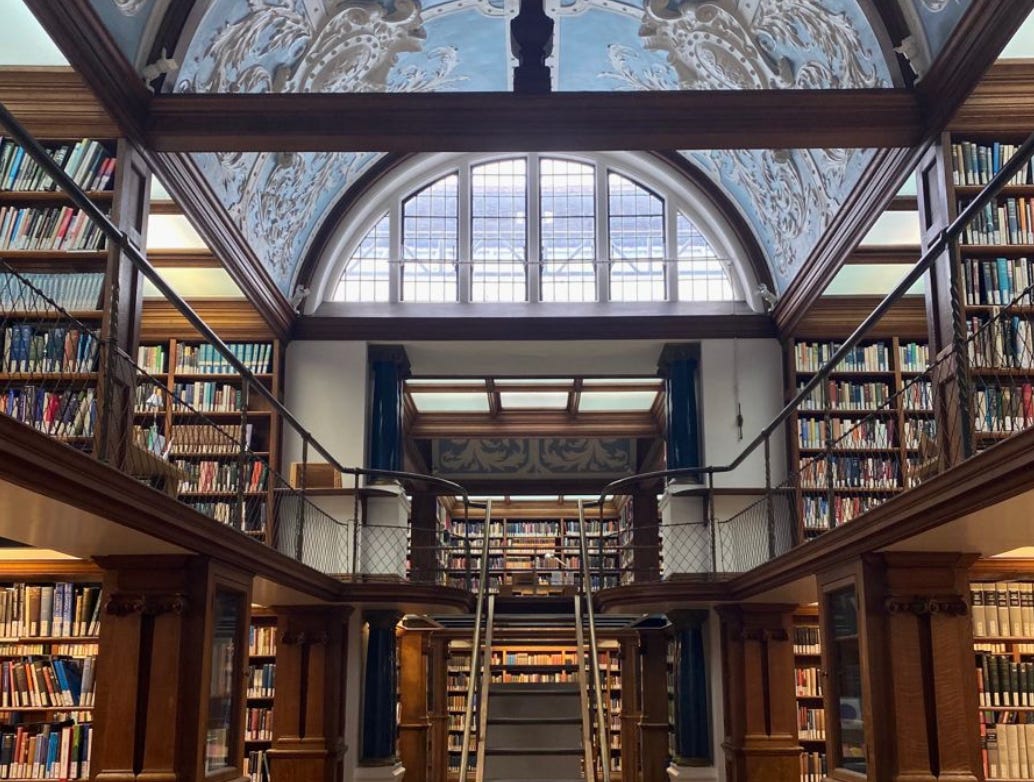
What interests me is that educated people are often especially susceptible to this phenomenon because they tend to mistake awareness for independence. They recognise that social pressures exist and therefore assume themselves immune to them. Yet recognition occurs within boundaries that are themselves socially constructed: one can think carefully about which path to follow whilst remaining entirely unaware of the landscape beyond the horizon.
The economist might describe this as a local maximum. A person standing upon a hill can improve their position continuously without ever discovering the mountain elsewhere. Every step upwards appears rational and there exists no obvious reason to descend, yet the very success of the climb obscures the possibility that a larger ascent exists beyond view. Entire lives can unfold in this manner.
People become extraordinarily sophisticated within a narrow region of possibility and never encounter sufficient evidence to question whether the region itself was chosen freely.
Travel has long been praised for broadening the mind, though this description lacks precision, for what travel broadens is not the mind, but the catalogue of possibilities available to it. The benefit lies in discovering that many things one had mistaken for features of reality were just features of a particular environment. Simply put, the boundaries of the imaginable are far more local than they first appear.

This is perhaps why arriving somewhere new can feel simultaneously liberating and destabilising. The experience is far more than geographical. You quickly become aware that entire categories of life which previously occupied the realm of abstraction are, for other people, entirely ordinary. The entrepreneur, the academic, the artist, the investor, the researcher, the founder, the writer; each appears inevitable within one environment and improbable within another.
I sometimes wonder how many ambitions are chosen and how many are inherited. The distinction is difficult to discern because inheritance rarely arrives in the form of instruction. More often it arrives through repetition.
Perhaps this is the greatest gift of leaving a place one has come to regard as normal. You don’t always discover better opportunities elsewhere, but you do discover the contingency of your own assumptions.
For a brief period the invisible becomes visible.
You notice that the world contains many hierarchies of ambition, each sustained by its own culture, its own institutions and its own conception of success. The effect resembles stepping outside a building you have inhabited for so long that its walls had become invisible. What previously felt universal begins to reveal its spacial origins, and the range of conceivable lives you could live expands accordingly.
Comments
Nothing yet. Say the first thing.
Sign in to join the conversation.