
As we approached the departures drop-off area of the airport, traffic came to a complete stop. Soon our Uber driver was working his way over to the right, out of the through lane and into one of the drop-off lanes. His efforts to switch lanes were met by aggressive honking from another vehicle trying to merge back out of the drop-off lane.
Before I even exited the Uber, my nervous system was on high alert. It was going to be a long trip.
As I noted in my article last week, our family therapist told us we were brave for taking our three AuDHD children on a week-long trip to Mexico. I responded, “brave or stupid.” Even a week after the trip ended, I’m still not certain which of those adjectives is more appropriate.
Arriving at the airport is rarely easy for anyone: between the crowds, the noise, and the chaos, it’s not exactly tranquil. My husband travels regularly for work and seems to be at ease in the airport, so who knows, maybe some allistic or neurotypical folks have no problems with it.
The moment we entered the doors, my middle child turned to me with large eyes and said, “this is overwhelming.”
I agreed.
There were lines of people everywhere, but unlike back in the 00’s when I traveled regularly between the US and the UK, there didn’t appear to be manned customer service desks. Instead, travelers were intended to use kiosks for self-check-in and then join a line simply to drop off their bags. In theory, this system works well, except when it doesn’t. The kiosk wouldn’t print our boarding passes because a human needed to put eyes on our passports first.
Thankfully, my husband is a frequent traveler, so he was able to see through the complete chaos and find a human being near the kiosks. There was, of course, a line to see said human being (with no barriers or signs indicating where people should wait), but Robert navigated us in the right direction. It’s a good thing, too, because if I’d been on my own, I’d probably still be wandering around the airport trying to figure out where to go.
All that is to say that even before we dropped off our luggage for our flight, my three kids and I were pretty overstimulated. And it wasn’t even seven o’clock.
The next airport gauntlet was security. As a frequent traveler, my husband has TSA PreCheck, which allows him to join a special line with expedited security, and the estimated wait for his line was only five minutes. Thankfully, minor children can pass through PreCheck with their parents, so the kids went with him.
Unfortunately, my PreCheck designation expired during COVID, and since I fly so infrequently, I haven’t gotten it renewed. There were several security lines to choose from, but the shortest line was twenty minutes, and it was at the far end of the airport. While my kids could coast through PreCheck with my husband, they would then have to wait at least a half an hour at the far side for me to get through security.
Or so I thought.
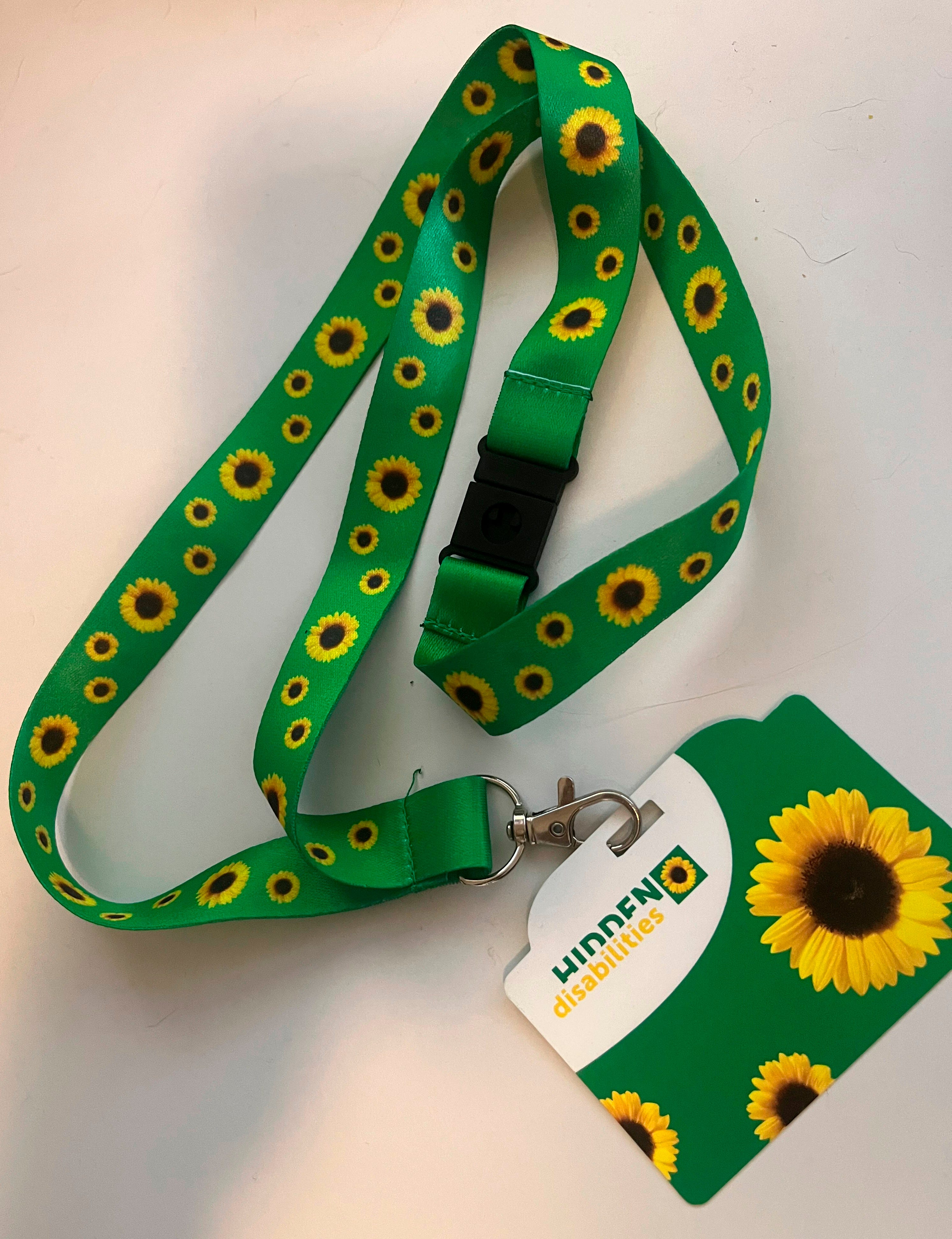
What I didn’t realize is that the airport has systems to help people in just my situation: Hidden Disabilities Sunflower lanyards.1
I hadn’t heard of Sunflower lanyards until Brad Kelley posted about them earlier this year. The Hidden Disabilities Sunflower program uses green lanyards decorated with sunflowers to discreetly signal that the wearer may need additional support, patience, or accommodations.
When I was planning for this flight to Mexico, I wondered if the lanyards might be helpful for me and my kids. I understood that the lanyards were supposed to alert people in the airport that the wearer has an invisible disability, such as autism, ADHD, etc., but I wasn’t sure what they would actually do for us. Maybe people would be more understanding when my children ultimately melted down or did something inappropriate in the security line. Maybe nothing would happen at all.
So you can imagine my surprise when, after walking the length of the airport to find the shortest line (long lines overstimulate me), the moment I reached the end of the line, a security person caught my attention and said, “you, come this way,” opening one of the segments of the line and waving me into another section.
Initially concerned that I had done something wrong, I was anxious, but I quickly realized that she had bypassed the entire line and moved me straight to the folks checking passports and tickets, making my walk across the airport and time in the line equally as fast as my husband and the kids using PreCheck.
I was mostly certain the Sunflower lanyard was what caused the security guard to help me skip the line, but since it was so subtle I wasn’t positive. Until it came time to board the plane.
As a serial worrier, I had ensured my family arrived at the airport with a full three hours before this international flight to Mexico. Between my husband’s status with the airline (which helped us drop off baggage quickly once we’d spoken to a person) and our fast-tracks through security, we arrived at the gate more than two hours before our flight.
For pre-child me, this would have been perfect, because we could just patiently wait until it was time to board. But all three of my children were squirrely. The youngest couldn’t sit still and alternated between spinning in circles and insisting on sitting in my lap. The middle child was overwhelmed by the sights and sounds and refused to sit next to a stranger, which was challenging given that the lounge was full of people. And the eldest child was completely losing his mind about the noise, despite having noise-canceling headphones.
If you are asking yourselves what we were thinking taking three such children to Mexico for the week, you are not alone.
An hour before the flight boarded, when we had finally found seats together that pleased everyone, they announced that our flight had switched gates, and we had to do it all over again.
My kids were antsy to get out of the crowd and onto the plane, and so was I. My husband’s status with the airline meant that we were in boarding zone A, which meant we’d be allowed to board as soon as they had boarded first class, people with small children, military folks, and folks with disabilities.
As soon as first-class boarding began, I led my family toward the gate, winding our way through a throng of teenagers. I intended to wait for boarding group A, but as soon as the gate attendant saw our Sunflower lanyards, she pointed straight to us and offered to let us board early.
Now I know what some of you are thinking. Why does early boarding really matter? And right up until this trip I would have wondered with you. The reality is that the waiting lounge was standing-room only full of people, and it was chaos. Getting my kids on the plane early meant getting them out of the crowd and into their seats, where it was easier to ignore the chaos and hyperfocus on their distraction of choice.
Thankfully, the flight was fairly uneventful, but by the time we arrived in Puerto Vallarta at the airport and navigated our way through the throngs of timeshare salespeople to get to our cab, the kids were seriously losing steam. The ninety-degree weather with ninety percent humidity was a bit much for everyone but my husband (who really does seem like an alien in our midst). We survived just long enough to get to our resort, get our luggage up to our room, and make a dinner plan when our kids all melted down completely.
Honestly, I think the meltdowns were inevitable, but I credit the Sunflower lanyards for giving my kids enough capacity that we were in our hotel and near food rather than in a crowded airport when the wheels fell off the bus.
Although the Puerto Vallarta airport doesn’t officially recognize the Sunflower initiative, coming home, we were once again routed to a short security line. Arriving in Seattle, we were lucky to reach customs and immigration at a relatively calm time, when there appeared to be only one other flight arriving. Our luggage was some of the last to come off the carousel, and I wondered how long we would have to wait in line for customs. When we arrived at the queue for customs, a security guard noted our lanyards and told us that there was a dedicated line for folks with Sunflower lanyards, but that at this time of night it would be just as fast in the normal line. And he was right.
My experience of traveling taught me a few things. First, I questioned my own need to have the Sunflower lanyard. While I am AuDHD, I have low support needs. I have a PhD from Cambridge, and in my daily life I manage three children and multiple jobs. It was easier for me to justify getting the lanyards for my children, who have higher support needs than I do right now. But after using the lanyard, I realized competence and disability aren’t mutually exclusive. You can be capable in some areas and still need additional support in others.
Invisible disabilities are just that. Invisible. Disabilities.
If, like me and my kids, you get overstimulated by mundane things like sunshine, people talking at a medium volume, and food that isn’t exactly how we expected, I encourage you to consider using the Sunflower lanyards. Travel should be available to everyone, even those of us whose nervous systems hit high alert before we’ve even stepped out of the car. Those of us with invisible disabilities deserve help to reach our destinations with a little sanity left in the tank.
Hidden Disabilities. 2026. What is the Hidden Disabilities Sunflower?
https://hdsunflower.com/
No posts
Comments
Nothing yet. Say the first thing.
Sign in to join the conversation.