
Readers of my Substack (and my friends and family in general) probably realize by now that I am a big road trip and travel nerd. In recent years, I have been inspired to visit as many National Parks as possible, along with other lesser-known natural locations along the way.
Literary and historical sites are high on the list of interest, too. My family has stopped at Little House on the Prairie locations (the Ingalls family homestead and other notable spots in De Smet, SD, for instance) on our way to some of the big-name National Parks (Yellowstone was the first major destination on this particular trip), with added “let’s make a little side trip” stops at the Badlands and Devils Tower.
Putting these places of natural beauty into my writing as settings has come pretty naturally for me. Dallas hikes a section of the Appalachian Trail in Book Two of the Chalice Series, for example.
Two recent news articles remind us that, while containing places of beauty and wonder, the natural world is far from being a guaranteed safe place.

And both of these news articles echo a certain risk-taking character’s impulsive tendencies in my current series-in-progress. My Fallen Angel beta readers may recognize some similarities in these true events as compared to the book’s scenes.
As an aside: Seth is my absolute most favorite character to write (sorry, Dallas and Channing, but also, they don’t read this Substack, so I won’t tell them if you won’t).😉
The coincidence of seeing these two news stories that reflect those risks Seth knowingly took while visiting Yellowstone reenforces that these are rare but real risks, and that park rangers make and enforce rules for a reason. And also that they cannot control everything and sometimes make miscalculations, and that any interaction between humans and nature can result in injury or death.
And I say Seth knowingly took these risks. But, really, does an impulsive 16-year-old truly have a firm grasp on weighing and understanding risks? So any time I see one of these tragic stories in real life, I try to keep in mind that, yes, some decisions are really stupid, but that we don’t always know what went into those decisions and that these are human beings who make mistakes and whose lives have value. And some decisions are well-informed and still go off badly through circumstances out of our control.
…was on a recent grizzly bear attack in Yellowstone National Park, not too far from the Old Faithful geyser basin. The title of this article caught my eye, because I knew of the bear management area which closes in the springtime due to increased bear activity, particularly that of mother bears with their cubs.
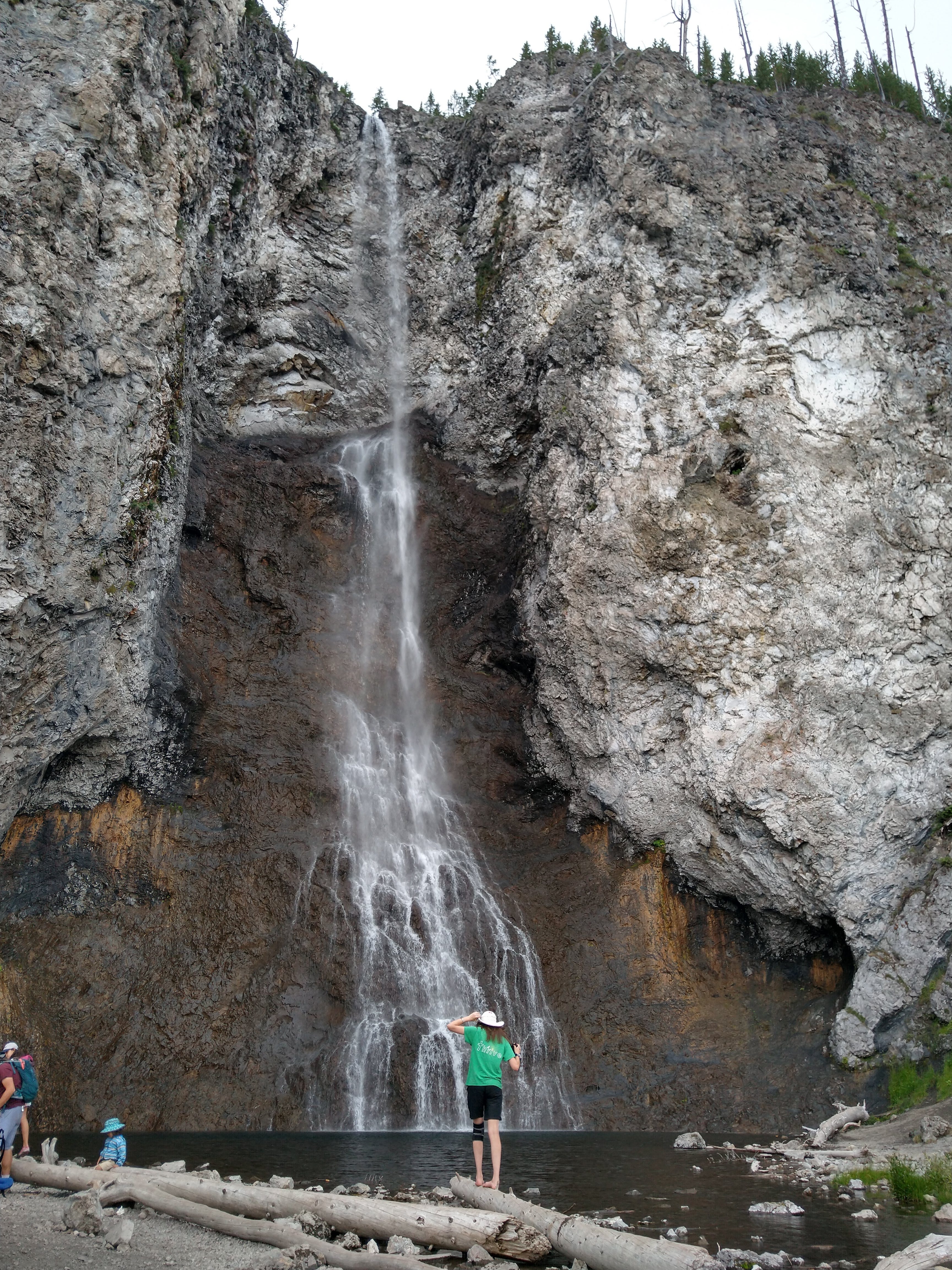
My family hiked to Fairy Falls on our summer visit to Yellowstone in 2021. This hike is in the same bear management area as Mystic Falls Trail, where the recent bear attack occurred. I learned of the springtime closure of trails in this area while researching for a scene in Fallen Angel in which Seth wants to hike the Fairy Falls trail. The story had them at Yellowstone in early May, and I found that the trail would have been closed at that time, because beginning in 1983, Yellowstone began designating bear management areas which were closed to visitors from March 10th through Memorial Day each year.
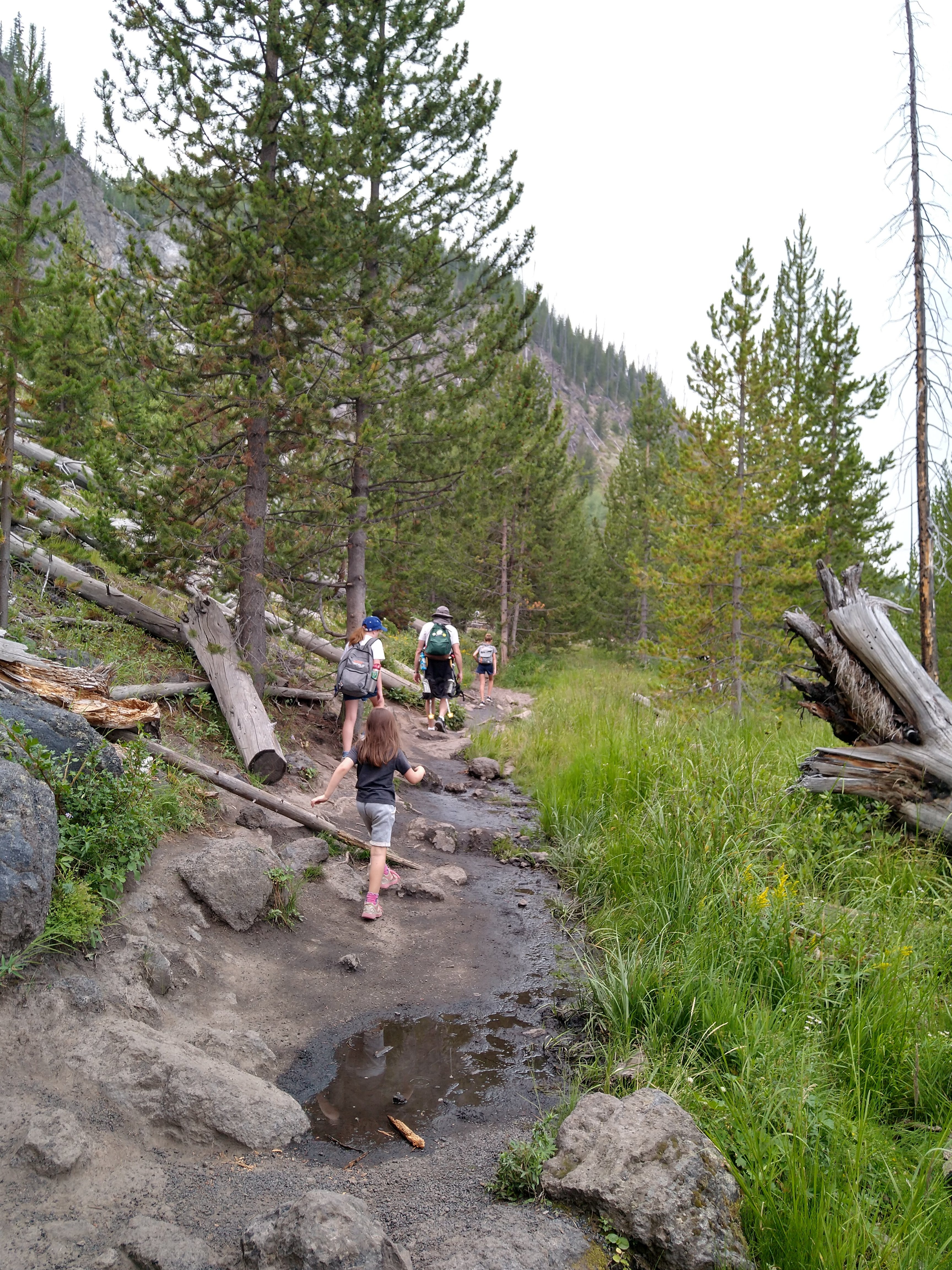
This led me to lean into Seth’s risk-taking behavior even more, as well as his mother’s well-meaning but poorly-formed decision-making skills. I didn’t have him say, “Oh, it’s closed; too bad,” nor did I change the story’s time frame so that the trail would be open when he was there. Instead, I had him take his girlfriend hiking on the closed trail with the reasoning that his mother once took his brother and him hiking there as kids the week before Memorial Day, and they were fine. And hey—she wanted to avoid the crowds!
Theresa’s response: Your mother took you near bears on purpose?
Seth’s rebuttal: It’s only closed for three more weeks. What’s three weeks? And do you know how many people have been killed by bears in Yellowstone, like ever? Seven. Besides, I have bear spray. We’re fine.
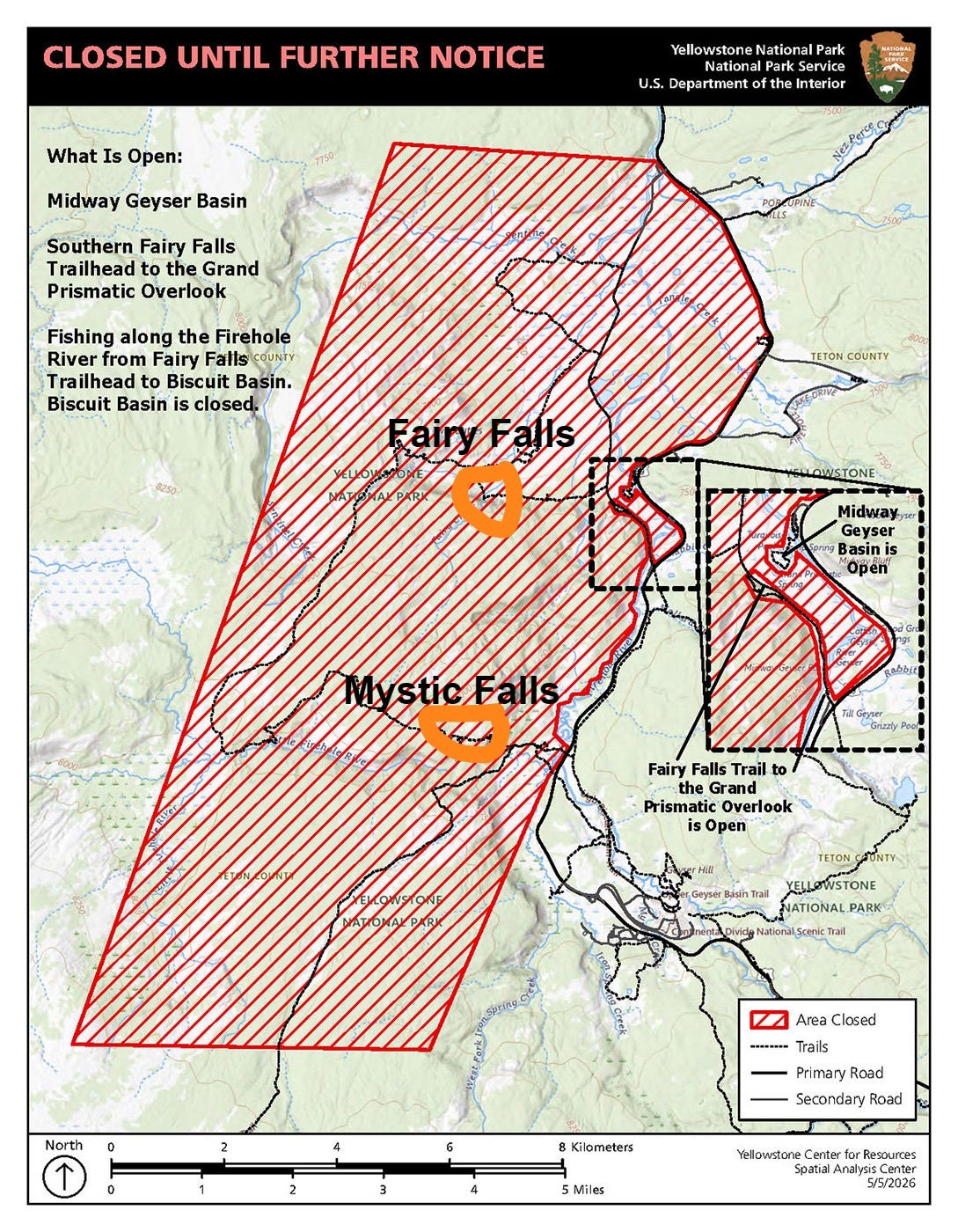
The image above shows the area of Yellowstone that is currently closed to visitors while the recent bear attack on the Mystic Falls trail is under investigation. I marked the locations of both Fairy Falls and Mystic Falls.
This same red-hashed area is the bear management area that was closed to visitors every March 10th through Memorial Day… until 2024. I’m guessing they deemed the bear activity low enough in recent years to have decommissioned this particular bear management area. I’m also guessing that in light of the recent attack at Mystic Falls, they will be reevaluating this decision.
Nevertheless, the area was closed in May of both 1989 and 1998, which are the two times this character hiked the trail to Fairy Falls.
Click here for more bear management information at Yellowstone.
…detailed the results of water sample testing from several National Parks. The “brain-eating amoeba,” Naegleria fowleri, was identified in multiple waterways, including the one pictured at the top of that linked news article, the Boiling River hot spring in the north section of Yellowstone National Park. It was also present in water from Firehole River and Lewis Lake hot spring, and, outside Yellowstone, it was identified in water from locations in both Grand Teton NP and the Lake Mead Recreation Area (near Hoover Dam).
The inconsistency? Boiling River no longer exists. The major flooding in Yellowstone during 2022 completely destroyed the way the spring flowed into the Gardner River at that location, rerouting the paths of the water there. So I’m guessing the testing was done on samples taken before these floods and lumped into the sampling of results that were recently publicized, because the article states that water samples were taken between 2016 and 2024.
They should’ve picked a photo of a current location that was also found to contain evidence of brain-eating amoeba. Whoops.
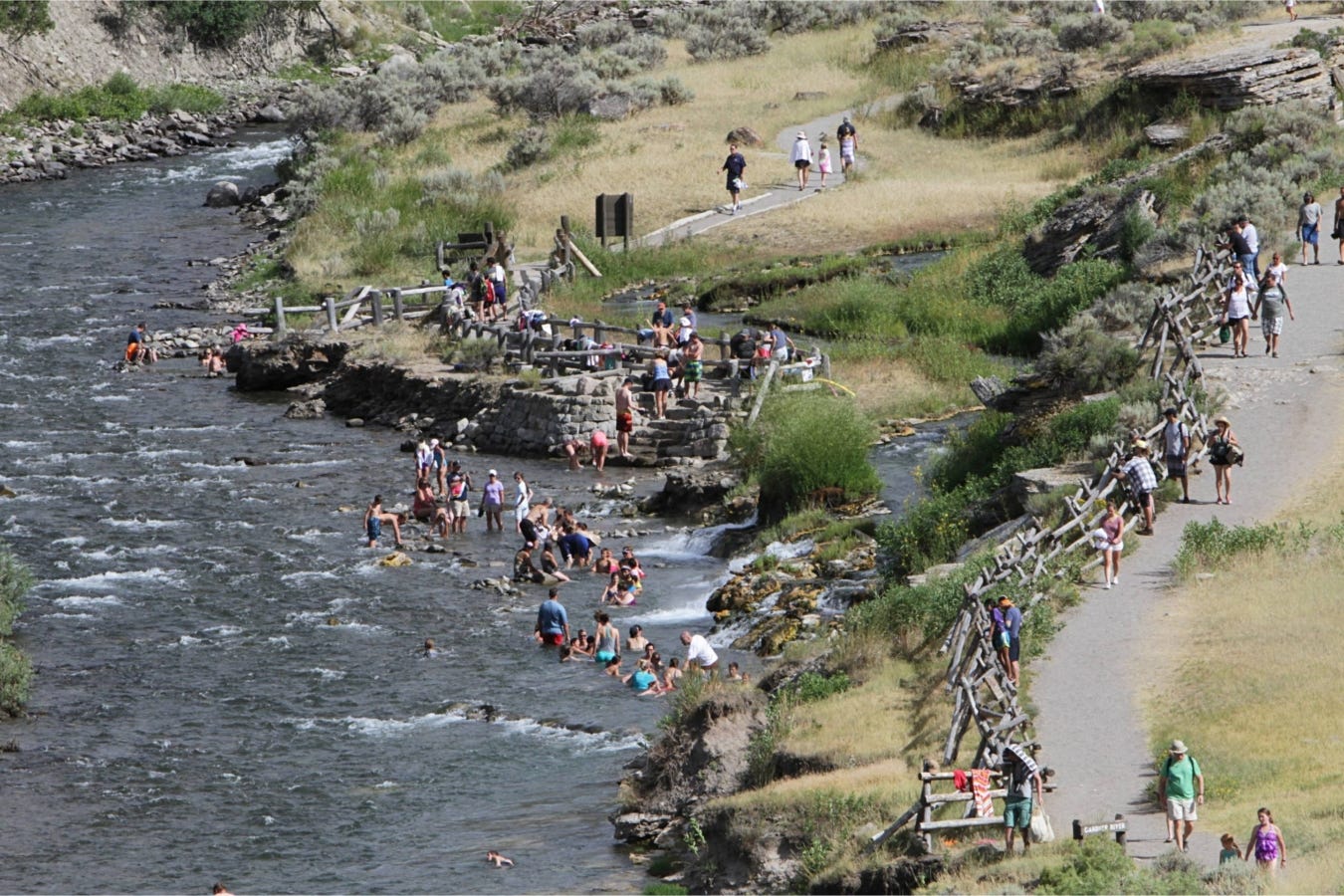
The possibility of contracting this parasite in warmer waters has been known and warned about for years. National Park information always tells visitors that putting their heads underwater in any natural waterways carries some level of health risk. This particularly fatal infection enters the brain through the nasal passages. While still very rare, most people who contract the disease will die from it.
Since my characters were visiting Yellowstone in 1998, the Boiling River still existed and was a popular soaking spot. When my family visited the year prior to the flooding, it was on my list of spots to go. Unfortunately (or maybe I should say fortunately?? lest you think I’m like Seth’s mother 🤪), the area was closed for some kind of parking or road construction, and we didn’t attempt to hike in from the main road. Recent reviews on Google Maps all confirm that the Boiling River hot spring is just… gone. Older reviews show how much people enjoyed soaking there, and none mention death by amoeba. So I’d wager that hiking in bear territory is still the bigger risk here.
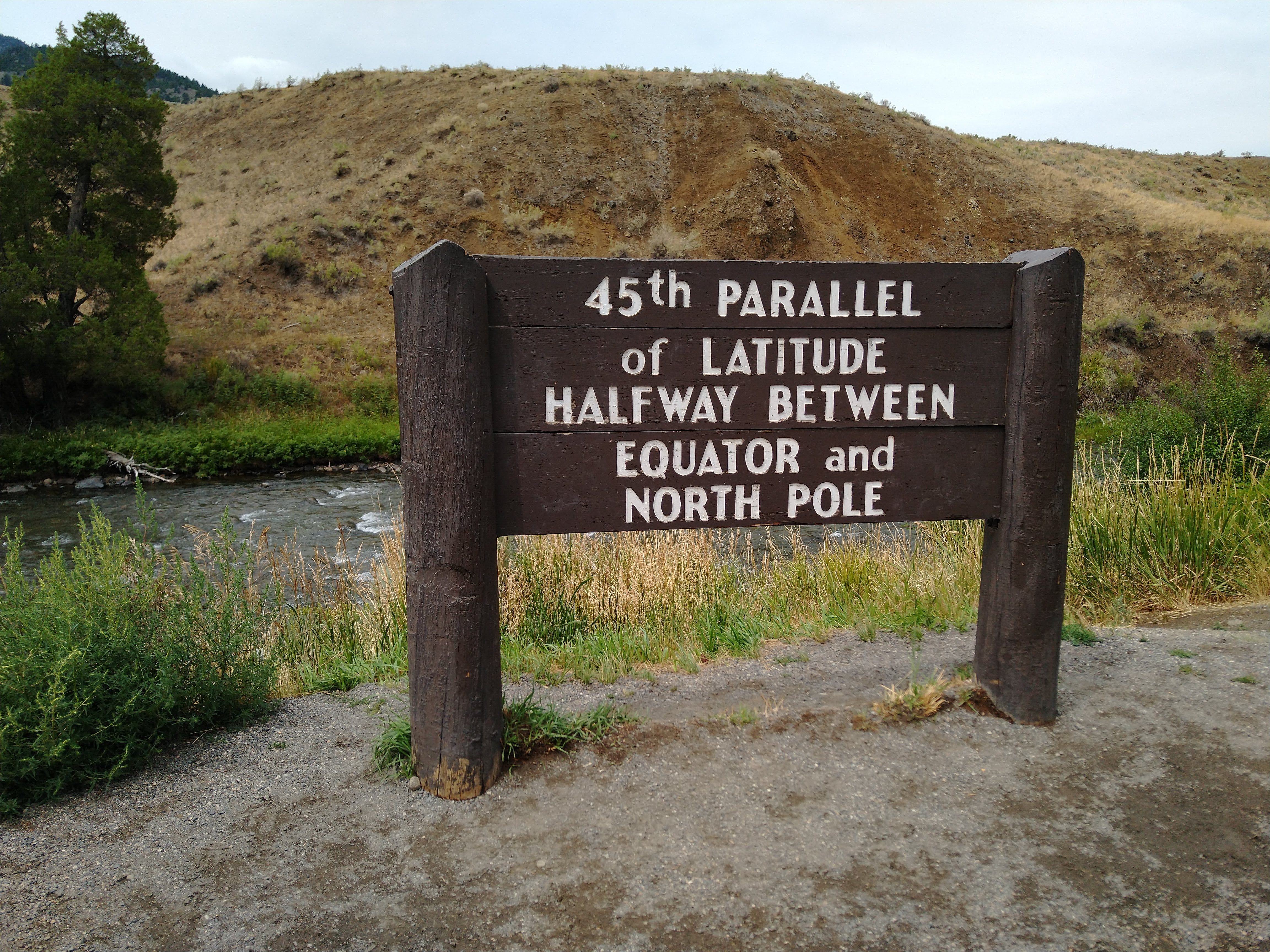
In Fallen Angel, Seth often experiences sensations that are of a supernatural nature. He doesn’t yet realize what these things mean or where they are coming from. In this instance, he seems to hear a kind of soundless scream in his brain as he’s driving away from the Boiling River. My amazing critique group, upon reading this section, suggested that it almost sounded like he had something physically wrong with him. Since Seth didn’t know why he was feeing this way, I thought it would work well if he thought, “What if some of that brain-eating bacteria got up our noses and that’s why I feel like this?” but then immediately shook it off with a shrug and an “oh well, at least we’ll just die together in each other’s arms.” Dramatic, impulsive, stupid teenage love. It gets him into plenty of trouble, that’s for sure.
As reckless as he is, Seth knows where to draw a line when he says at least he wouldn’t do this “like that moron he’d seen on the news.” Nor would he try to pet a bison, which seems to be the top warning given by Yellowstone on their NPS Instagram posts.
Okay, nature always has the potential to kill us. But, no, it’s not actively out to get us. It’s a reminder that we are quite small and God’s creation is unfathomably more powerful than we are. It’s dangerous enough that there are a bunch of books titled Death in [insert park name here]. [If you wanna buy me the Yellowstone one, I’d love that!] But that doesn’t mean we shouldn’t enjoy it, spend time in it, marvel at its beauty.
The mere names of some of these trails, landforms, and waterways within our National Parks remind us of our mortality and fragility: Devils Orchard. Devils Playground. Inferno Cone. Roaring Mountain. Hells Canyon. Firehole River. Death Valley itself, and its many ominously named features: the Funeral Mountains, Dante’s View, Devil’s Golf Course, Badwater Basin. [I play off many of these in my final book in this series, A Desert of Angels, which is set in Death Valley for the final scenes.]
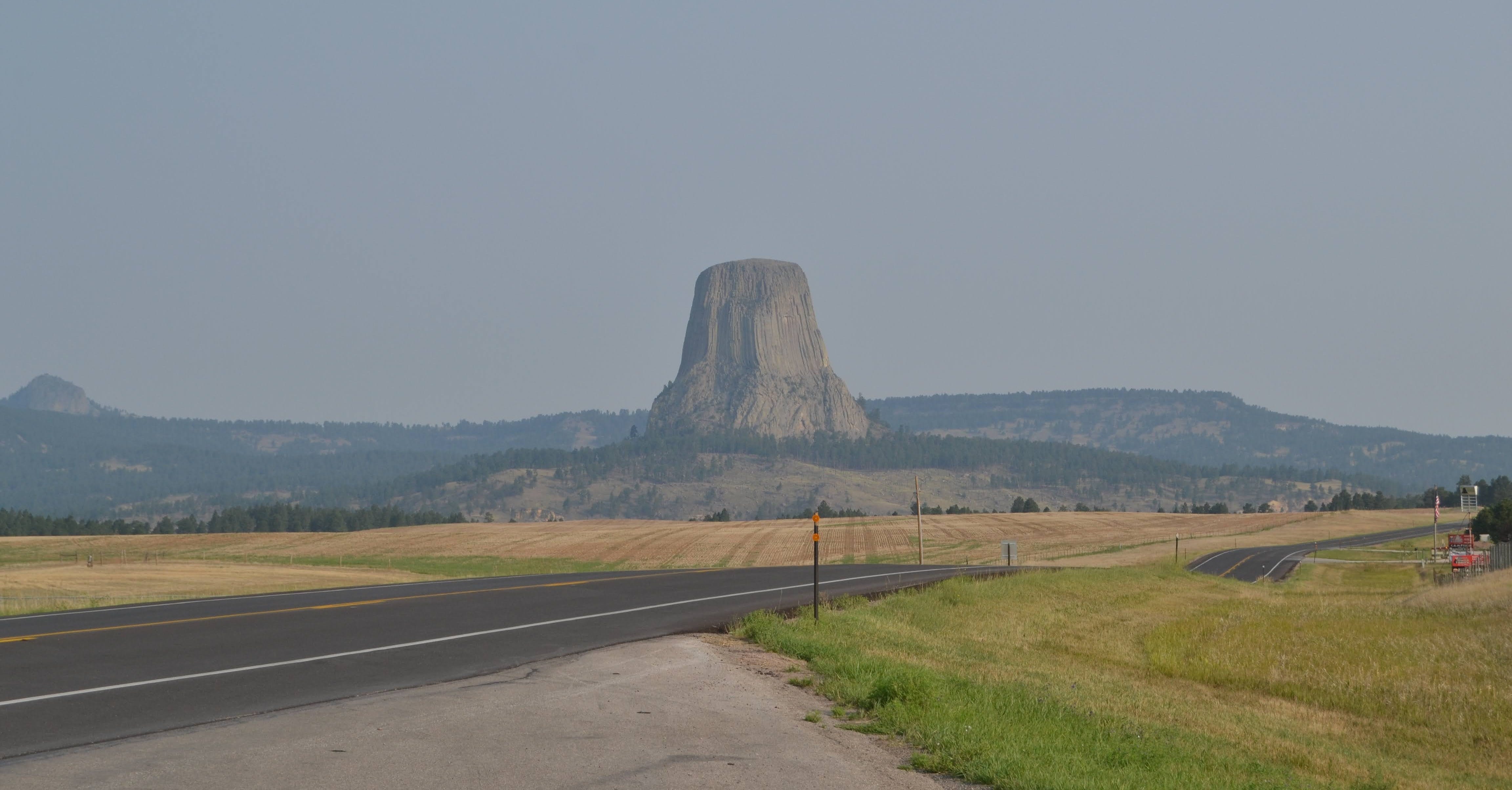
As Theresa says while visiting Craters of the Moon National Monument and Preserve, “Everything here has such evil names.”
Yep.
And the greatest thing about using these natural locations as settings in this series is the dual purpose they serve: the terrible possibilities laced with the grandeur that allows us to believe in and hope for something more. It’s a mirror to the characters’ lives and how the choices they make can take them down either a good trail or a bad one. But in both good and bad, God is always there, waiting for us to reach up to him with hope.
And God can wait a very, very long time.
Good thing for these characters. And good ting for us humans in general, as long as we keep in mind that, while God exists outside of time, our own time on earth is finite.
Until next time,
Erin
Comments
Nothing yet. Say the first thing.
Sign in to join the conversation.