
You can also hear the AI version of the reading here (with my dubbed voice!)
0:00
-18:03
We arrived at the hotel around noon, a glimmering monolith of a building right off the Champs-Elysées. A porter insisted carrying my small backpack to my room and after depositing it by the bed, waited for his tip in the narrow distance of my light-swollen suite.
The porter was shorter than me, paunchier, squeezed horizontally. I had no knowledge of what had brought him to this career-choice, but I assumed that like most men our age, he had years of internalized, unshared moments of hope, despair, spiritual renewal, and that his current job as a porter, like so many jobs, was one of many sea-changes.
There was little separating us as the tip-giver and the tip-receiver; years of college debt, credit card debt, a dozen or so lucky life choices, and, currently, an expensive trip paid for by my wealthy neighbor, were the only true “privileges,” as the word has come to be used in current debate over economic class.
It was disturbing how easy it was to reason away a good tip. I had not asked for his services, I convinced myself, and my circumstances and his minimal amount of effort required tempered expectations.
The porter studied the large two-euro coin that I had placed in his hand with annoyance, then, slowly, a look of amused recognition came across his solid, pocked face; a curled, slapstick grin like a cockney in My Fair Lady, ready to burst into song over the hardships of lower-class life. He saw the situation for what it was; I had not paid for this massive room overlooking the Arc de Triomphe, could not afford a real tip, and was, most likely, of some yet-to-be-determined value to the wealthy man with whom I had entered the hotel lobby. The porter, more satisfied with his revelation than the tip, nodded funereally and backed away like an old lady in a church portal.
When the door clicked shut, I took a cold water out of the mini-bar, read the price, then thrust it back inside as if it had stung my hand. Mini-bars were, as a rule, expensive, but a sparkling water, in this tiny recessed fridge, was nearly ten times that of a supermarket.
I wanted a cold bottle of water, but could not afford it. The only way I could drink this water was to deepen my debt to Clyde. I was not poor, but these were prices designed for people who did not think about money, and worse, prices that forced me to consider my own distinct lack of capital. I cracked the plastic seal, downed it in one gulp. I drank a second one. I was tempted to open a Diet Coke, but imagined Clyde’s twisted expression as he considered the line between quenching my thirst and exploiting his generosity.
When we moved to the Netherlands, my ex, Marieke immediately put us on the welfare roles. When I grumbled, she scolded, “Oh, your blue-collar values.” It was normal, she said, for people to occasionally go on welfare in the Netherlands, a statement I later learned was not true.
Since we were on welfare, the government furnished us with a brand new rent-subsidized apartment overlooking the city, one of those luxuries that Americans could never imagine. I learned that welfare in the Netherlands wasn’t so bad. You could buy generic groceries, see a movie, shop for second-hand clothes, but it wasn’t enough for Mediterranean vacations, a weekend of boozing, or a sushi lunch. If either Marieke or I started earning money, we’d have to start paying rent. So we were caught in a welfare trap, perpetually afraid of losing our benefits.
When Marieke and I split up and I began paying for my own apartment, a long, low-grade depression lifted. I felt whole again, my blue-collar values restored. There had been an emotional cost to sixteen-months of subsidized-living. Being so completely dependent on the government had stunted my self-worth
I was still thirsty, but I couldn’t bring myself to open a third bottle of expensive water from the mini-bar. I went to the bathroom and lapped water from the tap then flopped down on the king-size bed. From my seventh story window, I had an unobstructed view of the 17th arrondissement, the Palais Garnier, and as far north as Montmartre. Paris was lumpy from here, uneven white Lego blocks. The city’s beauty, its sublimity, lay in the trenches of the Boulevard’s, Avenues, and Rue’s, endless variations of fascias, gargoyles pressed between the sky and a cupolas, centuries of competing styles of thick front doors, maroon, olive, oak portes battantes safeguarding millions of French and their apartments stuffed full of opinions.
My phone rang.
“I ordered you a martini,” Clyde said. “Get down here!”
“I need a nap,” I said, but he had already hung up.
When I came downstairs there was a spread of French finger-food laid out across the table, soft cheeses, cured meats wrapped around fancy-fillings, olives glowing like sea pebbles in brine, and a row of fruit-laden cocktails.
“Did you just order the whole menu?” I asked.
“Ah you know. I like to try things. Been super hungry since the train.”
I peeked at the menu which was an extension of the mini-bar prices. Sweet potato fries were as much as a sushi boat down the street from my house in Amsterdam. The graph of taste to value seemed jarringly disproportionate.
Clyde ate half a fried shrimp and put the remainder on a napkin. He rubbed his hands on his torn jeans, patted my knee like father might with his son as they passed the largest prairie dog in South Dakota,
“We made it!”
The first martini went down too easy. I drank another and then another. We talked about America, living in the Netherlands, women, our neighborhood, women again, dissecting females in a superficial, detached way, as if they were a hostile trade union in need of dismantling.
“How’s Sarah?” I asked.
“Time to say ‘bye-bye,’” he replied through a shrug, concealing a sliver of lament. “We’re still friends, you know. It’s just that, I uh, she wanted more and well…”
I wasn’t surprised by the fact that Clyde had broken up with Sarah. But I was confused by the way he said, “time to say bye-bye,” as if ending a semi-serious romantic relationship was akin to taking an Elmo puppet from a toddler. Perhaps he was acting like this because we were on a guys trip, and, at late middle age, Clyde was, like most of us, still fumbling at being a man. However, such leveled insouciance, especially toward someone who had been in charge of his decorating budget, left me with a kind of bro-vertigo, where I realized that time spent with Clyde was disturbingly precarious, like storming a beach on D-Day where neither luck, talent, or skill could really save me from a metaphorical 7.92 × 57 mm Mauser caliber ripping through the warm flesh our budding bromance.
As we drank, Clyde told me about his career, building nodes, hiring top-skilled Russians when the internet bubble crashed, creating fluid, online television, skydiving with Apple executives, scuba-diving with celebrities. And even though Clyde rarely asked about me, he did seem to catch himself talking about himself too much. He’d reel back the braggagio by flipping to stories of programing medicine delivery drones in remote regions of Africa or creating independently-operated mobile internet networks for third world countries or deploying new internet banking and payment systems untethered from corrupt governments. I am sure that Clyde saw me as a writer, an artist, and probably thought my judgments could be massaged by tales of charity, but I had been in the Peace Corps and, during my two years in Armenia, just before the new millennium, had all, but lost my love for most international aid organizations and their gluttonous ways.
Clyde wasn’t an in-depth conversationalist, but he did have a lot to say, speaking associatively, piecing ideas from bits and fragments of things or ideas. His thoughts were his and he would lend them and snap them back as if testing their flexibility. He would go in certain directions and I would try to follow, but his remarks and observations were often linked to thoughts that he hadn’t yet verbalized and therefore I got lost in the alleyways of his discourse.
I have to admit, it was remarkable what Clyde had accomplished in half-a-century, especially the way he had bent the formless, shapeless internet to his will. Still, at the same time, he couldn’t hold a structured dialogue. With every sudden semantic deviation, his inability to connect through the English language became painfully obvious. Perhaps, I thought, we were witnessing an evolutional mutation, a brain, Clyde’s in this case, which was more suited to the nebulous, fragmented nature of the internet than it was to human interaction.
When Clyde went to the bathroom, I ordered a glass of sparkling water from the bar. The bartender was off smoking a cigarette and the bar-back and I chatted. It was refreshing to be in a normal dialogue even if it was just shooting-the-shit. Eventually the bar-back asked if there was a tab. I said yes. He pointed to a credit card by the register and asked if it was ours. I squinted, said yes again, and was handed, quite recklessly, Clyde’s American Express Centurion Black Card.
All my struggles with money and the very limited economic benefits of being a writer were reduced to an existential question mark. This invitation only, million-dollar limit credit card was, in reality, just a credit card. But it was also a symbol. The Black Card meant that regular cards no longer met your needs, that zero-balance transfers and air-miles points and cash-back credit were below you, that the whole six-trillion dollar credit card industry with hundreds of billions in profits, was nothing more than polluted spume tossed away by your ASTM A131 Grade EH36 Steel hulled, super-yacht.
I had been raised a Quaker and the joke is that Quakers came to America to “do good and did very well.” For the Quakers, simplicity, frugality, and hard-work brought enormous wealth. I had never been comfortable with the simplicity and frugality part of being a Quaker because, well, I had always wanted expensive things, finer bits of luxury, and, as a result, regularly lived beyond my means. When I saw Salman Rushdie’s beautiful New York apartment of John Updike whizzing down 10th Avenue in a new Porsche 911 Turbo, I imagined myself also rising into similar financial success. However, and perhaps this was why I was so in awe of Clyde’s fancy credit card, even in my most far-flung dreams of endless bestsellers and movie adaptations, the Amex Black Card was still unattainable.
Someone tickled me. I jumped. Clyde had snuck up behind me. He took his card out of my hand as if taking a tissue and ordered another drink for himself.
“We have to get going soon,” he said, slurring and holding onto the bar for support.
Then he ordered two rounds of shots.
Clyde and I were hammered by the time we got into a taxi and headed across town to the stadium. When we arrived, I showed our tickets to the a beefy Algerian security guard who looked at a wobbly Clyde then pointed to a sign stating that anyone publicly inebriated would be barred from entering. Clyde handed the man a hundred euro bill. The bouncer tapped his finger against my chest, and, with complete lack of comprehension of who Clyde was and my relationship to him, said;
“He does anything it’s on you.”
It took us awhile to find our seats. We asked the multitude of stadium employees for help, but none spoke English. The stadium was completely sold out. No one dared to leave if it wasn’t a break. We crossed an entire row of annoyed fans, who couldn’t understand how we could show up to a game so late.
Once we got settled, I noticed empty seats on either side of us and, when I pointed this out, Clyde asked, “Do you want to sit next to strangers?” It took me a minute to realize that he had purposely bought extra-seats, in a sold-out stadium, for elbow-room.
Even though I had lived in Europe for almost a decade, I could care less about soccer. Two or three points a game made no sense, like waiting all day for a quickie at night from your partner. Still, I tried to cheer when Paris-St. Germain came close to the goal or a defender repelled a shot.
The game was slow and I found myself drifting off, gazing over a sea of blue-collar men. I then looked at Clyde. He was sobering up into his normal jitteriness, twitching, checking his phone, staring at everything and nothing, uncomfortable in his own skin. I wondered what really separated Clyde from these people. He would never lift a shovel, drive a ditch-digger, plaster a living-room, or work security. But he had created companies that created vaporous products with little material value except to make corners of the internet hum. And the enormous amounts of money that these companies made would be used to hire these people in this stadium, to do the tangible work of installing fiber-cables, repairing electrical lines, maintaining the roads.
I manspreaded into the free space next to me then blushed. What gave me the right to such indulgence? Because I was a writer with a flair for snark? I was surrounded by men who had mortgaged their homes for season tickets, men who got up early and went to bed late, and who worked hard day after day. On the other hand, Clyde had purchased elbow room. I might one day write about it. But where was our contribution to society? One could easily argue it was negligible. When the revolution came, I would most likely be used as a doormat as the mob rushed to hang Clyde. “The proletarians have nothing to lose but their chains. They have a world to win.” That had been my mother’s Marxist refrigerator magnet.
The free seats next to me reminded me of a myth that went around Denver in the eighties. Back then, Denver Bronco tickets weren’t something you bought, but inherited. Anyway, the story went that there were two Bronco season-ticket holders, a father and a son who, for decades, never missed a game. One day, however, the father died. Everyone speculated what would happen to the seat. Bidders supposedly offered to buy the ticket, with prices going into the hundreds of thousands. There were also rumors of bonus-gifts, Lamborghinis, bricks of gold.
Following his father’s funeral, the son arrived with a keg to the game. Supposedly, all of Mile High Stadium watched on the Jumbotron as the son placed the keg in his father’s empty seat and began handing out free beers. He gave out free beers for years. We young boys debated endlessly about who would sell their Bronco ticket and who would give out free beer, dividing us, early on, into young capitalists and socialists.
The only reason I knew the Paris-St. Germain game was over was because people started getting out of their seats. Clyde was busy texting someone. I waited, watching these men, mostly immigrants, imagining what their lives were like once they left the stadium gates.
When Clyde was done with his texts, he said; “You up for a club? I know a place you’ll like.”
We walked a few blocks then took a taxi the rest of the way. The club was the kind of place that you had to know someone to get in and I guess Clyde knew someone or paid someone to know someone because we middle-aged men, pale from drinking all day, breezed right past a line of young, attractive people. The place was empty so I could hear the following conversation between Clyde and the host:
Host: These tables here start at 10,000 euros. Those there are 5000.
Clyde: What about over there?
Host: 15,000.
Clyde: We’ll sit there. And I’ll have a bottle of Grey Goose and a bottle of Dom Perignon.
Host: Yes sir.
Clyde: And women?
Host: Yes sir.
About thirty minutes later a mob of beautiful women walked in. They came over to our table and immediately started talking to us, chit-chat which would be added to our tab.
“You know my reason for wanting to go to the Paris-St. Germain game?” Clyde said at some point. “Zlatan Ibramovitch. That guy. I only wanted to see him. Do you know why he is so good? He’s got that kind of ego that gets everyone to play for him.”
Clyde continued to lean over and talk, but I couldn’t hear him, so I just nodded as his warm breath entered my ear. I could feel my own soft fleshy interior, my disconnected exterior, and my brain, monologuing like a friend on speed. As I was staring at the ceiling, hundreds of gold and silver balloons fell upon us and, for a brief moment, it felt as if, instead, I was the one falling through them.
One of the women asked what I did and I told her that I was a writer. She squeezed my arm and said she loved Harry Potter. I said, “oh, I’ve never read those books” and she said, “Books? No, I love Harry Potter,” and pointed to a dance floor where sure enough Daniel Radcliffe, the actor who played Harry Potter in the Harry Potter movies, was doing his own version of the electric-slide to Robbie Williams.
On the taxi ride back, Clyde fidgeted with the tears on his jeans, batted at his bangs, and scraped his phone casing with his nail. The moon stood out in the taxi windows, a defying sliver.
“A moon over Paris,” I said.
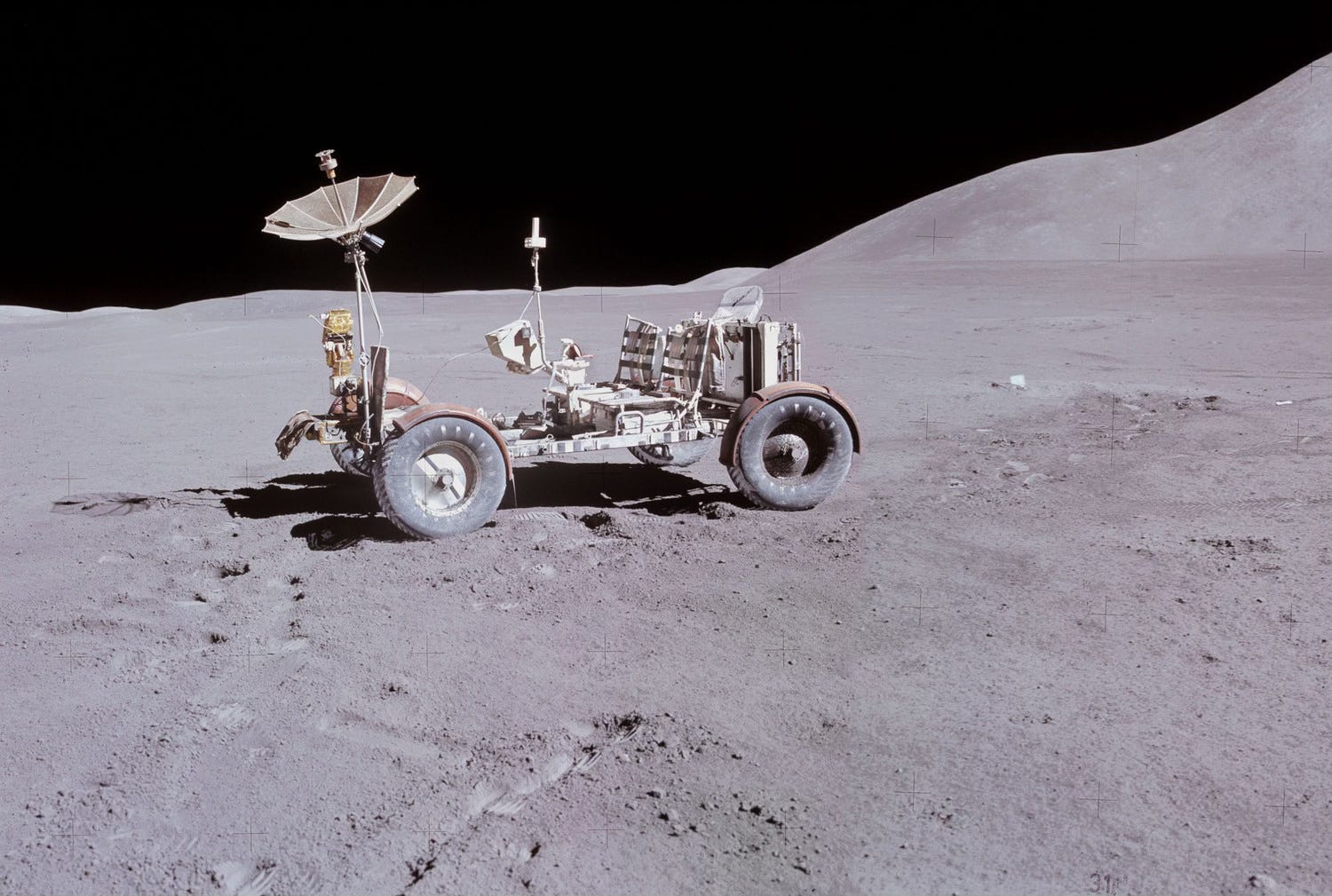
We were silent for a minute before he responded, “My dad’s stuff is up there. Still sitting there on that moon rover.”
I felt like this was Clyde’s Gatsby moment, where the truth got slipped up in the details.
“Your dad worked for NASA?” I asked. “So you lived in Florida? I thought you grew up in the Midwest?”
“The NASA kids had private schools. My dad wanted me to have midwestern values. So we moved.”
As usual, Clyde receded into his mind and I would have to wait until he surfaced. I looked at the moon again and realized that if anyone wanted to talk about “privileges,” it wasn’t just the financial ones that helped children get ahead quicker than their peers, but the accomplishments of their parents.
Clyde closed his eyes, his reflection in the window that of a man pretending to sleep. A stray bang fell over his right eye and I had the strange urge to brush it away. I had been listening to him, following him, participating in his alien world, but I had yet to see him as a human. He was protected, walled, a “shy” man as he had referred to himself, moving through a universe where he could no longer hide, where, simply because of his wealth, he would always be seen, followed, watched.
Comments
Nothing yet. Say the first thing.
Sign in to join the conversation.