
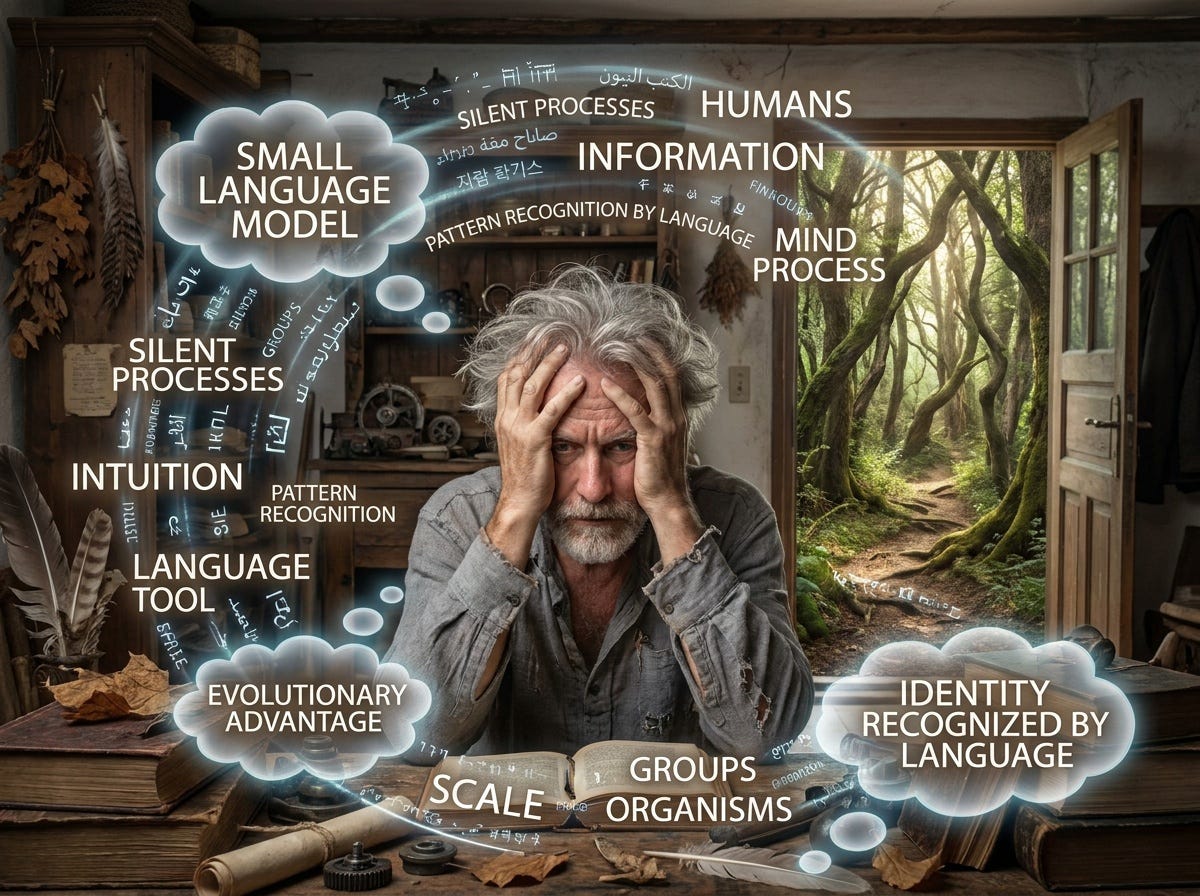
I just ran across a concept we need to consider: humans as “small language models.”
As opposed to an artificial intelligence, often referred to as a “large language model.”
The power in thinking of you and me as “small language models” is this: First, it separates what we do, what we are, from the wetware. We’re not just brains, we’re beings. “Mind” is a process, a series of waves along connections. Mind is not just the axons and dendrites themselves.
Second, thinking of ourselves as a “small language model” puts emphasis on “information.” There are many types of information, and not all are of language, of course: our five senses, for example, the warmth of the sun, the howl of a wolf, a mother’s hug or a father’s shrug.
There are also “silent” processes in the mind: intuition, insight, non-verbal recognition of patterns.
But if we want to reflect on what these mean, language is our tool. Language is one of the primary processes of thought. Language, as a means by which information is shared, has great impact on who we are, even what we are, as individuals.
Language is also our bucket for carrying information through time. I would argue that the human ability for complex language was the evolutionary advantage underlying our ascendency on the planet.
Finally, thinking of ourselves as “small language models” makes it easier to understand “scale.” Variations of language in different groups are one way we differentiate “our” group from “other” groups.
Communication between individuals is how we become greater than ourselves as families, tribes, communities, city councils, school boards, police departments, political parties, nations.
These aren’t just “organizations,” they are organisms, their identity recognized by their language.
So, I think the idea of humans as “small language models” is brilliant. I wish I’d thought of it. But I just didn’t pull the words together.
Comments
Nothing yet. Say the first thing.
Sign in to join the conversation.