

One thing I’ve come to learn about myself is that the people I love spending time with the most, are deeply curious about themselves and others. Curiosity is the basis for connection, but it’s also the basis for self-trust, and I think that’s why it’s such a guiding value in my life - for both myself and the people I surround myself with. People who have this deep natural curiosity and inquisitiveness about themselves are fascinated by understanding why they do what they do, their behaviours, motivations, hidden fears. For me, this comes from the fact that I care so much about being able to give myself a life that I truly, fully love - and I can’t do that if I do not prioritize getting to know myself as deeply as possible, and being completely honest with myself about what I discover along the way.
I believe that a prerequisite for giving yourself a life that you really love is being able to ask yourself the right questions, without being afraid of the answers. My own sense of self-trust was only built when I started admitting to myself the answers that I had been too uncomfortable to admit - and then taking solid steps towards aligning my life in the direction they were pointing to. If they showed me that I was more unhappy in my job or relationship than I let on, and needed a change, then self-trust was built by taking this knowledge and turning it into action. Without curiosity, we keep ourselves blind to what matters; without action, we never develop the trusting relationship with ourselves that makes life feel the best it can feel.
I had a conversation with a friend recently who was explaining that a few years ago, he used to self-sabotage in so many ways, and would end up feeling tired and angry at himself for it, resentful and disappointed at the repeating cycle. In his relationships, he’d often find himself being impulsive and doing or saying things he regretted, hurting the people he was with again and again; it felt like he was at war with the part of himself that was acting. How could he trust himself when he kept doing things he regretted? For a while, he thought he was just doomed to being that way, defeated by some innate part of his personality. But fortunately for all of us, John Steinbeck flawlessly cancelled moral determinism in East of Eden; and just like that, my friend also came to realize that he was not doomed to being any way he didn’t want to be.
He started writing a lot and became very interested in actually understanding himself deeply for the first time, becoming willing to ask the questions that he had avoided for years. With that inquisitiveness and honesty, eventually came self-trust. Because he now clearly understood the root of his actions and wasn’t afraid of admitting the difficult answers to himself, he developed the ability to know deeply, for the first time, that he had full control over his actions and the type of person he showed up as. There was no room for “I hope I don’t do that again”, or “I hope I actually keep this promise to myself”. Those two parts of himself, the one acting and the one hoping and witnessing, actually became one. He knew what he would do and what he wouldn’t do. He developed the ability to keep promises to himself instead of self-sabotaging. That, to me, is self-trust; and that is what the most confident people share. Real confidence comes from repeated self-trust: from knowing that you’ve always got your own back, that you will always do the right thing that’s aligned with what you want. Even (or especially) when it’s hard and confronting. Confidence comes from having enough trust in yourself to know that in any situation, you’ll choose to be your own best friend; where self-sabotaging feels foreign.
In relationships, whether friendships or romantic, I find it the easiest to trust someone when they live their life with this practiced curiosity; when they trust themselves. Curiosity is essential fuel for connection to ignite because there is nothing better than being able to have great conversations with people who know how to listen, question, and understand — but one step further than that, curiosity is also what allows trust to develop.
I’ve seen one too many friendships and relationships die because one person brought up an issue, and the other was defensive without being actually curious to understand what upset the other and why, or why they themselves acted in a way that upset someone they love. Without that understanding, how can we ever learn to be better towards ourselves and the people we love? In any connection, this curiosity is fundamental for deep trust. It says: I will not assume I already know everything about you and about myself. I will be open to anything I might learn that I don’t already know, because I care more about having good relationships and a good life, than about protecting my ego.
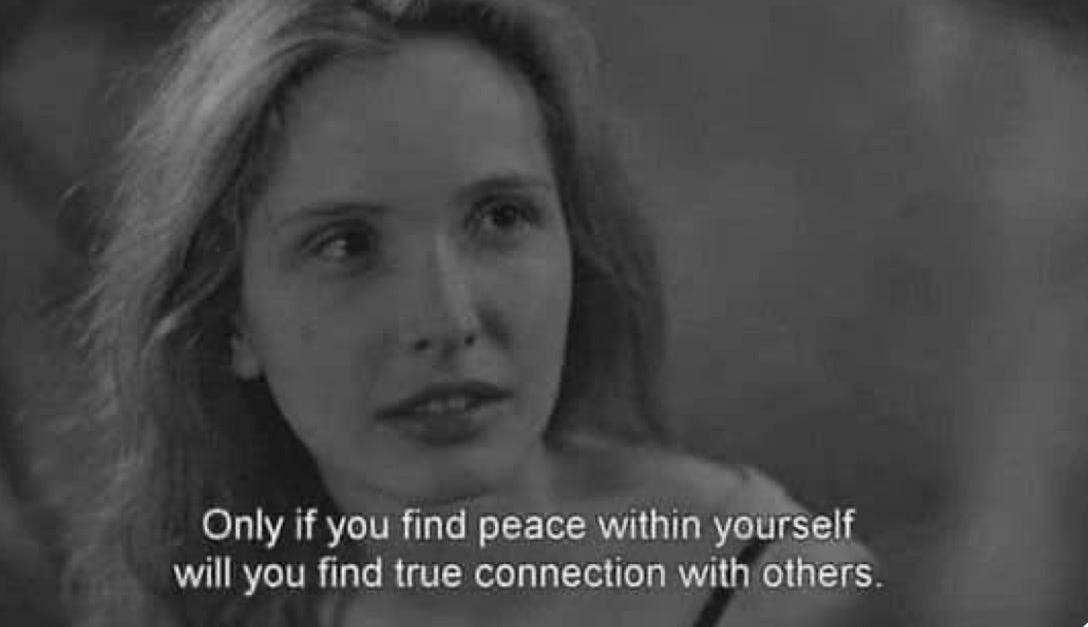
Curiosity requires space and time to flourish and dive into deep rabbit holes. Modern life barely leaves any room for a practice of curiosity and self-understanding to develop unless we create it on purpose, make time for it intentionally. I genuinely think that if I didn’t journal almost every day for the past years, all the big things in my life would look completely different than they do today, because the time I would give myself to really think through things, problem-solve and process, would be coincidental at best.
Most of us wake up, work, eat, take care of things, sleep, and repeat. Within that rhythm, you can easily go years without ever taking the time to connect with yourself meaningfully, ask the important questions, answer them, and see if you truly are happy with the way your life is laid out. A practice of self-understanding can look different for everyone: journaling, meditating deeply, therapy, or anything else that helps you look inwards with time and space to be honest about what you see. The important thing is making the time for it intentionally, because it doesn’t happen by accident. When you feel like things might be out of alignment, when you have a sense that something in your life might need to change, purposeful curiosity is what you need to lean into. Ask yourself the difficult questions and let the confronting answers flow, even if they mean it’s up to you to ignite change and shake the status quo. The more you do that, especially when it feels hard, the more self-trust you build — and that is the foundation for building a life you never feel trapped inside.
––––

No posts
Comments
Nothing yet. Say the first thing.
Sign in to join the conversation.