

Back in December, I decided that I had had enough of always jumping to the worst-case scenario every time my anxiety would strike. It wasn’t protecting me the way I thought it might be – it was actually just making my life harder. But of course, it’s not that easy to just notice that a way of thinking is making your life worse rather than better, and suddenly rewire it. But I wanted to set myself a personal challenge to prove to myself that, if I went 100 days always assuming the best, it wouldn’t be the end of the world – it would actually help me enjoy my life more, and trust more in uncertainty. That’s how the radical optimism experiment was born.
I didn’t expect it to, but it went viral on my social media, gathering around a million views across platforms. Lots of people joined too, starting their own 100 days of radical optimism, with many documenting their experience through videos and tagging me on their updates. When you do something as an experiment with a set timeframe, like 100 days, it makes it significantly easier to stick to it. That’s because you’re not asking yourself to fully change your behaviours overnight, forever – you’re framing it as a challenge that you’re doing for a specific time. If you’ve been subscribed for a while, you’ll know that I absolutely love setting myself little timed experiments, because they allow me to overcome my limiting beliefs and rewire behaviours that don’t serve me, without the fear that comes when you tell yourself that from now on, you’ll just be like this forever. That’s a massive ask! So I tell myself: I’ll try this for 30 days, or 100 days, and if it sucks, I just don’t have to do it ever again! But usually, it ends up sticking, as it did in this case.
Amidst hundreds of comments, a few questions were recurring: Is it worth it? How did your life actually change after doing it? This is coming from the fact that deciding to assume the best for 100 whole days is hard. It was a huge test of willpower, in my case, and definitely not easy. So I completely understand why many people wanted a little more encouragement in order to be convinced that it’s worth the mental and emotional effort. We can experience so much fear when we tell ourselves to be more optimistic or assume the best-case scenario; I think the most common one is the fear that having high expectations will lead to big, painful disappointments when some things don’t end up working out. So you keep your expectations low, in order to stay at a neutral state of not too happy, but not too disappointed either.
Here’s the thing: I know we often hear the recommendation “have no expectations, and you won’t get disappointed”. And I understand detaching from things you want in order to not feel desperate about getting them. But I also have a deep belief that when we live our life with expectations, with high hopes and faith that things can and might work out, we live a fuller life. I suppose it is about choosing a life with bigger joys and at the same time bigger disappointments, as opposed to a life of neutrality, of not hoping, and not expecting. I tend to favour the former, because one of my values is aliveness. I want to live life in a way that makes me feel alive, not in a way that numbs down the experience of being human, of wanting things, of having big dreams, for the sake of never feeling let down.
We sometimes fear expecting the best-case scenario because we think it’s unrealistic, yet don’t blink an eye when it comes to assuming the worst-case scenario. Is it in the name of preparation, or is it control, that makes us think this is a safer direction to take? When practicing radical optimism, we’re not trying to disregard the unpleasant possibilities. We’re trying not to disregard just how likely the GOOD possibilities are.
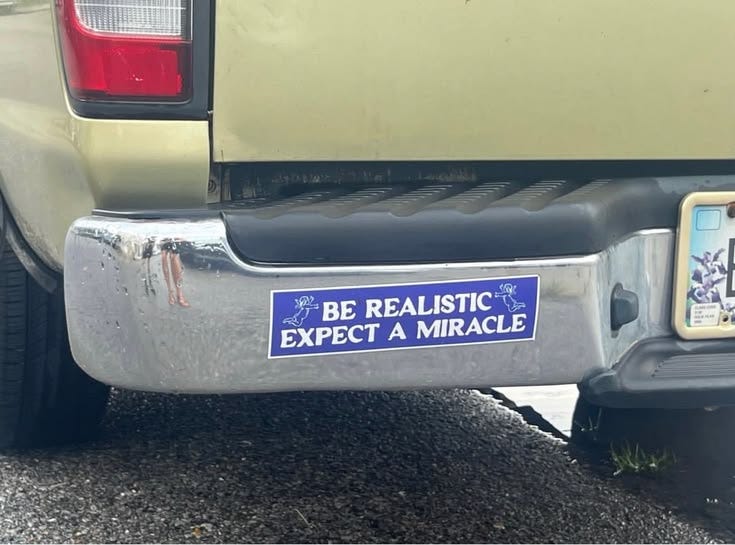
So, I wanted to share my experience doing this experiment, the things I learned in the process, and how it changed my life. I’ll be answering some subscriber questions about this below, too. If you’re tired of suffering more in your mind than in reality, then this is for you.
Comments
Nothing yet. Say the first thing.
Sign in to join the conversation.