
I grew up with the same Texas myths most of us did—wide sky, stubborn pride, stories that are part history, part legend. In the 2036 universe, I’m turning those myths a few degrees to watch what breaks and what holds. The Unified States of Texas (USTX) is my stress test: a Texas that secedes, reorganizes, and hardens—where borders are barricades, propaganda feels like scripture, and survival has a price.
This isn’t a manifesto. It’s a story about people.
Because Texas already lives in the American imagination as a symbol—of freedom, bravado, independence, contradiction. We argue about Texas because it means something, even to those who’ve never lived here. That symbolic weight lets me explore big questions with human-scale characters:
What happens when community becomes us versus us?
What do we keep when everything else is taken?
Who do we become when the rules get rewritten overnight?
In my canon, the USTX is split into five internal “states” plus the District of Austin—a city walled off by the Partition while the rest of the map learns new checkpoints, new codes, new lines not to cross. The State’s legal/ideological voices—The Standard and The Cadence—are quoted as if they were weather: constant, inescapable. Tech decays. Trust decays faster.
That’s the backdrop, not the point. The point is what ordinary people do inside it.
Because it lets me move the dials and ask, “If we changed this one pressure, how many other things bend?” It’s not about predicting the future. It’s about mapping the fault lines already in us.
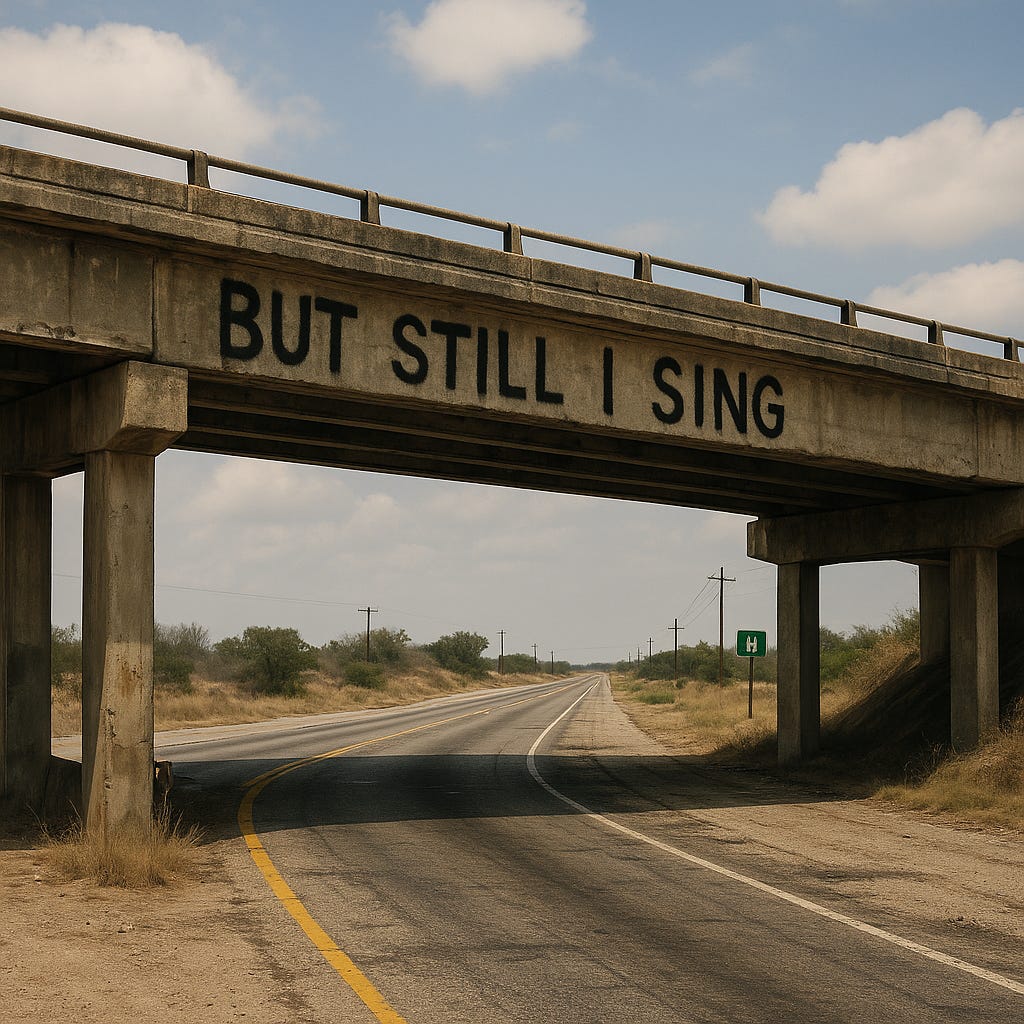
Alternate history makes room for myth. Sam Hall becomes a rumor that won’t die after a rope snaps in Fort Worth—was it chance, providence, sabotage? Depends on who’s telling it. Katie’s Song echoes through a wrecked highway: But still we sing. These myths travel faster than the truth. Sometimes they’re all people have.
We’re living in a time when certainty is easy to buy and hard to trust. Everyone has a megaphone; fewer have brakes. The USTX gives me a contained laboratory to examine the mechanics of power—how fear is manufactured, how obedience is rewarded, how neighbors become informants, how spectacle (a gallows at the Alamo) becomes policy.
But here’s my promise: I’m not writing edge-lord cruelty or misery tourism. I’m writing about courage, loyalty, and the stubbornness of love. The Williams family’s personal no-kill ethic, the quiet work of the Scavengers, the way music and story move through a controlled state—those are my north stars. Violence exists; it changes people. The books care about the cost.
Cal Williams is a protector navigating a house of mirrors—what you say versus what you mean, what you know versus what you can prove.
Cat is the heartbeat who makes hard calls—reviving a son, choosing a dangerous detour for the right doctor, paying the ultimate price for love.
Around them is a network—quiet hands, coded marks, hidden songs. The State broadcasts certainty; people survive with whispers.
They’re not partisan sermonizing in cosplay.
They’re not doom porn.
They’re not prophecy.
Character-first thrillers set in a pressured world.
Love letters to stubborn hope, sung through grit teeth.
Thought experiments about responsibility: What do we owe each other when the rules change?
Over the coming months on this Substack, I’ll share pieces from across the 2036 universe:
My Name It Is Sam Hall — a rope, a myth, a match to dry kindling.
Katie’s Song — a road novella scored by the little rebellions that keep people human.
2036 — the mainline novel that threads it all together: family, cover stories, rescues, betrayals, and burning a nation down to protect your family.
I’ll also post world notes (The Standard / The Cadence, the Partition, the Scavenger sign system), excerpts, art drops, and behind-the-scenes process. If you like seeing a world built brick by brick—with honest mess in the mortar—you’ll fit here.
Because I believe stories can widen the lane for empathy—especially when they put us in the shoes of people we’d rather judge from a distance.
If the USTX makes you uneasy, good. Uneasy means we’re awake. And awake is where change starts.
If this speaks to you:
Subscribe, share with a friend who loves character-driven dystopian fiction, and tell me in the comments: What’s something small you’d still do—still sing, still say—no matter who told you not to?
Comments
Nothing yet. Say the first thing.
Sign in to join the conversation.