
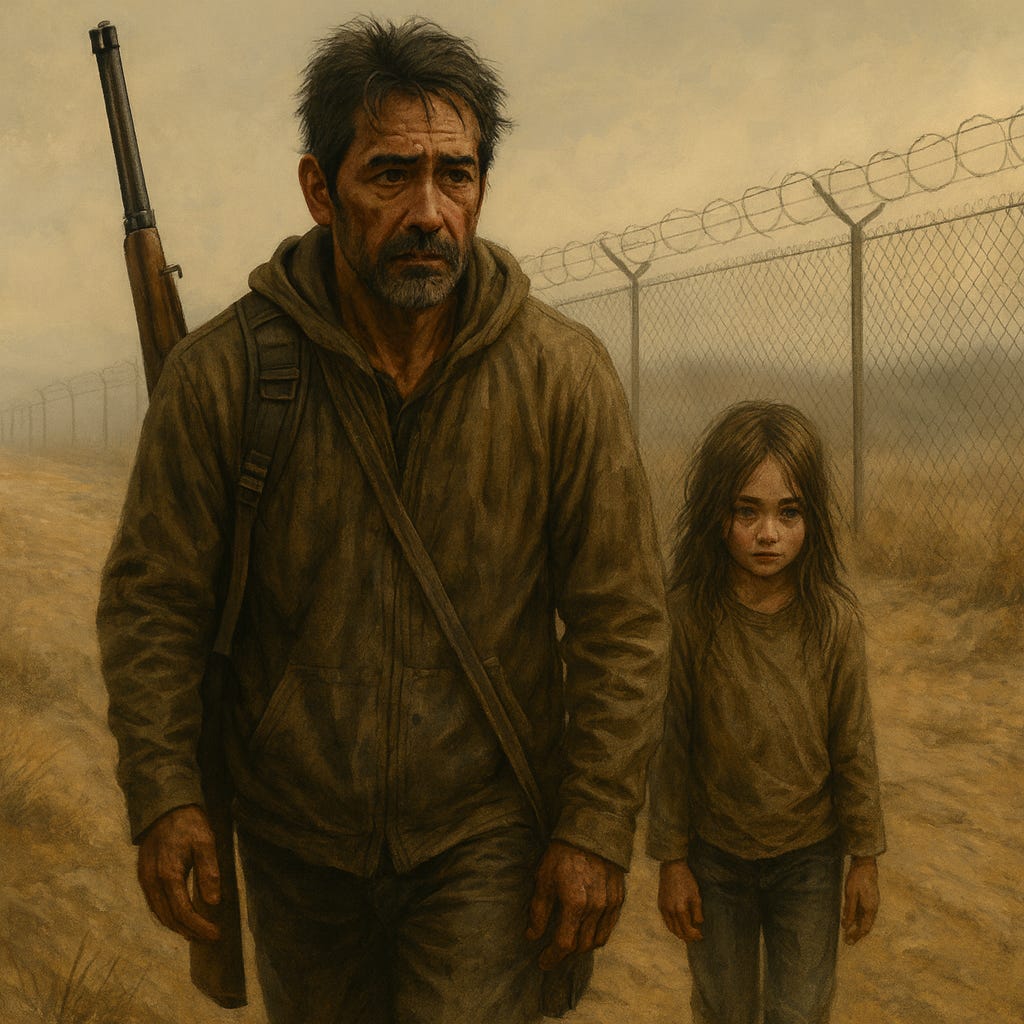
Author's Note:
Coyote is a standalone story set in the dystopian world of the Unified Stated of Texas, a fractured future where the State of Texas has seceded from the United States following a violent coup and ideological purge.
In this new regime, known as the Unified States of Texas, borders are militarized, dissent is criminalized, and survival often means choosing between morality and survival.
This story takes place years after the secession, along the contested northern border near Oklahoma — one of many escape routes used by smugglers, refugees, and rebels trying to flee the regime’s grip.
Coyote can be read on its own or as an entry point into the world of the USTX.
He didn’t know their names. Didn’t want to.
Names made things heavier than the packs on their backs. He’d learned that too late. On this trail, weight killed.
The girl was maybe thirteen, though her face had that wind-swept hollowness that made kids look older. Her shoes didn’t match. The left one was held together with rusted baling wire and cloth torn from a flag Diego didn’t recognize. The man—her father, probably—walked like he hadn’t slept in days. Carried a duffel that sloshed with each step. Water, maybe. Maybe something worse. Diego didn’t ask. He reached out once, without looking, and adjusted the strap of her pack where it was biting into her shoulder. The gesture was automatic, ancient. Then his hand returned to the duffel, and his eyes returned to the dirt.
He walked ten paces ahead, always just out of earshot. Not to lead. To separate.
They were three hours from the border—or what passed for it now. A stretch of collapsed fencing and repurposed oil field sprawl that marked the edge of the Unified States of Texas. Beyond that: Oklahoma. The blockade zone. Officially sealed. Unofficially porous if you knew where to cut and when to run.
The land here didn’t believe in mercy. Just rust, dust, and time. What trees hadn’t been burned were wind-twisted and brittle, holding vultures like ornaments. The ground was cracked open in places, as if the earth itself had tried to flee and failed. The only sound was the crunch of footfalls on gravel and the dry whisper of wind combing through barbed wire.
Diego’s boots were old, but broken in. They didn’t make noise anymore.
The girl coughed behind him—a high, dry snap, like a branch splitting in fire. Too loud.
He didn’t turn around.
Noise is a flare out here. Might as well shoot bullets in the air and wave a flag.
He scanned the sky automatically. Still too bright for drones. That didn’t mean they weren’t watching. The new models were glitchy—relics from before the embargo—but sometimes the broken ones were the most dangerous. They didn’t follow patterns. Just static and guesswork and gunfire.
They passed a collapsed fence, one post still standing, angled like a broken finger pointing nowhere. Diego reached out without thinking and touched it—quick, reverent. A ritual. Years ago, someone had burned a mark there. A circle inside a square. A scavenger glyph. Safe trail.
The mark was gone now. Time or fire had eaten it. Or worse—someone had come behind and scrubbed it clean. Erased the message.
He didn’t use symbols anymore. Too many had turned into traps.
The land changed slightly after that—rising, then dipping into a long stretch of hard clay and scattered limestone. An old dry wash. A natural funnel. Good cover if you were being followed. Bad news if you weren’t alone.
He raised a fist. The signal to stop.
The pair behind him obeyed immediately. Trained. Or just terrified.
Diego crouched at the lip of the ravine, one hand in the dirt. No prints. No movement. The sand was still layered from the last windstorm. That was good. That was something.
But his spine itched. A twitch he couldn’t name.
Run it or reroute?
There was no reroute. Not anymore. Half the northern lanes had been shut after the Crockett incident. Militia had started welding steel plates over the back routes. Too many rebels had gotten through.
He stood and turned to the girl. She was watching him with eyes too still for her age.
He looked away.
Then stepped into the ravine.
He didn’t like the feeling pressing behind his ribs. Not the heat. Not the ache in his knees. It was older than that. Sharper.
The feeling that something had shifted.
Not in the trail.
In him.
The ravine narrowed as they went, winding like a scar cut into the skin of the earth. Dry roots jutted out from the clay walls like grasping fingers, some charred at the tips. Old fencing wire dangled in loops, clinking faintly when the wind caught it just right. But the wind didn’t reach down here often.
Down here, it was still.
Still enough to hear your own pulse if you let it.
Diego didn’t let it.
He moved without speaking, eyes tracking the ridge line above. The sun was behind them now, angling low, casting long shadows across the cracked basin ahead. It would be dark in under two hours. He wanted to be past the drop zone before then.
Behind him, the girl and her father followed in silence. Their footsteps were uneven. The girl dragged one foot slightly, her makeshift shoe flapping with each step. The father’s breathing had changed—shorter now, edged with strain. Diego clocked every detail without turning around.
Weak lungs. Old injury. Not my problem.
He was here to walk them. Not save them.
He used to tell himself that part. Now it just echoed.
They came to a shallow bend where the path opened into a scorched rail bed. It was an old loading line, long since gutted and burned. Railroad ties still dotted the dirt in places, their surfaces blackened and blistered. A few twisted metal bolts stuck out like rusted thorns.
The fire had been at least five years ago, maybe more. You could still smell it—soot and ash baked deep into the bones of the land. No birds. No bugs. Just heat radiating off dead stone.
Diego froze at the edge.
The next stretch was exposed—sixty yards of open kill box, high ledges on both sides. A sniper’s dream. A tactician’s trap. No way to cross it without feeling like a target.
He raised his fist and dropped into a crouch. The others halted behind him.
He ran a hand through the dry sand near the tracks.
Not boots.
Not prints.
Scratches. Long, shallow drag lines. Four parallel grooves. Something with weight and panic behind it.
Could’ve been wind. Could’ve been an animal. Could’ve been someone else making the same run.
And not finishing it.
You don’t pause in a place like this unless you want to die, he told himself.
He waited anyway.
Then stood. Looked back at the girl.
Her face was unreadable. She didn’t blink.
He hated the quiet ones. Not because they talked less. Because they saw more.
He waved her forward.
She and her father started across. Head low. Feet light.
Halfway through the crossing, the girl tripped—hard. Her wire-wrapped foot caught on a bolt.
She didn’t cry out.
She landed hard, palms scraping stone. The duffel in her father’s arms sloshed—something heavy, something glass—and Diego’s hand went to his belt on instinct.
No drone. No shot.
The father helped her up. She shrugged him off.
They kept moving.
But something behind Diego’s ribs twisted like a knife. The same feeling. That day.
A hand. Blood down the wrist. A creekbed full of screaming. A gunshot. A girl with wild eyes, holding a stuffed animal by the neck. No shoes. No words. Just that look.
"Don't ask questions, Don Diego. Just take her. Go."
And he had. He had taken her. He had gone.
Hadn't he?
The girl ahead of him glanced over her shoulder.
Just a flick of her eye.
That same stillness. That same look.
Not suspicion.
Not fear.
Just weight. Like she knew. Like she remembered what he hadn’t told her.
He blinked, hard, and stepped onto the railbed.
Dust shifted beneath his boots. Too soft. Too quiet. Like walking on unmarked graves.
He didn’t look at the ledges. Didn’t look at the sky. Didn’t check to see if someone, or something, was watching from above.
He knew better by now.
If you stare into the ridge, it’ll stare back.
They reached the scrubline on the other side. Diego paused beneath the low brush and wiped the sweat from his brow. It streaked red-brown with dust.
The girl was already watching him.
Her eyes were too old for her face. Not hardened. Just… done. Like the world had shown her everything worth knowing, and none of it was good.
Diego looked away.
His hands ached. He hadn’t been holding his rifle. Why did they ache?
He thought of the tracks. The scratches. The blackened wood.
He thought of the silence.
And he thought again—not for the first time—that someone was watching from behind.
Not from above.
Behind.
Something was wrong with the wind.
It had been shifting all day—sometimes from the north, sometimes the west—but now it just stopped. Stilled. Like the world was holding its breath. Diego felt it hit the back of his neck, not as a breeze but as a presence. Heavy. Expectant.
That’s what triggered it. Not a sound. Not a movement. Just the absence of both.
They were approaching a ridge that looked no different from the dozens before it—burnt cedar husks and the wreckage of an old irrigation pump lying on its side like a sun-bleached carcass. But Diego had learned that patterns lie. It was the familiar places that killed you. The ones where you stopped scanning because you knew what came next.
He didn’t know what came next.
That realization made his fingertips ache.
Diego lifted a hand and signaled for the girl and her father to stay back. He stepped toward the ridge alone, rifle angled low, his eyes tracing the dirt.
Then he saw it.
A brass shell casing, half-buried, still clean enough to shine.
Too clean.
The wind hadn’t coated it yet. That meant it had been fired today—hours ago, maybe minutes. And from the angle of the imprint, it came from the east. From the top of the ridge they were now standing beneath.
Ambush spot. Elevation, sightlines, no cover. Textbook trap.
Diego’s mouth dried. His teeth felt too large in his jaw.
He crouched over the casing and touched it with one gloved finger.
Standard Militia. Close-range round.
He looked up slowly—scanning the lip of the ridge, the bleached horizon beyond, the skeletal silhouettes of dead trees curled by heat and age.
Nothing.
Just silence. And dust. And that feeling again.
That feeling he hadn’t let himself name in years.
It wasn’t fear. Not exactly.
It was the feeling you get when you realize the game is already over, and you’re the only one who didn’t know it.
And then, the figure stepped out.
He didn’t appear with fanfare. Just a shadow moving out from behind the edge of a rusted-out water tank, maybe forty feet away. Dust clung to him like it was afraid to let go.
He didn’t wear Militia gray. Not rebel scraps either.
Worn jeans. Canvas coat. Boots too big for his frame.
And a face Diego hadn’t seen in six years.
Isaac.
Diego’s knees almost buckled, but he didn’t move. Didn’t speak.
Just stared.
The girl gasped behind him. Her father muttered a curse.
Isaac kept walking, slow, measured steps down the incline—like he belonged to the land and it was simply returning him.
It was his shoulders that made Diego’s heart stutter. The tilt. The weight. The quiet fury in every movement.
It was him. The boy he'd trained. The kid he'd once called his son before the world burned that meaning away.
Isaac’s face was sharper now, more angular, sun-scored and cracked at the lips. But it was him. A scar ran beneath his left eye—a memory Diego didn’t have. The rifle slung across his back was civilian, beat to hell. The satchel under his arm was military. Newer. Out of place. He held it not like a burden, but like something fragile.
But what struck Diego hardest wasn’t the gear.
It was Isaac’s eyes.
They looked through him like glass.
They stopped five paces apart.
Diego opened his mouth but nothing came. He didn’t know what to say to a ghost.
Isaac filled the silence for him. His voice had dropped an octave, but the cadence was familiar. Calm. Too calm.
“Still running ghosts across the border?”
The words hit like a shovel to the gut.
Diego’s throat burned. “Didn’t know you were still breathing.”
Isaac gave a smile, humorless and dry. “Didn’t plan on it. But here I am.”
The world tilted just slightly. The dust seemed to hover midair.
Diego blinked.
Last time he’d seen Isaac was—what?—six years ago? Maybe seven?
It was on a run gone sideways.
A refugee family. A Militia perimeter. Chaos. Fire.
Isaac had been with him that day.
But when the smoke cleared, he wasn’t.
There was no body. No cry. Just static on the radio and the sound of boots retreating. Diego ran. He’d told himself there wasn’t time to search. That staying meant getting caught. That maybe Isaac had made it out another way.
But in his bones, he’d known.
He’d left him.
He’d chosen someone else.
A girl. No name. Just a face covered in soot and a voice begging him not to leave her alone.
He never told anyone about her, either.
“What’s in the bag?” Diego asked, nodding toward the satchel.
Isaac shrugged, eyes not leaving his. "Names. Photos. Proof of life. Insurance. And maybe a reason to keep walking."
Diego's hand hovered near his belt. Not for his gun—he wasn’t sure if this was confrontation or confession. Or something in between.
Isaac took a step forward.
“I need to cross. Tomorrow. With or without your map. Doesn’t matter.”
Diego stared at the ground between them.
“Adding another weight changes everything. The pace. The shadows. Timing’s off.”
Isaac tilted his head. “And yet… you haven’t told me no.”
He was right.
Diego hadn't moved.
Because deep down, he already knew he would say yes.
Isaac studied him with a look that wasn’t cold or angry.
It was measured. Like weighing the man in front of him against the one he remembered.
“You left me,” Isaac said quietly.
Not an accusation.
Just a truth.
Diego’s breath shuddered out. “I left… everything.”
They stood like that, the wind finally daring to return between them.
Isaac nodded once.
“So let’s see what you’re leaving behind this time.”
Diego didn’t answer right away.
He turned his back to Isaac and stepped a few paces up the trail, boot soles grinding against loose dirt. The sun had begun its slow descent into a copper haze, casting long shadows across the scrub. Everything looked stretched thin. Like the land itself was being pulled apart by time.
He looked toward the horizon — past the next ridge, past the busted water tower leaning like a drunk against the sky, toward the crooked line of fencing far in the distance. The line. The place where Texas ended and… something else began.
He’d walked people toward that rusted threshold dozens of times. Some made it. Some didn’t. All of them disappeared. That was the deal.
Get them to the wire. Turn around. Forget their faces.
Simple math. Clean hands. Or at least hands he could convince himself were clean.
This time didn’t feel like math.
Behind him, Isaac hadn’t moved. Just waited. Still as a shadow. Like he knew the silence was part of the test.
The girl and her father stood under a skeletal mesquite tree, its limbs bone-white and curled as if reaching for something long gone. The father clutched his duffel tight against his chest. The girl… she didn’t look scared. She looked settled. Like whatever came next, she’d already made peace with it.
But her eyes were on Diego, not Isaac.
That stare again — the one that pinned guilt to your ribs like a badge.
She saw him. Really saw him. And he hated that.
He turned to Isaac.
“You cross with me,” he said, voice low, clipped, “you move at my pace. No breaks. No complaints. If I say drop, you kiss the dirt before the echo fades. If you hesitate, you’re dead.”
Isaac nodded once. “Wasn’t planning on a reunion tour.”
Diego looked away again. Something between relief and dread rolled through his chest.
The rest of the hike was tight with silence. Not the kind that bonded. The kind that built pressure.
They moved single file through a narrowing gully carved by years of storm runoff. The earth had split in places, exposing layers of shale and fossil-gray roots. Vultures circled wide overhead, drifting lazy circles like they could sense the math had changed.
Four now.
Diego felt it in the rhythm of their steps — the syncopation thrown off. Too many bodies. Too much sound. Shadows overlapped. Footfalls doubled.
Every shift in weight became a risk.
Four isn’t a run. Four’s a broadcast.
They reached a long stretch of cracked highway, warped by heat and time. Sun-bleached road signs jutted up from weeds like headstones. One still bore letters: KEEP RIGHT — a bitter joke, Diego thought, considering what they were doing.
They walked without speaking for an hour.
When they made camp, it was under the collapsed remains of a maintenance bridge. One end had fallen into a washout, the other barely held up by rust and prayer. The ground was dry. The air was turning cold.
The silence stretched.
Ration bars. Warm water. The girl stared at the sky while she chewed. The father sat cross-legged beside her, staring at nothing.
Isaac hadn’t sat down at all.
He leaned against one of the tilted concrete beams, arms crossed, eyes on the horizon. Watching the line.
Finally, Diego spoke.
“You should’ve stayed gone.”
It came out harder than he meant.
Isaac didn’t flinch.
“I tried.”
He said it like a fact. Not a defense.
Diego looked down at his hands. Rough. Scarred. He flexed them, but they didn’t feel like they belonged to him anymore.
Diego's hand hovered near his belt... Isaac took a step forward.
"I need to cross. This has to get through. With or without your map. Doesn't matter."
“I didn’t know if you made it out,” he said. “I told myself you did. That you were faster than me.”
Isaac gave a soft, almost-smile. “You didn’t believe that.”
“No,” Diego said. “I didn’t.”
The girl shifted. Just a small adjustment of weight, but Diego noticed.
Isaac looked past him toward her. His voice dropped a half-step.
“She made it, you know.”
Diego frowned. “Who?”
“The girl. The one you carried out. The one you picked instead.”
A pause.
“She made it to the Dome. Lived two years. Malnourished. Didn’t speak. Ever.”
Diego felt something collapse in his chest. A beam giving out under too much weight.
He didn’t ask how Isaac knew. He didn’t want to.
The fire they’d made flickered and hissed. Shadows danced over their faces like restless ghosts.
He stood and walked a few yards away, lighting a cigarette with hands that remembered how even if he didn’t. He’d quit a long time ago. Said it was for his lungs, but really it was because every puff tasted like regret.
He watched the smoke bleed into the cold air.
Behind him, the girl finally spoke.
Quiet. Sharp.
“How many did you leave behind?”
It wasn’t a question. Not really.
Diego didn’t turn around. He just flicked the ash into the dirt and stared out into the dark, where the fence waited like a line drawn by a god who no longer cared which side you were on.
Tomorrow, they’d run for it.
Tonight, Diego lay in silence, under concrete and stars, beside the three people he might doom by morning.
And in his dreams, there were always five.
They moved before dawn.
Before the sky could decide whether to give them sun or storm.
No fire. No food. No words.
Only the sound of dry fabric brushing against skin and boots breaking crusted dirt.
The stars hadn’t faded yet. They blinked faintly in the east, drowned by light pollution from somewhere they’d never reach. Diego led the way in silence, his eyes low, his breath slow. The old trenchline curved north like a trail carved into bone.
This was it — the final stretch.
Beyond the ridge was flatland. Beyond flatland was the fence.
And beyond the fence…
He didn’t know.
No one ever told him what came after.
He reached the rise before the others. Dropped to one knee.
The wind was sharp now — not strong, but slicing. It carried that coppery scent that could’ve been dust or dried blood. In Texas, you learned to stop guessing.
He scanned the stretch ahead.
Just as he remembered: a wide-open sweep of earth, flat and brittle, broken only by the black remains of old utility poles and rusted fence posts sunk halfway into the dirt like forgotten warnings.
A hundred yards of nothing.
A hundred yards of everything.
The old border fence lay ahead, collapsed in some places, sagging in others. Beyond it, Oklahoma. The blockade perimeter. The illusion of something better.
Diego’s throat tightened.
This was always the part where people got loud.
In breath. In panic. In dying.
He turned to the others.
His voice came out like dry gravel.
“We go now. Fast. One breath, one push. No breaks. No turns. If I go down, you do not stop.”
Isaac gave a single nod.
The girl stared straight ahead.
Her father tightened his grip on her shoulder.
Diego’s pulse slowed. He stepped forward.
The first fifty yards passed like smoke — there, then gone.
Boots pounded rhythm into the dirt. No words. Just heartbeat and friction and the occasional jolt of pain from Diego’s knee that he ignored by force of habit.
He counted steps like prayers.
Twenty. Thirty. Forty.
Almost—
CRACK.
Gunfire, sharp and fast, punched the silence like a fist through glass.
The dirt near his leg exploded.
Diego dropped low, rolled behind a concrete post base half-buried in weeds. A second shot cracked air.
Then a burst.
Automatic.
From the south ridge.
Shouting followed. Men’s voices. Clear. Controlled.
They’d been watching.
They hadn’t missed the movement.
They were never late. They were already here.
Diego spun to yell, but the girl was already down — not hit, just frozen. Her father lunged for her, dragging her behind the remains of an old fencepost.
Another burst.
The father screamed.
He slumped sideways, blood blooming fast across his shirt. His fingers still curled around the duffel, but his eyes were wide. Distant. Unmoored.
The girl shrieked — a single, guttural note — and tried to pull him. He was too heavy.
Diego’s body moved before his mind caught up.
He ran to her, low and fast, his shoulder blazing with fire from the weight of the rifle and the years he hadn’t been young.
“Let him go!” he shouted.
She didn’t. She was still trying.
Isaac shouted from the ridge behind them — a warning, maybe. Diego didn’t hear the words, only the urgency.
The girl screamed again.
Another shot rang out — closer this time. Tight grouping. High caliber.
The father twitched. Then stopped.
Diego grabbed her.
She fought him — not out of rage, but refusal.
Her hands weren’t fists. They were anchors.
He yanked her up anyway.
She weighed nothing. Skin and bones and shock.
He threw her over his shoulder and ran.
The world narrowed.
Time fractured.
He didn’t think.
He ran.
The fence was thirty yards ahead. Barbed wire tangled like a crown of thorns. One section had been clipped. Isaac’s work.
Isaac was there now, shouting, moving, covering — firing controlled bursts into the ridge.
They’d practiced this, once. Years ago. Before the fall. Before the dome. Before the girl he left behind and the boy he’d failed came back wearing each other’s shadows.
The wire sparkled in the early light. Some of it was still live — the Militia had rigged certain sections to electrify randomly, a cruel trick designed to keep people guessing.
The wrong guess meant death.
Isaac raised bolt cutters and sliced the final strand.
SNAP.
“Go!” he barked.
Diego didn’t slow. He ducked. The girl’s hair caught a barb and ripped free. She didn’t scream.
He threw her forward.
Isaac grabbed her, pulled her through.
Diego turned.
And saw the Militia cresting the ridge.
Four men. Gray uniforms. Glasses glinting.
One dropped to a knee. Scoped.
Diego saw the man line up the shot.
He dove sideways through the fence just as the crack split the morning.
He hit the ground hard.
Pain burst through his thigh. Heat bloomed, fast and wet.
He rolled, gasping.
Isaac pulled him, one hand on his vest, the other on his satchel. The girl helped too. Small hands, fast, steady.
They crawled behind a low rise.
Breathing.
Just breathing.
Blood pooled beneath Diego’s leg. The bullet hadn’t passed through.
Isaac was already working. Stripping cloth. Pressing gauze.
“You’re lucky,” he said, voice tight. “You’re still here.”
Diego looked at him. Really looked.
Isaac’s eyes weren’t angry anymore.
They were tired.
Like someone who’d stopped waiting for the apology and just wanted the silence to end.
The girl sat beside him.
She wasn’t crying.
She just sat there. Watching.
Just like before, he thought. Just like her.
He looked toward the fence.
The wire still rattled in the wind.
The sound of it reminded him of breathing.
And of the time he told himself he’d stop crossing lines he couldn’t come back from.
He reached for Isaac’s arm.
His voice was raw.
“I left everything behind.”
Isaac didn’t flinch. Didn’t look away.
“Not this time.”
They sat together in the dirt, behind the line.
Behind the ghosts.
Behind the guilt.
The sun was rising, pale and slow, across a land that wasn’t Texas.
It wasn’t freedom.
But it wasn’t where they started.
And for now…
That was enough.
They didn’t speak again until the sun was full above the horizon, stretching thin gold over everything. The wind had shifted again — softer now, but still cold. It stirred the dust in slow spirals across the open field.
The girl sat beside Diego, her arms wrapped around her knees. Her face was blank, not from fear or shock, but from something older. Something practiced. She’d stopped crying before they crossed the fence.
That silence — that readiness — unsettled him more than the gunfire.
He wondered how many other crossings she’d survived before this one.
He didn’t ask.
He’d stopped asking questions a long time ago.
Isaac stood a few yards away, scanning the landscape with steady hands and half-lidded eyes. Not relaxed, but alert in a quiet way. He wasn’t looking for enemies.
He was looking for signs.
Of patrols.
Of safehouses.
Of something human beyond this field of wreckage.
He’d taken the satchel off and laid it carefully in the dirt beside him.
He hadn’t opened it again.
Diego still didn’t know what was inside. But whatever it was, it mattered enough for Isaac to cross the border under fire to carry it.
Maybe information. Maybe medicine. Maybe names.
Maybe a future Diego didn’t have the right to touch.
The wound in Diego’s leg was still bleeding, but slower now. Isaac had packed it with gauze and wrapped it tight with the torn sleeve of his own shirt. The pain was distant. Like it belonged to someone else.
Diego watched the girl absently sketch circles in the dust with her finger.
He wondered how long it would take before they turned into symbols. Messages. Warning signs. Children in this world didn’t draw suns and trees.
They drew routes.
Escape paths.
Graves.
He looked down at his hands.
Callused. Weathered. Still shaking.
There was blood under his nails that wasn’t his.
How many did you leave behind?
The girl’s voice echoed in his skull.
She hadn’t asked it like an accusation.
She’d asked it like a statistic.
A number.
Like every adult was a ledger, and their total had already been written.
He thought of Isaac’s words:
“Not this time.”
He didn’t know if that was forgiveness.
Maybe it was just a truce.
Either way, it was more than he deserved.
Diego looked past the girl, past the barbed wire behind them.
The fence was still rattling in the breeze, humming softly — like a memory that refused to die.
He watched it for a long time.
It didn’t matter that they’d crossed.
The sound followed you.
He closed his eyes.
In his dreams — the ones that would come tonight, and every night after — he’d still be at the fence. Still carrying someone. Still hearing the shot that came too late or too soon.
But he’d also see this morning.
This air.
This silence.
The girl.
His son.
The blood-soaked field behind them.
And this time…
This time, he’d remember what he carried out.
END.
Comments
Nothing yet. Say the first thing.
Sign in to join the conversation.