
We think of Viking ships as a feat of woodworking. But without wool, those ships went nowhere.
A single longship sail required the annual wool harvest of approximately 2,000 sheep. Two tons of fleece. And that’s before a single man stepped aboard.
Now multiply that. A raiding party of ten ships needed the wool of roughly 20,000 sheep — for sails alone. A fleet of 100 ships? 200,000 sheep. Researchers at the Viking Ship Museum in Roskilde, Denmark calculated that sails for the entire Norse fleet in the 11th-century required the equivalent of 2 million sheep worth of wool every single year.
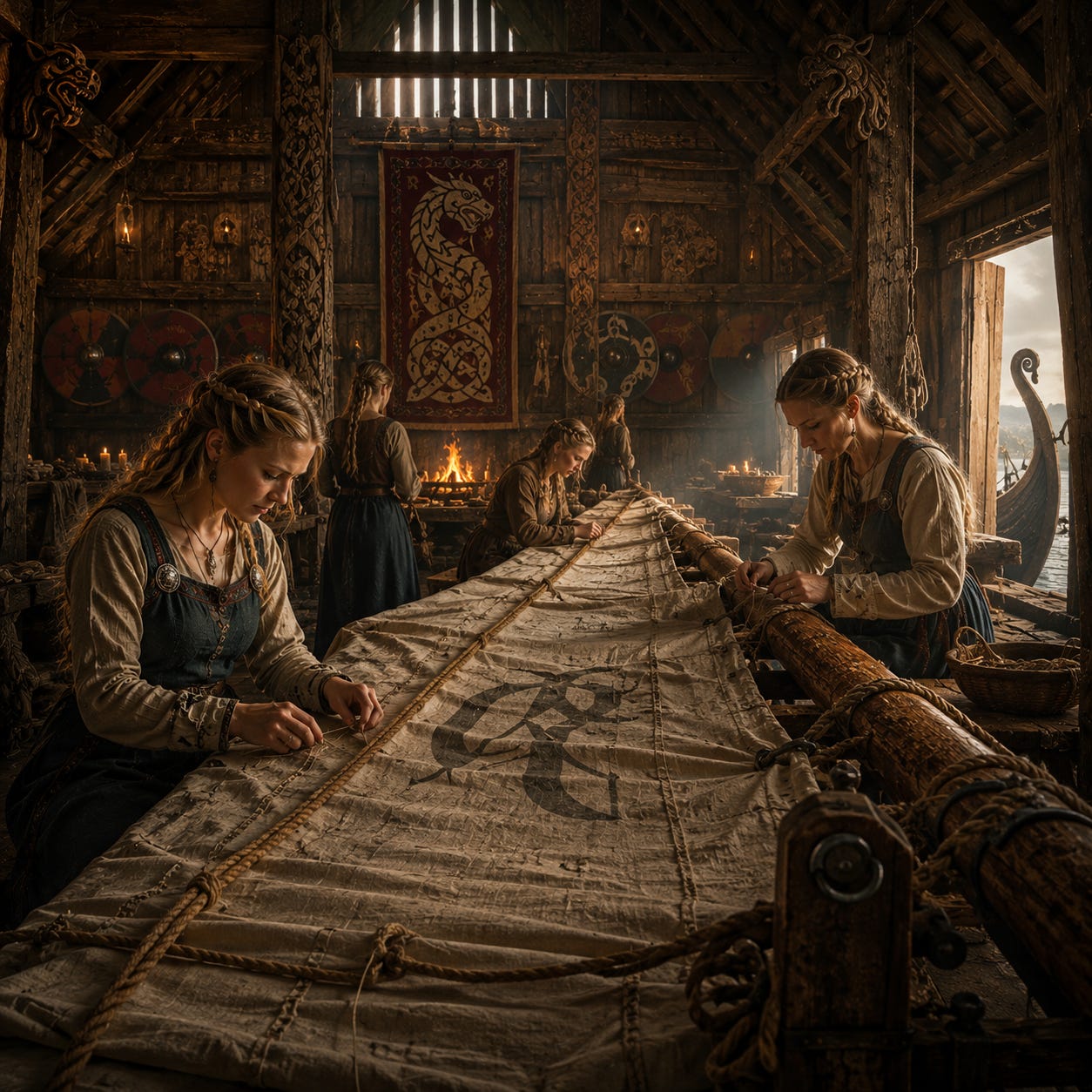
Then add the crew. Researchers estimate that fully outfitting a single vessel — sail and crew together — required the production of at least 2,000 additional sheep.
So where did it all come from?
The short answer: it had to be organised, and only the wealthy could do it. Ship ownership conveyed status. Kings and chieftains measured power not only in land or wealth, but in the number and quality of ships they could command. Behind every jarl’s longship was a network of farms, families, and women working looms — communities that banded together to produce what one man’s ambition required.
Textile researcher Amy Lightfoot has even suggested that the demand for grazing land to feed all those sheep may have been as much a driver of Viking expansion as the desire for plunder or trade.
The longship didn’t just need timber and tar. It needed wool and entire communities to work on it.
Read more in my essay about Viking ship economics.
Thanks for reading! If you enjoyed this historical tidbit, please consider sharing, commenting, or subscribing to History in Fiction. All new subscribers will get my ebook Forged by Iron for free.
Comments
Nothing yet. Say the first thing.
Sign in to join the conversation.