
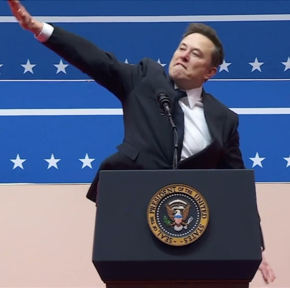
I hope everyone had a Merry Christmas and Happy New Year. I’m starting this year by finishing something I started back in the Spring: outlining what I see as the four distinct elements of the coalition surrounding President Donald Trump. That’s so we then can talk about how this ends, on the way to discussing how we can build something better.
This Trump governing coalition is not the same thing as “MAGA” – in fact, in this post I want to explore:
– which is decidedly not MAGA, but rather people who see themselves as superior to the great unwashed of Trump’s base and are simply using them, and him, to achieve their larger purpose.
There’s a common misperception that while liberals and progressives are congenitally splintered, conservatism is one, well-disciplined, unified mass. This appears even more so in the weirdly cult-like, authoritarian era of Trumpism.
But it just ain’t so – which is becoming more apparent to more people with the supposed post-Trump jockeying breaking out into the open, most notably at the recent annual gathering of Turning Point USA, the organization founded by Charlie Kirk. In fact, both political parties long have been split into several, largely-incompatible sub-movements (which would be more apparent if we had a parliamentary system as in most other democracies).
Republicans have long had to contend with internal tensions between those whose “conservatism” meant authoritarian imposition of traditionalist values and those who used the term to mean a sort of mild libertarianism in which all government is bad (including authoritarianism … except, of course, when necessary), especially if you’re a billionaire or corporation. Not unlike with Democrats, this intra-party tension long has been resolved in a rather Solomonic fashion: Rather than devising a comprehensive, intellectually-coherent approach to individual freedom and government, instead Republicans and Democrats alike generally split the baby in half, supporting Big Brother-ish approaches on some issues and state-free libertarianism on others. (The parties have simply differed as to which of two areas – personal autonomy or economics – to render unto Caesar and which unto God.)
The Trump coalition complicates these agendas. There are still the authoritarian vanguard (which I touched on in my last post and will address more in a forthcoming Hedgehog Review piece) and the religious fundamentalists (addressed in the post before that), both of which have been cornerstones of any conservative movement, uneasily united with traditional anti-government business interests. Both the authoritarian ideologues around Trump – those who worship Hungary’s Viktor Orban and wish simply to emulate his playbook – and the fundamentalists share a faux nostalgia common in conservative movements, particularly at times of perceived decline, for a Golden Age that did not exist but when their values purportedly predominated and created the faded glory. A good deal of the motivation for these movements, and the major part of their agendas, are thus to recreate these supposed prior conditions. This argument is historically quite common and persuasive – and, historically, wrong (as I discussed in Decline and Fall).
The traditional GOP business class, however, has undergone an odd transmogrification in the Trump era. At the outset, it was comprised largely of those who had made their money in 20th Century extractive industries and promoted a libertarian brand of conservatism in order to keep the government’s taxing and regulatory powers out of their businesses. The avatars of the 21st Century’s New Economy – largely Silicon Valley, but also those in media and finance – seemingly sided with the Democratic Party and presented themselves as socially liberal lovers of freedom, opportunity, and equality.
The rapid flip to the Trump column of these New Economy executives generally, and Silicon Valley’s Masters of the Universe in particular, thus has come as a huge surprise to many.
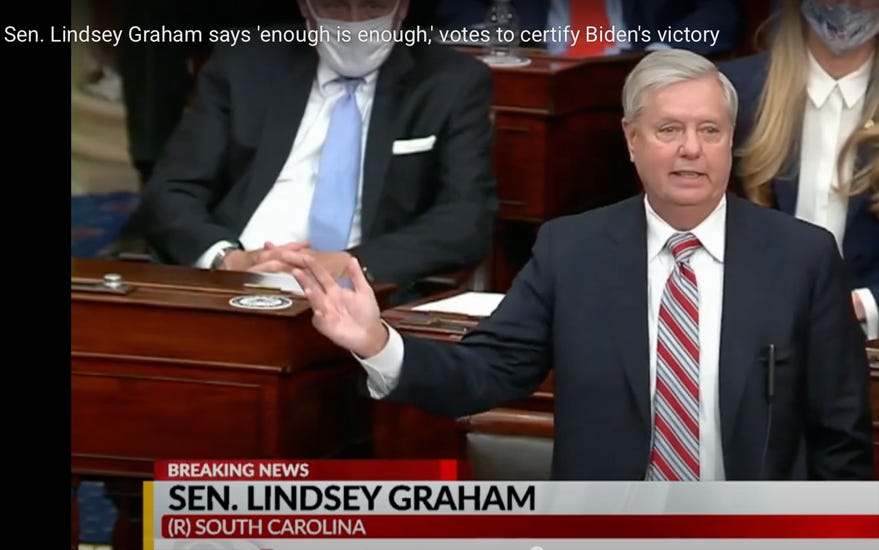
For one thing, these are businesspeople, guided primarily by business logic. You didn’t believe that all those DEI initiatives and progressive-seeming ads that sprung up in the wake of the George Floyd protests were sincere expressions of corporate philosophy, did you? They were responses to perceived changes in public opinion and the regulatory environment; now that those are perceived to be different, corporate leaders’ interest in them has vaporized. But I suppose the bright side of such moral flexibility is that, when Trump becomes sufficiently unpopular or powerless, all the tech titans who elbowed each other for front-row seats at the second Inaugural will deny having known Trump faster than will Lindsey Graham.
Beyond that, however, there has been a sea change in the two parties’ approaches to the tech industry over the last decade. The Internet and related technologies were originally seen as some sort of “new birth of freedom” and were greeted with a rhapsodic embrace on the left; they haven’t turned out that way, and, instead, as their control consolidated amongst a small number of extremely large economic actors, a populist reaction set in on both the left and right. The right’s major objection to Silicon Valley, however, and the main source of Republicans’ rare interest in using antitrust laws to threaten these companies, was the perceived liberal bias of both the company executives (which, as just noted, has turned out to be purely ephemeral) and the act of content moderation (which, in fact, does discriminate generally against rightwing voices because, well, who spends more time online these days talking about killing their opponents and ridiculing women and minorities?). As the tech companies have taken the hint, all-but abandoned content moderation, and begun showing proper obeisance, Republicans have lost interest in – and, in fact, now oppose – regulation of the industry. Liberals interested in promoting competition – another thing we’re supposed to think conservatives and capitalists are for – are now seen by the industry as enemies.
So, like most large industries, tech has shown that it is more interested in a government that lowers regulation and taxes than anything else – the supposedly revolutionary, anti-establishment stance of the earlier Internet era notwithstanding.
If this came as news to you, you hadn’t been paying attention.
I argued almost nine years ago, at the start of Trump 1.0, that this then-prevailing view of a benign tech industry was fundamentally misguided for an even deeper reason:
As it turns out, the information industry is just as extractive as prior economies.
In an interesting little book, Platform Capitalism, the British Marxist economist Nick Srnicek observes that data turn out to be simply another natural resource that our newer technologies have figured out how to extract, and how to extract value from, not unlike mining, oil drilling or agriculture before them. Meanwhile, like manufacturing, these IT industries are focused on how best to increase per-worker productivity and substitute capital for labor whenever possible. In a few years’ time, the jobs being lost to technology will be not only those of former blue-collar manufacturing workers – they also will include those of many who now consider themselves riding the crest of the New Economy wave, from Uber drivers replaced by self-driving cars to radiologists replaced by AI to composers and authors replaced by hit-producing bots. Many current Hillary voters will be joining the disgruntled Bernie and Trump supporters who see the Titans of Information as their threat.
Meanwhile, these Titans, despite their seemingly liberal politics, are proving little different from other Titans of Industry. They’re already finding common ground with the traditionally Republican wings of the Republican Congress and Trump Administration: They recently joined to repeal Obama-era prohibitions on reselling individuals’ online search histories – and just days ago the Administration unveiled its plan to eliminate Obama’s “net neutrality” rules, so that big players can further dominate the Internet. In the words of that noted political philosopher Peter Townsend: Meet the new boss. Same as the old boss.
A decade later, this is all now widely recognized. Big Tech is as much an extractive industry as mining – not noted for its libertarian and humanitarian history – except, with tech, the “mining” is more intensive: What’s being mined is you – your most intimate and personal data, which is extracted from your behavior (both online and off, both extensively monitored) and then resold at tremendous profit to others who use it to influence (and increasingly control) your behavior, so as to extract further resources from you. And who does all this mining for them? You do, every time you click, fill out a form, use a credit card, walk in front of a camera, travel with your phone or EZPass – you do the work for free of supplying them with the most valuable resource on earth right now: data. About you.
It turns out – who could have known? – that underneath their veneer of promoting freedom and creating community, the Tech Titans to a man (along with the rare woman) were interested in only their own personal freedom but, otherwise, total world domination. Who could have guessed, when Mark Zuckerberg, while still in college, intentionally targeted and destroyed another university’s own online “facebook” system when it dared to try to stand on its own, that the coming age of “networking” would be an opportunity for concentration rather than increased autonomy? Who could have imagined that Zuckerberg would later build his own private Facebook air force and issue a manifesto envisioning Facebook taking over government functions like disaster response? Who could have foreseen that a future U.S. president would soon start dismantling the government’s role in such functions so that they could be run by tech companies owned by himself or Elon Musk? Who could have dreamt that the megalomaniacal dreamers who founded OpenAI as a non-profit to keep an evil for-profit corporation like Google from consolidating control over this vital technology would eventually conclude they needed to convert it to an evil for-profit corporation to consolidate control over this vital technology – just, one that’s run by them?
These supposedly-libertarian Valley Bros have moved beyond mere market domination to political philosophizing, promoting a particularly dark vision, one in which government as we know it is destroyed completely and replaced by corporations, preferably those engaged in advanced technology. The destruction-of-government part is presented, self-congratulatorily, as radically freeing, and thus these avatars of the new age are sometimes referred to as crypto-libertarians. (“Crypto” technology, such as blockchain, in fact originally was driven by an underlying libertarian ethos and anti-statist architecture, but it, too, has long-since graduated from idealism to being just another billionaire grift for types like the Trump and Saudi royal families.) The rule-by-surveillance-capital part, however, makes the term crypto-fascist doubly more accurate: “Crypto” because the authoritarianism is both technology-based and hidden behind a façade.
And I don’t casually throw the term “fascist” at everything I don’t like:
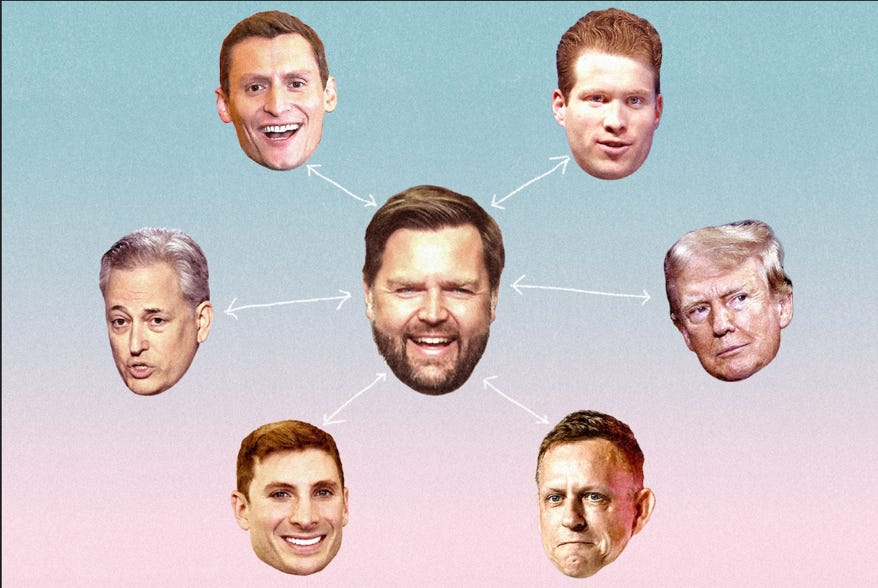
This corporate-libertarianism-turned-crypto-fascism represented by the Silicon Valley thinkers clustering around Trump, including Elon Musk and J.D. Vance, is radically different from either of the two more traditionally-conservative elements in the current regime. Superficially, in their growing disdain for and rejection of democracy, and belief in its replacement by tech-powered, hyper-efficient, corporate governments, they seem to embody simply a slightly different variant of the same basic authoritarian dystopia under Trump for which the DC think tanks and fundamentalist movement have been preparing over the past half-dozen years.
But they are not: They at least purport to represent the last flowering of traditional GOP libertarianism, rather than promoting overt authoritarianism. They are essentially global, not nation-state, oriented, in both ideology and operation. Their leaders, for the most part, cannot be said to subscribe personally to the puritanical cultural views of the core of the authoritarian movement. And, ultimately, they don’t seek to return to the past – they believe instead that they are constructing a completely disjunctive future very different from anything that has come before.
The views and objectives of these crypto-kings are of interest here for two reasons: First, they are strangely similar to my own as to the direction that the world is headed, and what our post-apocalyptic governing structures probably will, and perhaps should, look like. Where we differ, however, is that they see these “virtual states” as replacements for democracy, while I see them as the next evolution in our democracy – if, that is, we can keep it.
And that leads me to the second point of interest, which is that they aim to eliminate our current form of government and replace it with more efficient corporate dictatorships – you know, just what everyone wants government to be: more like Facebook, the airlines, the insurance industry, and the like. This may very well be the reality toward which we are headed, but this vision of radically decentralized and privatized government (and, I stress, this particular vision, because I have a very different one) descends ultimately into Thomas Hobbes’ State of Nature, a war of all against all, in which only the strong survive and rule.
Why do I suggest that the supposedly libertarian theories of the crypto-fascists are really authoritarian, and, then, that this authoritarian vision results ultimately in chaos – a chain of seeming-opposites pyramiding upon further seeming-opposites? Well, what is this vision toward which they are attempting steer the country? It is a world without governments – so (you say), obviously libertarian! But this is based on shallow wordplay rather than deep thought, taking a narrow slice of humanity’s 300,000 year history and saying:
They’re right about the last part of it – but there’s no reason why “government” has to suck, nor throughout all of history has it been what we think of “government” being today. That’s why I prefer to talk of governance, as the overall phenomenon by which groups of people or societies coordinate their activities to optimize their outcomes, using government – or, more specifically, the modern nation-state, i.e., established, static, territorially-based monopolies – to mean simply one potential form of governance: Many other possibilities exist, and have existed throughout history, such as:
Piratical or terrorist control, what the literature calls “stationary bandits” (probably the original form of most early states).
Voluntary associations for particular joint purposes (I’m actually speaking in a few weeks at a conference in Mexico about one such instance of this in the ancient Mayan world, which I’ll write about here after that).
And non-territorial systems that command followers’ allegiance and obedience, such as, say, the Communist International or the Catholic Church.
Among the other historical options is also privately-owned systems of governance controlling large swaths of territory and large numbers of lives, such as the Hudson’s Bay Company – now a department store but once legally and effectively the government of Canada – and, perhaps soon, the corporate governments envisioned by Peter Thiel and the other Silicon Valley overlords. These are governments in all but name – in fact, that’s their stated purpose.
The argument for corporate governments is, of course, that corporations are efficient while public entities are not. Now, I’ll be the last person to defend governments as “efficient” – the bulk of my business consists of making public entities more efficient, because they most definitely are not. But the idea that businesses – especially corporate behemoths – are efficient is decidedly delusional: Have you flown on an airline anytime lately? Or, for that matter, tried to get customer service from say, a tech company? In any event, the type of “efficiency” achieved by businesses means, usually, maximizing just one variable (profit), which is often achieved at the expense of everyone and everything else (for instance, by dumping waste into common pools such as everyone’s air and water).
Governments, in contrast, are expected to maximize multiple variables simultaneously – such as public safety, equitable distribution of opportunity and/or resources, creation of fair rules and disinterested settlement of disputes, promotion of “public goods” such as clean air and water, informed citizenship, widespread education and investment in human capital that benefit corporations that don’t want to pay for it, etc. I believe that profit-making models for these activities, whether public or private, can be designed today – in fact, that’s the main thrust of my spare time these days – but that’s not really what you hear promoters of global corporate domination talking about. You can bet that, under corporate governments, you may get the bare minimum of public parks and amenities to keep the population quiescent – as under any run-of-the-mill pharaoh or narco-terrorist enclave – but that will be a helluva lot less than people would be voting for if it were up to them. Which brings us to the main point.
The objective of global government by corporations is not ultimately simply to give us what we want, more efficiently – it’s to tell us what we want more efficiently. The participating corporations will carve up the world between them – you will simply live in, say, Googlandia or Amazonia. I assume the vision is, in fact, territorial – that Peter Thiel will rule over the Pacific Coast, say, and JD Vance will get the vast territory north of the Ohio River demanded by the evil character on whom he was modeled from Mel Gibson’s The Patriot – because they, ironically, like most people, clearly take the existing territorial nature of states and power for granted. Otherwise, the idea of corporate governments would imply a level of market competition, as well as expertise in actual governance, that, as we’ll discuss below, is both precisely the opposite of their own existing business models and antithetical to their philosophy of the future. And, in the logic of capitalism calling for unceasing growth in markets and market share, inevitably would lead to existential conflict – like in most markets. But with nuclear weapons.

So, you won’t have much choice – but you will get all the efficiency of Facebook. Except, of course, that instead of a provider that controls just what you get to see in your newsfeed and your virtual social life, it will also oversee your kids’ schooling, your healthcare (or, at least, whether you can afford it), your air quality and garbage collection, the welfare system (if there is one, since that’s hardly profit-making), the national parks (to be renamed “resource extraction venues”), and all public safety including arrest, detention, deportation, execution and, of course, as Mark Zuckerberg dreamed, disaster response.
What could go wrong is exactly what’s gone wrong with Facebook – which is everything people hate about soulless large corporations combined with everything they hate about unresponsive governments. (My long-time favorite data point on the nature and future of government was a poll showing that more people hated Facebook than the IRS.) The advantage of the marketplace – at least, if there’s more than one, monopoly provider – is that, if one company doesn’t meet your needs, you can always choose another. This is what forces companies to provide better products and services at better prices. As conservatives often insist, what makes governments bad is that they are both compulsory and monopolies (which basically go together) – largely because they are territorial.
In my conception of the changes that digital technologies enable, the territorial constraint disappears, and thus so do the compulsory and monopolistic aspects of governance systems – creating greater “consumer” freedom and provider quality. In the conception of the New Corporate Overlords, in contrast, the territorial, mandatory-membership, monopolistic – and thus overbearing – nature of traditional public-sector governments will simply be taken over by private-sector governments. Unfortunately, this retains everything that is suboptimal about governments, and adds in everything that is suboptimal about extractive industries.
I often revert to A.O. Hirschman’s definition of what makes for legitimate governing institutions – that they must provide their constituents either “voice” or “exit.” Territorial governments provide little by way of “exit” – outright dictatorships generally lock their subjects into the country, and while, yes, you can leave the decadent West (if that’s your view of things), are you really going to move to the libertarian paradise of Somalia? – and that’s why, to be legitimate, they must provide “voice”: democracy. The whole aim of handing over governance of existing countries to corporations will not be to provide more exit: It will be to provide even less voice – just let Mark and Peter and Elon and Jeff (and J.D.) tell you how it’s gonna be.
The justification for this is that, well, they know best, that private corporations (especially those run by such successful geniuses) are more efficient and effective, and that effective “voice” mechanisms – like elections, multi-party democracy, and the like – only get in the way. For starters, all of this is wrong, as we have already seen. Private companies are not more efficient at maximizing multiple variables – they are terrible at variables like customer service (including voice), equity and public goods that diverge from the one-and-only variable they do maximize, which is profitability. Unfortunately, people actually often care about these other variables – which is exactly why democratic political systems are so messy … and we’re all the better for it. And all of these problems are exacerbated by lack of competition: The more concentrated a market, the more mono- or oligopolistic, the less efficient, the less cost-effective, and the less customer-responsive – in short, the more like, say, Communism – such enterprises become.
That, however, is exactly what the tech titans have transformed most of the marketplace for goods and services into – Facebook, Amazon, Netflix, Google are all essentially predatory, extractive monopolists – and now the same entrepreneurs and ideologues think they should be allowed to do the same to governance services. (In addition, one of the great conceits of business executives – including management consultants – is that if you know how to run a construction or IT firm, you know how to run a government, a categorical error they would never make in confusing ability to run a construction company with the ability to run, say, PayPal or Google AI. After all, look at what a great job Elon Musk did with DOGE.)
All that is why this supposedly libertarian, anti-government vision is in fact a crypto-based blueprint for fascism.
But beyond this moral defect, and this initial surge of concentration and supposed efficiency, it suffers from the same practical defect as the two other strands of right-wing repression – the fundamentalist nostalgists and the outright authoritarians – that we’ve previously surveyed:
Over time (and it doesn’t take a whole lot of that), such static systems fall behind and decay economically, and thus – no matter how “virtual” they imagine themselves – kinetically (i.e., militarily) as well, and eventually are left as husks of their former selves, like the Spanish Empire or the Soviet Union. Like dying stars, each version of this intended rightward lurch – the traditionalist, the authoritarian, and even the rhetorically-libertarian crypto-fascist – produces first an iron-cold congealment, leaching energy and dynamism, and then eventually total collapse under its own deadweight, fueling one last chaotic explosion. The reactionary forces driving Trumpism, in any of their varieties, then, all lead ultimately – as exemplified by their rapid demolition of the public infrastructures of health, education and innovation in which America led the world for nearly 250 years– not to making America great again but to its sad, slow dissolution into mediocrity and desolation. As I noted shortly before Trump was re-elected, “The real prospect of a Trumpian government, in sum, is less a totalitarian state than a hollowed out, then collapsing, central government and, ultimately, a failed state.” That may produce a new kind of state for the Tech Titans … but the primordial State of Nature for the rest of us.
Which is why I’ve always believed that the fourth and final strand of Trumpism – the one personified by its figurehead himself, the tiger that all the others are attempting to ride – in the end will consume them all: the forces of chaos. It’s why the image I keep coming back to as I watch this movie play out is the climax of Akira Kurosawa’s Ran (which means “Chaos” in Japanese). And that’s what I’ll address next time.

No posts
Comments
Nothing yet. Say the first thing.
Sign in to join the conversation.