
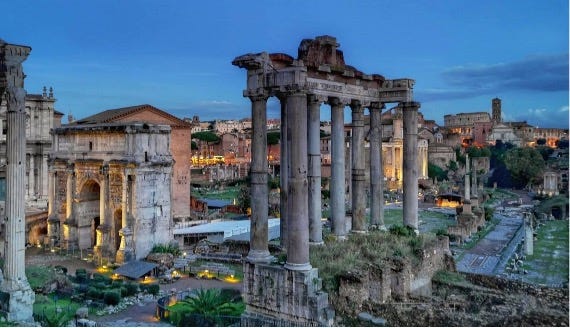
Never-Trump strategist Rick Wilson recently told an interviewer that whether Trump or J.D. Vance is president is irrelevant because, “It’s two separate pathways of Hell.”
My last post, The World Turned Upside Down, argued, however, that the “different constituencies of the Trumpist movement” include:
(1) fundamentalist nostalgists, (2) outright illiberal authoritarians, (3) seemingly-libertarian post-liberal techno-futurists who might better be described as “crypto-fascists,” and (4) the forces of chaos.
So, it’s actually four “separate pathways of Hell.”
Vance represents the third of these, Trump the fourth. This post will tackle the first: the challenge of the “fundamentalist nostalgists,” those who insist – as have others throughout history – that our society is in a moral rot and the only solution is to turn the clock back to a supposed former era of conservative political, moral, and religious orthodoxy.
Assuming there is indeed a dire need to Make America Great Again (as opposed simply to, say, keeping it that way), is this the way to do it? History suggests otherwise.
NOTHING NEW UNDER THE SUN?
In college, I had a tendency not to attend class, because I felt I had better things to do. My junior year, I enrolled in a course called “Political Sociology,” but after the first lecture, I decided to skip it for the entire semester, until the pre-final review.
I listened for most of the hour-long recap to the professor’s summary of the entire course, and then raised my hand to ask a simple question: Was he saying that all political development is linear – generally progressing over time to some higher level of general welfare – or cyclical, repeating basically the same scenarios over and over in different places at different times?
The entire room groaned. A friend leaned over and whispered to me that that was basically the sole question that they had spent the entire semester discussing in my absence. I was probably supposed to feel embarrassed, but I felt that that basically told me everything I needed to know about the course, and whether my time had been better spent elsewhere.
I’ve never bought that social evolution is either relatively linear and assured or cyclical with humanity doomed to repeat its mistakes over and over. I believe that, people being people, certain paths present themselves recurrently to societies throughout history – but we have choices we can make at each turn that can take the future in different directions. Some countries and their leaders make wise choices, and others disastrous ones; the results are not foreordained.
Nevertheless, cyclical theories are quite popular, and a recurrent one (thereby demonstrating the validity of cyclical theories?) is that all societies, or, specifically, Great Powers, go through a predictable lifecycle: They grow from humble origins into a dominant force in world affairs, something goes wrong in their maturity, and so they all then decline and die. And there’s a reason generally assumed for this inevitable deterioration and death: the decay of traditional mores and values, due to wealth and luxury leading to dissipation and dissolution.
So, whenever a society senses that it is slipping into senescence and decline, the solution almost always appears at the ready: Simply return to the austere, pietistic values that defined that society’s “real” nature and produced its rise to greatness. We have reached such a period once again, with a belief in the efficacy – indeed, necessity – of reaction and revanchism to make our nation great “again.”
The current moment is a particularly odd one for Americans to imagine that we’re undergoing a near-death experience: The U.S. probably has the strongest economy in the world today. Is still the center of virtually all the world’s scientific and technological knowledge. Is still the recognized military superpower of the entire world. And is the issuer of the world’s wholly-dominant reserve currency. Everyone else in the world gets this – which is why we are the recipients of the surging immigration we’re so afraid of: Everyone wants to come here and live like an American.
Nevetheless, since this sort of moral panic is indeed a recurring theme in nations concerned about their decline and fall, there are plenty of examples to look to throughout history as to how exactly this theory has played out. And it turns out that, in reality, the past isn’t quite so encouraging for those who wish to return to it.
NOBODY EXPECTS THE SPANISH INQUISITION
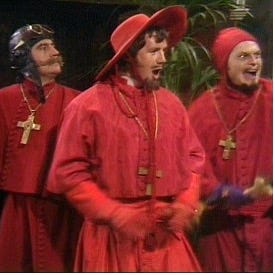
It’s likely not the comparison you’re expecting, but probably the closest parallel to what the Trump Administration is pursuing is the Spain of the Inquisition.
I’ve been to Spain, and I kinda like the music. But I wouldn’t want the United States to go the way of the Spanish Empire.
Spain as we know it today emerged from the fifteenth century effort to unite what had previously been a variety of smaller kingdoms and drive the Moors – Islamic Arab conquerors – out of the Iberian peninsula. The creation of a unified Spain with the marriage of the rulers of the two strongest kingdoms – Ferdinand of Aragon and Isabella of Castille – also resulted immediately in the launch of the infamous Spanish Inquisition, to root out all forms of religious heresy.
While the Inquisition is best remembered for torturing and burning religious dissidents, its main contribution was to destroy the world’s greatest empire from within by ossifying its intellectual and scientific institutions.
Spain’s rise and fall would be characterized throughout by the dichotomy between the forces of fundamentalist reaction and those of the technological innovation that would vaunt the country to unprecedented wealth and power: Emblematically, the year 1492 saw both the efforts at ethnic and religious purification achieve their long-sought victory by driving the last of the Moors, and expelling all of the Jews, from Spain permanently — and Christopher Columbus’ voyage of discovery to the New World that resulted in Spain becoming the greatest global empire in history to that point.
Columbus was hardly a solo visionary in a benighted world, as he is often portrayed: He was, rather, more of an heroically-determined, kooky autodidact, who fortunately for him found in the Iberia of his day an intellectual milieu of sophisticated navigators who better understood the movements of the heavens, the curvature of the earth, the likely distances between the continents, and the cycles of the winds that made global seafaring possible or not. This scientific knowledge – which induced the intellectual elite to endorse Columbus’ heretical scheme to a skeptical Isabella – was enabled in part by possessing what was then probably the greatest university in the world.
The three great original European seats of learning were Bologna, Paris and Oxford. But over three centuries, Salamanca had risen to stand as the pre-eminent scholarly center on earth. This intellectual ferment – with its openness to such religiously heretical ideas as the earth's spherical nature – laid the foundation for Spain's world mastery, starting with Columbus’ voyage and then the further discovery and exploitation of most of the Western Hemisphere.
The intellectual ferment stopped, however, as a matter of government edict: First disfavored peoples, like Jews, then Muslims, then Spaniards of lesser birth, were barred from Salamanca – from which it was merely a small step to the banning of inimical ideas and dangerous doctrines like, say mathematics (yes, mathematics). Stop me if this sounds familiar.
Unfortunately for Spain, technological change and intellectual advance did not cease similarly outside its borders. New methods of navigation were developed that changed the entire basis of warfare, shifting its focus from land to sea; contending powers simultaneously evolved toward a more modern vision of economic vitality and competitiveness. Spain, however, did not change with the times. This global sea-change empowered the much smaller Netherlands to rebel successfully against Spanish control and the until-then relatively peripheral English to defeat the Armada and begin their own rise to global domination. Significantly, both represented the liberal, relatively democratic, and capitalist societies of the future.
At the same time, the phenomenal revenues from Mexico and Peru began to taper off (there was only so much gold and silver to plunder) and the costs of empire began to exceed its benefits. But, rather than modernize politically and economically, Spain’s response to its relative decline was to double-down on its causes: both its traditional expansionist foreign policy (without the forward-looking economic and fiscal policies necessary to sustain it) and, in the words of Oxford don John H. Eliott, “the restoration of old values.”[1]
Spain, like every Great Power since, saw itself as the heir to Rome, and thus to the specter of Rome’s decline and fall. And like most, it explained that decline and fall as due to “subver[sion] from within by the decline of moral standards – by luxury, greed, effeminacy, and by the abandonment of the traditional moral and martial values that had given Rome its greatness.”
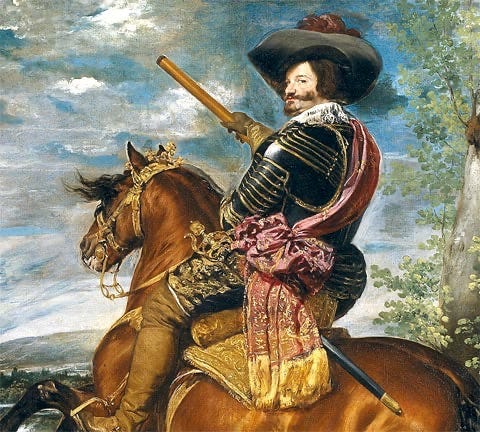
This produced the reactionary program of one of the greatest “declinist” leaders of all time, Gaspar de Guzmán y Pimentel Ribera y Velasco de Tovar, better known to history as the Conde-Duc de Olivares. “As a result,” wrote Elliott, an expert on the Conde-Duc, “one major aspect of the Olivares program was to be a great spiritual and moral house-cleansing, a puritanical reform movement which involved the closing of brothels, a ban on the publication of frivolous literature, and a new drive for austerity in dress.” A chauvinistic revanchism thus went hand-in-hand with a moralistic reactionism. Did such policies make Spain great again? We know today that turning to the past didn’t position Spain to win the future — it sealed its decline. Which makes the persistence of such approaches rather dumb-founding.
THE RETURN OF THE RUBICONMEN
As the Spanish case illustrates, Rome looms large in any discussion of imperial fate. The glory of Rome and its thousand-year rule has inspired imperialists ever since; so, right on cue, it seems to be latest inspiration of the Trump Administration.
As classicist Honor Cargill-Martin recently wrote in The New York Times,
When today’s conservatives — from the intellectual wing of MAGA to the so-called New Right — talk of Rome, however, their obsession is not with its glories but with its decay. They speak of Rome’s decline and fall with the zeal of prophets. We need look back only two millenniums, they suggest, for a window into our future.
“Anyone feeling late stage empire vibes?” Mr. Musk once asked on X. The United States, JD Vance has said, is “in a late-republican period,” referring to the era in which Rome transitioned to empire from aristocratic republic.
As I agreed in a series of posts several years ago, “I don’t think the problem with the U.S. today is that it resembles Rome at the end of the empire, but rather that it resembles Rome at the end of the republic.” The difference between my view and those of Vance and his fellow Trumpists is that I see this as a bad thing: Curtis Yarvin, the leading thinker behind the right-wing renaissance of authoritarian theorizing, which we’ll discuss in my next post, sees the collapse of the Republic into an imperial dictatorship as the “best-case scenario.”
Mr. Bannon, influenced by Edward Gibbon’s 18th-century opus, “The Decline and Fall of the Roman Empire,” [argues that] Rome disintegrated … because its moral fiber — the “Roman virtues of manliness, and service to the state” as he puts it — collapsed under the pressure of barbarian immigration and sensual excess among the elite. Mr. Anton agrees. “Prosperity and ease,” he wrote, and the “complacence and decadence” they bred, rotted the empire from within. Years of secularization, cultural war and national shame, these thinkers argue, are now doing the same to America.
Why haven’t these thinkers learned the contrary lessons from their predecessors, like Olivares, who argued the same thing, fatally for their societies? Because it suits their purposes to be willfully blind. (Despite Bannon’s admiration, for instance, Gibbon blamed Rome’s fall on the rise of Christianity – you know, one of those liberal Middle Eastern fads sweeping Rome and undermining traditional values.) As Cargill-Martin writes:
It’s a convenient intellectual starting place. An imminent political apocalypse naturally requires extreme solutions. The pressures on America, Mr. Anton has suggested, may necessitate the rise of a Caesar, whose “authoritarian one-man rule” would be “partially legitimized by necessity.” Mr. Anton is careful to specify that this is not a future he hopes for, but some in his orbit seem to dream of Caesarism as a coming golden age. A new Caesar, according to Mr. Yarvin, is the guarantee of “cultural peace.” Maybe, Mr. Musk has proposed, what America needs is a Sulla — the military commander who, in the early first century B.C., marched his troops on Rome, became dictator through force and imposed his vision of old-school decency on Rome by slaughtering his political opponents en masse.
“The Rome analogies the right uses to justify these conclusions” she writes, “are flawed.” I’ll leave you to read the rest of her piece – or what I wrote on this same subject at the end of Trump 1.0.[2]
As might not surprise you, my diagnosis of the problems facing both Republican Rome and contemporary America was a little different from that of Messrs. Yarvin, Bannon and Musk. The Republic’s “increasing economic inequality, the increasing political polarization, the total eclipse of ‘the greater good’ by what we’d call ‘special interests,’ the turn toward political violence” all looked “a lot like the present moment to me.” Out of this chaos emerged a series of colorful faux-populists bent, in reality, solely on personal gain and dictatorial power. Like Musk, I too compared Trump to Sulla; unlike Musk, I didn’t see this as a good thing.
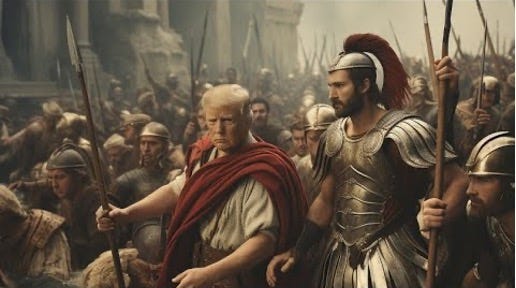
Despite the riveting personalities that make Roman history so interesting, though, the decline of the Republic was driven more by deeper, underlying factors than the individuals who took advantage of them – much like Trump. The Republic suffered from great economic inequality in a dramatically changing world with which Rome’s economy was more and more interconnected; its political system did little to address the resulting strains except when they reached crisis proportions – and then, only as much as necessary to get the working class temporarily to shut up.
Augustus did indeed resolve these tensions in Rome’s democracy by – as those around Trump now dream – imposing a backwards-looking, conservative, traditionalist dictatorship. The Empire, however, was, despite its superficial glories, hollow at its core. Rome’s successes in engineering and military technology, for instance, were unmatched by any similar advances in, say, science and medicine, or philosophy and the arts (unlike the Greeks). For the overwhelming majority of people ruled by the Caesars, life was – in Gibbon’s words – “awful.” That’s the future of which the reactionaries dream.
Instead of the Caeserite party’s right-wing aristocratic rule dressed up in faux-populist rhetoric, however, there was an alternative the Roman elite refused to grasp: Broadened and meaningful democracy along with progressive economic policies might have resolved the Republic’s underlying problems and averted a half-millennium of dictatorship dominated not by orderly succession but factional assassinations and coups until even the Empire eventually conceded it couldn’t manage the job and simply partitioned itself.
TURNING JAPANESE
Many other societies have faced moments of decline and had to face a similar choice whether to look forward or backward.
In Japan, in 1868, a coalition of samurai militia and similarly-disaffected traditionalists from the countryside, frustrated by their displacement under a newer elite, rebelled against the shogunate. They wanted to make the Floating Kingdom great again by restoring the Emperor, who had faded in actual power behind that of the Shogun (last year’s TV blockbuster, Shogun, presented an only-slightly fictionalized version of the rise of the shogunate) and reviving what they saw as Japan’s rightful political and cultural order.
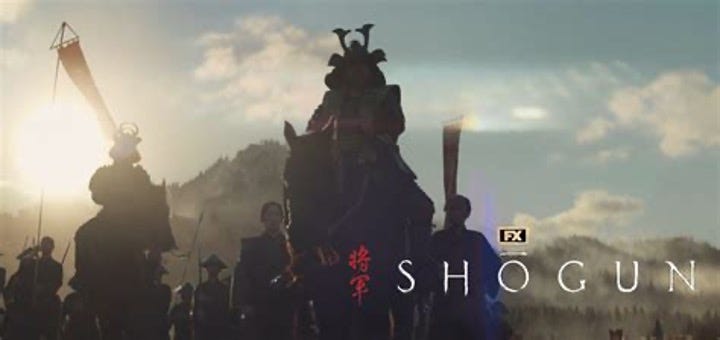
But their revolution didn’t bring back the traditionalism they had been promised. Once in power, the leaders under the Emperor Meiji instead launched a dramatic push for technological modernization, economic reform, internationalism, and at least nascent democracy. As a result, Japan surged in less than a century from an isolated backwater to an economic and military power of the first rank. This all was lost, however, when authoritarian, militaristic, traditionalist conservatives took over in the 20th century and led the country to destruction.
At roughly the same time, Czar Alexander II attempted a creeping liberalization of a deeply backward Russia. He freed the serfs, created an advisory elective body, and had plans to expand the franchise and institute real democracy. But, just as Alexander was about to sign a decree effectuating these reforms, he was assassinated; an excellent biography of Alexander, Alexander II: The Last Great Tsar (2005) by Edvard Radzinski, suggests that the reactionary aristocracy and secret police knew of the impending assassination attempt and allowed it to occur. Alexander’s dimwitted son and successor, Alexander III, reversed course. A staunch traditionalist, he rejected reform in favor of returning Russia to the Good Old Days of autocracy. The rest, as they say, is history.
Turkey offers another example of a country torn between the future and the past. In the mid-19th Century, the declining Ottoman Empire oscillated between sultans who recognized the need for modernization and reactionaries who resisted it. After the empire’s collapse, the Young Turks (yes, the genuine original Young Turks) rose under the leadership of Mustafa Kemal, gained control of the shattered remnant of the empire – the modern country of Turkey – and, like many countries in the 20th Century, instituted a forced-march to modernity and democracy.
CIRCLING BACK
Those gains remain contested. Turkey has continued to be torn between forces of liberalization and modernization, on the one hand, and of traditionalism and authoritarianism on the other. The same, age-old battle is now playing out worldwide: As I noted last time, the crisis of today is the reaction against all such advances of the 20th Century, particularly the ascendancy of modern Western liberalism. It is not yet at all clear how this struggle will end, in the US or globally.
The same historical challenges do in fact arise time after time. And conservatives in each era propose the same solution.
That doesn’t mean we have to keep adopting it.
History makes clear what happens when people try to turn the clock backwards to resolve anxieties about a changing future – rather than embracing it. From the Roman Republic to medieval Spain, from imperial Japan and Russia to modern Turkey, efforts to make countries great again by restoring the past have accelerated rather than reversed decline – for one simple reason:
Those who try to go backward inevitably find themselves left behind.
[1] J.H. Elliott, “Managing Decline: Olivares and the Grand Strategy of Imperial Spain,” in Paul Kennedy, ed., Grand Strategies in War and Peace (1991).
No posts
Comments
Nothing yet. Say the first thing.
Sign in to join the conversation.