
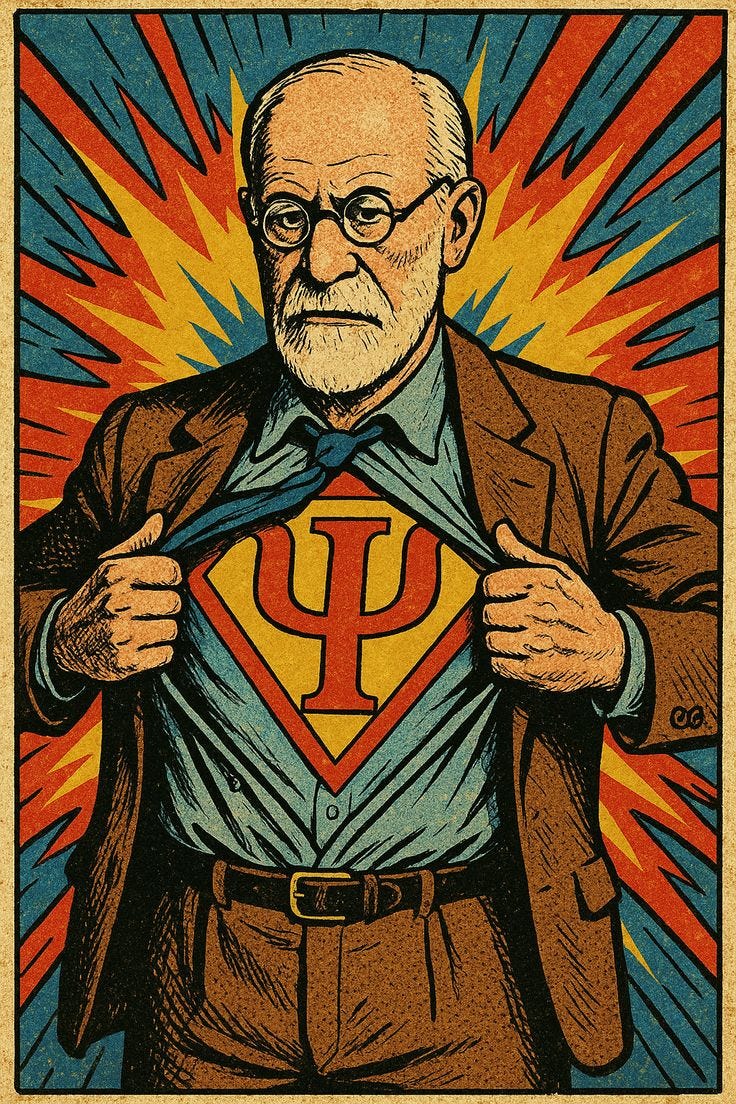
How did we make it for so long without psychotherapy? A thing believed necessary by so many today was virtually unheard of just a century ago.
I know several people who truly believe they could not make it week-to-week without their therapist. Perhaps they’re right. I’m a product of a 1980s childhood when no one but the seriously ill went to therapy. If you did go, you sure as hell didn’t tell anyone about it, especially in public. People would think you were a psychopath. Today, the opposite is true: virtually everyone goes to therapy, and many consider you questionable if you don’t.
What happened? As a therapist myself, I’ve had this question on my mind for at least the last decade. And to be honest, in just the last few months, I’ve been seriously rethinking my long-held ideas of what therapy should be. I recognize that therapy has limits. I think everyone does. But I also think the limits are far tighter than many appreciate.
For example, it is my experience that many people relate to therapy as they would religion. There certainly are many crossovers. Traditional religion has temples, therapy has clinics; religion has bishops and priests, therapy has professors and therapists; religion has sacraments, doctrine, and prayer rules; therapy has techniques, studies, and life skills.
Perhaps the most significant similarity is how therapy shapes a unique bond between the therapist and client. It’s not a friendship, it’s not family, it’s not business; it does not fit into any other relationship category. It is unique. The closest equivalent would be the priest-parishioner relationship.
To answer the opening question, “how did we make it this long…”, we made it this long without psychotherapy because we had religion—traditional religion.
Why has therapy exploded in popularity? Probably because it has become, for many, a surrogate religion in the wake of society’s massive retreat from religion.
Most people I know shudder at the mere mention of traditional religion. Images of Catholic nuns wielding knuckle-crushing rulers for disobedient students, or early New England Puritans wielding scarlet letters to mark out adulterers, come to mind. Even many Christians raise their fingers in the sign of a cross to ward off religious spirits when it is mentioned. Protestant Christians, designated as such early on for their “protest” against Roman Catholicism, are today basically the protestants of all traditional religions.
Having myself emerged as an Orthodox Christian after a nineteen-year journey through American Evangelicalism, I fully understand the fear of traditional religion from their perspective. I, too, believed that religion was the great Satan. I also fully understand the lack of genuine communion that our brands of Evangelicalism fostered. I found it to be in league with the basic zeitgeist of the age—stay busy, keep going, aim for pleasure, comfort, power, etc. Evangelicalism is as much at odds with traditional religion as Hollywood is. But how could it not when it is dedicated to protesting traditional Christianity, in which the Eucharist, the very center and high point of Christian communion, is rejected?
It took a long time of counseling clients and growing in the Orthodox faith to appreciate the true weight communion has on the psyche. Over the last few years, I have begun despairing as a therapist over this limitation. Psychotherapy, though it does foster a unique relationship for both therapist and client, does not give the sort of communion I am talking about, and this communion is essential for the “goals” of therapy to be achieved.
Let me stop here and acknowledge that there is not, and never could be, one defined set of therapy goals for everyone. Some issues require immediate solutions, while others more long-term remedies. So, instead, here are my thoughts on what should be the basic goal, generally speaking.
Whatever a therapist might have in mind for therapy, the aim should be to help the client become more inwardly united—one should aim to eliminate internal divisions. As Soren Kierkegaard (perhaps the true grandfather of psychology) asserted, authenticity lies in striving toward a “unified personality”. One could summarize Carl Jung’s entire project of psychoanalysis in a similar vein. He believed neurosis was quintessentially a matter of internal divisions that are healed through integration into a unified self. How a therapist helps steer the therapeutic journey in this direction will vary depending on their particular talents and competencies. But in the end, a “whole” person is the goal.
If this is true, and if humans are intrinsically wired for communion (which is not seriously disputed by anyone of note that I’m aware of), then a whole person is inconceivable without communion being the main component. Thus, if therapy is to achieve its overarching aim, it would need to be able to give communion to the client. This it cannot do.
I must also put my cards on the table on what I mean by communion, or I fear the main thrust of this article might be lost. I’m hesitant because it is such a huge topic that I cannot possibly do it justice in just a sentence or two; I’m tempted to save any explanation for a full article of its own. That said, here’s my best shot:
Essentially, there is a variety of communion found in the social community form, and a religious-based psycho-spiritual form. The mere social form itself has been radically beaten down over successive generations to the point that today we find ourselves forcing community where it used to come naturally. Think social media: we became so proficient at cutting ourselves off from each other through our drive towards individualism that we invented social media to bring us back together, only to find that social media causes a whole new level of faux-community that not only does not do the trick for communion but makes a parody of it. The form of communion I’m referring to throughout this article is the psycho-spiritual variety, the type that only comes through communion with God. As an Orthodox Christian, I believe in one God in a communion of three divine persons: Father, Son, and Holy Spirit. God’s being is communion (as bishop John Zizioulas put it). Made in his image and likeness (Gen 1:26) makes us communal beings as well. It’s more than just neuro-wiring; it is what we are ontologically. Thus, it follows that only God could give the sort of communion necessary for human well-being.
I am not suggesting therapists steer their clients to the Orthodox Church. My point here is to highlight this limitation in therapy and how easily therapy, if one is not careful, can be metabolized in the psyche as a pseudo-religion. They are vastly different despite their similarities and should not be confused. Psychotherapy is a cultural artifact created to meet the psychological needs inherent in a society cut adrift from community—that sea of liberated individuals connected not by rank, class, or even family ties; individuals freed to suffer the captivity of isolation in their private drives and ambitions. Psychotherapy can mitigate the symptoms of this existential isolation (anxiety, depression, and a host of other neuroses), but it cannot heal the root problem.
Please join me in my next few articles, where I will further discuss how and why psychotherapy came about and how it compares and contrasts with traditional religion, specifically Orthodox Christianity.
No posts
Comments
Nothing yet. Say the first thing.
Sign in to join the conversation.