

Fr. Klaus Schatz, S.J., received his doctorate at Rome’s Gregorian University in 1974 and taught Church History for many years at the St. Georgen School of Philosophy and Theology in Frankfurt, Germany. He is a well-known expert in the subject of the Papacy in history and, in particular, the 1st Vatican Council. I’m positive that he hardly knows this, but his book Papal Primacy: From Its Origins to the Present (1996), has been used by non-Catholics in order to try and arm their side with Catholic scholarship. In particular, Schatz can be found saying that the early centuries of the Church did not possess the supremacy of the Pope. Admittedly, there are statements in the book that can be read in this way. One example would be on p. 2:
“If we ask in addition whether the primitive Church was aware, after Peter’s death, that his authority had passed to the next bishop of Rome, or in other words that the head of the community at Rome was now the successor of Peter, the church’s rock and hence the subject of the promise in Matthew 16:18-19, the question, put in those terms, must certainly be given a negative answer.”
In my own book on the Papacy, I found there to be a much greater clarity on the evidence for papal supremacy in the early Church. Nonetheless, while I might disagree here and there with Schatz’s summaries, I found his book to contain some brilliant insights into Church history. Towards the end of his book, he gives what can be called an overall analysis of whether the doctrine of the Papacy (as defined at Vatican I) was really rooted in Church history or not. I find his summary to be not dissimilar from mine own.
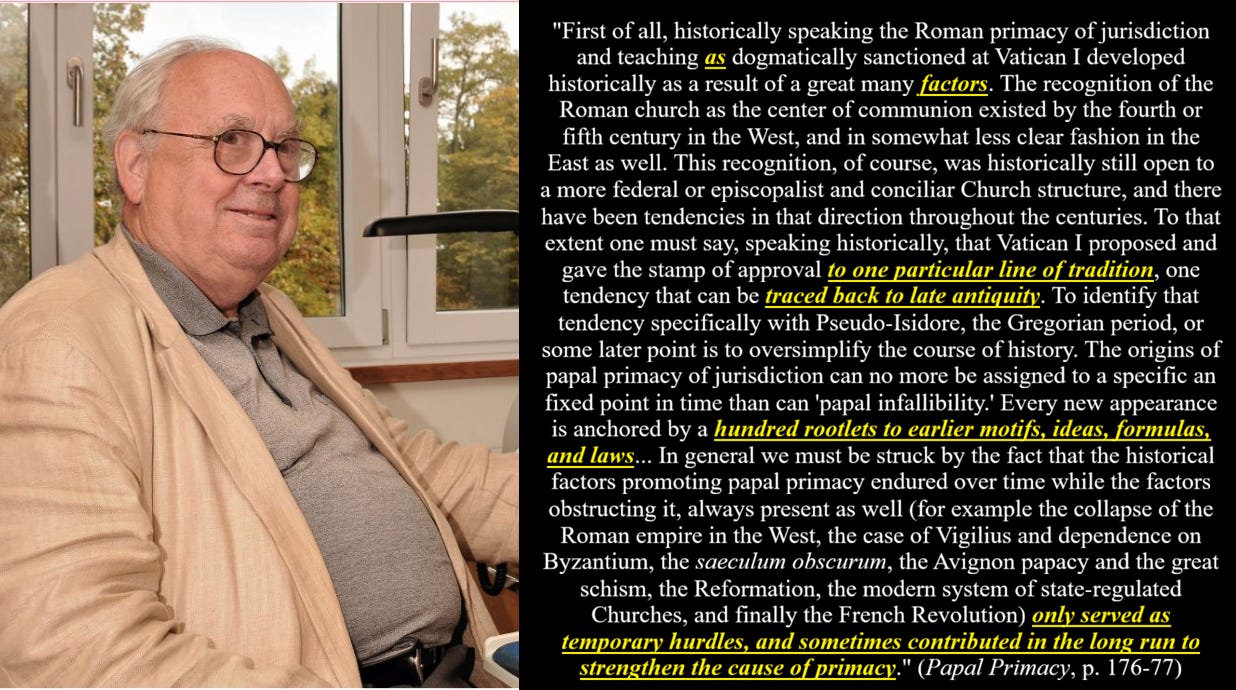
Notice how Schatz, responsible historian, accuses those who root the Vatican I form of papal primacy back to the Isidorian Decretals, the Gregorian Reform (i.e., Dictatus Papae), or some later Medieval aberration as oversimplifying history. One can think of how often people hear Eastern Orthodox apologists such as Jay Dyer or Alex Sorin exclaiming that the real Papacy was born from these later entities.
Schatz won’t have any of it.
Rather, while Schatz recognizes that there were resistances to the primacy of the Pope, the very claims of doctrinal infallibility and jurisdictional authority can be traced back to late antiquity (beginning ~ AD 250) and that there were several rootlets of prior witnesses for each new encounter of the exercise of Papal power during these centuries. Vatican I, therefore, put a stamp of approval on one “tendency” or “line of tradition.” While that might be far weaker than the historical evidence deserves, I think Schatz’s observations are brilliant, and even more so wonderfully stated.
No posts
Comments
Nothing yet. Say the first thing.
Sign in to join the conversation.