
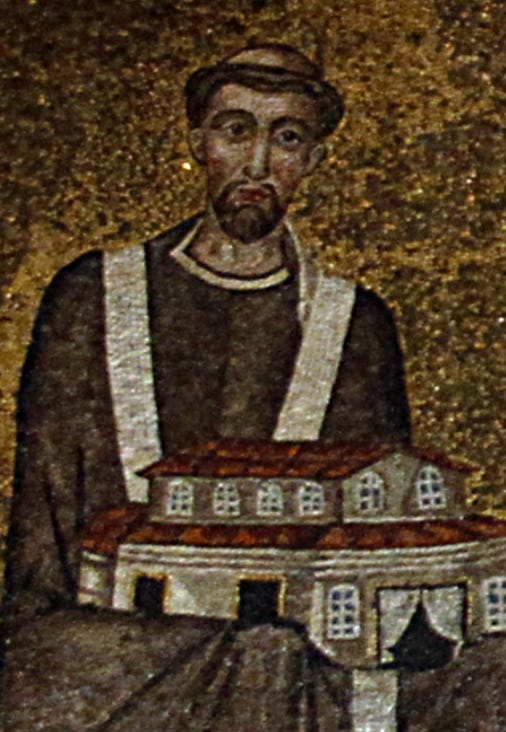
Did Pope St. Leo II revise the anathema against Honorius at Constantinople (681)?
The following are the words by which the 6th Ecumenical Council struck Pope Honorius with anathema:
“Having examined the letters of Sergius of Constantinople to Cyrus, and the answer of Honorius to Sergius, and having found THEM to be repugnant to the DOCTRINE of the Apostles, and to the opinion of all the Fathers; in execrating their impious dogmas, we judge that their very names ought to be banished from the Holy Church of God; we declare them to be smitten with anathema; and TOGETHER WITH THEM, we judge that Honorius, formerly Pope of Old Rome, be anathematized, since we find in his letters to Sergius that he follows IN ALL RESPECTS his ERROR and authorises his impious DOCTRINES..... Anathema to Theodore the heretic, anathema to Sergius THE HERETIC, anathema to Cyrus the HERETIC, anathema to Honorius THE HERETIC, anathema to Pyrrhus THE HERETIC.”
If we are going to say that the Council did not accuse Honorius of heresy, then we are going to have to say that the Council accused and condemned no one for heresy. That much is clear, and all Catholics should agree.
If we are going to say that Pope Leo II only ratified the anathema against Theodore, Cyrus, Pyrrhus, and the other Greek names, but once he got to Honorius, he redefined or revised the accusation to something *less than* heresy, we are going to have to say that Leo II himself was negligent.
Why?
Because he never explicitly opposed the Council’s judgment, as the Popes had done in the past (c.f. Canon 3 of C’ple 381, Canon 28 of Chalcedon, the anathema on the 3 Chapters at C’ple 553, and the use of “Ecumenical Patriarch” by the Bishop of C’ple at Nicaea 787). Popes do not give “hints” at their opposition to Councils (which is what the “negligence” explanation is). Popes announce what they disagree with and then impose on all adherence to that adjustment.
Catholic apologists have recently (~ 17th century) depended upon a passing reference by Leo II to Honorius’s “negligence”, but Leo II never shows how that should oppose the accusation made at the 6th council. In other words, negligence and the crime of heresy can cooperate in compatibility, and so an added accusation of “negligence” is not an indication of the absence of the crime of heresy. Such a point has been taken for granted by many.
Moreover, in all his letters to Spain (a couple of which are used by Catholic apologists to lessen the Papal accusation against Honorius), he imposes upon the Western bishops adherence to the Papal edict that Emperor Constantine VI had published. And in that edict, there is an explicit accusation against Honorius as a heretic that is unmistakable. And the so-called “negligence” revision isn’t even in every letter to Spain, and so didn’t even merit being repeated.
One would think that if Leo II were just as intent as Catholics since the 1st Vatican Council to distance Honorius from an accusation of heresy, he would have made a very clear departure from the Council and insisted that the Greeks adhere to a revised indictment.
No such thing exists.
Clear proof of this would be herein: if any modern-day Catholic apologist were to have been in Pope Leo II’s shoes and had received the Acts of 681 wherein Honorius was punished for heresy. How would that apologist deal with it if he were intent on exonerating Honorius from the same punishment that all the other Monothelites received (Cyrus, Pyrrhus, Theodore, et. al.)?
They would write a very clear treatise on why Honorius was not a heretic and make sure the Greeks got the memo on that. I know that is what I would have done. That is what any rational person would have done if their intent was such. It is therefore irrational, imo, to say Leo II tried to revise the anathema against Honorius, because it defies all reasonable expectation.
Leo II doesn’t even specify any point at which he explicitly disagrees with the Council, much less requires anyone else to disagree with the Council.
No such adjustment exists.
Which is why when the Greeks assembled together just 10 years later in Constantinople in 692 (under the Trullo of the Imperial palace = aka the Council of Trullo/Quinisext), they simply rehearsed the accusation against Honorius as a heretic alongside all the other heretics. And it is also why at the 7th ecumenical council the Greeks continued to repeat the same anathema against Honorius. And it is also why both the Greeks and Pope Hadrian II at the Council of Constantinople 869 simply rehearsed the accusation against Honorius as one of heresy.
Which means centuries after the Council of 681, the Greeks made no adjustments to their understanding of the accusation and punishment made on Pope Honorius. And not least the Greeks, but even in Rome it was still understood that the Council condemned Honorius for heresy (see Pope Hadrian II).
There’s more.
Anastasius the Librarian, a papal archivist who was intimately involved in Greek vs. Latin affairs (see his part in the Photian controversy), was a defender of Honorius. As a man intricately involved in translating documents from Greek to Latin, he was one to know precisely how things were registered in the Roman archives.
And yet, in his defenses of Honorius, he never once appeals to the so-called revision of Pope Leo II on the accusation against Honorius of the 6th council. I mean, wouldn’t that have been a linchpin? Of course it would have. Rather, he says the Council erred in its judgment, and he preferred the defenses of Honorius given by Pope John IV and Maximos the Confessor. In other words, Anastasius believed the Council was wrong. If Leo II had authoritatively revised the Council, Anastasius would have been bound to such a revision as being the Council’s view. But he had no such option.
As far as I can tell, no Catholic ever made the claim that Leo II lessened the blow to Honorius until well into the 2nd millennium. When is the first time someone claimed that Pope Leo II actually revised the anathema to Honorius? As far as I can tell, the first time is in the 17th century with Jean Garnier in his Liber Diurnus Romanorum Pontificum. I’d be interested if anyone can find one earlier than this.
Ok, so what now? What option exists for the Catholic apologist? I think 2 options exist.
One can say the Council and the Popes erred on a matter of fact. Whether Honorius was truly a heretic or not, whether he actually subscribed to the Monothelite error or not, is a question of fact rather than the substance of doctrine. As such, the Council and the Popes could have erred in this matter of fact. This is what Anastasius the Librarian said, and so it has roots going back at least to the 9th century. In doing so, that very same Catholic can actually prefer, with Anastasius, the defense of Honorius given by Pope John IV and Maximus the Confessor. However, the cost of going this route requires saying that an Ecumenical Council and the papal court erred. But such an error was not on faith or morals.
A Catholic might point out that the venue of adjudication was out of scope. How? The Council of 681 met together 4 decades after Honorius had fallen asleep in the peace of the Church, and was therefore a “posthumous” examination. The Council’s actions were an application of a principle that was then long put into practice, namely, whether the dead can be prosecuted and condemned. The Church did not embrace this method until the 6th century during the Three Chapters controversy (though Augustine mentions the capacity of the Church to do so). As such, the condemnation of Honorius lacked proper venue. Again, this would cost saying the Ecumenical Council erred in its practice, alongside the Popes who ratified it.
Or, a Catholic can concede that Honorius was indeed condemned as a heretic and that even the Popes (from Leo II onward) likewise agreed with said condemnation. However, such a crime was not committed in any mode wherein the Catholic Church teaches the Pope is divinely protected from error. In other words, Honorius was not making any “ex cathedra” decrees that were binding upon the whole Church. This view likewise is recent in history and has no roots in the 1st millennium. It also runs the risk of calling into question other ex cathedra decrees that were commonly understood as such, e.g., the Letter of Pope Leo the Great to Flavian (aka, the Tome of Leo). The letters of Honorius to Sergius were answers to requests from the East to settle a doctrine. Honorius wrote back and certainly spoke on a matter of faith. Scholars do point out, however, that Honorius was far more hesitant and abstained from a judgment on either “one will” or “two wills” and preferred to stick with the language of the prior Ecumenical Councils.
No posts
Comments
Nothing yet. Say the first thing.
Sign in to join the conversation.