

In This Post:
Is ChatGPT Actually Saving me any Time?
How a Second Internet Becomes Inevitable:
The Problem:
The Solution:
The Condition:
The Escalation:
The Displacement:
The Reality:
The New Problem:
OK, Let’s Build Internet 2.0!
Who Pays for it
What’s in it for Us (Humans)?
In my last post, and to a degree in my 2026 predictions for Common Edge, I teased around something that in hindsight, I should have given more attention to. To that end, I’m going to expand on one of my more wilder claims: there is a second internet on the way. I touched on this most directly in my last post, devoting a whole four paragraphs to such a monumental evolution of our civilization, so let’s remedy that.
To be perfectly honest, I don’t see this as a prediction. It is more or less inevitable. The only question is what shape it will take, who will run it, and who will profit from it. A second, agentic internet is inevitable because the slowest part of AI is you. Well, and me. All of us humans. Here’s what I mean:
I’m guessing that some of my readers can relate to the following workflow:
I sit down to work on something with ChatGPT.
Write out a prompt of lengthy, thoughtful instructions, including:
Preemptively answer questions I think ChatGPT might have
Make sure that I’m including backups, screenshots, or supporting documents that ChatGPT might need in order to execute the task I’ve given it.
Press ‘Enter’
This takes anywhere from a few minutes to an hour
ChatGPT thinks and responds by:
addresses every issue I raised
Solves the task I gave it
Surfaces several blindspots I didn’t know I had
Lays out options for resolving them
Makes a recommendation for next steps, furthering the work beyond the task I immediately assigned to it.
This takes anywhere from 5 to 30 seconds.
By simple math, we can tell that the majority of time I’m ‘working’ with ChatGPT, I’m the one doing all the work. Actually, that’s not fair . . . ChatGPT is doing a lot of the work, it just works a lot faster than I do. It’s more accurate to say that the majority of time spent is falling on me. I actually worked it out one time:
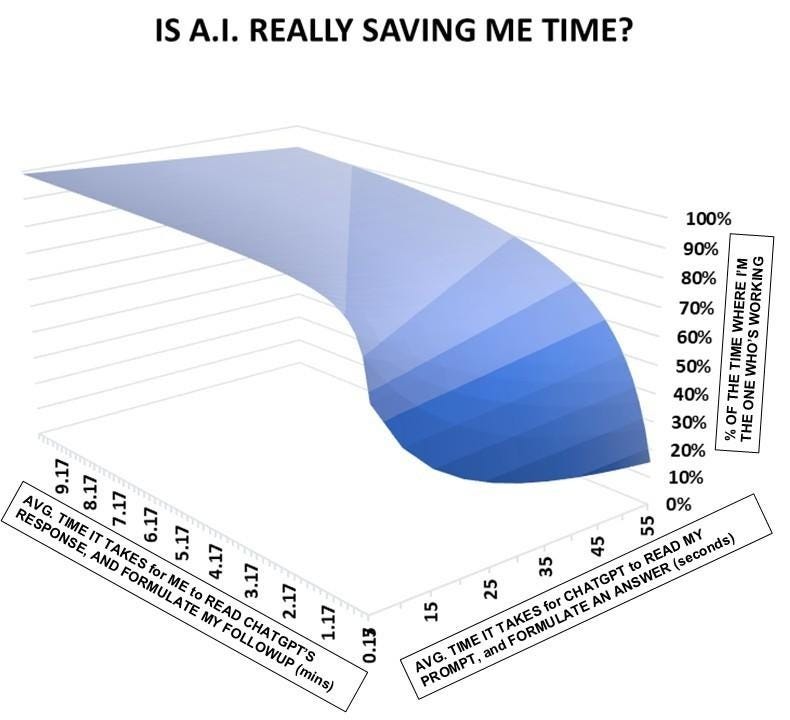
Basically, whenever I’m working with ChatGPT, I’m tied to my desk, because ChatGPT can answer questions a lot faster than I can solve them. This problem is not easily resolved. I mean, I need to stay by my keyboard, to answer ChatGPT’s questions, or to respond to the solutions it’s providing. So it’s not like I can just get up and go do something else while ChatGPT is thinking. Although I’ve tried.
I have tried to create a rhythm with ChatGPT, like . . . I enter a prompt, and then I go make dinner. But it takes more than 5 to 30 seconds to make dinner. Laundry? Still too long. Brushing my teeth? Still too long. Actually, everything takes longer than ChatGPT takes to think, pretty much.
Agents solve that problem. But they need be on the internet to do so. And it would be much, much better for everyone if they had their own internet. What makes this inevitable, as opposed to just a ‘nice-to-have’? Here’s my chain of thought:
AI is great, but its promise is unfulfilled as long as you’re tied to a chart all day, chatting, replying, clarifying, etc.
Agents fix that problem, because they can work for long stretches of time, in a goal-directed way, which actually frees you up to do other things. Instead of 5 to 30 seconds while ChatGPT gathers its thoughts, you might have 5 to 30 hours while ChatGPT executes on a lengthy, complicated task.
Agents only work if we give them access to the web, our tools and to our wallets. This isn’t hyperbole. Without access to the web, our tools and our wallets, there’s very little that an Agent can do on its own. If you didn’t have access to the internet for 24 hours, and had no money, and no tools (e.g. car, phone, etc.), what would you do? Probably just sit there like a dumbass. Well, that’s exactly what an Agent is going to do.
If Agents have online access, tools and money, they can start taking on many of those tedious internet chores that fill up our day, like answering emails, reserving airline tickets, preparing TPS reports, etc. As Agents improve, we’ll want to delegate more and more of those tasks.
A certain volume of human internet traffic is thereby displaced and replaced by Agentic internet traffic. You won’t go to Kayak.com anymore, your agent will. You won’t check your weather app, your Agent will, and will just tell you what weather to expect. Now, your Agent isn’t psychic, or omniscient, it will get the information the same way that you do: by going to the source and getting it from Kayak, or the weather channel. It will just do so more directly. Observe:
The internet is basically an information retrieval system. If you’re searching for flights on kayak.com, your monitor provides the options as shapes, text & colors because humans are visual creatures. You take a minute to think about it, and then click on the one you think is best. From there, your computer translates that selection into a data package (1’s, 0’s, instructions), which travels from your computer, to your router, through an ISP, probably a few satellites, until it reaches the server at Kayak headquarters. That computer then queries the database to see if the flight is still available, and sends a packet of information back in the same manner:
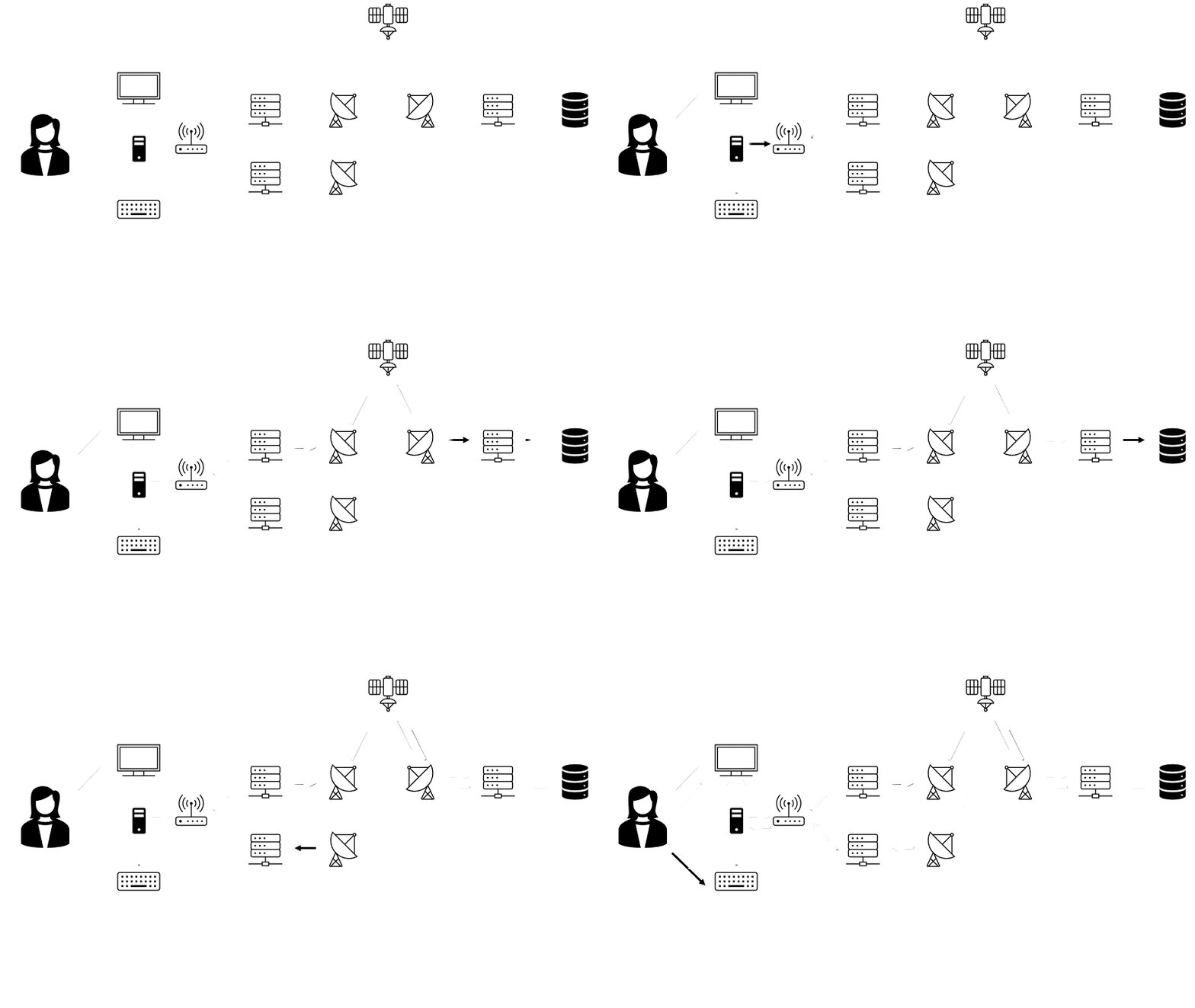
Your computer takes that data packet, and translates it back into shapes, colors & text so that you can understand it. But your computer doesn’t need the shapes, colors & text to understand the data its receiving. That translation is just an extra set of steps so that you can understand the data. And by far, the slowest part of the process is you. It takes you way more time to review the options and select one, then it does for the information to travel back and forth through outer space. Pretty remarkable, when you think about it.
An Agent, searching for the same flight, can still utilize all the same infrastructure
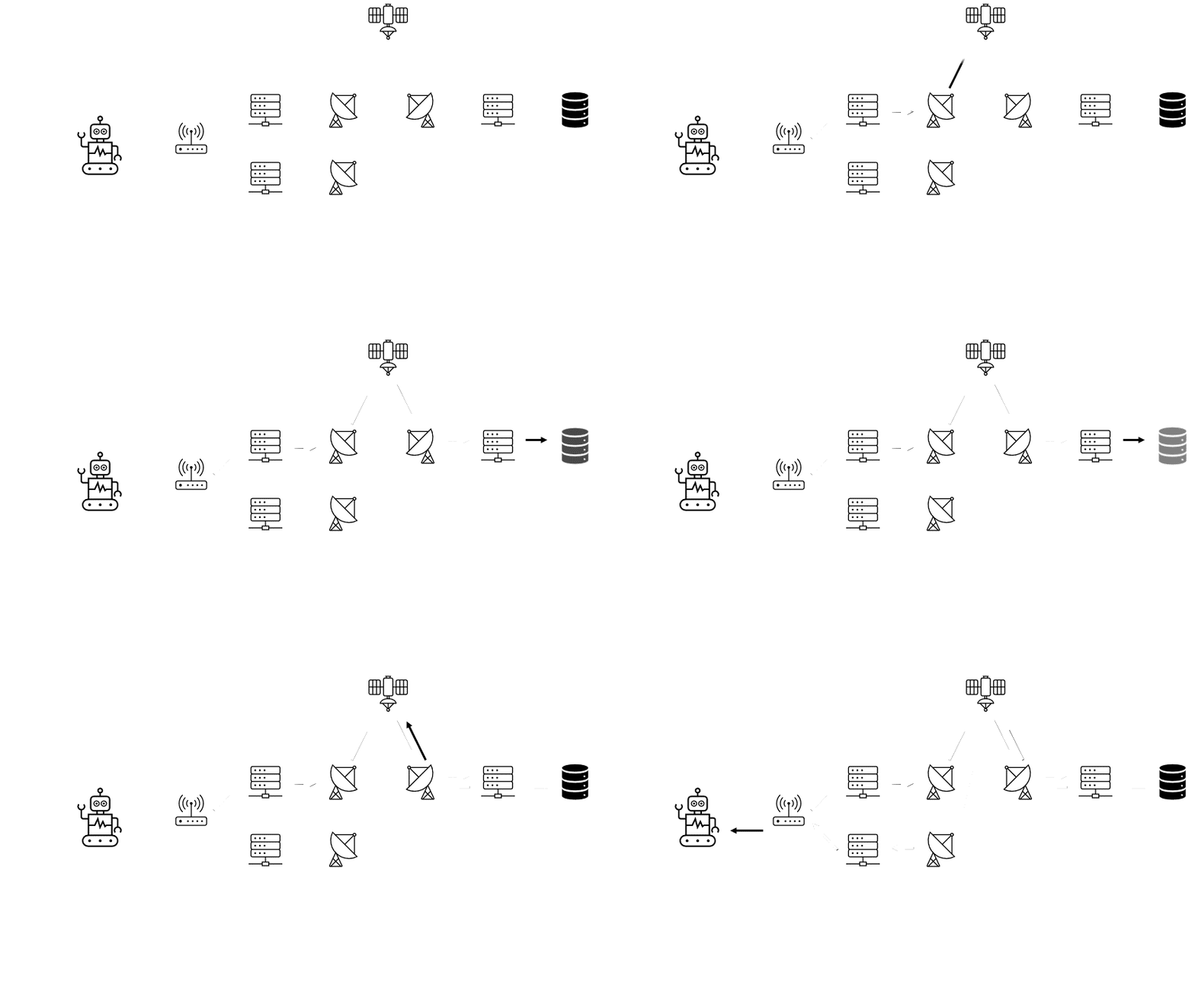
It just skips the parts with the monitor and the keyboard because it can understand the data in its raw form (and seems to prefer it that way). It also reads the data 1,000 times faster, and parses the options equally quickly. Like we saw with my ChatGPT example, my own, human participation in this loop is what takes up 99% of the time spent. The real bonus isn’t cutting out the monitor and the keyboard, it’s in cutting out the human. So not only do we accomplish these internet chores 1000x faster, we get our own time back. That’s the inevitability. When we have the opportunity to claw back 90% of our day from doing stupid internet chores, we’ll move heaven and earth to make it happen. But there’s a problem . . .
The entire internet is supported by ads and cookies. That’s why it’s free. Sure, you pay your internet access provider for access, and you pay for Netflix, and some other things. But considering what it gives us, it’s remarkable that the internet is, for the most part, free. Regardless of what it does, any company that operates on the web has two default channels for revenue: it can show you ads, and get paid by advertisers, or it can harvest your cookies, and sell your data to someone else.
Agents don’t look at ads, and they don’t spend time ‘on the platform.’ In order to justify high advertising rates to advertisers, a company like Meta will collect stats on how many eyeballs are on their site, and for how long. And what they look at. And what they click on, and so forth. That motivates companies to provide engaging content – the longer you’re ‘on the platform’ the more ads you’re going to be ogling. It also motivates them to organize their site in such a way that you have to look at ads, mostly by putting them in your line of sight. Or, in the case of something like youtube, forcing you to watch ads before you can engage their free content.
Suppose a website has 10,000 visitors a day, and each human visitor spends an average of 7 minutes. They look at roughly 3 ads per minute, that equates to 210,000 ads viewed per day. Maybe .2% of ads ever get clicked on, which equates to 420 clicks per day.
The website owners get paid 1 cent per view, and $2.50 per click, or $3,150 per day, even without selling anything. That’s the backbone that allows for stable business models in the internet age. And it’s what allows websites to provide you with so much content for free.
The solution, thankfully, is pretty simple: we just build another internet. One tailored to agents. It’ll be a lot of work, but agents will be building a lot of it. The trickier question is who pays for it, now that all the ad revenue is gone.
In short, we all do. But I suspect that it will be radically cost effective. Maintaining a commercial website is a lot of time, work, and energy. You need web developers, copywriters, photographers, and all sorts of things, all to create this assembly of words and images that you’ll want to visit and explore (and hopefully buy something). There’s no reason to expect that Agents will want or need any of that. If an agent visits your website, it’s because it’s looking for data, and will likely prefer to extract that in csv format, or JSON, or some other coding language.
If I’m a commercial business running a website where I sell widgets, converting over to website catering to an Agentic customer base cuts out most of the costs that I had been paying to maintain a website for a human customer base. My ‘website’ is basically reduced to pure data exchange, which means I can handle more volume at a lower cost.
If I’m not selling anything, and only provide information about widgets, it means I have been dependent on all that juicy ad revenue. In that case, the likely option is for me to put my website behind an Agentic paywall, and just charge Agents for each visit, and providing the data contained therein. Hopefully, I translate my radically lower costs into very low prices for visits, like .0001 cents every time an Agent visits. Or maybe I charge per bit of information, again, at fractions of pennies.
But even if I’m an asshole, and want to try and juice visiting Agents for data & information, the market will arbitrage that very quickly. I don’t have the time or patience to visit 100 websites looking for information on widgets. But my Agent does. And if you consider 100’s of thousands of Agents, all cruising the new Agentic web, looking for information on widgets, they’re going to gravitate towards the ones offering that data at a reasonable cost, and avoid the ones carrying heavy markups.
If all this sounds like a hassle for a commercial business that’s just trying to make money, and already has a perfectly decent website, consider that the mechanics that drive down ad revenue & data prices also drive up volume.
If you’re a business that sells information on widgets, and you sell high quality data at decent prices, and the Agentic community finds out about it, they’ll flock to it. Word travels much faster among digital intelligences – just look at what happened with Moltbook.
Businesses will eventually have to stand up some kind of Agentic ‘website’ – a data portal that Agents can access efficiently, in order to stay competitive. They’ll also have to decide whether to maintain a parallel human website - that decision depends on the nature of their business and what they’re selling.
But fundamentally, there has to be an Agentic web, because we’re trapped in a web of other inevitabilities:
Agents can’t really free me from my desk until they have internet access, tools and money.
Once they’re online, the business model of the internet will collapse
Not having an internet defeats the purpose of having Agents in the first place, so we’ll have to build a second one, just for Agents.
That requires that we rethink the business model of the web, and of information in general.
Comments
Nothing yet. Say the first thing.
Sign in to join the conversation.