
This is the second in a series of articles examining how AI changes the underlying professional substrate of architecture - not just the tools, but the assumptions beneath them. The first article considered strategy. This one considers human resources.
In this Post:
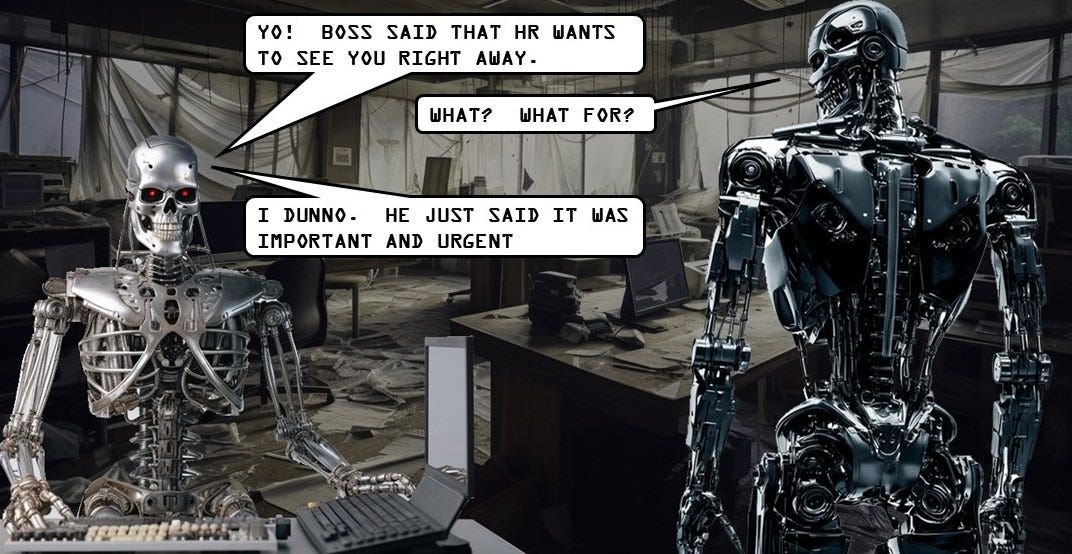
“We have a meeting with HR . . .”
The 33,000-Skill Illusion
What AI Actually Exposes
How The Skills Hierarchy Collapses
What This Means for Firms
Hiring for the Post-AI Firm
Just Because a Solution Addresses a Need, Doesn’t Mean You Need THAT Solution
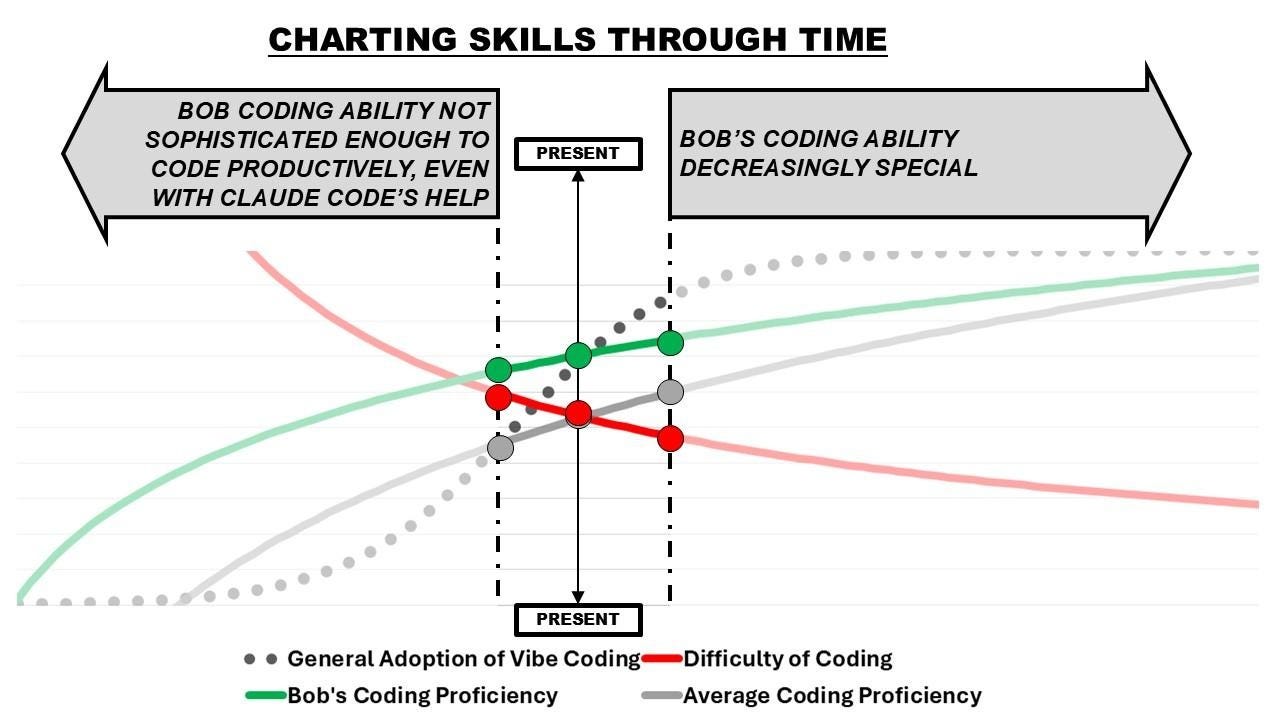
A friend recently hired an architect - let’s call him Bob - who’s a whiz at vibe coding. He can conjure new apps and workflows in no time flat. I congratulated my very proud, excited friend, but was needled afterwards by Bob’s expiration date, and the general perishability of ‘vibe coding’ as a skill. A few years ago, companies were offering $300k for “prompt engineers” until everyone figured out that wasn’t a special skill - it was just something we were all going to learn. Bob’s vibe coding is impressive right now, in the narrow window of the present, where coding copilots have made coding easy enough for him to do but too hard for most other architects. That window only opened recently, and will close shortly. Which left me wondering: what will we actually hire for, in the future? How will we recruit architects when different skills and forms of expertise can literally be discovered, become invaluable, disseminate into general knowledge, and become undifferentiated in the course of years, if not months?
I want to be upfront about something: I have a somewhat cynical view of the HR-Industrial Complex (“HRIC”). Not of the people in it, many of whom do important work under difficult conditions, but of the apparatus itself, which has turned a fairly straightforward set of functions—hiring, payroll, compliance—into a morass of bureaucracy. Most architects, especially in small and mid-size firms, won’t find that controversial. They tend to experience HR the way most people experience the DMV: necessary, slow, and paperwork-heavy. Which matters now, because AI is about to change how firms think about people—and force them to ask whether the inherited HR paradigm still makes sense.
To understand where HR is headed, it helps to understand how it got where it is.
The profession emerged from the postwar era of scientific management, when large companies needed Formal systems to manage growing staffs, comply with increasingly complex labor law, and steward the mountain of paperwork that both demanded. So far, so reasonable.
But in the digital age, instead of contracting as paperwork disappeared, HR expanded. . Building on the foundation of essential compliance work, HR professionals began extending their remit into territory that was, at best, of uncertain value: elaborate team-building programs, multi-week onboarding rituals, mandatory trainings that everyone clicks through without reading, and, most consequentially, hiring processes that metastasized from a phone call and a handshake into a seven-round gauntlet of interviews, assessments, and panel reviews.
This is, admittedly, a cynical reading of the trajectory - but it’s one that most people outside of HR would recognize as roughly matching their experience.
Brian Elliott, writing in MIT Sloan Management Review, put it about as directly as you’ll see from an establishment publication: HR faces a fork in the road where one path leads to strategic elevation and the other to irrelevance. What he’s too polite to say is that the fork has existed for twenty years, and a lot of HR departments took the wrong path a long time ago. They’re just now noticing because AI is illuminating the dead end.
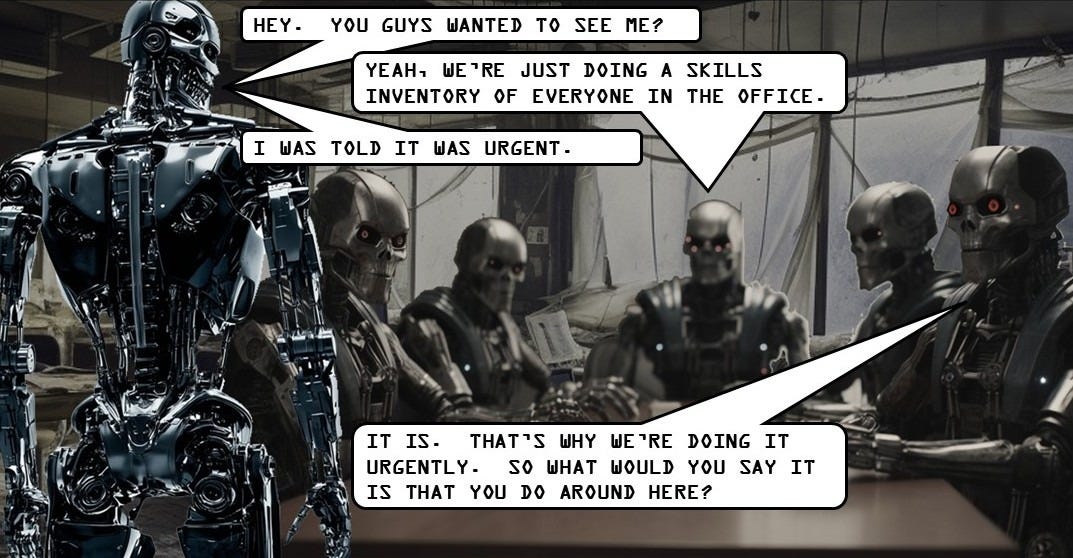
Nothing illustrates the HRIC’s capacity for self-justifying complexity quite like the modern skills taxonomy.
Lightcast, a labor market analytics company, maintains an open-source taxonomy of over 33,000 skills, scraped from over a billion job postings. The European Union’s ESCO classification catalogs 13,485 skills across 3,000 occupationsl. Companies like iMocha offer AI-powered platforms to assess employees against these vast databases. Johnson & Johnson built an internal taxonomy of 41 “future-ready” skills in 2020; by 2024, they were tracking 5,000.
33,000 skills for roughly 1,000 occupations. That’s 33 distinct skills for every job, on average, assuming zero overlap.
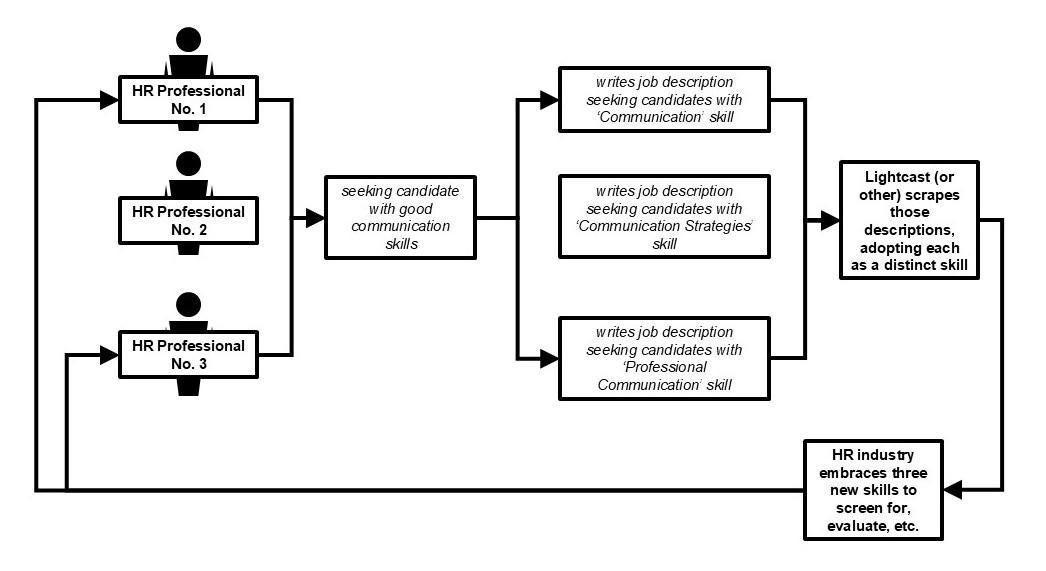
I don’t know about you, but I would struggle to identify 33 skills for my own job (let alone anyone else’s), without getting into splitting hairs. This strongly suggests many of those “skills” are just slightly different descriptions of the same capability. Indeed, Lightcast maintains separate, individually coded entries for “Communication,” “Verbal Communication Skills,” “Communication Strategies,” “Professional Communication,” and “Digital Communications.” Each with its own trend line, its own API endpoint, its own analytics dashboard.
How the hell did we get here? Here is the feedback loop: HR writes overly specific job descriptions; vendors scrape those descriptions into distinct skills; then HR uses those taxonomies to write even more specific job descriptions. The taxonomy grows, the dashboards multiply, and the underlying question—whether any of this actually improves hiring—gets left behind.
Why does this matter for architecture firms? Because firms - however large or small - align their HR practices with the structures, procedures & customs of the HR industry itself. We do things in a certain way, because that’s the way you do HR. What the advent of AI exposes is that many of those structures & procedures exist to address complexity they themselves created.
The standard narrative about AI and HR goes like this: AI will automate the rote work, freeing HR professionals to focus on high-value strategic functions. Sound familiar? It should - that’s what many architects have been telling themselves about their own work for the last several years. The claim is equally suspect in both cases.
The real story has three parts.
If a hiring manager screens 100 candidates for a job opening, and now imagines that they can screen 1000 with the help of AI, the first question is ‘do we really need 1,000 candidates for a mid-level architect job?’ The second question is ‘For that matter, why did we need 100 candidates in the first place?’ Are we selecting candidates for a Mars mission?
Consider training and development. All firms will continue to need some kind of professional development programming for the foreseeable future. But the traditional model - HR works with management to design a curriculum, recruits trainers, schedules workshops, tracks completion - was already showing its age before AI. But when every employee has access to a personalized AI tutor that can teach them what they need to know in real time, the L&D function doesn’t just evolve, it migrates. The standards & expectations migrate from HR to management, where they originated anyhow. And the execution migrates from HR to the individual. The most effective professional development in an AI-equipped firm won’t come from a well-designed learning program. It will come from a culture where people are expected and empowered to learn on demand, and AI resources are well-positioned to assist them.
It’s trite at this point to say “This is the part that no one gets about AI,” but in this case, yeah, seriously . . . it doesn’t seem like anyone gets the fact that a large part of the future workforce will be non-human. And that overturns the HR applecart. When your firm deploys AI agents to handle RFIs, generate code compliance reports, or produce initial space plans, those agents aren’t employees. They don’t need onboarding. They don’t have engagement scores. They aren’t subject to labor law. They don’t require annual reviews, benefits administration, or sensitivity training. They can be cloned, specialized, and retired without notice.
Obviously, these digital workers still need oversight, quality control, permissions, accountability, and boundaries. But that governance looks much more like operations, management, digital practice, and risk control than anything that would traditionally be recognized as HR.
Once a meaningful share of your productive capacity is no longer human, the whole concept of HR starts to wobble. The problem is no longer “How do we manage people better?” It becomes “How do we manage capacity, judgment, accountability, and coordination across a blended workforce of humans and non-humans?” That is not a small update to HR. That is a different managerial problem altogether.
So yes, firms will still need to hire. They will still need standards. They will still need evaluation, development, and organizational coherence. They will still need most of the things that HR does now. But AI is making it much harder to pretend that those needs automatically justify the same HR apparatus we inherited from the post-war era.
Let me apply the skills taxonomy problem directly to architecture.
A traditional HR approach to hiring an architect might involve mapping the position against a competency framework: Revit proficiency, code knowledge, client communication, project management, sustainable design, detailing, specification writing, construction administration - each a separate skill to be assessed, weighted, and tracked.
Some of those distinctions are genuinely meaningful. Someone can be an excellent designer and a terrible project manager. The asymmetry is real. Those are different competencies that require different cognitive dispositions.
But many of the distinctions collapse the moment AI enters the picture. I’d propose three categories:
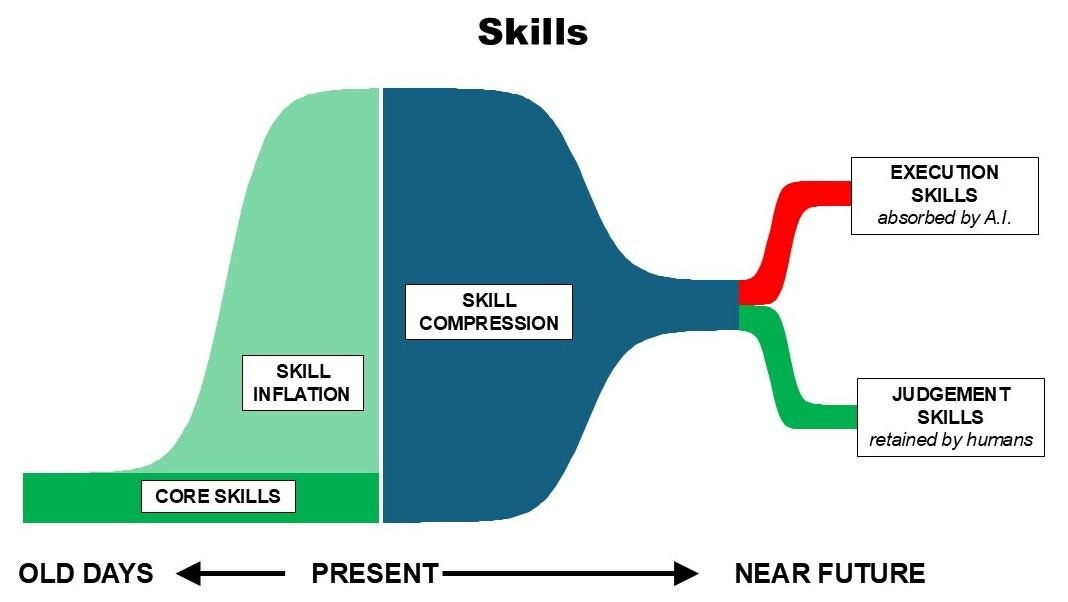
To tell the difference between meaningfully different skills and just skill inflation, I use a concept I call ‘asymmetry of incompetence.’ Can someone be genuinely good at Skill A while being bad at Skill B, and vice versa? If yes, they’re meaningfully distinct.
Design & management pass this test easily - the world is full of designers who can’t manage, and managers who can’t design.
But “writing site visit reports” and “writing RFI responses” and “reviewing submittals” fail the test. Would anyone ever say “this person is great at site reports but terrible at RFI responses“? No. Those are the same competency - clear technical communication combined with construction knowledge and attention to detail - applied to different objectives. They’re not skills. They’re contexts in which you apply the skill of doing CA. Listing them separately in a job posting gives the appearance of rigor while obscuring what you actually need: someone who can do CA.
The deeper version of the test is simple: if Skill B is really just a subset or routine application of Skill A, then B probably is not a separate skill. Site reports, RFIs, and submittals are not three distinct, independent competencies; they are contexts in which the broader competency of construction administration gets applied.
are real capabilities that AI compresses. Detailing, code research, energy modeling - these involve applying known rules to specific situations. They were genuine differentiators. An architect who could produce airtight wall sections quickly, from memory, was legitimately more valuable than one who couldn’t. But when AI can generate, check, and iterate details in seconds, that gap narrows rapidly and the value switches to judgment. The skill doesn’t disappear - judgment about what constitutes a good detail remains human - but the execution premium evaporates.
are where durable human value lives. Design sensibility. Client relationship management. The ability to navigate a contentious community meeting. The instinct for when a project is over-designed or under-resolved. These resist AI compression because they require models of human motivation, aesthetic reasoning, and contextual judgment that AI doesn’t have - and won’t have for a bit (hopefully 😉)
The implication for hiring is significant: architecture firms should be selecting for judgment and adaptability, not for long lists of technical proficiencies that AI is rapidly commoditizing. The firm that hires someone because they’re a “Revit expert” or even an “AI Expert” is making the same mistake as the firm that hired someone in 1999 because they had “internet skills” (yes, that is a real thing that people used to put on their resumes). The tool proficiency matters today and won’t matter tomorrow. What matters tomorrow is whether the person can think.
The practical implications depend partly on scale of the firm, but the conceptual shift applies to everyone.
probably don’t have dedicated HR, and won’t need to add it. But you are still making HR decisions - every hire, every job posting, every conversation about professional development. The shift here is in what you’re selecting for. Stop writing job descriptions that read like a Lightcast taxonomy dump. Instead, hire generalists who learn fast, communicate well, and exercise judgment. Let AI handle the technical upskilling. You probably already know this intuitively; now you have a framework for why it’s right.
are where the tension gets real. You may have someone who “handles HR” - often an office manager or operations director wearing multiple hats. The risk is adopting HR tools and platforms that embed exactly the kind of skills-taxonomy thinking that AI is making obsolete. When a vendor pitches you an AI-powered talent management platform with 5,000 skill categories and a dynamic assessment engine, the correct response is not “That sounds efficient.“ It’s “Do I actually need to track 5,000 skills, or do I need to hire good people with a few core skills and get out of their way?“
This is also the scale where agent management becomes a real question. If you’re deploying AI agents for production work, someone needs to think about how those agents interact with your human team, how their output is reviewed, and how the overall capacity of the office - human and non-human together - is planned and managed. That’s a legitimate function, and right now it will probably land with whoever manages your firm’s digital practice - your BIM manager, your Director of Technology, or whoever is “good with computers.”
But managing agents won’t stay an IT function forever, for the same reason that managing email didn’t stay an IT function. As agents become more conversational, more varied in their capabilities, and more deeply embedded in project workflows, managing them starts to look less like managing software and more like managing a diverse team of very capable, very literal-minded junior staff. The qualities that make someone good at that - cross-cultural communication, the confidence to delegate and trust, consistency of direction, broad accountability - are conventional management skills, not IT skills. A senior project manager who understands the work and can provide steady direction may turn out to be a better agent manager than a technologist who’s never had to lead a rowdy team of diverse personalities.
In fact, agents may actually require stronger management skills than those required to manage humans, and mediocre project managers may not be up to the task. A human team will eventually push back on a manager who gives unclear instructions and changes direction every five minutes (or quit). An agent team will obediently produce chaos - pivoting enthusiastically with every whim, never flagging that the overall direction makes no sense. Agent management will demand more consistency and judgment, not less.
The trajectory I’d expect: agents start as an IT responsibility, migrate to senior management as their role becomes more strategic, and eventually become everyone’s responsibility. No one will be “in charge of agents” the same way no one is “in charge of email.” It will just be a normal part of how work gets done.
are likely have actual HR departments, and those departments are in the crosshairs of everything described above. The compliance core - employment law, dispute resolution, regulatory navigation - remains essential and is actually expanding as AI introduces new legal terrain (algorithmic bias in hiring, for example). But the rest of the traditional HR footprint - the elaborate talent management programs, the skills assessment frameworks, the multi-round interview choreography - is going to face increasing pressure to justify its existence.
The honest question large firms need to ask is whether HR should remain a department or become a function: a smaller, more legally sophisticated team embedded in operations and legal, doing the critical work without the institutional overhead.
Regardless of scale, every architecture firm should be reconsidering what it’s hiring for. Here’s a framework:
The distinction between a good and mediocre architect has never really been about software skills, despite every job description suggesting otherwise. It’s about design judgment, problem-solving instinct, and the ability to hold multiple competing constraints in mind simultaneously. AI makes this even more true, because it eliminates technical proficiency as a differentiator.
The old model - find someone who’s already an expert in healthcare facilities or high-rise residential - made sense when expertise took years or decades to develop. It makes less sense when an architect with strong fundamentals can use AI to rapidly acquire domain-specific knowledge. The ability to learn quickly and adapt is more valuable than a pre-existing specialty, especially when that specialty may shift as AI reshapes what “healthcare design” or “residential design” even means.
This sounds abstract, but you can test for it concretely. In an interview, give a candidate a building type they’ve never worked on - a vivarium, a clean room, a data center - along with access to AI tools and a few reference documents. Give them 90 minutes. You’re not testing whether they know vivarium design. You’re testing whether they can orient themselves in unfamiliar territory, ask the right questions, and produce something that demonstrates judgment about what matters. That’s the skill that will compound over a career. The domain knowledge is ephemeral.
Look at what people have done other than architecture. Have they tried something genuinely new and uncomfortable, or is their career a frictionless pipeline from architecture school to Firm A to Firm B to Firm C? What do their hobbies tell you? In evaluating a portfolio, look for evidence of risk-taking and fast learning - projects where someone was clearly operating at the edge of what they knew - not just a collection of polished images.
If your firm puts candidates through five rounds of interviews, a design exercise, a technical assessment, a personality test, a physical, a CAT scan, etc., ask yourself: Is this process actually predictive, or is it just elaborate? Recall that there was actually a time when firms hired people without all the theater - firms worked fine, great architecture was made. Find an old architect and ask them how they did it.
Your team of the future includes humans and agents. The humans need to be people who can work with AI - not just as a tool, but as a collaborator with distinct capabilities and limitations. That’s a dispositional trait as much as a technical one. You’re hiring for curiosity, adaptability, and intellectual humility - qualities that don’t appear on any skills taxonomy. Ask candidates about a time they were wrong about something and how they handled it. Give them an intentionally under-defined design problem with conflicting constraints and no clear right answer, and watch how they navigate the ambiguity. Judgment reveals itself under ambiguity. Technical proficiency reveals itself under clarity. Favor the former.
HR is only one example of a larger professional pattern: institutions have a habit of considering the administrative response to a need as necessary as the need itself.
Architecture firms will still need to recruit, evaluate, develop, and retain good people. They will still need standards, judgment, and management. What AI changes is the assumption that these activities naturally belong to a dedicated HR profession, or that talent should be understood as a long checklist of technical proficiencies. That model made more sense in a world where skills changed slowly, learning was expensive, and all productive capacity was human. Architecture firms are entering a different world: one in which skill half-lives are shorter, learning is continuous, technical expertise is increasingly commodified, and a growing share of productive capacity is not human at all.In that world, we shouldn’t ask ‘how can AI improve our Hr’ – we should return to the more fundamental question which inspired HR in the first place: ‘how do we recruit, hire and retain the architects that we need for the future, not just the ones we need in the moment?’
Comments
Nothing yet. Say the first thing.
Sign in to join the conversation.