
For more than three years, two ideas have shaped the discourse about AI in education: the chatbot and efficiency. ChatGPT made the world aware of generative AI, and almost immediately we started to equate the interface with the technology. We learned how to open a chatbot, submit a prompt, and refine the output. We came to believe that was the only and/or best way to engage with generative AI.
Similarly, we have become used to talking about AI in terms of efficiency. Chatbots can produce work quickly and often competently, leading us to focus on questions of how much time AI does and does not save us. In education, the focus on efficiency has led to a lot of debate about whether saving time is really good for learning, and how we would know.
The last six months in AI developments have made plain how narrow this focus is. If we want to continue learning about AI and its implications for education, we should expand our understanding beyond the chatbot and beyond efficiency.
I offer this playlist as an introduction to terms, tools, and ideas that have become mainstream. It offers a glimpse into the way we will wrestle with AI in the next 12 months and beyond. I’ll be shaping my work around a lot of what’s here, and I hope one or more ideas here inspire others to do the same.
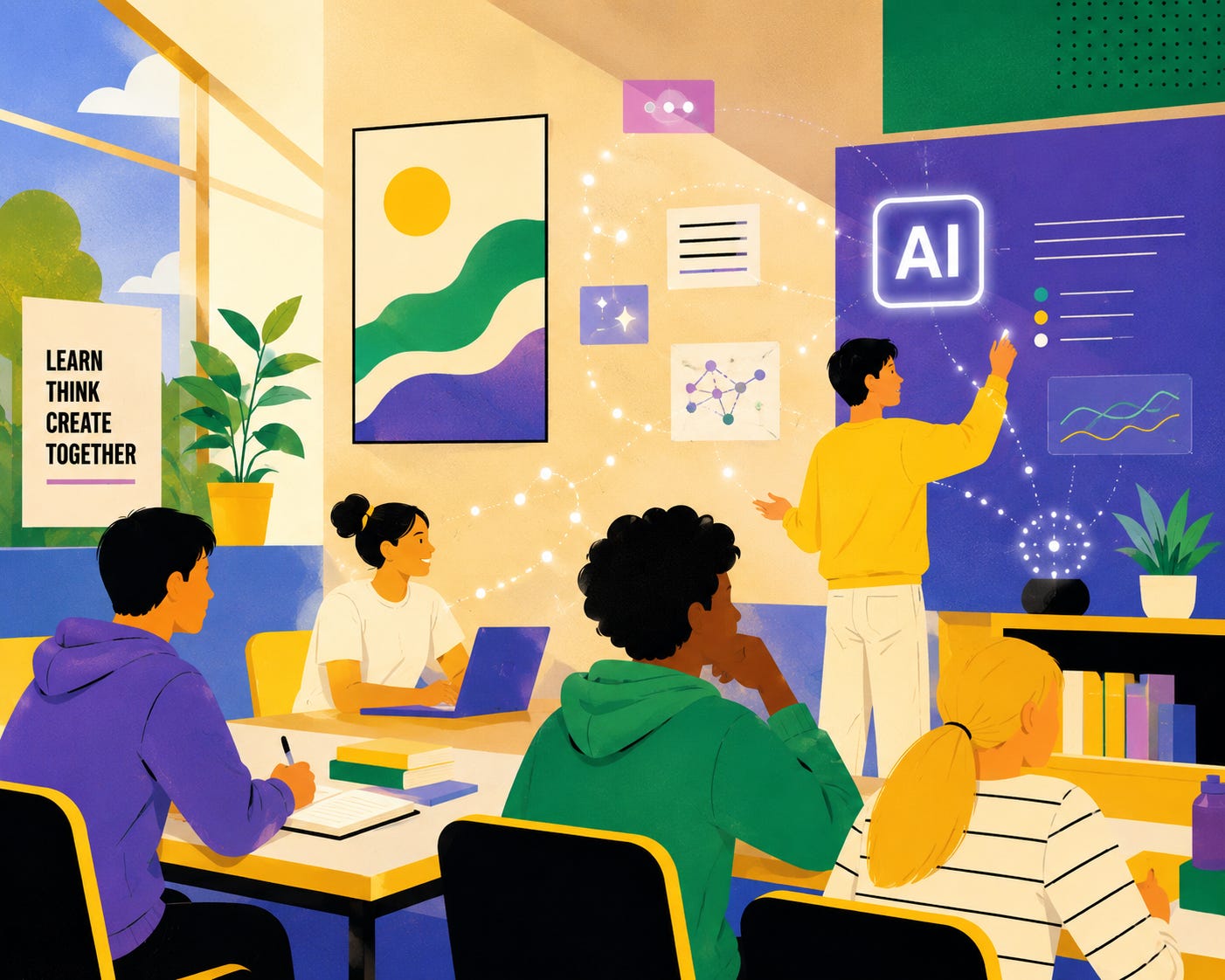
By understanding the myriad (and rapidly expanding) ways the average person can now use AI, educators will develop a deeper sense of the potential and pitfalls of AI at school. AI is not just becoming more sophisticated; it is becoming ambient and increasingly invisible to us.
Some key terms:
Vibecoding with AI makes us all app developers.
Agentic AI allows us to assign AI tasks to complete autonomously with minimal oversight.
Wearable AI puts on our bodies AI that listens, observes, and captures our surroundings in real time.
Some key ideas:
Ethan Mollick on how the chatbot interface limits our understanding of generative AI and our ability to use it well. And, in this post on ChatGPT 5.5, he explains how these new capabilities work and what they mean for how we work.
“Spatial Intelligence is AI’s Next Frontier” | AI pioneer Fei-Fei Li on the current limits of large language models and on research that develops AI’s ability to conceptualize, imagine, and navigate physical spaces. This will unlock a new category of AI capabilities.
“AI Is Being Built for Coders” | Stephen Fitzpatrick explains that whereas chatbots reward rhetorical skills, the latest AI capabilities require at least a surface-level understanding of code and other computational thinking skills. This has important implications for both students and educators.
“How Fast Will AI Agents Rip Through the Economy?” | Ezra Klein interviews Jack Clark, Anthropic’s head of research. Very helpful if you’re interested in what major AI companies are planning and the values/goals that drive their investments and decisions.
Common Sense Media’s AI Toys Overview | Spoiler: the risk level of generative AI in toys designed for the youngest children is deemed “unacceptable.”
“Building Websites with Claude Code” | Leon Furze explains how he uses simple, plain English commands to have Claude’s agentic features create websites.
“Exploring Agentic AI” | Lance Eaton describes some of his personal experiments with Claude Cowork, Claude Code, and ChatGPT Codex. Plenty of good ideas for those who want to begin exploring.
AI and assessment expert Jasper Roe is documenting his experiments with Meta’s AI glasses in order to reflect on the potential and pitfalls of AI that we carry on our bodies.
High school student Harrison Qian has put together a Vibe Coding Manifesto for anyone exploring how to use AI to build digital applications.
“Who (or What) Filled Out Your Course Evaluation?” | Marc Watkins on how agentic browsers have disrupted the ways we collect learner feedback.
Liza Long had written a free ebook on using AI to check and ensure accessibility of content. Take a look at the sections where she builds agentic workflows.
Journalist Joanna Stern just wrote a book about turning her life over to AI for one year. This wide-ranging interview with Kara Swisher touches on the many ways AI is already affecting and will affect her life… and our lives.
In the coming year, I think education will finally move beyond the “efficiency narrative,” which is a conversation mainly about time… what takes up our time, where we can save it, the pros and cons of saving time in learning, etc. Generative AI’s current capabilities raise important questions about:
Effectiveness: What are we good at in schools? How can AI makes us better at those things? What has AI made less effective in schools? What do we no longer need to be good at because of AI?
Innovation: How must we change in order to respond to AI? What possibilities does AI unlock? What needs to be transformed, not just adapted?
“A society that produces standardized minds — minds shaped by the same scope and sequence, evaluated by the same rubric, certified by the same credential — is producing exactly the population AI is best at substituting for. The factory model is not a defense against AI. The factory model is what AI is replacing.” From “Institutionalized Education as Cognitive Offloading” by Stefan Bauschard
“Motorways with no speed limits and car-free town centres.” | Assessment expert Daisy Christodoulou argues that our approach to AI should be divided between the applications that can be scaled effectively (useful application of AI) and the human-centered approaches that can’t be (AI should be restricted).
“On AI Glasses and Wearable AI in Assessment” | Blue books and proctored exams and browser lockdown apps are interventions designed for chatbots. These researchers ask us to consider what assessment should look like when generative AI is on our bodies at all times.
“From AI Tutors to AI Study Mates” | Phillipa Hardman uses a recent study on AI for learning to explain the important difference between AI tutors, which largely improve performance (efficiency), and AI “study mates,” which are designed to help the student become a better learner.
“What happens when you force students to use AI?” | Douglas Kiang on a course he co-designed with an English teacher that asks students to use AI as part of an investigation on what “voice” means in writing.
Jay Caspian Kang wrote an interesting series of articles in The New Yorker about the future of higher education. These two are explicitly about AI: “Will AI Make College Obsolete?” and “Why the Future of College Could Look Like OnlyFans”
Generative AI is not edtech; it is infrastructure that is changing how we live, work, and interact with each other. Any decisions we make in school should be made with an awareness of AI’s impact on the world we are preparing students to enter. Importantly, this is an area that students are eager to discuss. They know AI is affecting the world, and they want to learn about how it might affect their futures.
“Today, accompanying children and young people in using technology for developing responsible relationships, helping them to recognize the risks and choose what fosters inner freedom, is a concrete form of charity and will safeguard their dignity. Teaching new generations that technological evolution does not follow a predetermined path, but can be guided by personal and collective responsibility, constitutes one of the most valuable services to the common good.” | It’s worth reading the Pope’s encyclical on AI, regardless of your belief systems.
Echoing many of the sentiments in the encyclical, Holly Buck argues that democratic governance of AI is the most urgent AI issue.
“I’ve Been Writing About AI for Two Years. I Was Looking at the Wrong Part of the World.” | Exhausted by AI discourse in rich, Western countries, which tends to focus on abstract or academic questions, Carlo Iacono looked to the rest of the world and found people using AI to solve real problems.
“The AI Doc: Or How I Became an Apocaloptimist” | A documentary that sends a sharp warning about the current AI trajectory we are on, and how we can change that direction.
“How much electricity does AI consume?” | Hannah Ritchie’s very useful summary of data center and individual user energy use. Andy Masley offers additional context in “A History of the Data Center Panic.”
And/but: the AI workflows discussed in this post are more complex than simple chatting, and consume energy accordingly. The need for compute is only growing, leading to moves like Anthropic signing an agreement to use Elon Musk’s Colossus data center in Memphis, TN, USA.
This really interesting study of 1,500 employers shows hiring of entry-level positions is increasing, not decreasing, and that could be because of AI, not in spite of it. The employers name critical thinking and communication skills as their top hiring criteria. They are not interested in AI literacy.
We know enough about previous technological disruptions to make intentional choices about closing the digital divide that AI is already exacerbating.
Follow Bryan Alexander for his periodic and useful scans of AI’s impact on culture.
If you want to learn more about my work with schools and nonprofits, take a look at my website and reach out for a conversation. I’d love to hear about what you’re working on.
June 16-18. I’ll be facilitating a three-day AI program called “Learning and Leading in the Age of AI.” This intensive residential program is designed for school teams to have time and space to design classroom-based and schoolwide AI applications for the next school year. Hosted in partnership with the California Teacher Development Collaborative (CATDC) at the Midland School in Los Olivos, CA, USA.
June 23-26. I’ll be joining the Summer AI Institute at Lakefield College School (Lakefield, Ontario, Canada) as a speaker and coach. This event is for teams of educators to advance their AI work, design classroom and schoolwide AI initiatives, and learn from each other’s work. Just opened to schools from beyond Canada!
If you’d like a book to dig into, here are a few that have had a deep impact on how I think about AI and how I advise schools in approaching it.
The Opposite of Cheating by Tricia Bertram Gallant and David Rettinger (2025)
Verified by Mike Caufield and Sam Wineburg (2022)
Empire of AI by Karen Hao (2025)
An Ethic of Excellence by Ron Berger (2003)
It’s Complicated by danah boyd (2015)
The Score by C. Thi Nguyen (2026)
The Extended Mind by Annie Murphy Paul (2021)
No posts
Comments
Nothing yet. Say the first thing.
Sign in to join the conversation.