
If you’re looking for something to listen to on your commute this week, I urge you to check out my interview with Andy Chandler on NW Fresh. Andy’s a great interviewer, we have a lot of fun, and cover a range of topics. Where else are you going to learn about the “Upper Decker” theory of politics?
I went to lunch downtown this week. As we walked to our table, everyone in the group reported that as they walked from their cars to the restaurant, they saw someone hunched over smoking fentanyl. The conversation continued. Everyone over 50 admitted they are looking for ways to leave Portland, and many of their friends had already done so: “Once the kids are gone, we’re outta here.”
When the talk turns to the region’s taxes, declining schools, deteriorating roads, diminished public safety, and the commercial real estate crisis, someone will inevitably ask, “Can’t these politicians see what’s in front of their faces?”
Well, they do. But, according to a theory named after a long-time Boston mayor, they might like what they see because that’s a key to getting them into office.
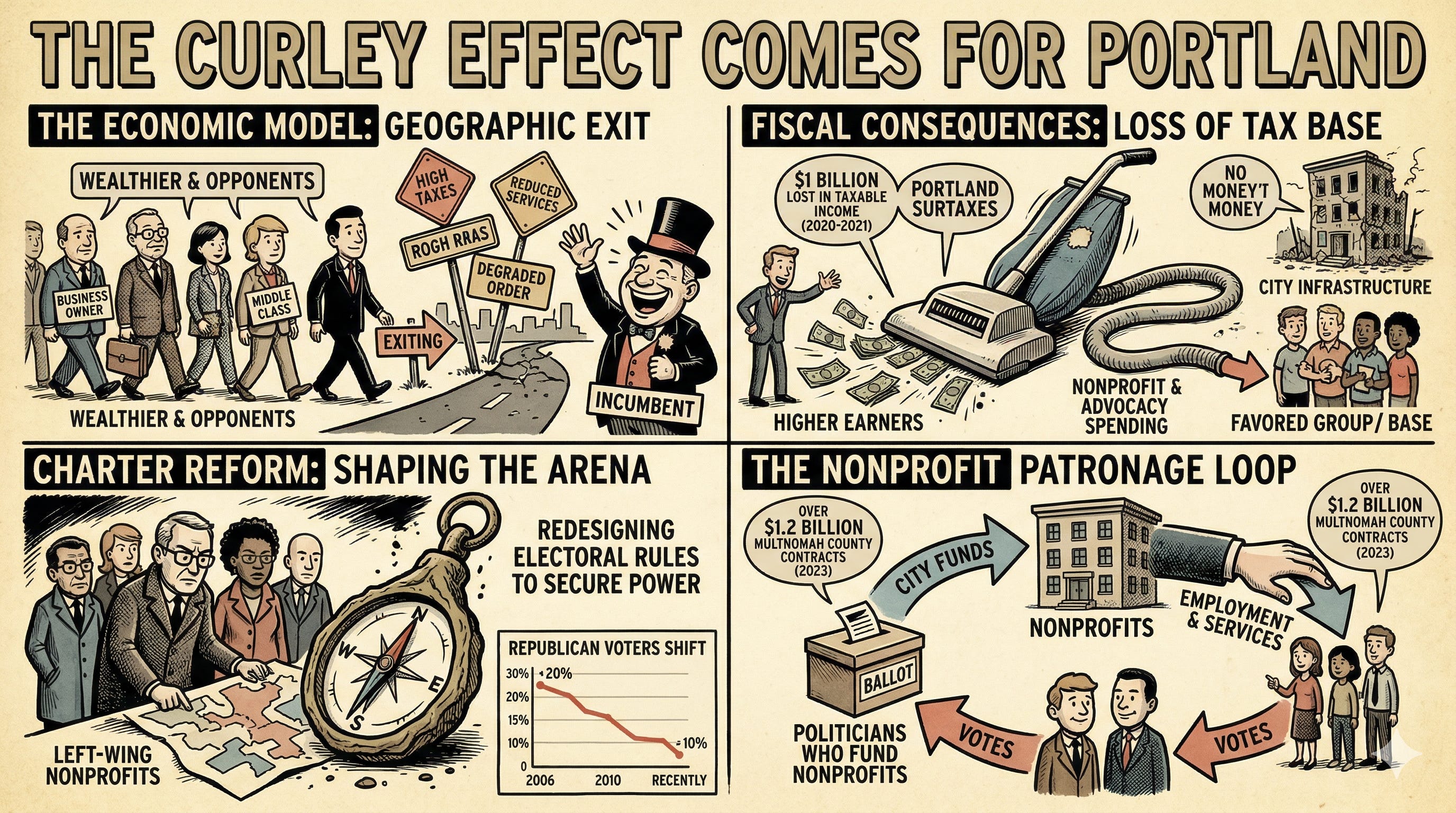
That theory is the Curley Effect, coined by Harvard economists Edward Glaeser and Andrei Shleifer and named for James Michael Curley, four-time mayor of Boston.
Curley spent four decades using patronage, targeted redistribution, and ethnic grievance to push wealthier Anglo-Saxon residents out of the city while keeping his Irish working-class base firmly in place. Boston stagnated. Curley kept winning. His Irish constituents were probably worse off in 1950 than they had been in 1914 — but Curley was still in power.
The Curley Effect says that an incumbent politician with a loyal base can increase the probability of staying in power by adopting policies that are distortionary and wealth-reducing — not despite those consequences, but because of them.
The model shows that if the policies drive opponents away, the electorate becomes friendlier toward the politician. The politician wins, even as the city loses. The model identifies two mechanisms.
The first is geographic exit: high taxes, reduced services, or degraded public order push the disfavored group out of the jurisdiction. The second is social mobility prevention: policies that discourage supporters from rising into higher income brackets, where their political allegiances might shift.
One of the model’s counterintuitive predictions is that greater geographic mobility makes the strategy more attractive, not less.
Standard economic reasoning says that when residents can vote with their feet, bad policies get disciplined — people leave, tax revenues fall, governments shape up. The Curley model says the opposite can be true. If your opponents are mobile and your base is not, policies that push opponents out will improve your electoral position. The easier it is for opponents to leave, the more politically rational it becomes to encourage them to do so.
The paper distinguishes between what I’ll call the strong and weak versions of the effect. In the strong version, incumbents deliberately engineer policies to drive opponents out. Glaeser and Shleifer argue the evidence for this is clearest in cases like Detroit under Coleman Young, who explicitly governed toward the creation of a Black political metropolis and openly welcomed white flight.
In the weak version, no one is orchestrating a purge; the policies reflect genuine ideological commitments, but the governing coalition benefits from — and learns to exploit — the demographic consequences those policies produce. The difference matters for assigning intent. It matters less for predicting outcomes.
Portland’s version begins in the early 2000s, not with a deliberate expulsion strategy but with an embrace of what was then fashionable urban-planning theory.
Mayor Vera Katz and her administration adopted the “creative class” framework associated with Richard Florida, which held that post-industrial cities could attract economic growth by cultivating talent, tolerance, and technology — building bike infrastructure, funding arts districts, and branding themselves as “weird.”
Portland was an enthusiastic early adopter. Portland State University published a 2005 “case study” that looked more like a strategic plan to implement Florida’s prescriptions to attract the creative class.
Florida himself later conceded that the creative-class strategy had largely failed on its own economic terms — that talent clustering generated rewards flowing disproportionately to knowledge workers while delivering little for everyone else, and that the cities that pursued it most aggressively ended up with gentrification, rising inequality, and displacement rather than broad-based growth.
Portland’s efforts to implement Florida’s creative-class approach led to demographic sorting. The city’s progressive cultural brand attracted young, nonprofit-employed, politically left-leaning migrants from across the country while signaling inhospitality to business and moderate-to-conservative residents and families.
Katz and her successors would probably claim that nobody designed this outcome. But it happened nonetheless. Unintended consequences abound in the world of public policy.
It’s perhaps the weakest form of the pull version of the Curley Effect: an effort to attract an electorate largely aligned with the incumbent.
After Katz left office in 2005, her chief of staff, Sam Adams, landed on city council and eventually became mayor. The now-loathed Arts Tax was his brainchild.
Efforts to get the Arts Tax on the 2012 ballot were led by the Creative Advocacy Network, a nonprofit “initiated” by — you guessed it — Sam Adams. Think about that. A city mayor founds a nonprofit whose main goal is to lobby himself and the city council for a new tax to subsidize arts organizations.
That’s the weak form of the Curley Effect in action: tax the masses, enrich your supporters, and leverage that support to stay in office. Adams didn’t run for re-election, so that strategy didn’t work that well for him. Nevertheless, the Arts Tax remains.
Between 2019 and 2023, taxes in the City of Portland skyrocketed. Three overlapping levies account for much of that increase.
Metro’s Supportive Housing Services’ two income taxes — a 1% marginal income tax on higher earners and businesses across the Metro region — generated more than $1 billion in unanticipated revenue.
Multnomah County’s Preschool for All income tax (1.5% to 3% on incomes above $125,000) accumulated more than $600 million in reserves even as actual preschool seat delivery lagged far behind projections.
Portland’s “Clean Energy Fund” surcharge — nominally a 1% gross receipts tax on large retailers — collected revenues approximately five times higher than projected, totaling $1.6 billion over five years.
In the Curley model, the incumbents tax the disfavored group and transfer some fraction of the proceeds to the favored group, with some loss due to administrative friction. The three Portland-area surtaxes closely fit this structure. They fall disproportionately on higher earners, large employers, and the business-owning class. The revenue flows primarily to nonprofit service providers, advocacy organizations, and public-sector programs — the institutional base of the governing coalition. Whether or not any legislator modeled this as an electorate-reshaping exercise, the incidence is the same as if they had.
The fiscal consequences are real. IRS migration data shows consistent net outflows of adjusted gross income from Multnomah County. Between 2020 and 2021, Multnomah County lost approximately $1 billion in taxable income. The most recent IRS data shows that the following year, the county lost another $1.2 billion in taxable income. IRS migration data show that people leaving the county have an average annual income of $105,800, while arriving residents have an average of $73,540—a gap of $32,260 per household.
In 2006, Republicans accounted for more than 20% of Multnomah County’s registered voters. The most recent data show less than 10% of the county’s voters are registered Republicans. True, the party of 2006 is very different from the party of 20 years ago. But some of that shift is surely due to exodus.
Back in 2006, business executives and middle managers served on city commissions and boards. They were engaged in civic organizations, like the Portland City Club. Some would successfully run for office. Today, that middle has been hollowed out.
Around 2019, in the name of “equity,” City Club purged its leadership — and effectively its membership — of anyone who wasn’t on the racial/ethnic justice bandwagon.
Public commissions and boards are now stuffed with nonprofit staffers and union leaders, with a token of one or two people from the business community to check the boxes. Part of that is due to the gutting of the business community, as companies move out of state or get bought up. But surely some of that is due to a recognition that their job on a city board is to silently serve in the superminority. That’s no way to spend an evening, when your family is sitting together on the couch watching a show.
If the regional tax architecture looks structurally Curley-like, the 2022 charter reform looks strategically so. This is where the strong hypothesis takes over.
Left-wing nonprofit organizations designed the reform measure. They shaped the 12-member council structure. They helped draw the new geographic district boundaries. They staffed the “independent” commissions created to implement the new system. Then they ran their own candidates under the rules they had written and, in 2024, produced a 5-member progressive caucus, or “Peacock,” four of whom are members of the Democratic Socialists of America.
Analysis of the 2024 elections showed public-sector unions — SEIU, AFSCME, IBEW, LiUNA — achieving the highest endorsement success rate of any organized political bloc.
Proponents of ranked-choice voting claim it puts more moderate candidates in office. The current makeup of Portland’s city council rebuts that claim.
The Curley model’s forward-looking version says that incumbents with long time horizons will invest in reshaping the political arena itself, not just the electorate. Redesigning electoral rules, drawing district boundaries, and staffing implementation bodies are exactly that kind of investment. The charter reform process is the clearest evidence that at least part of Portland’s governing coalition moved, at some point, from the weak Curley version to the strong one.
Underlying all of this is a political economy that does not require any individual actor to be conspiring. Oregon’s nonprofit sector employs roughly 11% of the state’s private-sector workforce — approximately 190,400 workers across some 10,500 nonprofit establishments statewide. As Oregon’s most populous county and home to the state’s largest city, Multnomah County contains a disproportionate share of these organizations and workers. However, county-level employment breakdowns for the nonprofit sector specifically are not published by the Oregon Employment Department.
That workforce is embedded in the city’s political institutions in ways that Portland’s traditional business community simply is not.
Multnomah County awarded at least $1.2 billion in contracts to outside entities in 2023. The homelessness-services ecosystem alone consumed $724 million in one year across 522 organizations in the Portland metro area, while measured homelessness continued to increase.
The arrangement is self-reinforcing: funds flow to nonprofits, whose workers and clients support the politicians who keep the flow going. Politicians who want to redirect those funds face a formidable, organized opposition with public money already in its hands.
This is the “social mobility prevention” channel of the Curley model operating at a sectoral level. The policy environment discourages private capital formation, burdens small businesses, and subsidizes a sector — nonprofits and public agencies — whose workers are unlikely to accumulate the kind of entrepreneurial wealth that tends to shift political allegiances toward the center-right.
Here is the part that should concern anyone still on the fence about the Curley framing: the strong and weak versions produce identical outcomes.
If Portland’s governing coalition deliberately engineered the departure of business owners and moderates, the city loses its private-sector tax base and its middle-of-the-road voters. If no one engineered anything — if the creative-class branding, the surtaxes, the charter reform, and the nonprofit patronage loop all happened independently, driven by genuine ideology and institutional momentum — the city loses its private-sector tax base and its middle-of-the-road voters.
The Glaeser-Shleifer model is not a conspiracy theory. It is a description of incentives. When the incentives produce Curley-consistent outcomes, the question of whether anyone intended those outcomes is philosophically interesting but practically beside the point.
The Curley model also predicts what comes next. Portland has seen two straight years of decreasing employment. Office vacancy downtown has reached 34.7%, a level that strains the commercial property tax base that those three surtaxes were not designed to replace.
The departure of the people and businesses that fund the redistribution eventually undermines the redistribution itself. Curley’s Boston stagnated. Young’s Detroit collapsed.
Portland is not Detroit, but it is following a recognizable sequence.
The governing coalition reshaped the electorate. The electorate now sustains the governing coalition. The coalition is currently insulated from the economic consequences of its own policy choices. Until they do, voting with your feet is your only option, and the Curley Effect will continue.
No posts
Comments
Nothing yet. Say the first thing.
Sign in to join the conversation.