
It took the Portland City Council five months, hundreds of staff hours, and an afternoon of testimony from 81 sign-ups to outlaw a product that eight businesses in the entire city actually sell.
On June 4, 2026, the council voted 7–5 to pass an ordinance banning the sale of force-fed foie gras inside city limits. The rules, codified as City Code Chapter 17.110, take effect July 1, 2027.
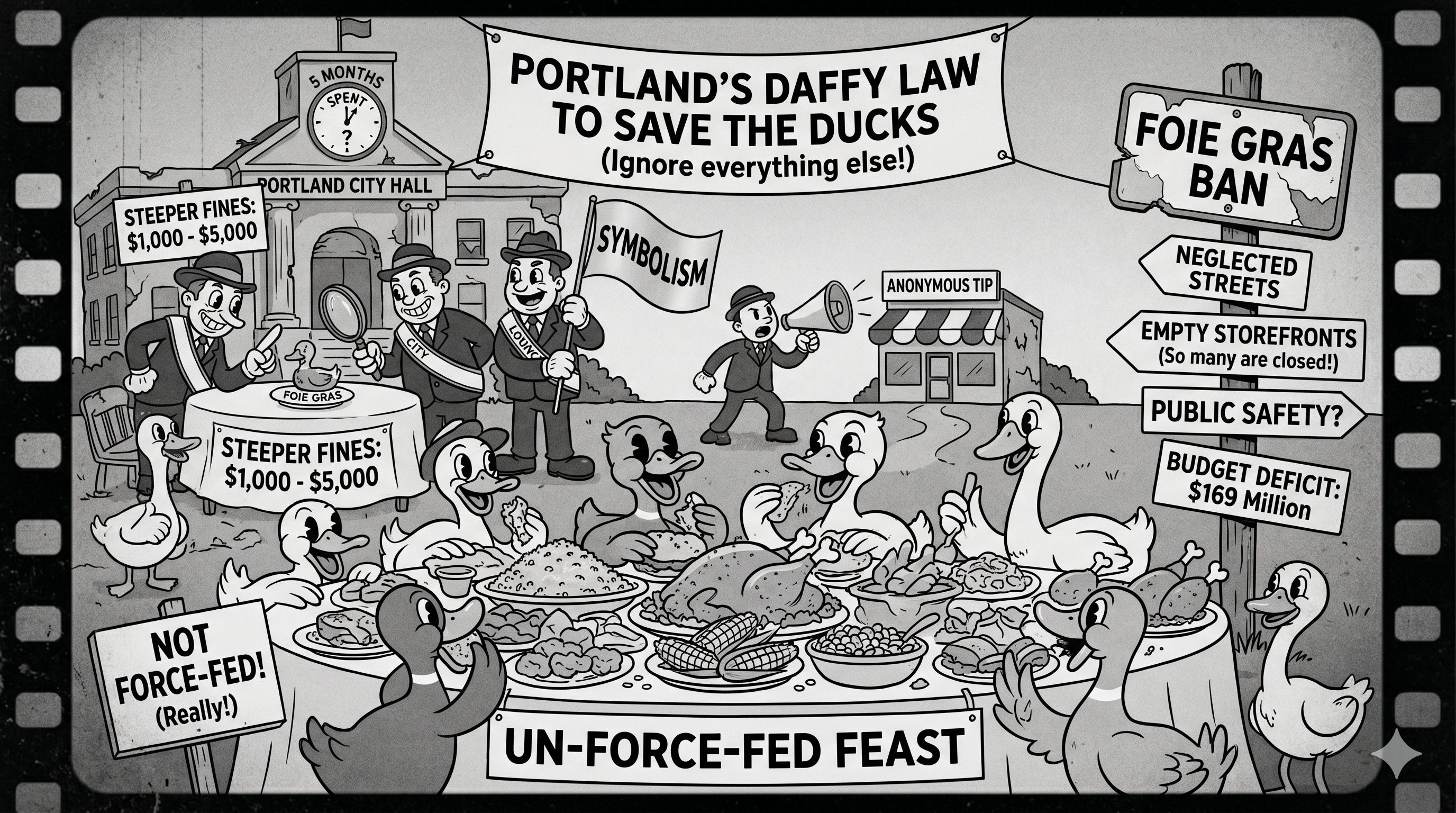
I never thought that a “data-driven” newsletter about public finance and local governance would spend any time on the menus of a few fine-dining restaurants. But here we are. That’s because the foie gras ban is a clean, almost laboratory-grade example of how Portland’s government now spends its scarcest resource. No, it’s not money (although that is getting scarcer). That resource is the council’s and the city staff’s time and effort.
Let’s set aside the question the council spent five months debating—whether force-feeding ducks is cruel—and ask the two questions it mostly skipped. Does this ordinance change anything for the animals it invokes? And what does it cost the city to pass and enforce? Once you answer those, the policy looks less like a moral stand and more like a symbolism substituting for governing.
Supporters described foie gras as a cruelty woven into Portland’s food culture. The city’s own research, gathered during the committee phase, says otherwise.
Of more than 2,500 licensed food businesses operating in Portland, only 7 restaurants and 1 specialty retailer were selling foie gras when the ordinance was drafted. Account for menu changes across a full year, and the count of establishments that offered it at any point still tops out around 16. The eight active sellers amount to less than one-third of one percent of the city’s licensed food businesses, and the dish reaches a tiny sliver of even those restaurants’ customers.
Against that footprint, consider the public costs of addressing this trivial matter. The process ran from committee introductions in January, through a council session on April 29, another on May 27, and a final vote in June. Bureau staff were pulled in to research out-of-state farms, write code language, and design an enforcement framework. One afternoon session drew 81 sign-ups for public testimony.
A single hour of a council meeting consumes dozens of person-hours of time (in the old days, we called them “man-hours”): 12 councilors, the city administrator, the council clerk, bureau staff, invited witnesses, and the members of the public who spend most of that time just chillin’ waiting to give their two minutes of testimony. It’s possible that city council and staff collectively spend hundreds of hours on this one topic that covers less than a dozen establishments and involves a product that less than one percent of Portlanders know how to pronounce, let alone have ever eaten.
It’s likely the city spent more money passing the ban than the combined revenues from citywide foie gras sales.
That ratio is the story. The council took one of its most limited inputs, senior staff and member time, and aimed it at one of the smallest problems on its desk.
Set aside the cost for a moment and grant the ordinance its best case. Suppose force-feeding is exactly as cruel as supporters say. Does a Portland retail ban reduce it?
It does not. A localized sales prohibition does not erase demand. It just shifts it elsewhere.
Oregon has no foie gras producers. The local farm economy has nothing to do with the trade. The handful of Portland restaurants that serve the dish buy it from two family-owned operations roughly 2,500 miles away: Hudson Valley Foie Gras and La Belle Farm, both in upstate New York. Nothing in the ordinance reaches a barn in the Catskills. The farms’ national and global customers remain in place. The number of birds raised and processed remains unchanged.
What does change is a minuscule amount of discretionary restaurant spending. A diner with an insatiable urge for foie gras can drive fifteen minutes to Lake Oswego or cross the river to Vancouver. The only measurable result is a modest penalty on a few Portland storefronts that bring people to town to spend money—at a time when the central city has few such draws to spare.
If the purpose was to improve animal welfare, the ordinance has no mechanism to do so. If the purpose was to relocate a tiny slice of dining out of Portland, it just might succeed.
The ban also has a practical problem: Portland has no effective way to enforce it.
The city does not field a culinary inspection unit that audits restaurant kitchens for prohibited poultry. So the ordinance leans on complaint-driven enforcement, with the city coordinating through Multnomah County’s environmental health staff.
Complaint-driven enforcement works tolerably for violations that are visible and objective from the public side—an unpermitted addition, a blocked sidewalk. It works poorly for a single ingredient sitting in a walk-in cooler behind a commercial kitchen. The county’s health inspectors are already committed to core duties, including foodborne illness prevention and sanitation. The ordinance assumes an inspection capacity that does not exist, then assigns it a task it is not built to do.
The bigger flaw is the incentive the complaint system creates. Direct Action Everywhere, the activist group, testified that it already runs regular protests outside independent restaurants such as Le Pigeon and Canard. A municipal complaint line is a cheaper and more durable tool than a picket. An anonymous report can open an administrative inquiry, and a restaurant serving ordinary, legal duck or chicken liver can find itself answering for a dish it does not sell. Clearing that up means the owner spends hours and legal fees proving a negative—that the liver on the plate did not come from a force-fed bird.
The city has built a process that rewards the complaint, not its accuracy. That is an invitation to harass compliant small businesses and burn public resources doing it.
The clearest signal in the ordinance is the price it puts on the offense: civil fines from $1,000 to $5,000 per violation.
Put that next to what the city charges for conduct that visibly degrades public space. Penalties for minor property damage, illegal dumping, and public-camping violations are generally much less than $5,000 and often less than $1,000. Lie about lobbying under the city’s ethics rules, and the fine tops out at $1,000. Same for violating the city’s sign code.
So, Portland has arranged its incentives like this: a licensed business selling a federally inspected food product produced in the U.S. faces a steeper fine than someone who destroys public property or corrupts the political process. The city can bring its full coercive weight down on restaurants that pay taxes, hold licenses, and answer their mail. In contrast, the behavior that actually shapes our city’s livability goes largely unaddressed.
That is not an accident of drafting. It reflects what is easy to enforce. A handful of high-end restaurants are visible, solvent, and law-abiding, making them easy targets for a $1,000 fine. The thousands of harder cases on the street require sustained, unglamorous work, which the council has shown little appetite for. Faced with a choice between the enforceable but trivial and the consequential but hard, the council chose the former and calls it leadership.
During the debate, Councilor Eric Zimmerman named the pattern directly. Legislation like this, he observed, is what a governing body produces when the real problems are too big to dispatch in a single vote.
He has a point worth taking seriously. Portland is staring at a roughly $169 million budget deficit, a thinning downtown retail base, and unresolved questions about how to fund basic infrastructure. Addressing these issues can’t be distilled down to a tidy 7–5 vote and a press release. Banning an organ meat does. It lets the council claim a national first on animal welfare, satisfies an organized and vocal constituency, targets a tiny minority, requires no budget trade-offs, and demands no hard conversation with swing voters on council.
The trouble is that the symbolism does real work in the wrong direction. It consumes staff time that the budget process needs. It tells the independent operators who are still betting on the central city that their reward for staying is a new ground for inspection and fines. And it tells anyone watching from outside that the city’s leadership will reach for the gesture before the substance.
The foie gras ban teaches nothing new about how ducks are raised in New York. But it offers a great deal of insight into how decisions are made at Portland City Hall.
When the council spends hundreds of hours of senior time on a product sold by eight businesses out of 2,500, it reveals its priorities are symbolism over substance. When it attaches a $1,000-a-day fine to a menu item while letting street-level disorder go unenforced, it is telling residents it has given up on solving the big problems.
Portland’s restaurants earned their national reputation through the work of independent operators—their sourcing, their risk-taking, their freedom to run their own kitchens. City Hall did not build that, and it cannot legislate its return. What it can do is stop treating the people who still show up to invest in the central city as the most convenient enforcement target in town.
The council has now demonstrated it can find five months and dozens of staffers for a problem that affects almost no one. The deficit, the empty storefronts, and the conditions on the street are still waiting for the same attention. They say too many cooks spoil the soup. Maybe, too many councilors spoil the city.
No posts
Comments
Nothing yet. Say the first thing.
Sign in to join the conversation.