
Hey everyone! It’s been a minute! I’ve been a little consumed with a job change, plus some travel, so I haven’t been posting lately, but now I’m getting back to it. Here’s one about game design, just like the old days!
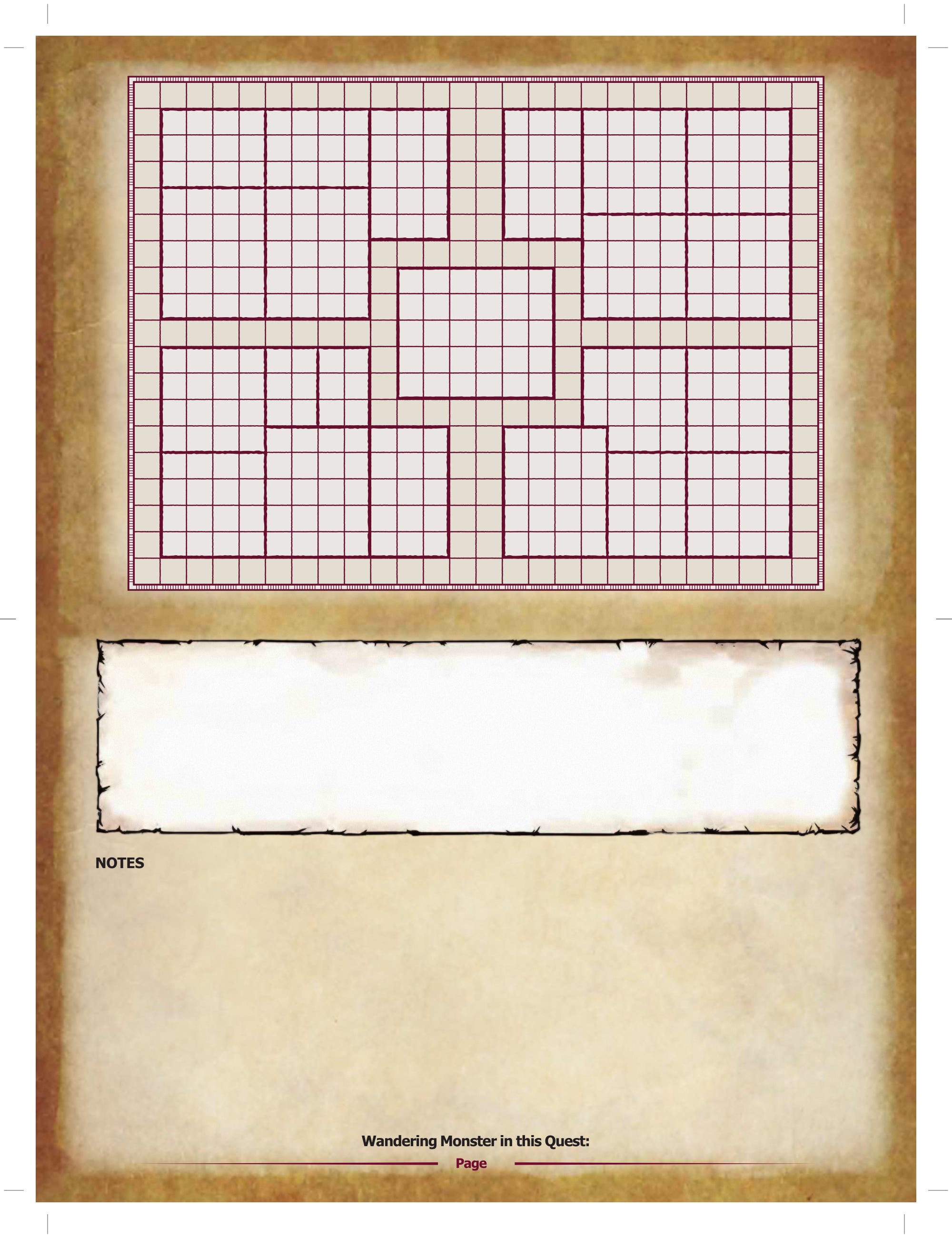
There are two moments in my adolescence I can point to that solidified my lifelong love of adventure games. The first is something I’ve written about on this Substack a bunch of times — the experience of playing Final Fantasy VI and that danged opera scene. The second happened after I was gifted a copy of HeroQuest for Christmas when I was maybe 8 years old. I didn’t have anyone to play the game with (everyone in my orbit thought it was too complicated or nerdy), so I just thought about how fun it looked while I stared at the contents of the box — its miniatures, its board, and especially the blank template page at the end of its quest book.
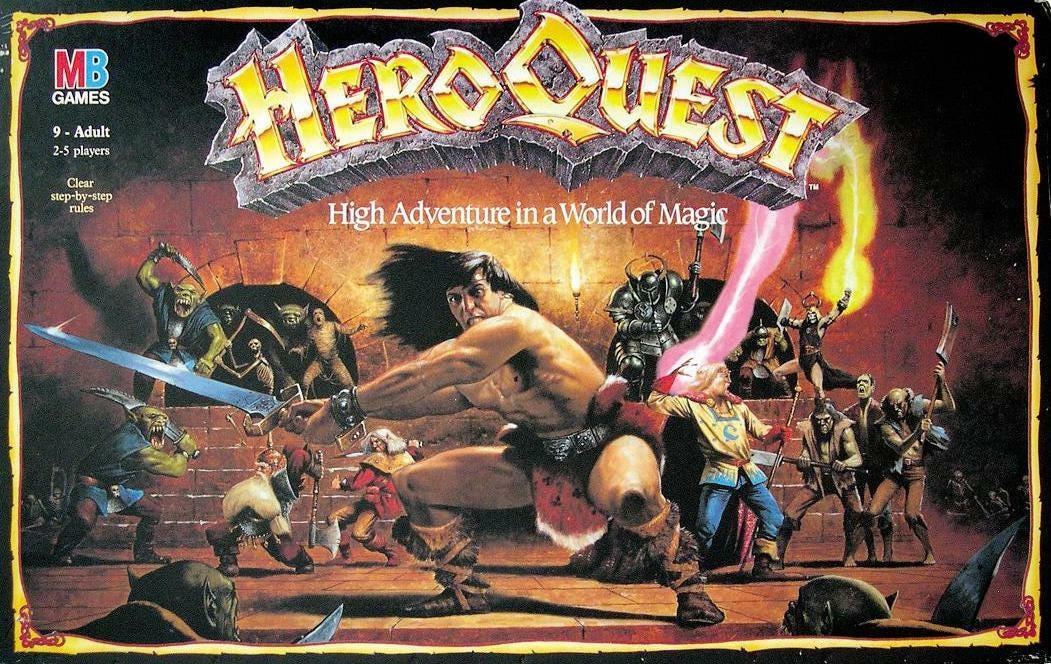
For those unfamiliar, HeroQuest was a mass-market fantasy board game published in 1989 by family company Milton-Bradley in cooperation with big time hobby publisher Games Workshop. It was basically a simplified board game version of Dungeons & Dragons (or the dungeon-crawling aspect of it, anyway), designed to be played by adolescents, and marketed as such. I think my mom bought it for me because of my love of He-Man, who the guy on the front of the box sort of looked like; at the very least, they share a common ancestor.
That map template, which invited players to create their own HeroQuest scenarios for their friends to play through, unlocked something almost profound in my imagination. To be given a blank map and then to be told that I had the power to fill it in — man, that spoke to me. In the comedy group I created with in the 2010s, we used to joke that horse girls and train boys were two gendered expressions of the same phenomenon. I am not a train boy per se, but adjacently, I am very much a map boy1, and I think I can probably point to HeroQuest as the reason why.
In my youth, though, I never took the plunge of filling in that map. I never even got to play the game. HeroQuest became my gaming white whale, and I never really let it go. I spied a complete, near-mint copy of the game at a Half Price Books once, but it was $300, and I couldn’t justify the expense. When I was doing press for the Chicago Board Game Cafe, I snuck into a couple interviews that I would love somebody to donate a copy of HeroQuest to our gaming library, but a Google search tells me no journalist ever let that sentiment get to print. For 35 years, I remained unfulfilled.
But then, the wave of nostalgia spending fueled by the novel coronavirus deigned to give me what I wanted. In late 2020, Hasbro announced a crowdfunding campaign for a sort of “remastered” edition of HeroQuest published through their imprint Avalon Hill2. The project made over a million dollars in one day, and a year later, I had a fancy new version of the game delivered to my door. I was, finally, ready to quest.
And, as I suppose was inevitable when I spent so much of my life building up the experience, I ultimately felt a little let down.
To the modern tabletop gamer, who has likely at least sampled some of HeroQuest’s grandchildren (Gloomhaven, Descent, Imperial Assault), the original HQ feels dated. For one, it’s a roll-and-move… like, on their turn, players roll two red dice (d6s! With pips!!) to determine how many dungeon squares their heroes can travel that turn. That may fly in the capitalist hellscape of Monopoly, but in THIS Dungeon, we do not roll dice to travel on squares.
And more seriously, once I got into playing with some friends — as, in the intervening years I became cool enough to find a posse who wanted to play HeroQuest as much as I did — I, as the game’s antagonist Zargon, discovered the biggest bummer of playing HeroQuest with savvy gamers. Namely, it is wildly, unflinchingly easy for the players to win.
There is, as my players discovered, an essentially unbeatable strategy in HeroQuest: spend turns lining up all the heroes outside any door in the dungeon, in “marching order” (so tanks and DPS line the door, while range and support stand back a space). As the final turn in whatever heroes’ round, the last hero to act opens the door, then steps back, leaving monsters in the room precisely one space to move into in the hallway. At this point, the monster AI demands that they file into that buffeted space, marching slowly and inexorably to their deaths one by one in what my players dubbed the “HeroQuest meat grinder.” This would take multiple turns to set up and even more to finish but, barring any ridiculously lucky attack rolls by the monster currently stuck in the grinder, the heroes were basically guaranteed to get out unscathed, while the monsters’ fate was written in blood the moment that door was thrown open.
It was a delight to see my players stumble into this strategy early on in our first HeroQuest campaign, and then, honestly, not that fun to see them repeat it over and over again, slowly eliminating all resistance and barely ever facing challenges. Because all HeroQuest action is pre-set on the map grid, even monster placement, there were very few ways to challenge a group of four smart modern gamers with a lust for treasure and a thirst for monster blood.
As it happens, this was a known issue with the game’s design even back in the ‘80s. I cannot find the original interview this comes from so you’ll have to trust Wikipedia’s citation on this point: “In a 1989 interview, designer Stephen Baker agreed that the game was too easy if the players all cooperated, but explained that ‘The game is really aimed at 10–12 year olds who play with their mums and dads. My feeling is that they play in a very competitive, rather than co-operative way.’”
In other words, the folks at Milton-Bradley assumed that kids would play HeroQuest the way they’d play any other board game, considering only their own piece as they tried to kill as many monsters and raid as much treasure as they could take for themselves. It was assumed that the kids’ drive for power and fortune would supercede any thought they had about banding together. If the 12 year olds were sharp enough to realize that coordinated teamwork meant they could share all the dungeon’s riches equally with basically no chance of defeat, the game became broken, and all players could more or less get what they wanted without resistance.
Hm. Hmm. HMMMMMMM.
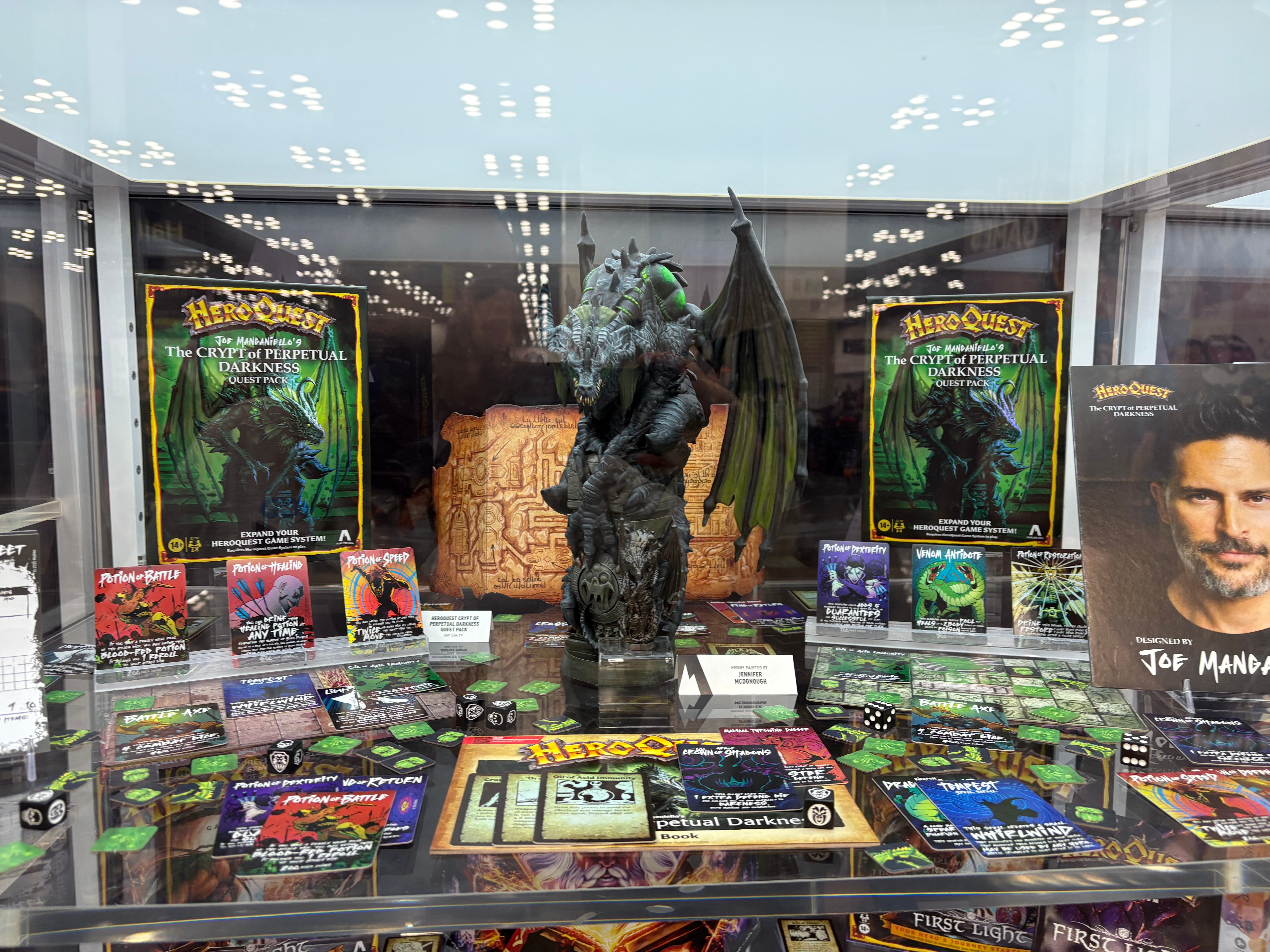
Earlier this year, Avalon Hill released an expansion pack for HeroQuest entitled The Crypt of Perpetual Darkness. This expansion was designed by actor and D&D luminary Joe Manganiello, and it has sick heavy metal design aesthetics. What can I say, I’m a simple man. I grabbed a copy of the game at Gen Con and texted my HeroQuest-playing pals to see if they’d be up for another go-around.
The gang was ready to quest again, but we all agreed that, rules-as-written, HeroQuest was too easy. And so I was called upon to spice it up… to try, as much as I could, to bust up my players’ unionizing tactics.
Fortunately, this is a question that lots of folks have devoted themselves to studying. Since the ‘90s there have been entire communities built around the concept of “Hardcore HeroQuest” — of turning a game meant for 12-year-olds into a brutal dungeon-crawl. Normally, I might deride the idea of transforming a thing meant for kids into something ugly and painful. But fuck, dude, miniatures and maps are expensive, and HeroQuest gives you so much cool shit in the box! I look at this not akin to a gritty modern reboot of a beloved childhood piece of media but more like a design challenge springing out of that blank quest map I studied when I was 8. How can we take the (very good) bones of a (very cool) game meant for children, and allow it to grow with its players?
It was easy enough to eliminate the roll-and-move aspect, which basically every take on Hardcore HeroQuest accounts for. The rule I sourced that I liked most is: heroes’ base move starts at 7 (the statistical average die roll of 2d6, rounded up). For every piece of armor they don, that base move drops by 1. This brings HeroQuest movement roughly in line with D&D combat — most PCs there can move 6 squares per round — and it also situates the heroes in a reasonable spread across the various monster movements.
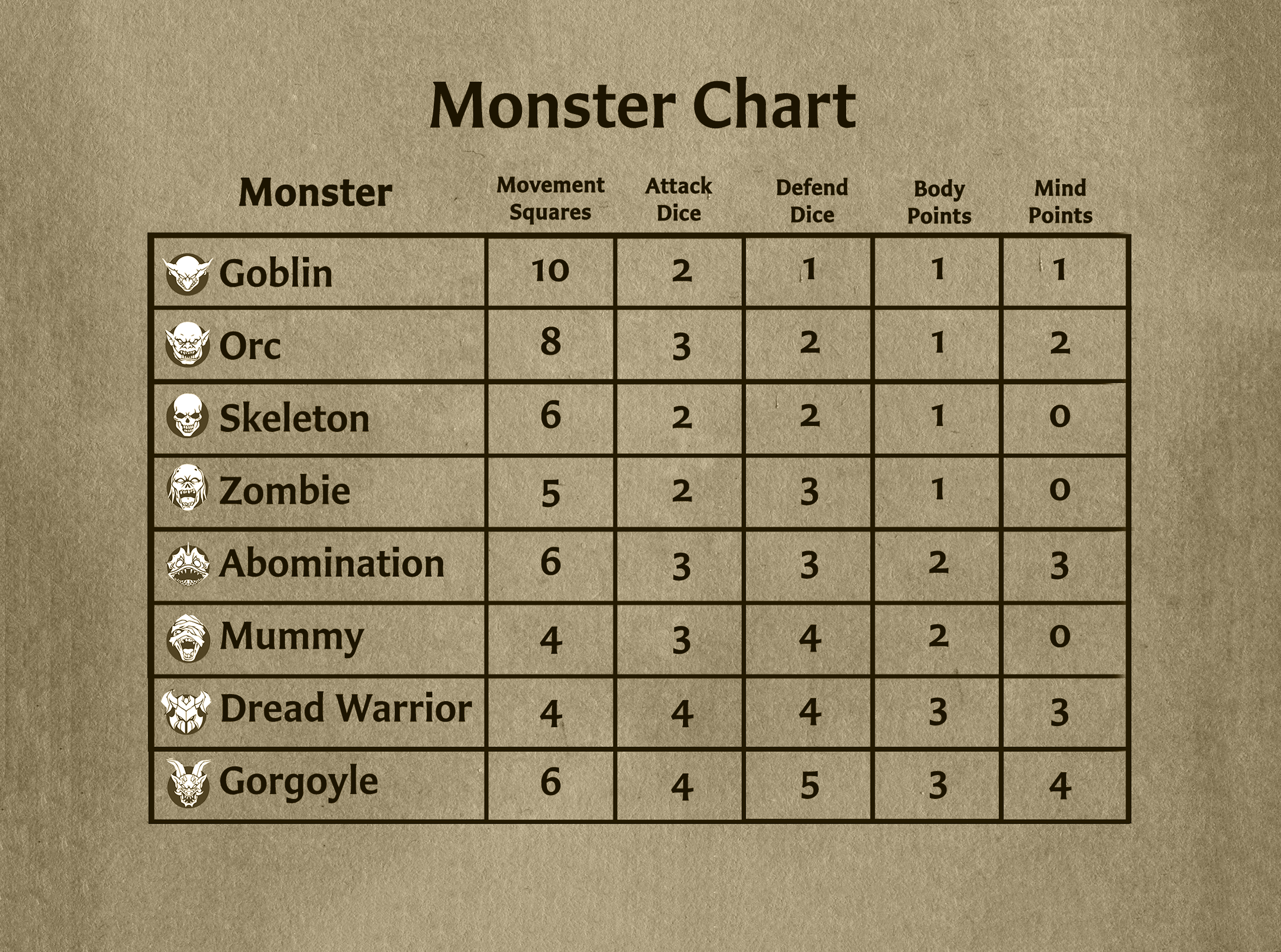
Fixing the “HeroQuest meat grinder,” though, took a little more doing. And I didn’t find many satisfying answers in existing Hardcore HeroQuest variants that I saw. I think most folks in the HH community (probably rightly) assume that merely by virtue of making combat more difficult, complex, and deadly, the players will face an increased challenge regardless of their tactics. I imagine that’s true, but it didn’t solve the key issue I was looking to address — that the game as designed has no answer for heroes spending turn after turn lining themselves up in the ideal formation to take on monsters on their terms. As much as the players are grinding up monsters, they’re also grinding up my patience as I watch them take two uncontested rounds to make sure their positioning is perfect before they dive into the next room.
Tabletop RPGs already have an answer for this, of course — the random monster encounter. Old-school D&D (as ported into modern games like Old-School Essentials) asks the party leader to roll a d6 every two turns of dungeon exploration; on a roll of a 1, the party is surprised by a random encounter. Fabula Ultima, taking inspiration as it does from JRPGs, complicates this a bit — every location is assigned a travel roll on a die from a d6 to a d20, depending on that location’s danger level (a higher die means higher danger), and a roll of 6 or higher on any of those dice triggers an encounter in a travel day. In either/all systems, and adventure video games too, the point of these encounters is to wear down players’ resources and put their management to the test — to give them a bit of a grinder like they gave my poor monsters.
And the thing is, HeroQuest already has a mechanic that fits here: the wandering monster.

Except, wandering monsters in HeroQuest are deployed with the same design philosophy that assumes 12 year olds are playing this game only for themselves. They only spring up when a hero searches for treasure in a room where no set treasure exists. In those rooms, players pull from a randomized deck of Treasure cards that starts out about half gold/potions and half wandering monsters. And players can search for treasure in every room of the dungeon — in fact, rules-as-written, every player can search every room once — so the game intends for wandering monsters to become more frequent as the good stuff gets thinned from the treasure deck. Unfortunately, the very simple solution to this is to limit random searches for treasure (which don’t often pay more than a few gold anyway), and search in such a formation that even if a wandering monster does pop up, it becomes more fodder for the grinder.
I thought the wandering monster mechanic could be used for a different function, though. To me, I saw these guys as a clock.
Many adventure game designers will tell you that adding a clock — some element of timed pressure — to your creation is essential to giving your players a challenging, satisfying experience. With no time pressure, there’s nothing to stop players from slowly exploring every corner of a dungeon and sauntering out with all its treasure (exactly my problem with HeroQuest!). With a clock, there’s incentive for characters to move their assess, because unknown danger could be around any corner.
That’s how I wanted to play it. I wanted to take something like the random encounter roll from classic D&D, but add an escalating element of danger as in Fabula Ultima. I thought about what element would most make sense to guide that escalation, and what I hit on was open doors.
Avalon Hill’s HeroQuest box comes with 16 open door miniatures. As heroes progress through a quest, they leave a growing series of these in their wake (the game does not provide any rules for closing doors once opened). I reasoned that open doors would narratively be a pretty good signifier to dungeon denizens that something was amiss, and might put them on higher alert. So, the more doors that were opened, the higher chance there might be of running into something unfriendly randomly in the hallway. Using 16 as the ceiling (since no quest should ever use more doors than the game gives me minis for), I came up with an escalating system of random encounter rolls I would secretly make every villain turn based on the number of open doors on the map. I’d roll a d6 and determine whether the quest’s pre-set wandering monster would pop up based on the following:
1-3 doors open: 1-in-6 chance
4-6 doors open: 2-in-6 chance
7-9 doors open: 3-in-6 chance
10-12 doors open: 4-in-6 chance
13-15 doors open: 5-in-6 chance
all doors open: wandering monster guaranteed
This felt like a good system to me, because it meant that if players decided to take their time and explore every far corner of a specific map, there’d be a higher chance for something dangerous to come their way. More importantly, it meant that they couldn’t spend uncontested turns putting themselves in perfect formation order, because wandering monsters could pop out at any time, even if the heroes’ only action in a turn was moving down a hallway.
My friends and I just wrapped our Crypt of Perpetual Darkness campaign a couple days ago, and I’m pleased to say, this one adjustment to how wandering monsters work made all the difference in our game. All of a sudden, HeroQuest became potentially super punishing. With tough RNG, heroes could have a handful of the game’s meanest monsters pop up on their tail as they furiously searched for a dungeon exit. Acquiring treasure no longer became the key goal — surviving each level did. And every turn the players would spend trying to set up the Heroquest grinder would be a turn their plans could be thwarted from a monster coming at them from behind.
Did this rules change feel a little unfair at times? I think so, yeah. I will say, I never fudged a roll across our whole campaign, but there were a couple times where I let players bend the rules a little about who was carrying health potions because danger rolls had been exceptionally cruel to them that quest. There were two near-total party kills, where only one or two heroes survived by the skin of their teeth. But, like… that’s fun! At least we thought it was. In a modern roleplaying game like 5E, character deaths feel bad because you invest so much emotionally into your person, making them your cypher in a fantasy world. In HeroQuest, where only tactics matter and each character gets as much depth as a notecard-sized stat sheet, I think the occasional character death feels good. It reminds the players that, when they don’t die, it’s only because they played well.
And man, play well they did. By the end of our campaign, the players got really good at finding optimal rhythms of group exploration with a time crunch, and they pretty much tore through the final boss level without a sweat. But, that felt earned. It felt like a victory lap instead of exploiting a design issue.
When the rules of the game are exactingly written and perfectly fair, nothing can stop a group of heroes who take their time and coordinate their efforts. But even when randomness is high, when it feels like the game can be rigged against you just by virtue of you doing what it needs you to do, teamwork wins the day. The heroes just have to be quick on their feet, keep their eyes on the prize, and help each other get to the end. That’s the one thing those monsters never do.
We’ve got a Mortified Chicago show with a spoooooky Halloween theme this Friday at the Athenaeum Center, and it’s looking great! Teenage diaries, murder mysteries, heavy metal, self-insert Twilight fanfiction — we’ve got it all! We partner with local public radio affiliate WBEZ for these shows, and as you may have heard, public media is sort of Going Through It right now, so a ticket purchase also helps fight a corrupt, treasonous federal administration. Fuck those wandering monsters.
You might imagine that Ticket to Ride makes me feel like the last panel in that Vince McMahon meme.
I later learned this was project managed by a friend of mine from the comedy scene, Patrick, currently Director of Product for Hasbro Games. Hell yeah, Patrick!! You rock, man.
No posts
Comments
Nothing yet. Say the first thing.
Sign in to join the conversation.