
In this post, I continue on with some personal writing I’ve been working on in therapy, a sort of memoir that centers on me learning to tell my own story in a clear-eyed but positive way, with the help of some of the most impactful media in my life. I’m posting entries from that work here every so often. I’m sharing because I put a lot of effort into it, and because it feels like a good thing to do if I’m trying to feel more at home with my own narrative. Pre-posting edits will be made if it feels appropriate, and identifying information of others will be obscured except where it’s impossible. If you want to skip these posts, it’s all gravy, baby!
No one has it easy as a teenager, right? Pop culture likes to tell people who slot into the “nerd” archetype (me!) that the popular kids coast through high school, but as the producer of Mortified Chicago, I’ve seen enough artifacts created by those kids to know that they’re little weirdos too, just as obsessed as the rest of us with figuring out who they were and what they wanted, with the added pressures of holding onto their nebulous social status at all cost. “Poor man wanna be rich, rich man wanna be king,” as the Boss says. Only once in seven years of producing Mortified have I run into somebody who told our team that they were actually happiest in high school, that the thing that made them most sad about revisiting their teenage diaries was that they weren’t living that life any more. Truly that was one of the biggest bummers I’ve ever heard; not only could we not book that person on our show (as Mortified is a comedy show and this feeling is not funny), but I really wanted to help them find joy in their adult life because it’s not supposed to be that way. Unfortunately, that is largely beyond my purview as a comedy producer, so instead I just held onto this anecdote.
Anyway, I say the above to note that I think some of my professional adult choices have gifted me a pretty reasonable perspective on the challenges of being a teen, and in a lot of ways, my teenage years shared these same universal mundanities. I wanted friends, I (desperately) wanted girls, I was anxious to discover the person I was going to be, despite my AP English teacher using Saul Bellow’s Henderson the Rain King to sneakily let us know that, indeed, we would be becoming our whole lives (thanks for the lesson, Mr. Raftery! You’re the best). All of that is the Teenage Experience (™), minus maybe reading Rain King in English class… I don’t know your curriculum.
But I faced a few more unique challenges, too, and honestly I don’t really like writing about them because I feel like so far this whole story has been sad, and it’s going to get sadder. And that makes me as an adult sad, because it’s starting to feel like there was no joy in my life, and that’s just not true. First of all, I think it’s abundantly clear that I took joy in the fantastical media I loved – He-Man and Batman and the like. I also had some great friends. And as much as Batman: The Animated Series gave me consistency and stability in my adolescence, I also started to find consistency and stability from my peers, too, as I was able. In no particular order, I want to shout out: Tom, Sam, Ryan, Derek, Vince, Steve, JD, Nick, Jim, and Mark – some of the guys whose companionship made these years not only bearable but often super fun. A theme will emerge in these writings of found family, and this era of my life is the beginning of that. I truly think that we, or at least I, have best found myself (or maybe found myself best?) through the people that I love, and when I was a teen, these were the people who helped me find myself. And I do love them.
That setup was necessary for me to feel okay about getting to more sad stuff, so now, let’s rip the band-aid off. Towards the beginning of my 8th grade year, a few months into me being 13, my mom had an aneurysm while doing some yard work. This took her ability to speak and, largely, to be conscious, and she never recovered. Towards the beginning of my senior year of high school, a few months into me being 17, after being in a coma for the prior four years, she passed away. I remember the date of that day – September 21, 2001 – because In Those Times, as they like to say, there was a hyper-acute sense of date awareness anchored to 9/11. What a bizarre couple months.
So, it’s pretty fair to say that my teenage years were bracketed by losing my mom (in stages), the same way that my adolescence was kicked off by losing my dad (mostly). Although I couldn’t tell you the precise calendar date the aneurysm happened1, I remember what it was like while it was going down. My mom and I were outside raking leaves, and she told me she had to come in because she wasn’t feeling well. That didn’t seem wildly unusual, so I didn’t go inside to check on her until I finished a little more work, and when I did, I found her sitting on the stairs, staring into space. I kept trying to ask her what was wrong and she couldn’t reply more than a few words, delivered nonsensically, in a faraway tone. I was terrified, and I called her mom/my grandma, who lived three hours away in the Chicago suburbs, to try to understand what to do. My grandma told me to call 911, and that she would soon be on her way to our house. The paramedics came and took my mom to the hospital. I don’t remember how I got there. Maybe a neighbor gave me a ride? My grandma got there a few hours later. The staff told us that she’d suffered an aneurysm that led to a stroke, and that the damage looked serious. They’d need to operate on my mom’s brain to have any hope of saving her, but the operation would likely change her capacities. Permission was granted. The operation happened, a piece of my mom’s brain came out, and she was never fully conscious or aware again. She fell into a coma and spent the rest of her days in nursing homes and hospitals, until she passed from an infection.
Understandably, this makes me really upset. Because I’ve had so long to process growing up largely without a mom, though, it sort of makes me sadder for her, now – for Denys Garneau. If I really think about my mom’s life – how hard and unforgiving it was, the disrespectful and unappreciative treatment she often received – it strikes me how unfair it all is. Her aneurysm happened to her when she was 45. That’s only four years older than I am now, and I have to acknowledge that my life has had a lot more freedom and adventure than hers. She should have been able to enjoy long, rich years full of love; she certainly generated a hell of a lot of love herself while she was here. But besides her mom, and me, and a couple friends, I’m not sure how much of it she got back. It sucks. She deserved better. I’m sorry, mom. I’m sorry, Denys. Life wasn’t fair to you, and you did the best you could to ensure that mine was brighter than yours. I am grateful for it.
The most obvious thing you can say about the show Boy Meets World, at least if you’re my age, is that it grew up with you. It’s obvious because it’s correct. Across its seven seasons, from 1993 to 2000, the characters and the comedy of BMW aged before its audience’s eyes. What started as a sweet, relatively simple family sitcom featuring sixth grade punching bag Cory Matthews grew into an absurd reality-warping dramedy featuring an ensemble of college kids (with sophomore Cory still vaguely at its center) who monologued like 40-year-olds. And if you’re like, hey, someone can’t go from sixth grade to college sophomore in seven years, WELCOME TO ONE OF THE CENTRAL MYSTERIES OF THE SHOW, BUDDY.
For a lot of its run, Boy Meets World was appointment television for me (and often my mom). Cory really did grow up alongside me. I was in 4th grade when he was in 6th (close enough for the magic of Main Character Identification!), and when I was going through some of the heaviest parts of my formative years, he was rocketing through high school drama and into college turmoil via the time warp of the Showrunner’s Edict. Maybe the fact that Cory grew up unnaturally quickly on the show especially resonated with me because I felt like I did, too. “It’s a feature, not a bug.” Honestly, I felt like I was pretty developmentally in lockstep with our intrepid Main Character, and I give showrunner Michael Jacobs props for being able to so vividly connect to a kid with such a particular set of circumstances. It’s like he just innately understood something about growing up2.
So by the time I was experiencing some pretty heavy teenage drama, Cory & friends were, too. Except, the drama Cory was going through was almost… aspirational for me? Like, so much of his story centered on Topanga, his longtime partner and destined lover (again, these characters were teenagers – but I guess that’s how love feels when you’re a teen!). I did not have a Topanga. Man, I wanted one so bad. But who could watch Boy Meets World and not? Honestly, though, the stuff this show says about love, while relatable to teens, also feels sort of dangerous; looking back on it, the Cory/Topanga relationship model is probably responsible for as many ill-adjusted adults as the Joker/Harley Quinn model. But I digress.
I wanted to relate to Cory; I wanted a Topanga. But upon revisiting Boy Meets World in my adulthood – first, rewatching when Disney+ came on the scene, and later, rewatching alongside one of my favorite podcasts – I have come to realize that, indeed, the character I most saw myself in on Boy Meets World was not our Main Character, but his troubled best friend. I was not Cory – I was Shawn.
After my mom fell into a coma, my home life became fully uncentered. Prior to this, I had been living with my mom exclusively for a few years and didn’t really talk to my dad at all. Of course, we had to let him know about all this. Since my grandma immediately jumped in to take care of my mom, she ended up staying in my mom’s house and being my caretaker as well, for a little bit (she rocked). But in my dad’s infinite patriarchal wisdom, he decided that it would be better for my development if I moved in with him and his new family in the house they’d just bought instead. This place was a literal mansion, sitting on top of a hill overlooking the less fortunate part of town. Something I realized about my dad later in life is that literally every single one of his houses I knew him to have was on a hill – usually at the top, so he had something or someone to look down upon. Curiously, his bachelor pad apartment was in the middle of its hill. Too on-the-nose, dad.
So after a few months of staying with my grandma in a familiar place, trying to pretend that things were normal, I packed everything I owned into boxes and moved into a new dwelling for the first time in my life, alongside a family that was pretty alien – my dad, his new wife, her three kids, and their infant son that they’d had together. Easy peasy!
And look, honestly, those folks might have been making an earnest effort to welcome me, at least at the start. I just wasn’t really in a place to be welcomed. I remember the first day I was there, a Sunday evening in early January, my stepmom asked me to run down all the extracurricular activities I had so she could make sure I had rides to and from school when needed. That’s nice! I also remember them telling me that they had a maid come a couple times a week to tidy up, which I laughed at because I thought they must have been joking. Turns out, they weren’t. Oops!
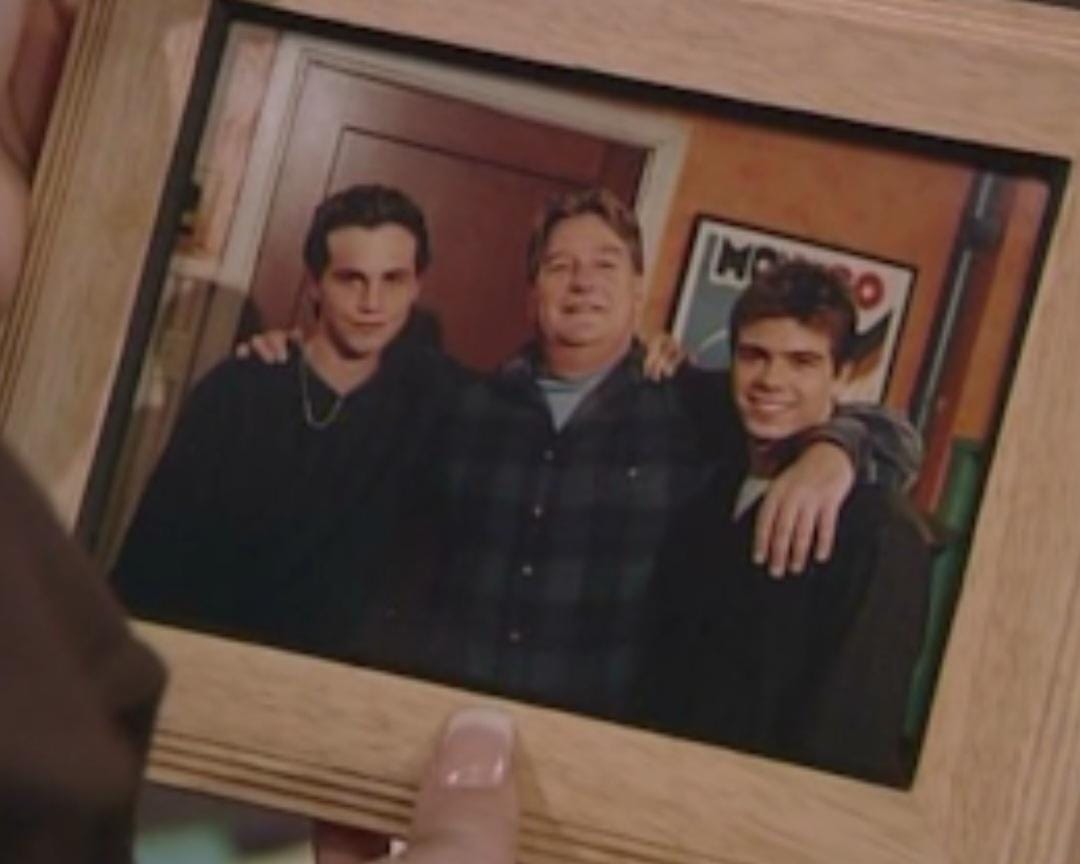
“We’ll Have a Good Time Then” is one of the more melodramatic episodes of Boy Meets World, but as an angsty teen, I loved the melodrama – even moreso since this was an episode about parents.
It’d been a part of Boy Meets World’s DNA since almost the beginning that Main Character Best Friend Shawn Hunter came from a troubled, broken family. There are even some hints that Shawn’s father Chet may have been abusive, although those are couched in throwaway dialogue lines that don’t linger too long on such a heavy topic. By the time of season 6, in which “We’ll Have a Good Time Then” airs, viewers hadn’t even seen Chet for over a year. But his absence was typically played for either laughs or light drama, with only the occasional nod towards what his absence said about his parenting, and what that meant for Shawn’s development. But after years of teasing, “We’ll Have a Good Time Then” shows up ready to rumble.
Here, Chet drops in on Shawn and his half-brother Jack at college after over a year of road life, doing odd jobs, living a journeyman’s life. But this time, Chet tells his boys, he’ll be sticking around. Despite Jack’s excitement, Shawn feels certain that Chet will be out the door again in no time. He’s pretty snotty about it too (I get it). But then, Chet has a heart attack in the middle of an intense conversation with his sons, and all of a sudden, he can’t just roll out of town, even if he really wants to.
Chet’s medical issues, and the differing impacts they have on Shawn (who knew him his whole life, sort of) and Jack (who’s just getting to know him), set the stage for an angsty as hell family drama in which Shawn’s parent-related traumas pour out like a flood. This season, Shawn’s been struggling with his inability to maintain a romantic relationship, or even to feel at home in his closest friendships. And so, the drama of this episode comes to a head when Shawn recognizes his patterns and takes a stab at where he learned them from. He says to Chet: “I can't keep a relationship. I drive all my friends away. I hurt everybody I care about…. I’m just another version of [you].”
As a kid with dad issues, let me tell you, this hit hard.
After some more heavy conversations, and a bit where it looks like Chet’s going to get out of the hospital and take off again, a second heart attack ends up being fatal. And even though there’s a tiny moment of reconciliation between Shawn and Chet right before the end, where Chet even apologizes for how he treated Shawn, it’s not much, and it’s not clear whether Chet was really going to change his behavior this time. In the end, Shawn will never know. Do any of us?
I lived with my dad and his new family for about five months in total. I don’t remember much specifically, except that it was tense and awkward and I never really got to relax. Again, exercising empathy, I bet the kids in my stepfamily felt that way too, so I should give them grace for having a weird outside kid they barely knew thrust upon them, too.
But yeah, it was never a comfortable situation; I think by that point there’d just been too much resentment between my dad and I, augmented by years of silence. We didn’t know how to communicate (did he ever? Did I?). I’m not sure he was that interested in learning how to communicate with me, honestly. As a now-Evangelical Christian, and a rich man besides, he felt like he knew the right way for all of life to unfold before him, and it was up to the rest of us to simply bend to his will. Wrecked over my mom, adrift in uncertainty, and forced to cohabite with people I barely knew, I simply did not want to. It’s not that I was actively hostile. I just didn’t feel like I needed to pretend that I wasn’t sad about things (which is, like, pretty fair!). Thinking about it now, that sadness probably ate at my dad, because it meant that emotionally, I was fixated on someone other than him, someone who had spurned and defied him before. Unacceptable.
Things shifted irrevocably one Friday night in the spring when my grandma called to let me know that my mom’s condition had taken a turn for the worse. At this point, the decision had been made to move her to the Chicago suburbs, so my grandma could be back in her home and watch over her daughter. My mom had been in a nursing home for a few weeks, but something happened that necessitated sending her back to the hospital. It didn’t sound good. I freaked out and called a bunch of my friends – whoever would be home on a Friday night (Boy Meets World night!) – just to have someone to talk to. One of them, hearing how upset I was, called me back to say that their parents had offered to give me a ride out to Chicagoland the next day so I could visit my mom. I told my dad. He said: “I know you asked them for a ride and then made up this story about how they offered, so that you could manipulate me into saying yes. You’re always manipulating me. Well, if you so badly don’t want to be here, you don’t have to be. We’ll get you to Chicago.” And by the next weekend, I was moving in with my grandma full time.
It feels so wild to me how ghoulish my dad comes off in my memory. But a version of the above is really what he said. Like, he was positive that I lied about my friend and their parents offering to help me visit my mom. He couldn’t conceive of a world where someone would just offer to do something nice for somebody else, let alone his child! So, instead, I was a liar, poisoning his family with my manipulative ways.
Fuck him, man. I’m glad I got out of his fucking house.
I moved in with my grandma just a few weeks before my eighth grade graduation. I missed some crucial social experiences with my peers, but I settled into a place where I felt safe and loved. Although I didn’t have a vibrant emotional language at that age, I absolutely remember feeling like I was beaming the day I moved in. It truly, finally, felt like I could breathe.
I said before and I’ll say again, my grandma was a rockstar. It could not have been easy for a woman of her age (at the time, 73) to take a teenager into her house, let alone one whose life had been upended so much in the past year. Yet she did it without question. And, if I’m being honest, I’m sure a little bit of her reasoning there was spite, because she hated my dad (rightly!). But that never showed, to me, because she absolutely loved me, too, and her house gave me the space I needed at the time.
That said, you know, it was not necessarily the easiest high school experience to live with someone two generations removed from me. For one, my grandma didn’t really drive, except the few blocks to the nursing home to see my mom – which she would do twice a day, once in the morning and once in the afternoon, for an hour at a time, just to sit by her, hoping for some sign of life. When I wasn’t in school, I would go along, too, and listen to Elton John or Billy Joel CDs on my discman or read some paperback sci-fi novel while we sat (my pop culture tastes were very hip). It felt like a vigil, or maybe even like my grandma was punishing herself for something.
Because she didn’t drive, and because I ended up going to a private school a few towns away, I didn’t have super easy access to friends. Which I had to make a whole new set of! While starting high school! I did okay at that part, honestly. I was still a pretty friendly guy, and even though I had what I thought were pretty niche interests, wouldn’t you know it, I found people to talk about comics and video games with at my new school! But I didn’t get a ton of time to hang with them after hours, or even do extracurriculars, because I was beholden to the school bus schedule, and at 14, your friends don’t really drive. So it was a little isolating.
One memory that sticks in my mind for how silly it is is the time my sophomore year when my friend Vince invited me to go see a Poison concert with him and some other friends. I want to be so clear that I was a high school sophomore in the year 2000. Poison was not what the kids were going to see at the time. No one would have thought anything about them other than that they were just trying to recapture their glory days of the ‘80s. But for my grandma, who was old when Poison was young, they were just a loud rock & roll band that was probably up to no good. People did drugs at those shows, right? Sounds like trouble. So, at 16 years old, in the year 2000, I was not allowed to go see Poison. I did not have “Nothin’ But a Good Time” that night.
Thank god for America Online, am I right? I’d have nightly IM chats with my friends “back home” while I was devouring news about Star Wars or Batman or whatever else was on my nerdy mind. This kind of started a trend in my life, honestly, where, no matter where I was, I always felt like the last place I’d lived was home. I don’t know if I really start to see my grandma’s house as home until I went to college, and then all of a sudden I couldn’t wait to get back to my high school friends on the weekends. Hmm.
My grandma and I did fight, a little, but what house with a teenager doesn’t have some fighting? At least on her part, though, fights never became about active cruelty or trying to hurt me. Looking back now, I think it was more just my grandma trying to herself deal with all the hurt she’d been given, while adjusting to having an adolescent boy in the house. Whatever friction there was, though, was blunted by the fact that I was never really worried I was going to be expelled from her place. My grandma wouldn’t abandon me.
At the end of “We’ll Have a Good Time Then”, Shawn had an absent parent and a dead parent, and they were the same. In my life, I had an absent parent and a parent who died after years of nominally clinging on to life, and they were different. But still I felt Shawn’s struggles deeply, even though I wasn’t as conscious of it at the time as I am now.
That stuff he says in the episode about not being able to hold onto a relationship? Yeah… have you noticed I haven’t talked about any romantic partners yet? And I’m not going to, for a long time. Granted, in my teenage years, maybe that’s not so irregular. But like… I didn’t date anyone in high school. I harbored some wild and almost certainly unhealthy crushes, but I never had a girlfriend. At the time, I consciously chalked that up to being a not-wildly-attractive nerd, but the truth is that people who look all sorts of ways, with all sorts of interests, partner up in high school. The subconscious fear I had was exactly what Shawn said; maybe I even picked it up from this episode and squirreled it away! I was afraid that, because of the tumultuous and nonexistent relationships I’d had with my parents, I was unable to form deep, stable bonds with other people. Or, as Bruce Springsteen would say about his own father in a 2021 podcast, “I couldn’t find a life with the information that he’d left me.”
I’d later unpack this with my first therapist and learn that, in a way, my fears were true. Because of how things had gone, with my dad in particular, I had a deep well of abandonment anxiety inside me, and that would manifest in romantic circumstances and would often turn people off or push them away. And it wasn’t for a long time that that wouldn’t be true. But we’ll come back to that.
I opened this whole exercise with the capper to this period of my life – my dad, after flirting with reconnection, cruelly and irrevocably casting me out of his life for good, just months after my mom died. My grandma felt terrible for me and was there for me as best she could be, but at this point, I think I was shocked into a sort of emotional numbness – there was just a depth beyond which I could not allow my heart to explore, because of the damage that had already been inflicted on it. I just didn’t know how to respond to how I’d been treated, so I kind of … didn’t. I carried on, internalizing the things I’d heard from my dad and Boy Meets World and wherever else. And I have to admit that this set me on a course, for a long time, of not really liking myself.
I hate typing that. I hate what this says about the next 20ish years of my life.
I sort of hated typing this whole thing, honestly. This is the nadir for me. It’s hard not to think about all of the ways things might have been a little easier for me if I’d talked to a therapist then, or just been a little more vulnerable with my friends, or had a dad who wasn’t a complete shithead.
But the upside of that is this – it’s gonna take a while, and there’ll be some setbacks, but from here on out, we’re on the ascent. Let’s fucking go.
Although I can tell you it was close to October 31, 1997, which, according to Google, is the day the PS1 fighting game Star Wars: Masters of Teras Kasi came out, and I remember my grandma buying me that game to try to give me something fun to focus on while all of this was going down. I loved it at the time! Watching YouTube videos of it now, oh boy. But in 1997, we loved our polygons, didn’t we, folks?
Although, listening to the Pod Meets World podcast as I do, it’s sort of difficult to hear the hosts – three actors from the show – talk about working with Michael, who seems like a managerial tyrant. I had a boss like that too. We’ll talk about that later.
No posts
Comments
Nothing yet. Say the first thing.
Sign in to join the conversation.