
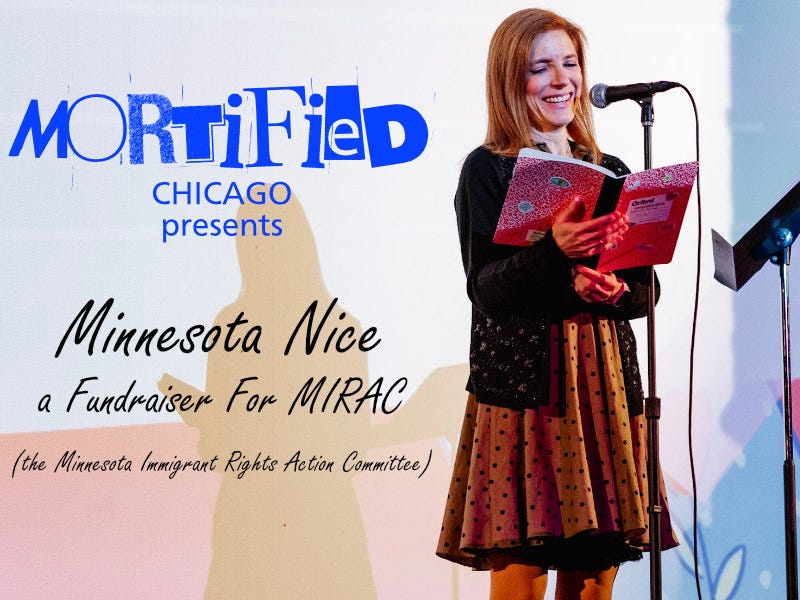
In this post, I continue on with some personal writing I’ve been working on in therapy, a sort of memoir that centers on me learning to tell my own story in a clear-eyed but positive way, with the help of some of the most impactful media in my life. I recently said I was done sharing these on here, but I changed my mind, partially because I wanted to send this out as a relevant reminder for an upcoming show Mortified Chicago is putting on to raise funds for MIRAC (the Minnesota Immigrants Rights Action Committee). I previously wrote about that show, and the music that inspired me to put it up, here.
When you’re stuck out in the middle
You just figure that there’s something you’re missing
But it turns out that California
Is just tripping and disinterested kissing
Back in my hometown
There was nothing but the hum of the locusts
And the rest of my life
To get used to being washed out of showbiz
I was down around the docks
But I never saw anyone surfing
From a distance it looked pretty much perfect
But it’s different in person
The doctor said he only wants
To help me make more healthy decisions
Went out around the Fourth of July
And I was back by Thanksgiving
-The Hold Steady, “Lanyards” (2021)
I told her how last year I’d gone out to Seattle for a wedding and my cousin took us sailing on Lake Union. And in the middle of the stillness I felt an urgency to live where nobody knows me. Where all my prior sins couldn’t be held against me
I keep thinking about just moving there and crashing with my cousin. Doin’ landscaping or somethin’. But my cousin has two children and Seattle’s expensive and funds have been elusive
It’ll probably never happen and that’s probably just as well
Because I don’t want to be some dude that makes a big deal out of moving then comes back a few months later, a total goddamn failure. Like when Fletcher went to Denver, he had three kegs at his send off. Then he came back before Christmas and everyone was laughing
And they won’t let him forget it and they won’t let him outlive it. Behind his back they call him Rocky Mountain Fletcher. They’ll destroy you just for trying something different.
-Craig Finn, “Fletcher’s” (2025)
I am not, generally, a very fearful person. But I do have a very present fear that I rarely talk about, and this feels like a good time to dig into it. I am afraid of, I guess you would call it, “showing my ass” – of announcing I’m going to do something, and then blowing it so hard that I become a very public failure.
This has happened to me a fair few times recently (once in a way that was written about by national media, which is pretty fucking wild). A new business venture or two, a cross-country move, even a new relationship – things I approach tentatively at first, then decide to dive into, then tell people about, then they blow up. And I always get so low about it, the normal weight of failure laid atop a smothering blanket of embarrassment.
There is no doubt in my mind that this is a side effect of the perfectionism instilled in me as a kid. But what I think is interesting about it is that I have never been afraid to try things! If a big leap presents itself to me, I largely do not shy away. I’ll take swings knowing they could not work. I don’t feel there’s any shame in giving things a try. It’s just when other people get involved – when they see, when they know, and then when I proceed to fuck up – that I feel like a true, deep failure.
Which is why the lyrics I’ve excerpted above, from Hold Steady frontman and solo artist Craig Finn, really resonate with me. In pretty quick succession, at two inflection points in my life, he released songs that involve a guy who talks up a big move in search of glory, only to come back tail between his legs, forever derided as “Rocky Mountain Fletcher.”
I desperately don’t want to be “Rocky Mountain Fletcher,” and I’m worried that I am.
When I left for California in the summer of 2020, a good friend of mine secured her apartment complex’s back patio and threw a COVID-safe going away party for me. We had themed food and drinks and a Jeopardy game centered on questions about me that she and another mutual friend wrote together. It was so lovely and kind, and it felt like an amazing capstone on my time in Chicago, especially given the environmental limitations.
But, honestly, it also made me feel a little ashamed when I made the decision, just nine months in, to leave Los Angeles (something I’ve written about before). I felt, in particular, like I was letting down those two friends, who put all this effort into throwing a wildly creative party for me. I felt like I was disrespecting their work, somehow.
Which of course is ridiculous, right? Because the whole point of throwing someone a going away party is to let them know that you’re going to miss them, and the cure for missing someone is to see them again. But still, it made me feel extra ridiculous about throwing in the towel on West Coast adventure after a scant nine months; I thought to myself, “that’s the last time my friends are ever going to throw me a party.”
I thought it was so funny and appropriate that, in the middle of my time in LA, the Hold Steady released Open Door Policy, the album with “Lanyards,” which is straight up a song about a dude from the Midwest (the fantastically ironic Independence, MO) who goes to Los Angeles to make something of himself but quickly learns he can’t hack it. “Went out around the Fourth of July and I was back by Thanksgiving.”
A lot of people have this experience, ultimately, which is why Craig is able to so adeptly write a successful song that speaks to people about a guy like this. But with its timing in relation to my own journey, the wild specifics about geography and timeline, and the incisiveness with which Craig can characterize this person, I felt so seen by this song, at a time when I think it scared me to feel that way.
A few years ago, I bombed a Kickstarter campaign. Let me tell you, that sucks. You wanna talk about showing your ass? Hard to think of a more bald way than asking people for money for a creative project of yours, then not meeting your goals and having to explain it to those people.
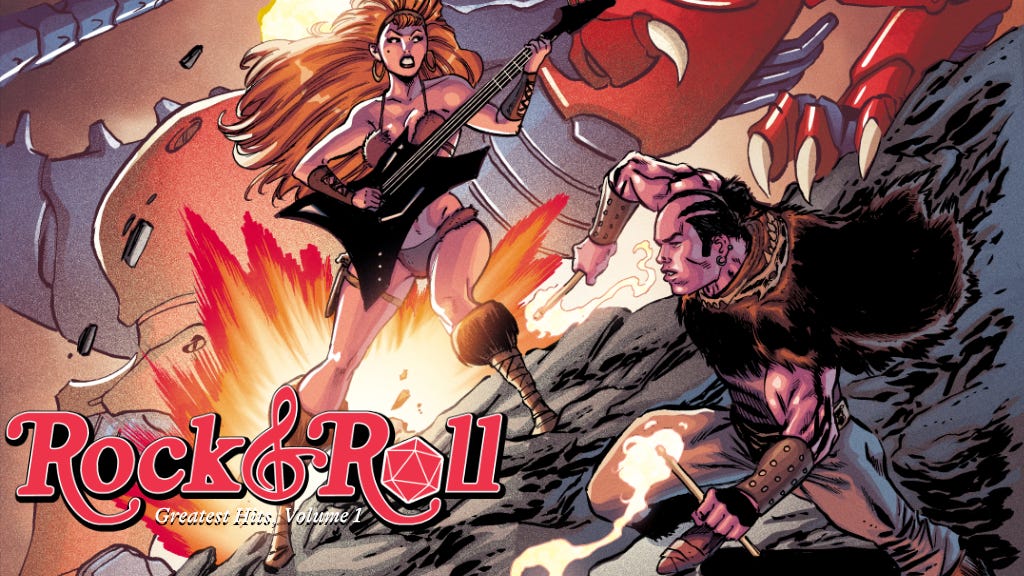
The campaign came out of a hobby I picked up during COVID. I had lots of time to read in Los Angeles, and one of the things I read was a 700+ page book about the history of tabletop roleplaying games called Playing at the World. Something I was spellbound by in that book was its discussion of fan culture, particularly fanzine publishing, which helped RPGs find and grow their audience in the early days. Something about the lo-fi, garage band feel of “I threw this together at home and you can build a whole fantasy world around it” really appealed to me, so I reached out to a couple folks who had been on my team at the Chicago Board Game Cafe to ask if they’d be interested in trying to make a modern zine with me, just for fun. I had come up with a concept that spoke to me called Rock & Roll (note the alliteration, just like D&D) – RPG adventure modules inspired by people’s favorite records. I thought it was a compelling idea, and although I had no idea how to self-publish something, I had plenty of time to learn. I read techniques from other zinemakers, I bought some publishing software, I hired some other artists and writers to round out our content, and we were off.
I Kickstarted a four-zine series of Rock & Roll in February 2021 (the same month the Hold Steady’s Open Door Policy came out). We only needed $2000 to fund. We didn’t do much marketing at all beyond our own social media spheres and a few message board posts. It was a gamble, but $2000 seemed doable. Worth noting: the whole project came together in like three weeks, so I didn’t have time to talk it up or even really tell many people I was working on it. We launched on some random weekday that seemed fine, and we funded in about 6 hours. In the end, the campaign took in about $7000, well beyond what I would have thought. It was a big success pretty much out of nowhere, and it gave me an unrealistic expectation of what other crowdfunding campaigns would be like.
Working in the game industry (which I was notably on hiatus from for the first part of 2021), I know some things now that I didn’t know then. 1) The Kickstarter algorithm prioritizes first-time creators. Like any algorithm-based application, they want people new to the platform to have a good time, so those people get a little boost. 2) I was accidentally getting our campaign in at the tail end of ZineQuest, an annual Kickstarter tradition where zines get even more visibility on the site. 3) COVID was an insane time for the games industry, specifically for crowdfunding. You’ve got a bunch of people sitting at home with pent-up fun money, spending aspirationally to try to capture any bit of joy they can. So, don’t get me wrong, we did great with the campaign, but we were also kinda set up to succeed.
I made a few other zines after that, often tied into ZineQuest, and they all funded, although not to the same scale of success as Rock & Roll did. Every project felt a little more hard-fought. Although also, every project felt a little more niche, so I was making the marketing lift harder on myself.
But I decided that I wanted to do something more ambitious than a zine, and more commercially viable. I wanted to professionally publish a hardcover RPG supplement, something that could reasonably be sold into and at local game stores alongside the core books of the hobby. I thought the Rock & Roll concept was good enough to make it happen, so I reached out to even more friends and creatives in my circle to put together a pretty ambitious volume of gaming material. And, like, I had some true creative powerhouses in there – some of the folks whose work has wildly influenced my own. Freaking Kieron Gillen was contributing – a dude who’s written some of my top graphic novels of all time and co-created what I might called my favorite roleplaying game, DIE.
I assembled enough material for a proof-of-concept (even with a professional designer, so it looked fucking good) and prepped a new, larger Kickstarter campaign. This time, the goal would be not four figures but five – $20,000. I figured that provided a reasonable buffer to do professional printing and pay all the people I needed to, and based on past campaigns, with the names I had attached and the content I was providing, I should be able to pull at least $30-40k total, a comfortable number for sure.
NOPE. The project launched on a Monday morning with just a little extra promotion than the zine had gotten (meaning I sent some emails too), and by the end of day 3, we were at around $3500. In Kickstarter land, that’s bad. The wisdom goes that you want to at least be a third of the way towards your goal after three days, because typically you get a third of your funding in the first three days, a third in the last two, and a third in that giant space in between. Additionally, projects that get closer to their goal quickly get boosted by Kickstarter’s algorithm, because they look hot and fun (again, like a dating app). So it pretty quickly became clear that $20,000 was just not possible with this campaign, and I canceled the project. At first, I made plans to relaunch with paid marketing and a more reasonable goal, but I just didn’t have the marketing budget to spend what most big-time Kickstarter successes tend to. And besides that, the failure smothered a little bit of the fire for the whole thing.
It felt bad, man. To so publicly announce an ambition, and to fold so quickly – I felt like I was in a (much nerdier) Hold Steady song. When is Craig gonna write about the independent zinester, anyway??
As I mentioned up top, situations similar to this feel like they’ve been coming up quite a bit for me in the last few years. After all the promotion pumped into the Chicago Board Game Cafe, it closed to the public after a month, and I left after five. Granted, that was due to COVID and thus wasn’t my fault (that you know of!), but I still felt the failure deeply. I made a big deal about moving to California and then left after 9 months. I told everyone how excited I was to be dating a partner that really got me, and then on my birthday weekend that she planned to spend with me and all my friends, we broke up. I was starting to feel, unhelpfully and unhealthily, like any time I felt sure enough about a huge opportunity to excitedly tell people about it, it would blow up in my face and leave me feeling empty and ashamed.
So that felt like a pretty big hump I had to get over when I made the decision to move back to the Midwest and then, a few years later, Chicago proper. I had to reckon with the fact that I had, in a way, cemented a narrative about leaving, only to quietly, sheepishly revise it because my new story hadn’t been good enough.
In both those circumstances, external factors helped push me through that shame. Leaving California was inspired more by financials than anything else; I simply could not afford to stay in Los Angeles much longer without a real, adult job. I knew I wanted to keep working in the games industry, so I took the first salaried job that would have me, which happened to be in Madison, WI, a scant two hours from Chicago. With the proximity to friends that promised, that worked out nicely. It still felt like capitulation, but I wasn’t upset that my survival move coincided with more social opportunities. All the same, I also interviewed for jobs in Austin and New York, so that could have gone very differently.
And then, coming back to Chicago itself – that was motivated by both internal and external factors. It happened in the wake of the aforementioned breakup. We had had some serious talks about me perhaps one day moving closer to her (as we’d had a long distance relationship), so I was already primed to leave Madison at some point anyway. And one day, a few weeks into my breakup, stewing in misery and loneliness in a city where I didn’t have a lot of friends outside of work and looking for anything to make me feel better, a lightbulb went off – why would I move somewhere for a romantic partner, but I wouldn’t move somewhere for myself?
So I started to think about how viable it might be to move back to Chicago. I’d have to make arrangements with my job or find a new one, I’d have to be prepared to pay a shit ton more in rent… I’d also have to finally, fully acknowledge that the whole “leaving Chicago” procession that happened in 2020 was being unwritten because I didn’t accomplish what I’d set out to.
What pushed me over that hump was the same thing that had me focused on it in the first place – my friends.
That romantic relationship that had ended gave me a taste of having real, vivid love in my life. I didn’t want to let that go. But, obviously, the love of another person – especially romantic love – is not within one’s control. So I figured the best thing I could do would be to put myself in a situation where I was at least more likely to have access to that kind of love again. Dating in Chicago would be easier than dating in Madison, absolutely, but beyond that – my friends made me feel loved. And if I was a 20-minute drive from them instead of 2 hours, I reasoned that having that love in my life would feel much more accessible. And making that happen was worth getting over any shame I had about rewriting my narrative.
I mentioned at the start of this that, when I heard the Hold Steady’s “Lanyards” in 2021, it made me feel seen in a way that felt uncomfortable. I didn’t like that there were characters like me on this record. I felt like a loser.
But through a generally very positive romance, and through all of the reembracing of friendships I’d already been doing since I came back to the Midwest, I learned that feeling seen by people that loved me was amazing, was truly what I wanted, even if it could really hurt sometimes.
So I made a move that allowed me to feel seen, in metaphorical and very literal ways (I can hang out on weekdays again!), and you know what? I don’t think my fears came true. I don’t think I’m anyone’s “Rocky Mountain Fletcher.” Now, to be fair, in that song, the narrator says that people call him that behind his back. Maybe people call me “LA Eric” and I just don’t know about it. I really doubt it. Even if they did, so what? I’ve been back in Chicago long enough to know who my people are, and know how much we value each other. If the price of that is some people making fun of me, I’ll pay it gladly.
And through it all, in these last few years, Craig Finn has become – behind Bruce, of course – my favorite music artist. I find comfort in the way he lovingly and with such great humanity writes songs about people who embarrass themselves and struggle and lose. I absolutely still see myself in those people. It’s sort of a “there but for the grace of God” thing, but substitute God for the grace of my friends and, thankfully, myself.
Most of us could end up characters in Craig Finn songs, I think. For a while, I was one. I have been fortunate enough to escape that trajectory, and I chalk that up to the care I have in my life. I cared about myself enough to not worry about being the guy who “went out around the Fourth of July and was back by Thanksgiving,” because what I came back to was home. And there’s no shame in that.
Speaking of shame, can I interest the Chicago folks in the audience in some tickets to Mortified? There will indeed be a Craig Finn-penned song played by the house band and sung by myself, though it will rock a little harder than the two I’ve quoted in this piece. I’d love to raise some good money for a great cause, and have a healthy house to play to!
No posts
Comments
Nothing yet. Say the first thing.
Sign in to join the conversation.