
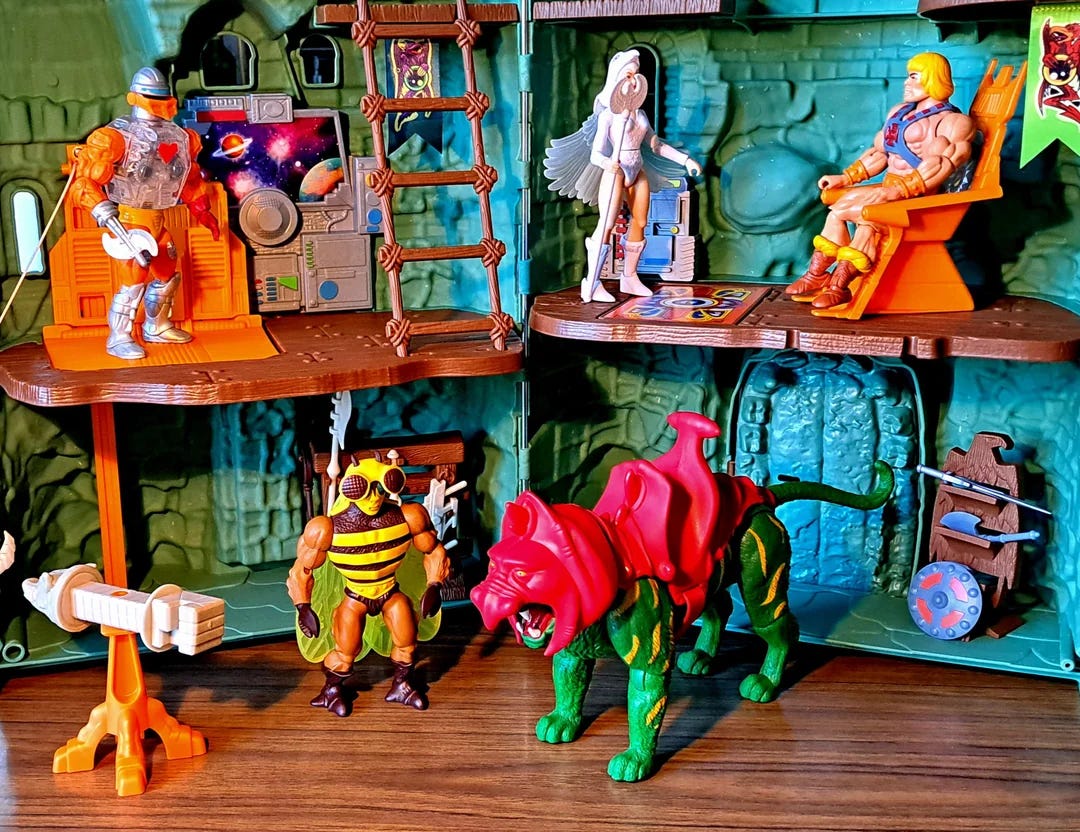
The trailer for the forthcoming Masters of the Universe movie drops today. If you didn’t know, I’m pretty into He-Man, and I wanted to take this opportunity to share some thoughts I’ve been turning over about MOTU and the Most Powerful Man in the Universe.
I don’t think it’s a secret to say that Mattel is hoping for a repeat performance of Barbie with Masters of the Universe. I certainly heard that line enough when I was working with Mattel at my last job (which was honestly really cool — there are some truly rad people there!), but that’s always the dream, right? To have a financial mega-hit that dominates cultural conversation and finds favor with both critics and general audiences — any production company would kill for that, and I’m sure some did back in the studio system days. As much as I would love Masters of the Universe to hit big, though, foisting Barbie-level expectations on it feels pretty lofty — at least, by the numbers. There aren’t a lot of Barbies in the history of cinema; only 15 films have ever grossed more at the box office.
BUT, there’s another aspiration nested in that wish that’s more interesting to me, and it’s one that I do think is possible. One big thing I loved Barbie for (and this is the most obvious thing in the world to say, but it’s still true) is how it critiqued, in a fun and compelling way, modern toxic masculinity, and (I think!) celebrated how vivid and diverse femme expression can be when given oxygen and support.
I genuinely think Masters of the Universe could do a very similar thing from the masc perspective. I feel that a big-screen 2026 version of He-Man could embody a positive, warm version of masculinity that stands in opposition to the toxic variety peddled by the Kens (in the fictional world) and a bunch of shithead right wing grifters (in, unfortunately, our real world). And honestly, I don’t even think that’s a super farfetched wish.
“I think there is a modernity to him that is really interesting,” MOTU lead Nicholas Galitzine told Screen Rant in an interview about his superheroic role. “It feels like who he is as a person is a handshake between what traditional masculinity and femininity are.”
What a line! Conceptualizing the “Most Powerful Man in the Universe” as a gendered yin/yang feels like a pretty bold thing for Galitzine to do, especially in light of his penchant for playing queer characters (although straight himself — something he’s addressed deftly). The actor once told Cero magazine (described as “a nonprofit culture publication that spotlights rising talent with a dedication to creativity, inclusivity, sustainability, and accountability” — WOKE!!) that he feels drawn to roles that play within the “ever-changing landscape of masculinity” — and this was two years before he was signed to be He-Man. Surely his casting is no accident, then — I mean, when it comes to portrayals of masculinity, how much more on-the-nose can you get?
Of course, all the worst people on the internet are furious about Galitzine’s cinematic history and his “handshake” comment, crying that this sort of portrayal isn’t the “real” He-Man. Obviously, I think they’re wrong. But I want to look at some history to interrogate why.
According to Etymonline, which is not necessarily a grade-A source but a fair place to start, the term “He-Man” first appeared in 1832 among United States pioneers to refer to an “especially masculine fellow.” The term really found its spotlight in the 1930s thanks to an Our Gang (Little Rascals) short film called “Hearts are Thumps,” where one of those titular rascals establishes a “He-Man Woman Haters’ Club” because he’s resentful about coupled people celebrating Valentine’s Day. What prescient incel behavior!1
Of course, in 1982, the term “He-Man” would come to mean something completely different for a generation of youths. According to toy designer Roger Sweet, the name happened because it’s what stuck from a brainstorming session:
“At the time I did the first prototype figure, I still didn’t have a name for him. So I brainstormed 40 or 50 names. Among those names were Mighty Man, Megaton Man, Strong Man, Big Man, but the instant I got that name He-Man… I cannot tell you… how big a bell rang in my head. The whole line came together. Here was a highly generic name that had a kinda brute-force feel to it. And what could be more of a direct name than this for a heroic figure? It’s just one in a million.”
That checks out, and if you only followed the toys, you could pretty much draw a direct line from US pioneers to the Little Rascals to MOTU. He-Man was conceived as a more child-friendly Conan the Barbarian, a strongman whose musculature would stand out in toy aisles compared to the more meek action figures of the day. Scope this early ad, which I gotta say is pretty freaking bold.
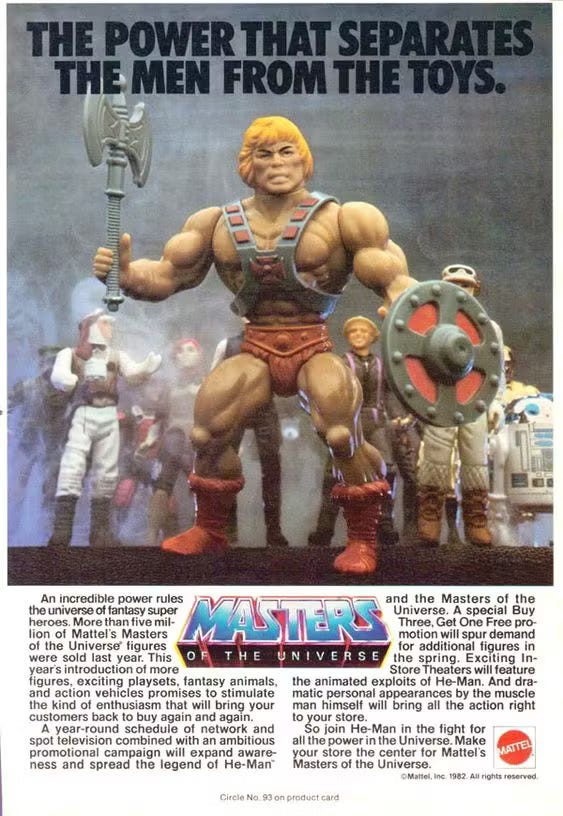
Initially, there wasn’t much of a thought to the character and world of He-Man beyond what would look cool enough to little boys to move toys. But, if you’re reading my Substack, surely you co-sign on the Power of Narrative if not the Power of Grayskull, and Mattel pretty quickly figured that they’d have an easier sell on their hands if they could put He-Man and his muscly pals into a compelling story. That started out as minicomics packaged with the toys that, at first, still hewed pretty close to Robert E Howard fair. But then… then came the cartoon.
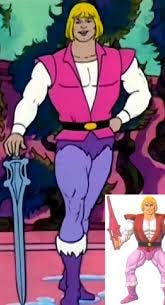
I mean, like… tell me this isn’t feminine-coded, right?
Now, I know what you’re thinking. Prince Adam uses the Sword of Power to turn from this effete pink and purple-adorned royal into the most manly of men. The show is explicitly saying anything girly is meant to be shed, right?
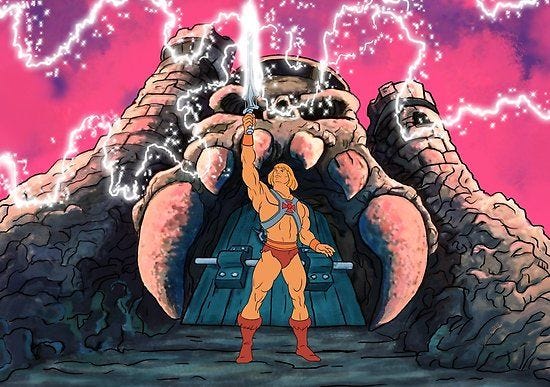
I mean, maybe. Maybe those online freaks are right. But that’s not what I took from He-Man.
One of my favorite episodes of the He-Man cartoon is called “Not So Blind.” In its opening scenes, our hero Prince Adam meets Luce, a young blind boy, while running errands in town. He learns that the boy has always wanted to meet He-Man, and so, he arranges an adventure for Luce, himself, and Ram-Man to visit the mythical Singing Crystals, a natural wonder that Luce will be able to enjoy, since their big draw is the sound they make. Unfortunately, when they reach the cave where the crystals are housed, a falling stalactite pierces one and causes it to explode in a bright flash, temporarily blinding He-Man and Ram-Man. The two heroes, who are not used to operating without their sense of sight, are now dependent on Luce to lead them back to safety. At the end of the day, He-Man makes a new friend, and everyone learns to value the diverse talents that different people can bring to bear in navigating the world.
Is this corny? Hell yeah it is. The episode definitely has that Reagan-era after school special vibe. But it’s also very sweet. When I rewatch the episode even today it makes me feel warm, and nice.
I’ve written about He-Man before on this Substack — in particular, about how an episode of Masters of the Universe provided me with my first memory. Those colorful characters defined my childhood, and I truly believe that He-Man and his real-world creators taught me more about being a man than my dad did. And the He-Man I learned from is the He-Man in episodes like “Not So Blind.” This dude has incredible powers and unrivaled strength, but he doesn’t use it to intimidate people or to go around beating up folks he considers “the bad guys” (something that is in fact directly addressed in “Not So Blind”, when a snotty kid asks Prince Adam why He-Man doesn’t just go to Snake Mountain and end Skeletor once and for all!). Instead, largely, He-Man uses his strength to protect the people around him. He wants his neighbors to be safe and his friends to feel valued. He cares about nature and justice. He loves his pet cat (tiger).
In other words, despite his tough muscles and incredible camera-shaking punches, the He-Man I loved watching was often very soft.
Now, sure, some of this softness was the cartoon creators trying to appear “pro-social” and family-friendly during a time of heavy conservative media policing (see: the Satanic Panic). If we never see He-Man clobber Skeletor directly, and if he gives a speech at the end of each episode about how it’s good to eat your vegetables or tell the truth, maybe parent groups won’t assault the show. Left to their own devices, perhaps Mattel and Filmation would have made a violent-as-hell, Conan/Heavy Metal-style cartoon, were it not for the Tipper Gores of the world. And yet, they didn’t. And for a couple years in the early 1980s, the He-Man that made his way into so many of our homes was a strong, sensitive guy who worked tirelessly to keep the world kind and just.
So I see what Nicholas Galitzine means with his handshake comment. And, in my dreams, he’s going to give us a He-Man who incorporates some of those more traditionally feminine traits into this icon of masculinity. Because damn, I think we could use it. In the same way that I loved James Gunn’s Superman film for how it made an argument for kindness and its relationship to justice, I am very hopeful that Masters of the Universe will do the same for softness and its relationship to strength.
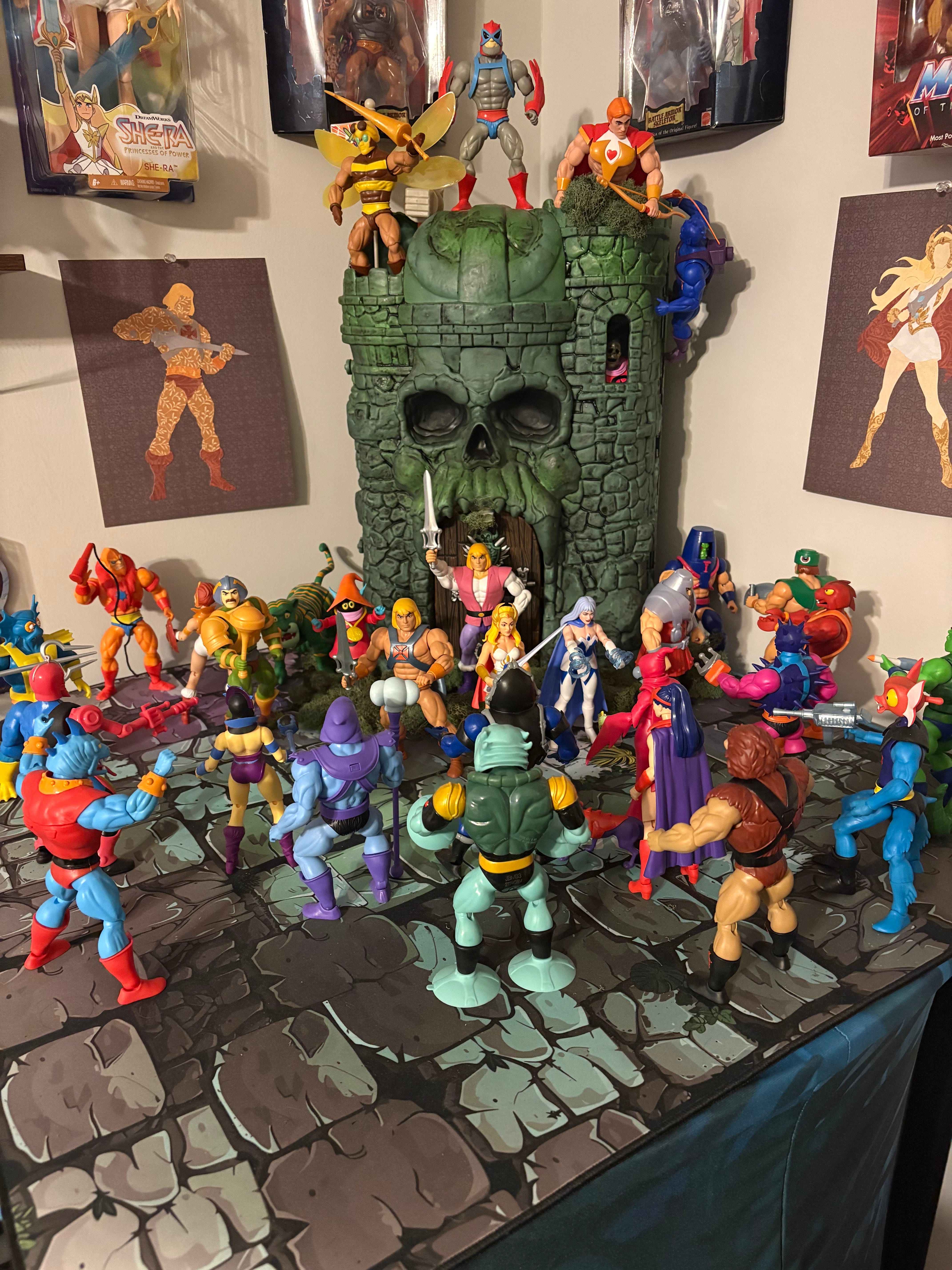
Time will tell. But man, the fact that MOTU comes out a day before my birthday… it feels like a personal sign. Until then, me and my sick office He-Man display will be chilling in our secure softness, hoping for a more sensitive world.
If you don’t want to be like the Little Incels of the Little Rascals, maybe you could use some pro-social Valentine’s Day plans, like checking out our next Mortified Chicago show! We return to Lincoln Hall, one of my favorite independent venues in the city, and the show is shaping up to be a great one. Would love to see you there!
This is neither here nor there, but in 1990 the band Extreme released a song called “He-Man Woman Hater” that, while perhaps dubiously ironic, sounds absolutely sick. Nuno Bettencourt is one of the best to ever do it.
No posts
Comments
Nothing yet. Say the first thing.
Sign in to join the conversation.