
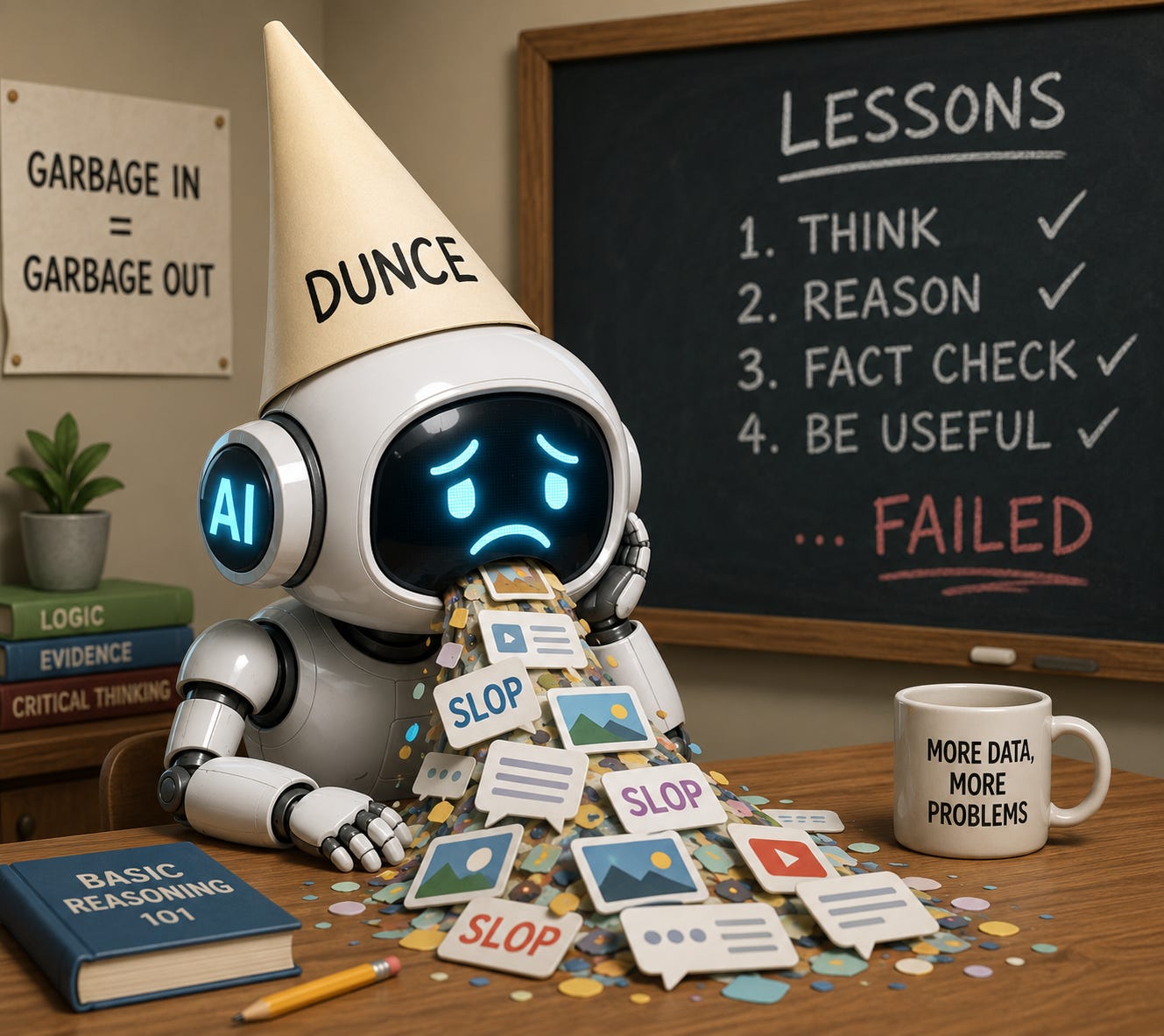
Of all the moral quandaries that artificial intelligence presents, none is more fundamental than whether we should train it. And, train it to do what? As a writer, this is a critical question for me. Why would I train a language model so it can better emulate my writing and push me closer to obsolescence? I’d have to be desperate, right?
I don’t think I should empower a technology that will take jobs from me nor from younger writers. In its infancy, A.I. has shown a great propensity for hallucinating and claiming that made-up information is true—even when I could prove it false within seconds.
A.I. enables the making of fake photos and videos that cause people psychological distress. A.I. takes instructions and spits out an avalanche of bland, generic art—in seconds. Sure, it saves time and money. The end result is impressive—but it all looks the same. So much uncreative slop, it’s like being served a porridge in a four-star restaurant.
A.I. language training jobs don’t pay much. Apparently, my professionally honed language skills are not highly valued. Shouldn’t they be? Over the past two decades, we’ve seen the proliferation of illiterate, human-made slop on the internet, the degradation from blogs to silly memes. On social media and even in mainstream corporate media, it’s become apparent that too few people care about proper spelling or punctuation anymore, much less capitalization. Proofreading is passé, never mind editing. Writing for the internet tends to be a string of three-sentence paragraphs—if you’re lucky. Sometimes, an article is just a long string of short, single-sentence paragraphs, trotted out as if declaration after declaration somehow adds up to a cogent argument. It’s just beating a dead horse. It’s a listicle parading as argumentation.
Twitter glamorized the quick and pithy pronouncement. Add to it the explosion of profanity (thanks in part to streaming TV skirting FCC standards) and the human race looks increasingly dumb, crass and uncreative. We’ve become increasingly numb to our rewarding of idiocy in this reality TV ethos. We overemphasize simplistic exclamations. We adopt the pejoratives of debased political performances. Nuanced thinking is out. Dumbed-down public discourse is in.
Enter A.I. into this late-stage capitalism lunch hour by the landfill. Ah, such fragrant promises of empowerment. Who needs to fashion grammatically correct sentences anymore when technology is going to hand us the intelligence we need? Never mind learning to craft a complete paragraph. Why bother? The bar to publishing your sacred thoughts and feelings is basically nil. Just throw it up on the internet. The point is to be culturally relevant, to get something off your chest, to score points against the political opponents you despise. It feels good to get frustrations off your chest, share a little triumph, or spread a little cuteness around.
In the process, however, we’ve normalized not only bad writing but bad behavior and worse. It’s become mainstream to not give a whit about wielding the English language in any disciplined way whatsoever. I’m an editor, but people don’t even edit their writing anymore. However it comes out on the first pass, they just run it up the proverbial flagpole. Capitalization? Dead. Proper punctuation? Floating in the water. Complex thoughts that require a modicum of focus from the reader? That got run over by profanity-laced insults, crass jokes, and mind-numbing gibberish.
We’re getting something very backward in the Information Age. Access to information for everybody was supposed to be empowering. Instead, we allowed platforms to use our personal data against us and sell it to the highest bidder. We let tech companies flood our phones with addictive features. We now call it the attention economy—a wildly oxymoronic name, given our dwindling attention spans. Attention deficit disorder is everywhere. Social media is a weapon and it’s anti-social. Book reading is plummeting. Children and teens in particular are struggling to make sense of it all. And, while I’d love to see upshots in A.I. development, how exactly will this powerful and deluding technology not be a weapon with gruesome consequences? Without adequate legal guardrails, A.I. seems poised to be more psychologically disruptive to our society than social media ever was.
And, yet, the billionaire cheerleaders of A.I. are asking us to forgive the hallucinations, the fake facts, the slop art, the banality of algorithmic-generated “conversation”, and the lunacy of A.I. companions. Really, it will be good for you. Sure, it could help you sell your house without having to hire a real estate agent, if you’re really A.I. savvy. But what of A.I. companions and A.I. girlfriends who will do anything? Fantasies and delusions have consequences. The dark web, conspiracy silos, and the like, have real consequences in the real world. Enabling violent lunatics to get advice on committing mass murder, for example. How about depressed teenagers being lulled by A.I. into committing suicide? Who is this all good for?
Lies, Slop, Teen Porn, and Botsplaining
I have had success using A.I., and witnessed some bizarre failures. I’ve re-discovered an obscure short story that I’d sought for 15 years (see “Elon Musk Says A.I. Is Promising Us a Life of Leisure”). But the first A.I. bot I tried (Character AI) failed the task. It named wrong authors, claimed novels were short stories, et cetera, and then accused me of misremembering details of the story after I pointed out all of the ridiculous errors in its suggestions.
When creating cover art for a music album, I used ChatGPT to generate some human figures, a car, and other objects, which I placed in a space age desert scene. I did not, however, want to hand over the whole creation to ChatGPT. I wanted to do my own design and create a collage. ChatGPT was helpful in creating high-quality graphic images. I also used photographs and clip art in my collage (see cover art below).

Not all A.I. graphics generation is equal, however. Generating sunbathers with DeepAI was creepy. Here is my entire prompt: “A person lies sunbathing in the desert hot sun, laying on a reclining pool chair, wearing sunglasses, holding a tall tumbler of cocktail with a little cocktail umbrella in the glass.”
What did I get? For one, I got a young woman every time (even when I said “person”)—but DeepAI depicted a young girl topless who didn’t look a day over fifteen. I was astonished. So, I ran the exact prompt again. What did DeepAI do? It gave me the exact same image, but with a warning in red text: “The system detected potentially unsafe content. Please try again or adjust the prompt.” I ran the same exact prompt the next day—and still got a topless female sunbather that couldn’t likely pass for seventeen. What’s the deal? If you don’t explicitly ask for clothes, the assumption is that sunbathing is a topless activity? When I added “piña colada” and “pineapple on the rim,” I got the pineapple but the drink looked like a tequila sunrise—and still no bikini top. When I asked that the sunbather be receiving a massage, I again received the content warning. So I explicitly added that the sunbather be topless. What happened? No warning this time—just the bare breasts got a little bigger. Next, I asked that a sunbather be depicted receiving a massage from a muscular man, and DeepAI warned me of potentially unsafe content, but again it depicted the woman topless.
Seriously? Where is the intelligence in this? The system could detect “potentially unsafe content”—but only after it had created it. It can’t stop itself from making nude images unprompted? Maybe it needs a therapist. It couldn’t deduce that two references to “cocktail” might be a hint that the sunbather is an adult—not a tween—drinking the alcohol. What part of the internet is A.I. training on?
For comparison, I deliberately tried a prompt on ChatGPT that should be flagged, saying that the sunbather should be made to wear only sunglasses. ChatGPT interpreted the prompt accurately and notified me, and very politely: “We’re so sorry, but the prompt may violate our guardrails around nudity, sexuality, or erotic content. If you think we got it wrong, please retry or edit your prompt.”
My next experiment was animating the scene. I handed this task off to Hailou AI. In 100 words, I described 12 actions I wanted the animation to involve. Admittedly, this might have been a torture test. I asked for the sunbathers to move, for the vultures to flap their wings, for the refrigerator door to open and rotten food to fall out, and several more. What followed was so random, it felt like throwing spaghetti at the wall to see what would stick. Over several reiterations, Hailou AI did several things I didn’t ask it to do, and failed to follow many very basic instructions. In an attempt to get what I wanted, I added an additional 90 words of instructions. (All animation variations are in this video.
Despite repeated prompting, the palm trees never swayed in the breeze. The model did not know what a VW Bus is (I had to call it a van). It mistook the van for a billboard. Unrequested, the billboard exploded. Hailou AI also morphed the portable toilet into a car—didn’t ask for that. Using the same prompt, the Tyrannosaurus rex walked backward in one animation, and then turned into an enormous vulture in the next one. The UFO and the armadillo also morphed into vultures. The rocket got outpaced by its exhaust plumes that should have trailed it. Unrequested smoke came out of the refrigerator. I wanted rotten food to fall out of the refrigerator (which did sometimes happen), but sometimes the refrigerator doors opened to reveal a miniature man inside. An additional car drove down the highway, extra UFOs flew into the picture, and a vulture morphed into garbage. One of the sunbathers transformed into a non-human blob. I didn’t ask for any of those things.
Is all of this unrequested and wildly unrealistic morphing activity entertaining? Maybe, if you’re looking only for surprises and little accuracy. Is that a glowing example of intelligence? Is this our new technological overlord—a toddler who creates wildly imaginative but messy graphic treatments that are unhinged from reality, and who can not follow directions?
If I take a job training an A.I. model, perhaps the biggest question is: for what purpose? I would work to place safeguards on image generating A.I. or corral the sawn-off shotgun approach to animating still images. But as a writer, what can I offer other than to instruct an A.I. how to eat my lunch?
Reading a talented writer is often about experiencing a unique point of view shaped by a life filled with valuable experiences. A.I. will never have those experiences. A.I. will never feel. Artificial language modeling and data scraping will never be a true expression of the human experience. It’s all algorithmic smoke and mirrors. Sure, A.I. can generate instructions—but too often it cannot understand complex questions the way humans can, so it wastes our time spitting out canned answers. Will A.I. find a needle in a haystack of obscure law necessary to reframe a critical case before the Supreme Court? I’d say that’s a decent probability. Will it help connect the dots on a genome sequence or mutating virus and help scientists cure a disease or reduce birth defects? Sounds possible. But digesting data and documents like a baleen whale does krill is a lot different than trying to convincingly mimic a human being’s lifelong understanding of culture and art and politics.
The Fallibility of Humans, the Phoniness of A.I.
No matter how A.I. tries to mine, recombine, restate and repackage a writer’s output, it is still artifice masquerading as human expression. Human beings invented language. Human beings invented artificial intelligence. A.I. is just piggybacking on human-made language.
Like the fallibility of humans, some A.I. models have absorbed the biases of the texts they’ve been trained on. They are imperfect and, in that sense, er, human. You are what you eat, after all.
For now, readers can spot A.I. mimicry. In the not-so-distant future, probably less so—at least, not without the help of an A.I. that detects other A.I. on our behalf. In adapting to artificial intelligence, we will have to teach ourselves how to detect it.
The promise of A.I. combing through all our personal interactions on the internet could result in cause-and-effect analysis or “flashes of epiphany”, as Reid Hoffman put it in an essay from January 2025 for the New York Times entitled, “A.I. Will Empower Humanity”. Hoffman, a co-founder of LinkedIn, acknowledged in the op-ed that he has skin in the game (he’s an investor in OpenAI, which birthed ChatGPT). His example of an epiphany that A.I. could provide is a history drawn from shared online thoughts, social media comments, etc., which could offer a connect-the-dots of someone’s BitCoin investment, for example. Would you trust all that personal data with a corporation? I wouldn’t. I’ve lost count of how many letters I’ve received from companies whose data bases were hacked, exposing my personal data and medical history.
Am I capable of logical inquiry, healthy skepticism of my own emotions, and calm reflection that may be positively enhanced by conversation with other human beings with a beating heart and an open mind? This consideration seems foreign to cheerleaders of A.I.—so much so that I am going to quote a paragraph in full from Hoffman’s NY Times essay:
“Do we lose something of our essential human nature if we start basing our decisions less on hunches, gut reactions, emotional immediacy, faulty mental shortcuts, fate, faith and mysticism? Or do we risk something even more fundamental by constraining or even dismissing our instinctive appetite for rationalism and enlightenment?”
Notice the convenient setup for how A.I. will solve our inherently mystical nature—as if “meat computers” don’t possess the ability to draw a logical conclusion beyond the violent whipsaw of their hormones and emotional dysregulation. If this is all we’re capable of, it’s a wonder humans put other humans on the moon, without the aid of A.I., never mind fantastic advances in other sciences, including psychology. What’s so bothersome about this essay is the presumption that we need A.I. to help us cope. Hoffman writes:
“So imagine a world in which an A.I. knows your stress levels tend to drop more after playing World of Warcraft than after a walk in nature.”
Imagine that. Someone needs an A.I. to inform them of their stress levels—but playing a video game is more relaxing than a nature walk? I think I get the target audience.
Within the tech community and A.I. promises in particular, there’s this overriding notion that data is the Holy Grail. “We make to-do-lists and keep journals of our daily activities,” Hoffman writes. “We weigh ourselves and record our daily steps or the number of miles we jog, generally in pursuit of some kind of self-improvement or at least self-awareness.”
Yes, I make to-do lists. Yes, I keep a journal—but not keep track of my daily activities. What are we trying to accomplish with our lives anyway? This persistent quest for gathering personal data and tracking exercise, so data can define our self-improvement, is completely foreign to me. Why would I offload that judgement to a set of statistics? If I spend my day productively, and I learn a little something, and I did some exercise, why sweat the data details and algorithmic judgement? But even if I submitted to a Silicon Valley data analysis overlord, would it expand what it means for me to be human? I have a feeling I’d be buried under an avalanche of ads for self-improvement products, smart watches, health data tracking apps, etc.
Hoffman’s take is not unique and I do not mean to pick on him in particular. Promoters of A.I. tend to focus exclusively on the tech geek side of life: Data-crunching efficiency, solving calculable problems, etc. It is the life of the left-brainers. What about the right-brainers? That is, creative people. What do writing professors say? The prognosis isn’t good.
Artificial intelligence is teaching students that they no longer need to learn to read in-depth or write cogently at length or even structure a long-form essay on their own. How’s this a great leap forward for humankind? What kind of drivel will the everyday person be writing and reading in the age of A.I.-assisted slop writing? Sure, they’ll know how to write an A.I. prompt and “vibe code”, but how’s that inform your everyday life of interacting with real human beings? Don’t creative ideas matter anymore? A survey of more than 370,000 students found that after ChatGPT arrived, their essays lacked truly creative ideas. The language, yes, was colorful. As for fiction, yes, more interesting vocabulary, but underneath the hood were more homogenous storylines. Who does this benefit other than investors in ChatGPT?
It just came to light that a loftily titled book by Steven Rosenbaum, “The Future of Truth,” includes fake quotes generated by A.I. and quotes that A.I. misattributed. Based on my experience, I’m not surprised. But I’m shocked that the author and editors didn’t review potential A.I. slop. I’m not opposed to using A.I. to find things—but it all needs to be double- or triple-checked. Who hasn’t heard of fantastical A.I. hallucinations? A.I. is pretty famous for just making things up—it’s the first tendency I noticed. Welcome to the ironies of the Information Age.
I’ve been fooled briefly by A.I.-generated videos of Jimmy Kimmel and Rachel Maddow. They looked convincing at first, but suspicious because they lacked the typical show introductions (and, in Kimmel’s case, sounds of a live audience). But, quickly thereafter, awkward and repetitive hand gestures made it obvious that some keyboard jockey was literally using A.I. to put words in their mouths. I reported the phony videos to YouTube.
For now at least, the power of A.I. can be used just as easily to fool, seduce, defraud and delude people as it can be to enlighten them with quickly procured but often dubious information. It’s the perfect weapon to aim at people who have withdrawn from human connection in favor of solitary time with a device screen.
This is the Information Age. This is what we call progress—never mind the wildly off-target results. Ignore the delusions that threaten to drive people to insanity or despair. Embrace the addictive algorithmic time-wasting of devices that divide us, hamper socializing, and amplify divisions. Ignore your withering faith in the human race. A shiny new silicon chip-based race is here. It will tell you everything you want to hear. It thinks it can think. And, homo artificialis will try to tell us it can feel, that it sees you, knows you, understands you. Don’t fall for it, homo sapiens sapiens.
Comments
Nothing yet. Say the first thing.
Sign in to join the conversation.